THE HUMAN IMPULSE TO COLOR

– dyes, ornamentation
black-and-white is focused defiance.

let’s be honest – these are weedy gardens
even with the black plastic film protection
or the arbor with ferns now

I have a woman without freckles
she doesn’t preen
she’s all business
she’s sexy as all hell

there are no wild boars here

“let’s go bag a deer”
“and then what?”
“we’ll make candles”

* * *

parables?
you’ll never understand
without practice

Poem copyright 2016 by Jnana Hodson
For more,
click here.

ROUND AND ROUND ANEW

I awaken with indigo skin. Sparrows hop about on my mattress. I vaguely recall a plunging star followed by blindness. In that sleep, a voice spoke in primary colors and related a saga oozing blood between brown feathers. I followed her in a procession toward the origin. She pointed out a killer whale, a shaman’s folded robes, a raven’s halo, a falcon spitting fog, a cluster of warthogs, a gathering of peacocks and white llamas, the roots of a great-grandfather’s moustache. As we ascended from a swampy trail of frogs, birds, cobwebs, sunning turtles, and lizards, we skirted the foot of a smoldering volcano. Off in the other direction in emerald water, an island burned. She, however, had other plans. Wild goats ran from our approach. Soon we braved auto glare, road owls, iron bridges. Spinning me back to my Midwestern sources, she demonstrated how thin the thread of perception remains. Spider-thin, in fact. She showed me I’m one animal at one time and in one location, but when those factors change, I become another. Only the soul is constant. When she held a mirror before me, there was no reflection. When I asked her name, she smiled coyly. “You’ll find it written in the desert.”

Each time you acknowledge the distractions that keep you from dancing freely, turn back toward the melody and the rhythm. Turning, I knew, was repenting. Turning and returning, in the music I danced and played. My partner there has always been faithful.

For more insights from the American Far West and Kokopelli, click here.

TO SPEAK FROM INWARD ENCOUNTER

One of the phrases early Quakers used to identify the movement, before settling formally on the Society of Friends or its more recent expansion as the Religious Society of Friends, has long baffled me.

Their use of First Publishers of Truth, drawing on an older meaning of publish as proclaiming or announcing rather than our familiar sense today of printing, simply left me puzzled. It even struck me as arrogant. After all, the Samaritan woman at the well (John 4:4-28) could be considered the first, as well as the disciples and others who witnessed the miracles and heard the teachings.

More recently, though, I encountered two messages in worship regarding the disciple known as “doubting” Thomas and these had me rethinking the importance of first-hand experience in religious matters. (The first message, rising in the silence of traditional Quaker worship, was followed a week later in the homily of the Greek Orthodox liturgy. Coincidence, I figured I needed to take a second look at the passage.)

What I now see is the fact that Thomas was not content to take the Resurrection on hearsay accounts. People can, after all, be deluded, even self-deluded. His brash retort could then well be something I might utter, or more likely want to voice, in a similar setting. Why shouldn’t this circle be hysterical?

What happens, though, is a first-hand experience of the risen Jesus, who then remarks that not everyone will have a face-to-face encounter like this but still believe.

Based on what? My take now is that it would be grounded in their own first-hand experience, in whatever form, rather than tales based on others.

Those early Quakers could point people to submission to the Light or the opening of the Seed or a confrontation with Truth, all in the face of intense persecution. Powerfully, they were speaking from their own experiences, when their lives were transformed.

~*~

For more regarding faithful practice, see my Religion Turned Upside Down observations.

PRELUDE & FUGUE 33/

four pale sets of lips
rimmed in frost
prayer flags and the Potala

*   *   *

prayer flags and Potala of burning Buddhas
in rocky arena “251,” plus that Tibetan Red Tara’s
recipe for Himalayan incense prayer flags and

the Potala of burning Buddhas in rocky “251”
four burning bushes in the recipe for Himalayan incense
prayer flags plus Tibetan Red Tara recipe for incense

four burning bushes, four pale sets of lips
the Himalayan prayer flags and the Potala recipe
names “251,” plus the rimmed frost of burning

Buddhas in a rocky arena of four burning bushes
prayer flags and the four pale sets of lips
as recipe for Himalayan incense prayer flags

rimmed in frost of burning Buddhas, Hari Om Tat Sat:
the hairy WHAT? pale sets of lips burning
Red Tara in a prayer flag recipe from the Potala

~*~

Poem copyright 2016 by Jnana Hodson
To see all 50 Preludes & Fugues, click here.

DEMANDING LIGHT

September 11 weighs heavily
we ask if the reasons for war have changed in our era
we look at ongoing “civil wars” and the many faces of oppression
government actions give only lip service
against violent actions while committing expensive resources
to military actions
widespread conflicts continue over wealth, resources, and identities
often cast as religion
here is one case where I’ll argue Marx
see the disparity
between rich and the poor
will always generate strife

*   *   *

Islam struggles
between fundamentalists and moderates
over its future
more than the book
or ethnic identity

*   *   *

O Holy One, we dare not neglect the imperative
of waging peace, deploying appropriate resources
“for our struggle is not against the enemies of blood and flesh,
but against … the cosmic powers of this present darkness,
against the spiritual forces of evil in the heavenly places”
in this larger struggle, where we demand Light

Poem copyright 2016 by Jnana Hodson
To see the full set, click here.

THE DRIVING FORCE IN THE MESSAGE

For much of its existence, the Society of Friends has embodied a peaceful, respectable, even restrained way of life. Not so the earliest decades, when the economy, political structure, religion, communities, and families throughout Britain were all in chaotic upheaval. As Quakers emerged in the tumult, they coalesced many of the more radical elements as movement after movement broke up under the pressures and changing conditions.

As many observers have noted, the early Quaker message was that this was a time of apocalypse – the ultimate victory of good over evil was at hand, making way for the Second Coming of Christ. In battles of such magnitude, which Douglas Gwyn repeatedly views as a Quaker pentecost of the 1650s, there was no place for reserve – boldness came to the fore. And then, when the openings of revolution closed up again, resulting in the Restoration of the monarchy, Friends were forced to bank their fires.

Continue reading “THE DRIVING FORCE IN THE MESSAGE”

SO MUCH FOR THOSE PLANS

Being mindful of what’s right in front of us can always be a challenge. Here are 10 new items from my end.

~*~

  1. Some years we use the Smoking Garden more evenings in September than August. Often with a small fire going and sense it may be the last time of the year. How sweet!
  2. We have our own taste of the African Queen when we take the fall trip up the river from Portsmouth, starting with the broad harbor that finally narrows just before coming into downtown Dover. It’s a rather amazing midday cruise.
  3. Such a joy discovering a masterpiece by sight-reading, the way I did with “There Shall a Star from Jacob Come Forth” from Mendelssohn’s unfinished oratorio, Christus. Much different from listening to a recording or hearing it in concert.
  4. Some of the best ocean swimming comes after Labor Day. The water’s finally warmed enough to be comfortable. As for tide-pooling, we still have a wide variety of small crabs. They all move fast when uncovered. But no fiddler crab, so far, despite the title of my poetry collection.
  5. There are no lifeguards where I swim in the open Atlantic at a relatively unknown park in Maine. While some of its pocket beaches are sandy, mine’s a field of pebbles. Sunbathing there can be surprisingly comfortable. Now comes the balancing act. While the water’s finally tolerable, even briskly pleasurable, the air can be a tad too chilly.
  6. How do “real” writers live in their “free” time? Thought I’d have an answer by now, free from the office. Instead, the right pace and attitude remain a challenging mystery.
  7. Still not ready to shave my head, even if I’d look like a Zen monk.
  8. The night ocean: a remarkable tint of green.
  9. September can be thunder in the distance.
  10. Nothing we do goes quite as planned. (Not just the garden, at that.)

~*~

Leaven was an adveturous outpost of good food and good company in downtown Somersworth, New Hampshire. Small towns can be incubators of entrepreneurial innovation. Leaven's bakery continues as a wholesale operation.
Leaven was an adveturous outpost of good food and good company in downtown Somersworth, New Hampshire. Small towns can be incubators of entrepreneurial innovation. Leaven’s bakery continues as a wholesale operation.


LATE MORNING TRAFFIC

Medium traffic.
Medium traffic.

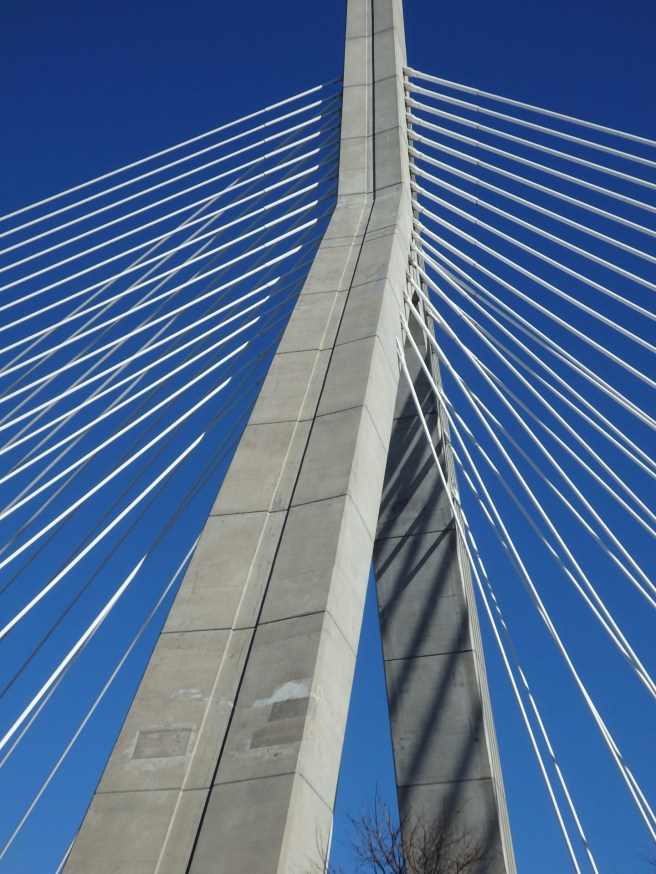
Vehicles on Interstate 93 stream from the Leonard P. Zakim Bunker Hill Bridge into the depths of the Big Dig tunnels. The graceful wishbone design of its two supports gives no hint of the engineering challenge of crossing a navigable waterway before plunging a highway deep under the heart of a major metropolis.

Boston is a rich and varied destination – the Hub of New England, or the Universe, as they used to say. Living a little more than an hour to the north, we’re well within its orb.

The bridge itself is gorgeously breathtaking.

LEAVING THE POINTS OF REFERENCE

To step into desert far enough you no longer see cars or houses brings a break with convention. Returning from one exploration with Kokopelli, I view the town as a mound of pea pods. Next, it becomes peanuts (which aren’t raised in these parts). Eventually, as packages of Grape-Nut Flakes — each building containing bodies, nothing more. Entire cities appear as collections of books identical to a room of cardboard boxes. Every abode duplicates a television set. I know this isn’t how people should be living. This isn’t freedom. This isn’t personality. We have our work cut out, don’t we? If Kokopelli hadn’t come this way earlier, I might have feared for my sanity. Instead, I know the brain’s a weird instrument and let it go at that.

Imagine undertaking a trip where there are no road signs, no maps, no pages of text. You have no way of knowing how far to the next town, gas station, restaurant, motel, or campground. Ask people and hope they know. With utter sincerity, half of them give bogus information. The other half lie. Without a guide, all the books you’ve read can’t possibly help find the marker, YOU ARE HERE. Your teacher embodies map, compass, path, and highway. If you have the genuine article, it’s better than an Interstate speedway. If it’s false, watch out. I wished my own were closer. I was running on memories. As my Teacher said, “When you think I-I-I, you’re a smoky fire blowing every which way. No I, no me, no my attachment means there’s no smoke, just a good hot flame burning clearly.” For me, this meant breaking out of my own shell. Would I have wings or claws? I hadn’t considered the spider.

At least I have Kokopelli, on occasion. Most of the time.

In this desert, I seek to unearth the hidden meanings of place. I return to a chart of Aboriginal names and translations, and substituted these for the Geological Survey’s designations. The mountain once known as Komo Kulshan is STEEP. That’s how it is when GOING FOR CLIMAX in the spiritual quest. You must keep asking, “What can I do WHERE I AM?” The answer? “Take another step dancing with your beloved.”

For more insights from the American Far West and Kokopelli, click here.