SHELLS UNDER THE RIGGING

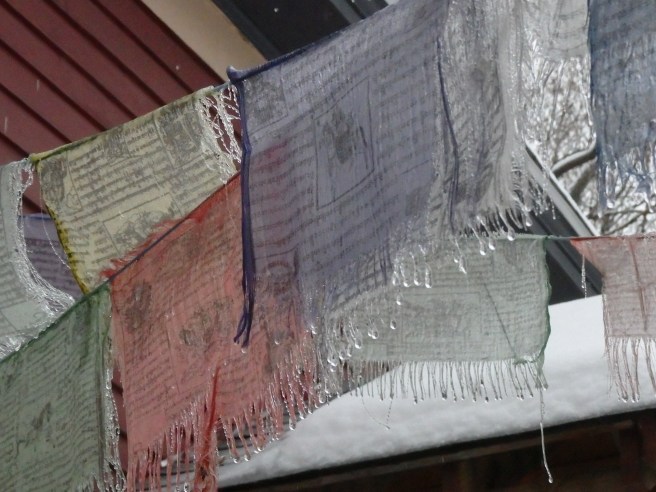
fingers stiff, numb
on ice-encased rigging

any fire in the hull
a hazard

tend the footing, Jack,
and stay dry, if you can

steering around the storm

*   *   *

hell comes without
flame
without smoke
under the prow

*   *   *

impressed
by chance misfortune

or the flight from somebody
gone astray

rolled together, creaking
skin to crab shell

all the same
lost, for the cold duration

Poem copyright 2016 by Jnana Hodson
To see the full set of seacoast poems,
click here.

AND HAVE A GOOD DAY?

In the early days of Friends, they’d often greet each other with the question, “How does Truth prosper among you?” Not “How are you doing?” or even “Good morning.”

Strikes modern ears as puzzling, even problematic, beginning with that verb prosper, which we tend to consider along financial terms rather than thrive or even proliferate. Equally unfamiliar is the idea of Truth being active – alive – rather than static and unchanging.

To further thicken the plot, consider their linkage of Truth and Christ, so the question also asks, “How is Christ alive among you?”

How would you answer that!

~*~

For more along these lines, take a look at Religion Turned Upside Down.


THE PRIEST’S WIFE

The celibacy expectation for their priests and monastics leaves many Roman Catholics perplexed when they hear of the married ministers of their Protestant and Anglican/Episcopalian neighbors. Sometimes this is seen as a question of whether a pastor is able to focus all of his attention on the work of the church without the distractions of family life – or, on the other hand, the ways that family service enriches his ability to understand and counsel the members of his congregation.

(Yes, I’m aware of the male pronoun there – we haven’t touched on the matter of the ordination of women in many of those Protestant and Anglican/Episcopal churches, contrary to Roman Catholic strictures.)

While the focus is usually on the pastors, the condition of their spouses is typically overlooked. Are they fully members of the congregation or are they somehow set apart? They’re definitely in a spotlight and held to a higher standard than the rest of those in the pews. In addition, many congregations assume the spouse – usually the wife – will function as an enthusiastic unpaid full-time employee of the church, either as an unofficial co-pastor, minister of music, choir director, secretary, or some other visible role. Whatever the ultimate definition, it’s a high-stress situation to fill. Not all marriages survive. As one former pastor told me, “My wife said she married me, not the church.” For him, to take another pastorate would have led to divorce.

To add insult to injury, they’re rarely accorded any open recognition of the duties they fulfill, much less given a place of honor. Their husbands are typically addressed as “Reverend,” for starters. As for the wives, though? Only Mrs.

In contrast, the Eastern Orthodox introduce a fascinating alternative. While the priesthood is reserved for males only, they are allowed to marry – if they do it before ordination. The last year of seminary, according to the story, is a time of intense courtship. (Otherwise, it’s celibacy.)

As for the wife? In Greek circles, she’s accorded the title presbytera in English, drawn from priest or elder. Among other Orthodox, similar titles from their native tongues.

Of course, now I’m wondering how it plays out in practice.

YES AND YET

The mind dances here and there, rarely in a linear fashion. So what’s on my mind these days? How about counting on these fingers?

~*~

  1. She’s big on Christmas traditions, including our observing Advent these days. I’m still surprised she inherited none of it in her family! Created it like a radical quilt. Makes this array all the more remarkable, from my perspective.
  2. Slush on the windshield. Ice underfoot.
  3. Winter’s setting in, though I’m already tired of it.
  4. The earliest sunsets of the year have plateau’d and are already inching back in my part of the world. The oppressive late-afternoon darkness will soon be obviously relenting. We don’t wait for the solstice.
  5. I like the Eastern Orthodox insight of Mary as the Mother of Light.
  6. In reality, I hate being the caretaker, responsible one, cleaner-upper, put-awayer. Contrary to my self-image.
  7. It’s been a long road to here. Sometimes it feels like a hangover.
  8. In working a seasonal job, she has a curious freedom in not having to worry about being fired, losing the mortgage, and so on. Just put the hours in and go home.
  9. Whatever happened to my collection of winter scarves? (As if I really need to ask.)
  10. Authenticity: something that speaks to the bones.

~*~

OLYMPUS DIGITAL CAMERA
Brussels sprouts are one of our crops that taste sweeter after surviving a good frost. We’re known to harvest some for Thanksgiving and Christmas dinners, and that can mean having to dig them out from the snow. One year required us to shovel more than two feet down.

CLEARING, FROM SNOW

after the blizzard, a raven
lands over our suet and cracked corn bird feeders

and then, while digging out
the driveway
the front steps for the mail carrier
and the barn steps for the grandmother
a pathway to the compost bins, on one side
and the stacked firewood, on the other

I’m at the heart of my universe

while my wife tends the fires
in our kitchen

Poem copyright 2016 by Jnana Hodson
To see the full set of Home Maintenance poems,
click here.

ESPRESSO FIT FOR THE GODS

With a holiday touch.

Vittorio’s in the North End is famed for its espresso and pastries. With Mercury as one of the coffee makers, you can see why the neighborhood is also renowned as Little Italy.

Boston is a rich and varied destination – the Hub of New England, or the Universe, as they used to say. Living a little more than an hour to the north, we’re well within its orb.

REVELATION, BEGINNING WITH GROUNDHOG’S DAY

BEING SINGLE AND without children for much of my adult life, I could get around Christmas without getting caught up in many of its trappings. One year, getting my holiday greetings out late, I launched my annual letter with “A happy Ground Hog’s Day to thee.”

That’s particular calendar date had seemed so weird, until I discovered there are “solar seasons” as well as the ones our calendars show. In solar winter, for instance, the solstice comes at the middle of the season, rather than the beginning; so Christmas would be right around the middle of solar winter, even though it’s at the beginning of the calendar winter. Why does my brain ever go into these bizarre leaps? Oh well, as long as we’re at it: If my calculations are right, Ground Hog’s day comes at the end of solar winter. Follow that? In other words, as far as the amount of sunlight falling on the Earth is concerned, winter is over, even if we wind up getting another six weeks or so of cold and snowy weather, right up to the vernal equinox. So what I really began asking was whether Punxsutawney Phil, the official ground hog those Pennsylvanians in tuxedos and stovepipe hats bring out every year, is stuffed or live. He sure looks stuffed in the official portrait the wire services move, but what do I know? One of my coworkers, who has witnessed the event, claims it’s a living critter.

Awareness of solar seasons puts other events into perspective. Halloween, for instance, acknowledges the beginning of solar winter. May Day brings solar summer. The Midsummer’s Day or Night, ostensibly announcing the beginning of calendar summer, really does come at solar midsummer. The beginning of August is the invisible event in our awareness.

(Neo-Pagans, incidentally, put their own significance into this alternative alignment of seasons.)

Dwelling in northern New England, as I do, presents another awareness of seasons. They are not evenly divided across the year, as a calendar would do, but are instead of unequal duration. Winter, for instance, begins around Halloween and lingers until the beginning of April – five months, rather than three. Summer, on the other hand, opens around the Fourth of July and ends by mid-August – all of a month and a half. That leaves three months for spring and two-and-a-half months for autumn. Within that there are other divisions. Winter, for example, ends with Mud Season, Black-Fly Season, and Mosquito Season. Or some Mainers see the year as Freezin’ Season, Black-Fly Season, and Road Construction Season.

It’s easy to make the leap to the emotional dimension of the seasons. Skiers and ice fishermen can view deep winter with their own appreciation. I revel in the glorious mutations of October foliage, while another friend dreads its appearance, knowing all too well the gloom that will follow.

Some creatures, of course, will hibernate.

~*~

For more Seasons of the Spirit, click here.