
You never know what we'll churn up in cleaning a stall
Maybe it’s all those years I’ve lived in places where I’ve been represented at the state and federal levels by some truly embarrassing public officials.
The ones I dutifully voted against, as a point of moral witness.
Note that I still voted, even when it often felt like a losing cause.
You can imagine my elation on those rare occasions when my candidate actually won office.
The U.S. representative who proved most satisfying was Kweisi Mfume, who was elected from my district in Baltimore shortly before I headed to New England. He was about as unlike me as you could imagine, apart from his voting record, and then he and I were in delicious harmony.
What I’m getting at is about my exasperation with those who insist they won’t vote unless it’s for somebody they agree with 100 percent.
At the moment, that means those in the Bernie camp who can’t accept anything less, except maybe Elizabeth Warren. Some of these are people I love dearly and respect, apart from their belief that it’s time for the entire system to crash and burn so it can magically resurrect in what they call “revolution or else.”
I hate to tell them this, but crash and burn rarely if ever leads to something better. There’s no Phoenix or Firebird. Look at Rome after the Visgoths and Huns. It was never again the same without the full Roman Empire, not that I’m a big backer of Caesar in any form. My sentiments are more in line with the Jewish resistance, not that it matters.
And, no, I definitely don’t believe in unicorns.
I know how hard it is to start an enterprise from scratch or even to turn an existing one in a new direction.
I heard a similar crash-and-burn argument from some who voted for Trump the last time around. Yes, they hated the way things were at that point, but they weren’t differentiating between crucial differences. One wanted something other than an entry-level job. I doubt she has even that now.
Me? I knew I’d much rather have someone in office whose positions meet me half of the time than one opposed to mine 90 percent of the time … or more. Take environmental protections or the independence of the Internet as current two examples.
I also knew I want someone who’s a problem solver, working with verifiable facts, than a problem maker, spouting off lies and superstitious gossip.
And I want someone who’s not in the pocket of the lustfully super-rich and their lobbyists. You know, money-sex-power, those who have it want more of it all … now.
I remember all too well Ralph Nader’s role in giving us the eight years of W that were so detrimental to progressive legislation in this country and its judicial benches, and also how Nader refused to acknowledge his part in undermining those positions. I’m also among those who chide Bernie for undercutting Hillary Clinton’s campaign as well, especially as we look at the devastation that’s followed. Look, I voted for him in the primary and have come to regret it.
The reality is that like dating and courtship, we’ll never find someone who can fit into everything we desire. As I’ve learned, a clone of myself is a very imperfect match. A successful working relationship is something quite different. A candidate who fully matches my stands would never, ever, get elected, not even if I lived in a lefty outpost like Cambridge, Massachusetts, or Berkeley.
Yes, I’m all for a revolution, but that’s within existing realities and resources, the way the call of ’76 turned out to be.
Anyone else have a soundtrack of “Hamilton” to play now?
The Covid-19 shutdowns are reminding many of us how much of religious practice involves community interaction.
Yes, personal practice is also essential – we could easily build a list of ten examples – but it blossoms and bears fruit in our interactions.
Here are ten ways those are being impacted by coronavirus.
I do want to mention a renewed appreciation for the medieval tradition of anchorites, women who lived in isolation in the church tower itself and prayed unceasingly for the members’ well-being. These days, their writings seem especially meaningful.
OK, there’s no bingo on my list. What else am I missing?
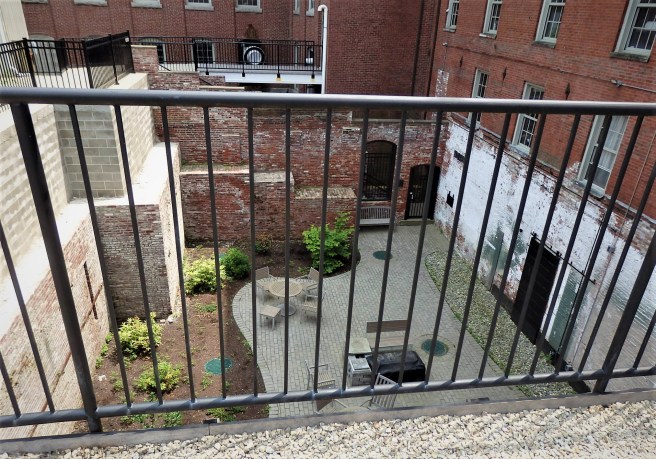
In this time of social distancing and shelter-in-place, many of us would go stir crazy if we couldn’t get out for long walks. Seeing so many other people also out strolling – with or without their dogs – has been a bright side of our lives lately.
Where we live, a highlight of those treks has often come in checking out others’ gardens, landscaping, and flowerbeds. I don’t know about you who live in apartment complexes or high-rise developments, but I’m curious. Maybe something out on the deck, if you have one?
These days, I’m seeing a lot of raised garden beds going in. Fresh wood, reminding me of the time we were just getting started here. (Some of my earliest posts told of the reasons for raised beds when dealing with northern New England’s clay soils.) You’ve no doubt heard the stories of folks who have recently decided to grow their own food in the face of Covid-19. Maybe you’re even one of them. Part of it, of course, is a concern about breakdowns in our food-supply system or even long lines just to enter the supermarket. Another might even be boredom, as in give me something new to do. From questions we’ve been getting from neighbors and passers-by, they’re really green and in for a lot of surprises, some of them harsh disappointment but a few real treats, too.
We could see this coming when some of our favorite seed catalogs announced they were running out of supplies and would not be selling to new customers; they felt it crucial to serve their longstanding commercial growers first and foremost, followed by their devoted regulars. Fair enough, that’s long-term loyalty. At least, seasoned as we are, we had our orders well in hand by mid-February.
As you know, gardening is a staple of the merry-go-round here at the Barn, but my posts aren’t the detailed advice kind for beginners – more just a taste of the experience, no pun intended. I’m hoping many of the neophytes will discover those of you who post expertly on growing and harvesting. You’re such an encouragement, truly.
Maybe we’ll get them in for the long haul, too, when it comes to things like composting (remember, those two cute bunnies you’ve been seeing featured here are big helps on that front … plus they prompt me to weed daily, just to keep them supplied in greens, which they then convert into their little composter pellets).
And, I should note, we just installed a new colony in our beehive and are anxiously waiting to see it the queen takes hold. If all goes well, our honeybees will be tending pollen in gardens in a radius of up to five miles.
Should we warn people what a few tomato plants can lead to?

One more scene from from the heart of my town.


I’ve had to learn the hard way that a word can mean something quite dissimilar for two people. Sometimes it’s based on assumptions or misunderstandings. Sometimes, on deliberate deception.
Either way, one person can be deeply injured by the outcome.
Take “I love you” as an example.
A used car is in “perfect condition.”
“I’ll be right there.”
In the hippie era, we had a raft of phrases that glossed over differences – “Hey, I’m cool with that,” “Don’t hassle me,” “I dig,” “Chill out.” Meaning?
It comes up especially with “God” or even “peace.”
There are plenty of other examples, some of them keeping lawyers in business.
What’s one from your own experience?

