Everyone in Cambridge looks straight from Central Casting, no matter how frumpy they’re dressed.
(And you overhear a world of languages, too.)
Or, the memories …
You never know what we'll churn up in cleaning a stall
Everyone in Cambridge looks straight from Central Casting, no matter how frumpy they’re dressed.
(And you overhear a world of languages, too.)
Or, the memories …
As I’ve looked with delight at the renaissance of my small city’s downtown, one modeled in part on Jane Jacobs’ then revolutionary attack on urban renewal back in the ’50s, I am a bit bothered by how much of it is now based on a commercial cookie-cutter concept known as mid-rises – five-story stick-frame construction above a steel-frame pedestal that’s then given a brick or similar exterior facing.
It’s happening all over the country, actually, and not just in the heart of a city, either. Even here in Dover, we’re seeing something similar happening about a mile south of downtown as an over 50s-something neighborhood called Pointe Place with rents that astound me. Who can afford it? Some retirees, apparently. It’s a downtown within a doughnut, in effect. You can’t really walk there from anywhere else.
Of course, the Covid-19 pall casts a big shadow over these developments, but some observers say it might encourage more people to move from big cities to smaller communities like ours. We’ll have to be patient and see what actually unfolds.
As I’ve argued here in various forms, I’d rather have a real city center abutting organic neighborhoods, one with a funky fringe of mixed-use buildings, unlike apartment complexes surrounded by parking lots along the major highways or shopping strips.
What we definitely have here in Dover is the attraction of a river that rises and falls with the tide, as well as the historic mills once renowned for their calico and now serving as entrepreneurial incubators and housing.
Call it atmosphere and scale.
~*~
As Dover’s emerged as New Hampshire’s fastest growing city, the bulk of the new downtown residents are presumably singles and child-free couples, either young professionals or older folks who want the amenities of living close to restaurants, parks, and public events.
The retail and professional rentals are a larger concern, though, especially as many small merchants find themselves at a disadvantage against Amazon. Take the local hobby shop as an example. And that’s even before the bigger threat of coronavirus hit the entire economy.
Even so, these projects haven’t been on hold.


The old block may look charming in the photo, but the buildings were rundown and unwelcoming to pedestrians, as was the sprawling parking lot behind them. There was also a traffic bottleneck that’s being eliminated.
In my novel What’s Left, what she discovers about her deceased father (her Baba) is much zestier than this passage. So I cut it. You’ll still get the drift in the final version.
As a kid, your Baba figured out he never quite fit in with his surroundings. He thought about things he couldn’t explain to others, though to be fair about it, he rarely caught their signals, either. Deep within himself, he sensed there was much more to life than what was happening around him. I think he wanted the big picture, which is what he must have felt when he was climbing mountains.
~*~
Too many things are trying to happen there, I’m afraid. We can move along better without having to trip over the added baggage. I do like the image of climbing mountains to feel the big picture, though — something I see as recharging his soul.
Where do you turn to recharge yourself? Anyplace special? Music? Dancing? A deep bubble bath? Meditation? Or is it something else altogether?
~*~
I’m also thinking about typical encounters with professional photographers. There were strange, formal portrait sessions when my sister and I were very little. Do families still do that anymore? Then there were the senior portraits in high school or yearbook group shots, which were akin to elementary class pictures earlier. But weddings are the big event for many, the mother lode of the profession.
Tell me about your parents’ wedding pictures. What do they reveal? What do they mask?

~*~

Catching up on my stack of Harper’s magazine, I came across a remembrance of the poet Etheridge Knight, and it stirred a long buried memory.
Etheridge? I paused, before remembering he was a black inmate of the Indiana State Penientiary when he began writing seriously. Damn good stuff, as I discovered.
My introduction came in the mid ’70s when Roger Pfiingston asked if I wanted to go with him up to Indianapolis, aka Naptown, to a reading and open mic. I was free that night. The trip from Bloomington was a little over an hour, and he was driving.
The event was at a bar in the inner city, not a familiar terrain, and Etheridge was hosting. I should go back to my journals for details, but I recall it as a warm and comforting evening. I think Jared Carter was the featured reader. Another damned good Indiana poet.
I was a bit nervous about one of the pieces I’d brought with me, one that quoted a friend’s father about a lover in the ’30s, but I read it anyway.
The line in question triggered delighted, loud laughter from Etheridge, especially. I was sooooh relieved!
Looking back, I see it as one more confirmation – and welcome – as my identity as a poet.
What a wonderful community!

By now, you’ve probably had your fill of Zoom or GoToMeeting or Skype. (Any others I haven’t heard of?) They’ve become inescapable, it seems, and essential.
Here are ten takes from my end.
What stands out from your encounters?
I like having my wife working from home.
(As long as I can stay out of the camera every time I dash past to refill my mug.)

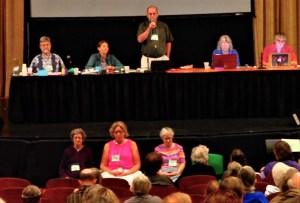
The top level of governance in the Society of Friends is the yearly meeting, so-named because it gathers once a year in decision-making sessions. The constituent local congregations, in contrast, are termed monthly meetings, since they gather in business sessions once a month. (Yes, it’s confusing, since we sit together in worship at least once a week as well.) Everyone active at the local level is welcome to participate in the annual sessions.
Rather than having a single overarching yearly meeting, ours exist independently, originally on a regional basis. Something like the various strands of Eastern Orthodox, for that matter, with the Greek Orthodox and Russian Orthodox the best known of many.
Among Quakers, New England Yearly Meeting is the world’s oldest, founded in 1661, and was held in Newport, Rhode Island, until 1903. Since then we’ve gathered for a week each August on college campuses or other residential sites around the six-state region. In my time here, that’s been Hampshire in Massachusetts, Bowdoin in Maine, and Castleton in Vermont, and I’ve heard tales of the years the event was held in a camp on Lake Winnipesaukee in New Hampshire.
It’s a solemn and joyous occasion, one that many participants – and many families – schedule their work vacation time around. It’s something like a huge class reunion, too, where you reconnect with many people you hold dear. And living in a college dorm, as most of us do, it’s not uncommon to find that random pairings among those of us who go solo turn into regular roommates, year after year.
So I’m still stunned by the announcement a few weeks ago that we will not be meeting in person this summer, due to the coronavirus. Yes, we will be attempting something online, but it won’t be the same.
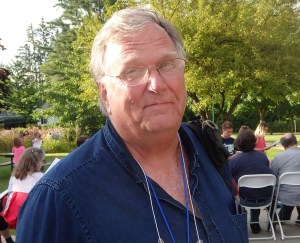
Just as jarring is the more recent cancellation of summer sessions at Friends Camp in Maine. For many of our kids, it’s a highlight of their year, and friendships they form there sustain them through high school and college. As one of our neighbors says, a camper who became a counselor, the news is a bummer.
Amen.

