While my Quaker lines eschewed all forms of ritual, their movement nevertheless also expressed an awareness of the mystery of water as they moved inland, as the naming of some of their Friends Meetings conveys: Black Creek, Pagan Creek, Goose Creek, Cedar Creek, Herring Run, Gunpowder (for Gunpowder Falls, with its series of rapids), Indian Spring, Sandy Spring, Patapsco, Little Falls, West River, South River, Bush River, Deer Creek, Pipe Creek, Monocacy, Dunnings Creek, West Branch, Crooked Run, Cane Creek, Deep River, Back Springs, Short Creek, Stillwater, Miami, Caesars Creek, Whitewater, Clear Creek, Blue River – the litany goes on, and with it, an image of water (Living Water, in New Testament terms) expressing the motion and working of Holy Spirit.
One may turn, too, to the angel in Revelation 22:1-2, as well: “And he showed me a pure river … On either side of the river, was there the tree of life.”
And, as the chorus of Robert Lowry’s 1864 hymn rings, drawing on that text, “Gather with the saints at the river, That flows by the throne of God.”
That’s why I named one collection of essays Stillwater.
about it, except for an annual holiday trek up the railroad tracks along the river and brisk swim before the pool closes with Labor Day as ritual with a list of things to do filling four pages feeling depressed half the time even overwhelmed would be natural, too much I lose balance, lose focus, lose center then need to get back into the room by myself relating her entire summer rather beat
The coastal loop of Maine north of Portland but before Acadia National Park can easily be overlooked by many tourists who stick to Interstate 95. Besides, U.S. 1, its principal route, turns into a traffic jam during the summer, which is why we go in the shoulder seasons.
Many of its delights are found along the side roads that reach down its fingers to the sea or inland in the other direction.
Here are a few of the things we enjoy.
The lighthouses, of course. Pemaquid Point at Bristol is a photographer’s favorite, but there are 20 more. Some are privately owned, and many – including the 11 on islands – are viewed best from the water.
Ferry rides are one way to get to the islands and a fun trip in their own right. The state runs vessels from Rockport, Bass Harbor, and Lincolnville, and private services add New Harbor and Port Clyde to the points of departure.
Getting to Morse’s sauerkraut in Waldoboro, leading away from the water, can seem like forever, especially in winter, but when we go, we stock up. This cabbage is nothing like the crap we were force-fed as kids, and the German restaurant and store are treats in their own right.
Moody’s Diner, back out on U.S. 1, is a classic and where I learned the difference between lowbush blueberries common to Maine and the highbush ones like I grow.
If you can, pick a town and stay there for a few days. We’ve done B&Bs in Bath, Belfast, Boothbay Harbor, Camden, and Damariscotta – as well as weeklong conferences in Brunswick – and each town is different. We’d go back in a flash to Camden in the depth of February again, if the opportunity arises. Or if it’s in the summer, we definitely want to visit the lavender farm. You have to walk around to really enjoy each town and its people.
The Farnsworth Art Museum in Rockport emphasizes work by Americans, especially modernists – and its connection to the Wyeths and Alex Katz are strong. The museum even owns the Olson house, made famous in the painting Christina’s World.
Bay Chamber concerts have been providing classical music each summer out of the old opera house in Rockport and related venues along Penobscot Bay. It began as the summer home of the famed Curtis Institute in Philadelphia and maintains high standards.
Popham Beach in Phippsburg has to be the loveliest in the Maine. The state park is also the busiest. Get there early, if you can, before the line forms.
The river herring also known as alewives are a regional treat, especially when they migrate each spring. You can see them up-close in Damariscotta … or dine on them, if you ask around.
When the herring run, the osprey follow. The big birds rival eagles in their majesty.
It’s is not my debut novel. Rather, I have the feeling it’s the opposite — the final one. I could never do this again. What’s Left is a big novel chock full of surprising turns, deep thoughts, and lively details. Unless Cassia starts speaking to me again, there will be no sequels. For me, at least, the story condenses so much into its pages I’m feeling completed.
Unlike my earlier novels, this one was not written on the fly while working full-time as a journalist. Like them, though, it’s undergone extensive revision.
Woven through the book are themes I’d explored in my earlier stories, now seen in a new light, while investigating others I’m tackling for the first time. Family and family enterprise, adolescence and childhood, death and divorce, and Greek-American culture, especially, are new while counterculture, romance, spirituality, community, nature and specific place, livelihood, journalism itself all run through my previous work.
~*~
Think of this bit as going into the compost rather than being served on the plate:
All I’m doing is asking you to apply your new comprehension to the rest of your life.
~*~
Of course, you’ve heard somebody blurt out, “I’m never going to forget this as long as I live!” Or some such. And sometimes it’s true.
Me? I have trouble remembering nearly everything. Could it be one reason I read so widely is to help me remember? Of course, writing gets it down on paper, once again so I don’t forget.
So while I read to help me remember and to gain insight on the world around me, it’s not the only reason by any stretch.
What do you look for most in a novel or poem?
~*~
A large Queen Anne-style house with a distinctive witch’s hat tower something like this is the headquarters for Cassia’s extended family in my novel. If only this one were pink, like hers.
If you’re going for taste over looks, the heirloom Goldie is as heavenly as it gets in a tomato. I prefer mine in a sandwich lathered in mayo and Old Bay seasoning, skipping the bacon and lettuce. One slice is the width of the bread. It’s worth waiting all year for these to kick in.
Sitting down to compose a novel requires some bravado, an assumption or presumption, even outright arrogance, that you have something important to say and an ability to do it in an interesting way.
You know, balls, swagger, mojo. Go to a writers’ group and just listen. But it’s not all sheer ego-driven. For many, at least, there’s an ongoing tension between believing in our own talents and shielding ourselves from the nagging self-doubts. Even Stephen King has them. Remember, the practice of the craft is a solitary act, not a team sport. It gets lonely, especially in the absence of feedback or fans in the stands, whether they’re cheering or jeering. Sometimes, to your surprise, harsh criticism is easier to handle than any praise.
Unless you’ve been there, you have no idea how precious a voiced reaction can be in nurturing you. Those brief reviews and star ratings are important, not just for guiding others to certain books but for guiding you as an author in your practice. An astute reader picks up important elements that have slipped right over their creator’s consciousness. Please, please, please take a few moments to weigh in when you finish a volume. We all need confirmation that we’re not wasting our time – or yours. Best of all is the epiphany when we’re left feeling that someone finally “gets it,” actually understands what we’re about. Don’t be shy.
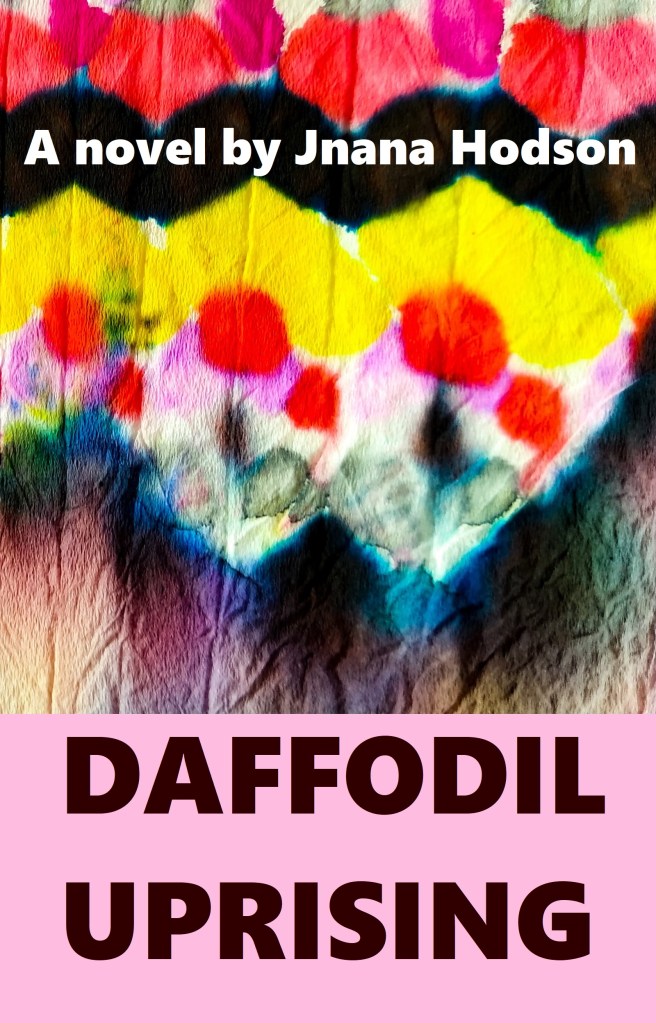
The paperback cover …
I recall giving a friend a booklet I’d written about the Quaker metaphor of Light. (By the way, in the first two centuries of the Society of Friends, the term was always Inward Light or some variant, never the Inner Light expressed today. It’s a crucial distinction.) When he finished, he thanked me, said the text had cleared up his understanding, and then added, “You write very well.”
Even after four decades in the words-on-paper business, I was taken aback, considering that he is, by any measure, an important American literary figure and a master of the language. It was like “welcome to the club,” the exclusive one with the dark paneling and Manhattan address. It was like a cup of fresh water in a desert. Within myself, I felt freed from the “hack writer” label so often applied to journalists from Dr. Samuel Johnson on.
Later, in an aside, he told me I was more of a poet than a novelist. Knowing his fondness for poetry, I took some comfort in the perspective, as well as some umbrage about the fiction part.
On reflection, I now have to agree on his assessment, at least as my novels stood then. He certainly helped my character Cassia press her case for the reworking of all my existing novels, as I did in the aftermath of What’s Left, where she’s the star.
There’s also that frightening moment in the gap between when a book’s been accepted for publication and when it actually comes out. We’re afraid someone’s going to somehow uncover our darkest secrets or that we’ll be shamed by some indiscretion or that we’re about to make an unforgivable transgression. Again, go to a writers’ group and listen … or even ask. If you’re an author, you think you’re somehow bonkers when you feel this, not knowing how much company you actually have.
… and the back cover.
I’m of the camp that hews to Bukowski’s regime of daily “butt time” at the keyboard, day in and day out, regardless of how inspired you might be feeling. Many days it’s a dry struggle, but on others something different and amazing blossoms. From my perspective, it’s when writing becomes a kind of prayer and you find yourself in a “zone” where things come together as if by magic and characters start dictating to you, if only your fingers can keep up with what your soul is hearing. It’s a dialogue with the Other, as in Muse, and you’re the mere scribe at her service.
It’s what happened when Cassia started dictating to me.
It’s not always at the keyboard, either. Sometimes it happens while you’re in the shower or on the throne next to it or swimming laps in the pool or commuting to work.
You can’t control this. Realistically, it happens when you’re not in control.
It happened to me at the finale of “Subway Hitchhikers,” which years later became the launch pad for “What’s Left,” where I had to make sense of what I’d been given, however intuitively.
Perhaps the best, well, I just had a phone call and lost the thread of thought. Maybe it wasn’t that important.
It’s about 700,000 times smaller than the average human.
It has 960,000 neurons, compared to 86 billion for a human.
It has six articulated limbs, each with six segments.
It has five eyes. Two of them are compound eyes made up of 6,900 lenses and cover about half of the face, These two mega-eyes sees the world differently. Red looks black, and the three primary colors are blue, green, and ultraviolet. It detects motion intensely but outlines are fuzzy and images, blocky.
Its other three eyes detect only changes in light, as a warning of danger.
Its four wings move at 11,400 strokes a minute.
The wiggle dance tells other members of the colony where a nectar supply is within a five-mile radius of the hive.
Of 20,000 species of bees, only four make honey.
Around 80 percent of all American fruit, vegetable, and seed crops are pollinated by bees.
Its straw-like tongue extends far beyond the jaw but has no taste buds. Instead, specialized hairs sense the chemicals that brush up against its exceptionally hairy body.
– from an article by Natasha Frost at Atlas Obscura
Like most of us, Cassia finds herself carrying a host of identities. She’s Greek-American, on one side, and Midwestern WASP, on the other. She’s been raised with both Tibetan Buddhist and Greek Orthodox religious influences. She’s a female, of course, and an entrepreneur. She’s part of a large extended family, a Hoosier, a bohemian, a college graduate, a devoted sister, a daughter. And that’s just for starters.
What are your most prominent identities? How do they shape your life?