After finding myself being referred online to another as “a compelling and brilliant man,” I have to admit how energizing that felt.
All of my Quaker humility aside.
You never know what we'll churn up in cleaning a stall
After finding myself being referred online to another as “a compelling and brilliant man,” I have to admit how energizing that felt.
All of my Quaker humility aside.

Islands come in all shapes and sizes, and even that can change dramatically with the tides. Now that I’m living on one, I’m really beginning to appreciate their variety. Some you can drive to or from, while others require a ferry or even an airplane. The better-known ones seem to be vacation or travel destinations.
Here’s a sampling, starting with home.
Care to tell us about others?
Decades have passed since I’ve been in any part of New York City. In the late ‘60s and early ‘70s, though, most of my buds were from there or nearby, so I wound up staying in all five boroughs. And I was reintroduced in the mid-80s as well.
I became fascinated with the transit rails and even imagined what I cast as Subway Hitchhikers, their psychedelic underground adventures now available in my novel Subway Visions.
Oh, the history! The city has certainly undergone a wild ride in the years since, some of them admittedly terrifying.
As improbable as my hitchhikers seemed at the time, reality has since produced several parallel developments.
The first was the Mole People, the homeless who created villages in the tunnels starting in the Reagan era.
The second was the Subway Surfers, daredevil youths who would ride the tops of the trains or more recently, hang from the sides.
I thought they had faded from the scene, but a spate of recent fatalities is proving otherwise.
As for the adrenaline rush? Or is it testosterone?
Maybe someone will be able to describe it to the rest of us. I’m not sure I’d want to see the movie version, sedate as I’ve become now.
Quakers Do
Quaker Stew
As my new book came together in its revisions, I began to feel some parallels to John Baskin’s 1976 New Burlington: The Life and Death of an American Village, a non-fiction opus based on what was then the new field of oral history.
The village he examined was largely Methodist and Quaker, the latter having come en masse from South Carolina as their rejection of living in a slave-holding countryside. In fact, when they relocated as a Quaker Monthly Meeting, they carried their treasured minute book with them and continued their records in Ohio.
His book became something of a classic and was even excerpted as a popular series in the Dayton Daily News.
While relying heavily on quotations from his sources, he did knit the interviews together with some heavy interpretation on his part. And here I was, becoming an active narrator in the action in my own work.
My book, as it stands, is heavily influenced by what I’ve learned writing fiction, in addition to my lifetime career as a newspaper journalist. I view the result as a story.
More to the point, when Quaking Dover came out, one longtime friend asked me if it was another novel. I bristled, I think, “No! It’s a history! Non-fiction!” While also thinking, “Didn’t you read the description? What did you miss?”
~*~
I am trying to remember the first time I mentioned Baskin’s book, probably in a Quaker circle in another part of the state, and hearing the response, “It’s all fiction.”
Huh? It seemed pretty solid to me, and the asides on Quakers were rather informative for a newcomer, as I still was then.
A decade or so later, visiting family back in Ohio, I ventured off to worship at the New Burlington Quaker church, which had rebuilt out by the highway after the village had been flooded by the U.S. Army Corps of Engineers.
At the close of the service, I was asked why I chose them rather than the more silent Friends in nearby Waynesville. Well, I had worshipped in that historic meetinghouse years earlier but, as I replied, I enjoyed visiting other branches of the Quaker world. And then I added, “Besides, I have the book.”
A moment of awkward silence struck the circle around me before the oldest person, a woman perhaps in her early 90s, softly pronounced, “It’s all fiction.” Obviously, they all knew what I meant by “the book.”
Oh? I was in no place to argue and accepted her verdict as literary criticism. In some ways, I took it as advice, not that anyone knew I, too, was a writer. Those of us in the news biz were already treading on thin ice in too many ways.
Still, as I retold the encounter to a reliable bud, he inhaled sharply and noted, “That’s strange. It’s the same thing Aunt Cecille said. Her words, ‘It’s all fiction.’”
Well, she did live in a town only a few miles up the road, one where the local Friends church had recently petered out. She, too, had Quaker roots and community creds.
~*~
As a journalist, I can relay one fine reporter’s observation that he knew he was on course with a controversial issue when he found both sides of the story were upset. Not that I want to go there. Still, I do know that we humans have a hard time accepting our own shortcomings and follies and that we view events through our own lenses.
I should add that Quakers, as a whole, write a lot. It’s a crowded field.
How crowded? The primary Quaker history journal takes this stand: if a book hasn’t been vetted by a peer review panel of historians, it’s taking a pass.
As they did on mine.
Being invited to speak about my book, either as a solo outing or as part of a panel, is something quite new to me.
It’s distinctly different from being the featured poet at a café reading or even having a chapbook in hand for sale.
Since Quaking Dover is a factual history, the narrative ties into much more definable readerships than my novels have. I’m even able to present PowerPoint slideshows of people and places appearing in the story, and then be surprised afterward to meet descendants the families or the current residents of houses I’ve touched on.
Having a presentation be recorded and made available on YouTube, as happened through the Whittier Birthplace Museum in Massachusetts, is personally thrilling.
My previous YouTube appearance was private, for a selected audience, largely a sequence of appropriate Scripture and related images. It even had an original, emotionally moving musical score from a talented collaborator.
My face wasn’t visible there, by the way. Yes, the invisible writer as witness.
Alas, it’s gone and I do wish I had a copy.
Remember, writing is a solitary activity. Rarely do we get feedback from our finished efforts. Are we writers simply navel-gazing or do we somehow reach others, especially one on one? Have we actually been wasting our time?
In blogging, I’ll assume you, too, are a writer and know what this means.
Humbly yours, all the more.
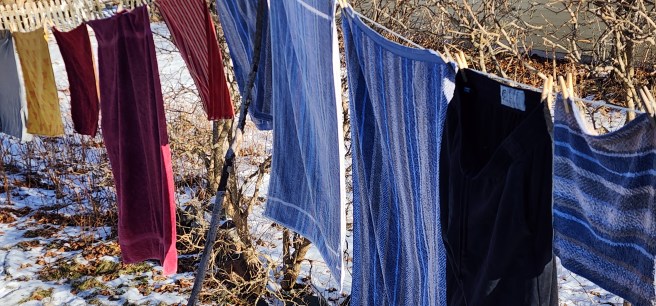
The Amish do it, after all. Somehow, wet laundry hung out to dry in below-freezing temperatures still manages to dry.
Often a piece is already stiff before it’s fully pinned to the line.
The clean clothes and linens come in smelling heavenly sweet.
For those of you living in New Hampshire or southern Maine, here’s an invitation to Dover Friends’ annual Arts & Letters event now rescheduled for 2 pm Saturday, March 18.
It’s one way to sample the local Quaker community as members of all ages display their artistic talents, from painting, drawing, weaving, and photography to original music, poetry, and fiction, perhaps even dance or furniture-making.
The mix each year is different. I remember our amazement when we first saw the museum-quality quilts a newly retired English teacher had begun creating as well as the array of Sculpey figures one of the kids produced. The afternoon even includes a potluck, billed as culinary arts.
The historic meetinghouse is at 141 Central Avenue, just south of the downtown.
Cheers!
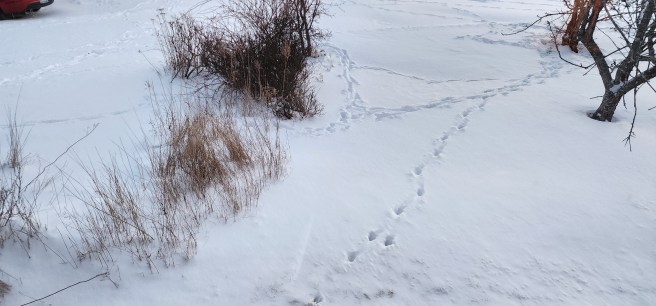
They had an active night, as seen from our kitchen window.
 Jnana's Red Barn