Factor in the Scottish prisoners of war

Quakers weren’t the only significant minority along the Piscataqua watershed in the colonial era.

One that doesn’t appear in my book Quaking Dover is the Scottish conscripts who had been defeated by Oliver Cromwell and his Puritan army at the battles of Dunbar in 1650 and Worcester in 1651, with some then showing up in what would become Berwick, Maine, and Oyster River in New Hampshire, now the town of Durham.

The Scots had sided with Charles II as king rather than Cromwell’s commonwealth. Hence, the “Bonnie Charlie” of the folksong lament, “Will yae ne’er come back again?” I now see the song also applying to the sons and brothers lost in the battles.

Despite their shared Calvinist theology, the Puritans took up to 16,000 defeated Presbyterians (Covenanters) as prisoners of war and treated them harshly. Many died in an infamous death march to Durham, England, or of illness later. Of the 3,000 survivors, around 900 of the healthiest were then deported to the American colonies, where they were sold for 20 to 30 pounds apiece (the cost of their passage) into indentured servitude, a form of slavery with freedom after five to eight years of satisfactory labor. The numbers of soldiers, I should caution, vary widely, depending on the source, at least until we get to the passengers on the ship Unity, 150 when it set sail late in 1650, and an additional 272 who reached Boston Harbor aboard the John and Sarah in late 1651.

I had come across passing references to some who had been sent from there to Berwick, Maine, but had not known of the enormity they endured or of their impact on the Piscataqua. One roadside historical marker, as I now understand, sanitizes their history.

~*~

The Old Berwick Historical Society has pursued the story of about 25 Scots who were brought to reconstruct and expand a sawmill on the Great Works river, on a site now on Brattle Street in South Berwick.

For full details, check out their website and its post, The Scottish Prisoners of 1650.

For an idea of the impact of that number, remember that neighboring Dover, the largest town in the region, had about 60 households.

The Puritans in the New World did continue to rub salt in the Scots’ wounds.  Before the town of Berwick was set off from Kittery in 1713, the English often called the settlement Unity, after the first ship that had transported the prisoners.

B. Craig Stinson’s Oyster River Scots, available online at the Scottish Prisoners of War Society’s thorough website, names another 22 who were taken to what was then part of Dover and then examines 18 of them. His list is drawn from the tax list at Oyster River, 1657-1659, most of them arriving on the John and Sarah. These are men who had fulfilled their indenture obligations, been freed, but were still in the settlement. Many of them later moved on to new locations.

~*~

Cultural clashes with the New England Puritans were inevitable. The records tell of Scots being taken to court for using foul language or bold confrontations with militia leaders as well as one husband put in the stocks for kissing his wife on Sunday and a minister being barred from preaching.

Considering the imbalance of European men and women in the New World, I am surprised by the number of Scots who managed to marry after they had paid off their indenture. According to the New England Historical Society, many of the brides were Irish housemaids who had been brought to the region, in this case likely Scots-Irish; a few others were even the daughters of the men’s former bosses. Notably, few of the former prisoners of war returned to Britain. Still, I’ve wondered if any of them had left wives and families behind and somehow reunited with them in New England.

In subsequent generations, I do see some descendants marrying into Quaker surnames, but not many.

One notable exception, told in my book, is Quaker Richard Otis’ third wife, Grizel, the daughter of Scottish POW James Warren of Berwick.

In the devastating 1689 attack on Cochecho Village, her husband and a stepson and stepdaughter were slain, while she, her three-month-old daughter, and other family members were taken captive to Montreal, where she was renamed and remarried to a French-Canadian farmer and had five children. After being widowed again, she returned to Dover without her children and established a prominent public house, or tavern.

The Otis story is part of my book.

I’m having fun preparing PowerPoint presentations

In general, when it comes to new tech, I’m pretty much of a neo-Luddite. I prefer to stick to the tried-and-true rather than chasing after every new twist and trying to master it before it’s obsolete by the next wave.

I still haven’t stepped up to host a Zoom session, for heaven’s sake. And we’re definitely not E-Zpass users when it comes to highway tolls, either.

Preparing visuals to accompany my public presentations related to my new book, Quaking Dover, however, has me beaming.

The first leap was in learning to connect a laptop to a slide projector – you know, so folks could watch a slide show on a big white screen or a wall.

From that experience, I realized the shots really needed to be all of one size. Some pictures I was discussing ran off the screen, while others were too small. That led to the PowerPoint format.

My initial outing with PowerPoint was with the Whittier Birthplace Museum’s virtual lecture series back in January. There, I was amazed to discover how much I could enlarge a detail from a photo without having it pixilate. Individual signatures from a Quaker marriage document, for instance, could be displayed prominently. The size of the photo in hand wasn’t an issue, either. Up we go!

I’ve been at it again, this time for presentations at the Dover Public Library on March 22 and the Pembroke (Maine) Historical Society on April 18, as well as a third in July via the Falmouth Friends Meeting on Cape Cod. All will be streamed, by the way, if you’re interested in participating. (Do mark your calendars.)

It’s getting easier with each round, and I’m learning how to easily copy a PP slide from one production to another. Yay!

Fun? I’m finding it downright exciting. Hope you do, too.

Town meeting and grassroots democracy

New England’s annual town meetings are often hailed as an epitome of participatory democracy, but I have yet to hear an examination of how they mutated from the original Congregational churches’ model of self-governance, back when the town and Puritan parish were one.

As long as voting on town affairs was limited only to males in good standing with the local congregation, up to two-thirds of a town’s households were excluded from the deliberations.

In New Hampshire, that wasn’t the case, even after Massachusetts annexed the colony. What happened then, I’ll venture, is that the Quakers and Baptists tempered the deliberations in the future Granite State in ways that eventually seeped elsewhere.

Quakers, or more formally Friends, served as a loyal opposition, one that wouldn’t take up arms in its cause but that would nonetheless hold firm to its convictions. Like the Baptists, they also believed in a separation of church and state.

The Quaker practice of conducting community business in a monthly session meant seeking unity on an issue without ever taking a vote. A vote, after all, would create a minority. Instead, when differences arose, due consideration might produce a synthesis – not a compromise. The former would be superior to either of the earlier positions. The latter would mean settling on the lowest common denominator.

Crucial to this process was the Meeting’s clerk, carefully listening to all involved.

A skillful town moderator, so I’ve heard, needs similar abilities.

I’m curious to hear how this played out in Rhode Island and on the Cape, where Friends and Baptists were also an influence.

Do note, the Puritan colonies had none of the toleration of Maryland, New Jersey, Pennsylvania, or New York to the south and west, yet they lacked the town meeting heritage.

I do want to hear more.


Add to this to our list of items made obsolescent in our lifetimes

Even before many folks switched to unlisted numbers, in part to evade obnoxious ding-a-ling solicitations, the annual telephone book began shrinking. The migration from landline to cell phones was apparently the final straw, along with Yellow Pages regulars who turned instead to website searches or FaceBook.

What was long a standard reference volume for local communities is now long gone.

When’s the last time you saw a phone book?


Looking forward to another open stage night

Here’s a shoutout to our monthly open stage at the Eastport Arts Center at 6 tonight or, if the weather’s bad, the same time tomorrow.

It’s always a lot of fun, alternating live music and spoken word. I even tried a section from Quaking Dover last month, instead of poetry or fiction, and some found my reading emotionally moving. I did bill the genre as creative non-fiction rather than history. Well, there are no footnotes and I’ve focused on the overall story and people more than mere names and dates. The reaction has me looking at additional opportunities for presenting the work.

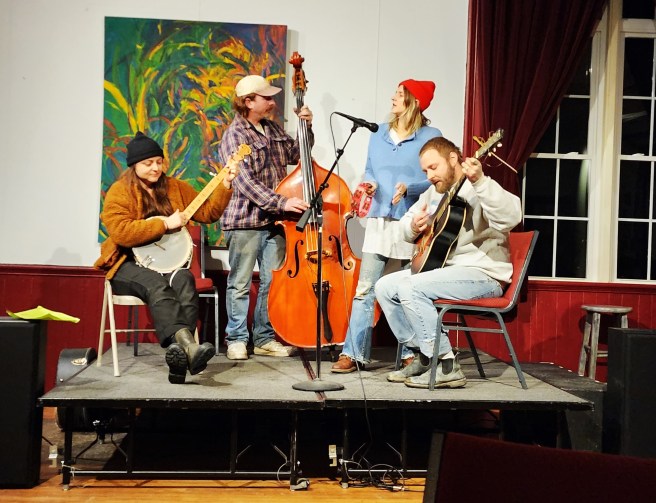
Here’s one band that showed up, and I’m hoping they’re back. They do look quintessentially Maine, and you can imagine their joyful sound.

The free event’s billed as “open mic” but I’ve long hated that spelling of “mike,” even if it’s become too widespread to counter.

Still, we had a fine turnout and went an hour longer than planned. I’d be really surprised if you wouldn’t be wowed by at least something. There’s so much talent around here.

With or without a camel caravan

TRAVELING WITH A LINGUIST, somewhere in Eastern Europe … perhaps the Balkans … or perhaps even parts of Asia, such as Kurdistan. At any rate, he was explaining the addition of syllables to a place name to indicate our destination as we headed toward the train station or a marketplace or the like. We were in crowded towns, of dark brown shades, all the same.

As the scene unfolded, we agreed to part, planning to reunite, which left me to wander on my own for a while. Of course, I became confused but not panicked. At one point, I actually saw him and another – maybe even an old girlfriend of mine – walking a street below me, though I was unable to catch up.

Somehow, I became part of a wedding party reception. An old girlfriend, in fact, maybe even the same one I’d glimpsed earlier, though we were now quite distant memories of one another. Still, when our paths crossed in the crowd, we acknowledged each other’s presence, yet I’m not sure either of us wished the other well. Still, I was dragged off to festivities at a long bar with seats all around, like the Tiki bar at Lobster on the Rough, only larger. It was late afternoon or early evening – dark, that is, with twinkle lights – a Renoir kind of scene. I was told to order dinner, but getting a menu was another matter. All of the menu-like brochures said nothing of the food, as far as well could tell, much less the prices. As I hesitated, I told the waiter to go on, I’d catch up to him. Finally, it came down between a steak at $60 and lobster, also $60. I ordered the lobster. I went over to the waiter, whispered my decision to him, and was told, “Wait,” and soon a lobster on a platter was handed to me, right there. I was also told, by my neighbors at the bar, to go ahead and begin eating while the food was still hot, so I was one of the first to do so. It was a large lobster, over two pounds, served with a kind of chili on the claws. (We’d had a bean soup earlier that evening, reminding me of chili.) The father of the bride was picking up the tab, probably $8,000 for the event. (My first lover’s daddy? Maybe because I’d come across his obit again earlier in the week.) Even so, I was aware that I was one of two or three “poor boys” admitted to this affair.

The next morning, perhaps, on a lawn overlooking a lake, I was told by another participant how much he enjoyed my presence, that I was one of the few people who could carry on a conversation, who had something to say, who had really done things. So that’s why I’d been admitted.


TRYING TO CONSOLE a deeply depressed Prince Charles. (Well, in some ways he was more like Mick Jagger. But when a dream imposes an identity, we stick to it. Besides, we were both much younger than we are now.) Considering the circumstances, we were getting along quite well. He even asked for a long hug before running off to jump on the mattress, like a trampoline, and then a set of sofas as the scene morphed into a hotel lobby as others, including the girl, drifted into the setting.

It started off when a woman I was involved with (a contra dancer?) who worked in his household or some other organization of his wondered if I would ask him, when he arrived, what he thought of her. Well, he and I hadn’t been introduced, so I was reluctant but now see that as an American, for me that wasn’t the problem.

Since he was essentially alone, I was able to strike up a conversation, however awkwardly it began. He did indeed recognize her name (Kate, never mind, not his daughter-in-law but more like Kate Moss) and rattled off a list of statistics and the like – nothing of an emotional nature, but still thoroughly informed.

A while later, I asked if he was a reader, and he assured me he was. I was beginning to tell him of Nicholson Baker’s work when we were interrupted.