I looked out from the kitchen sink window and saw this:
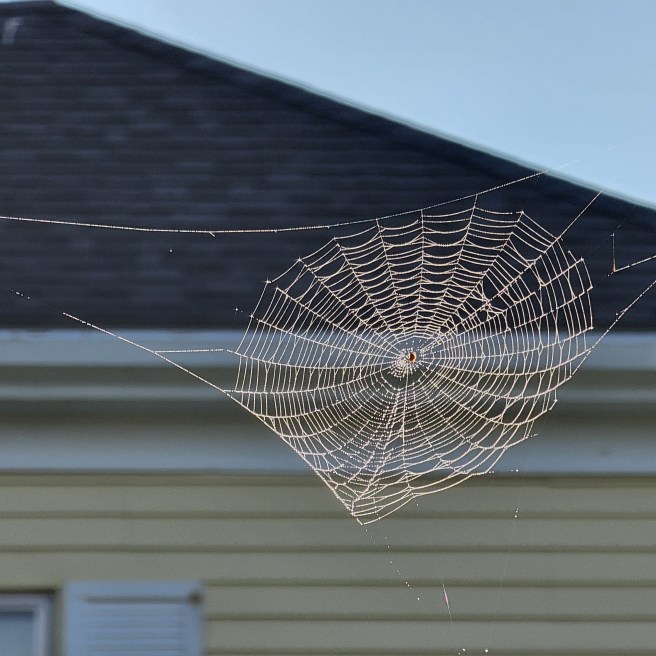
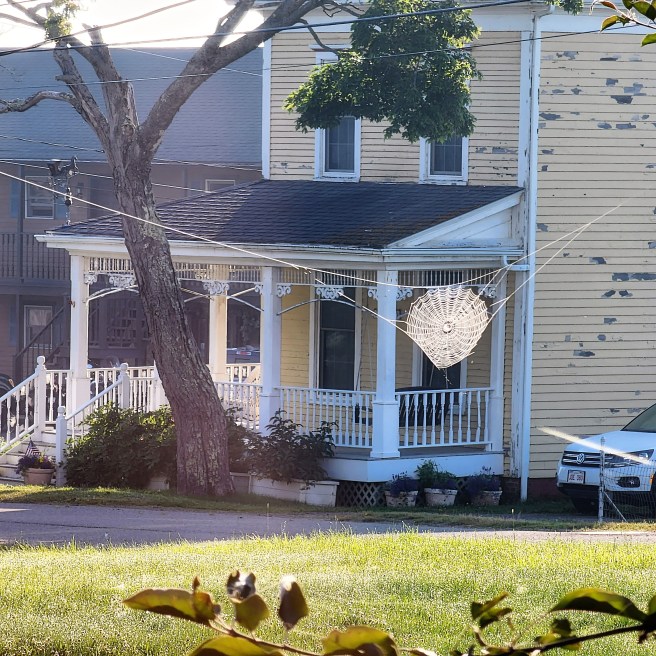
With the Suncatcher House in the background.
You never know what we'll churn up in cleaning a stall
I looked out from the kitchen sink window and saw this:
With the Suncatcher House in the background.
FLYING UNDER BLANKETS (sheets? or Navajo blankets?) with Photographer over mountains (starting out from Selah or Naches?) we wind up, after rocky and snowy stretches, Goat Rocks, say, over Vermont, other end of the country – a children’s camp, actually, high up a dirt road from a dream a few nights earlier …
Freeform with or wearing a harness, hands free, touch of Yakima, touch of New England.
I’M GOING TO BE BURIED TOMORROW so go out with my friends or family on a sunny spring day, actually, that’s where it starts, on the country highway, looking up the intense green grass toward a plateau or leveling, with tombstones white in the sun … we climb and there see three new holes dug in the earth. One would be mine the next day.
Am I being buried alive?
DRIVING ALONG FLAT FARMLAND, like that of northwest Ohio. Great blue sky. Humming along, with a ditch full of water to my right; may be a small river. A small town looms on the horizon, with an elevated green bridge in front of it. First, it’s an interstate highway, and then a railroad. My companion and I discuss the possibilities ahead.
Pass under it and there’s a forced right turn. Everything turns dark and interior. (Hmm. Shades of the water-cage highway weeks earlier.) I overhear a young woman telling of a dream in which she, too, had a prominent bridge. I approach her, ask if her bridge was perpendicular to the highway, as mine was. No, it was beside it. Still, we’ve bridged a conversation. She’s wearing a black cocktail dress. Smiles slyly, seductively. We begin kissing. It’s only a momentary thing, one of us says.
So here’s a dream with conversations about dreams! Again, a sense of places I’ve lived, back when.
I didn’t make these points this baldly in my book Quaking Dover, but as I’ve prepared for my upcoming presentation from West Falmouth Friends’ Peace and Social Order committee’s Zoom presentation, I’m seeing these elements at play.
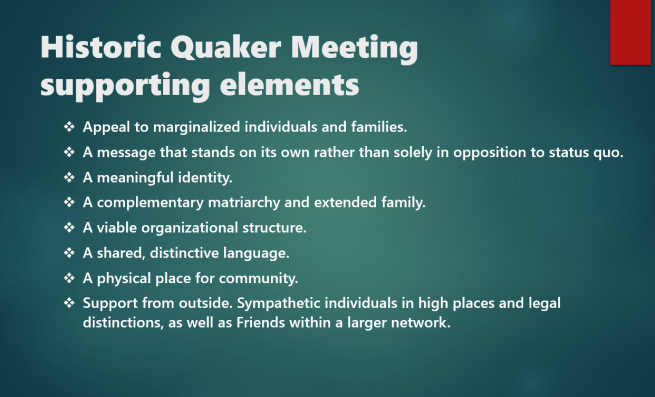 I do hope you can join us online for this free presentation on Sunday, July 9, at 12:30 pm. Please not that preregistration is required at https://bit.ly/QuakingDover.
You don’t have to be a Quaker to participate, either. (Insert smiley face emoji if you must.)
Just how do peaceable communities emerge and survive?
We’re feeling sorry for vacationers to our end of Maine the past two weeks. Especially those with children in tow.
It’s been cold – our furnace is still on – and very foggy and damp, accompanied by showers and thunderstorms.
It’s not what you’d want to run into on your well-earned summer getaway.
At least we’re getting a break, however brief.
Today’s forecast is for mostly cloudy, followed by two partly cloudy days. And then another solid streak of rainy days resumes.
Glimpses of real sunlight and blue sky will lift spirits, no doubt. I might even stop reminding folks of six straight months or so of this for people living in Seattle. (You know, it could be worse. We might even have to start watching movies in German.)
One thing you can also anticipate is the sound of lawnmowers the moment the grass dries sufficiently. Otherwise, a failure to mow in time can lead to an impossible task, as I remember when I had to learn to scythe back in Dover … and my vow to myself never to do that again.
For us, it also means doing laundry. We have a washer here but not a dryer. So we’re anticipating hanging wet clothes and linens out on the line to dry. There is a backlog to address.
Another must-do is a big round of grilling. Maybe even dining al fresco, if the temperature cooperates.
Well, as we’ve been saying all along, this too will pass.
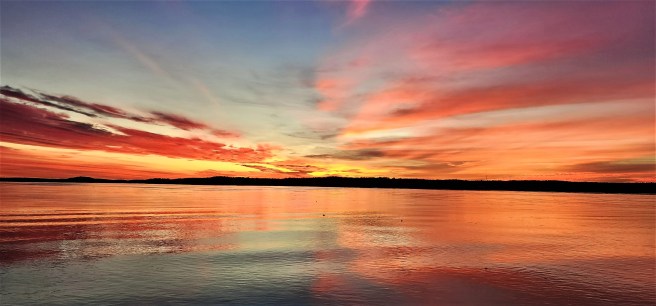
Good morning! This is another example of our dawns around here, just not during our current two weeks of heavy fog, rain, and occasional thunderstorms. It is a welcome reminder, though.
An annual cod relay race – using raw salmon instead – is one of the more hilarious traditions at Eastport’s extended Fourth of July festivities.
Running down the street with a fish is only part of the excitement.
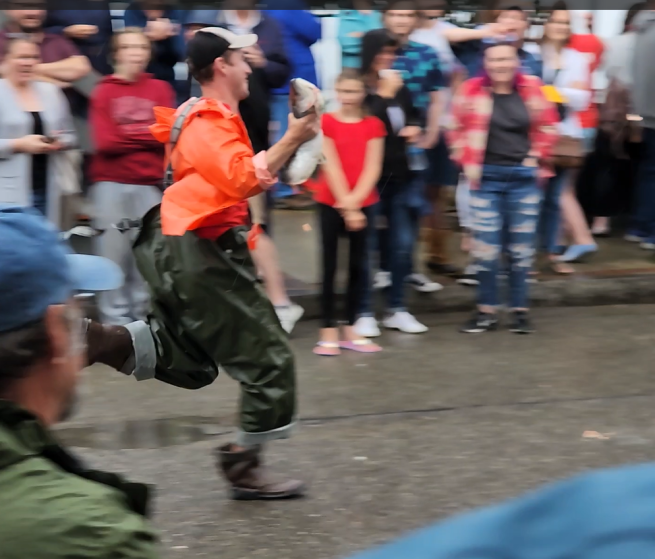
Relaying the gear – boots and the slicker, along with the fish – to the next runner is the heart of the contest. Here, two of the younger runners have it almost down to a science.
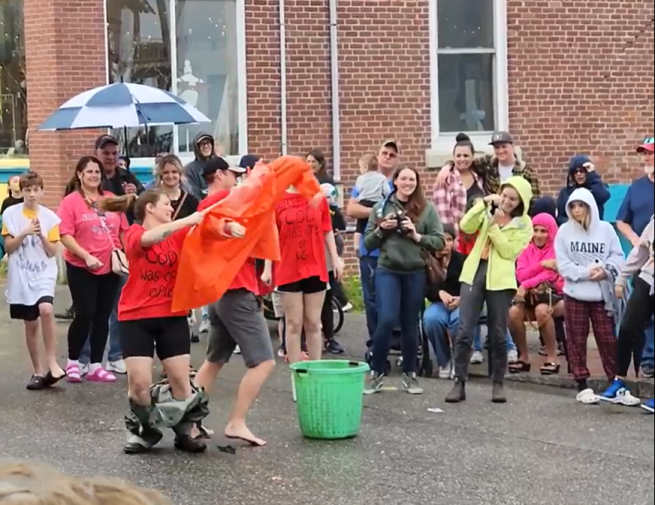
All-ages teams are paired off during the day until there’s a first-place winner.
Unabashedly, I am a snob when it comes to putting big fireworks together in an aesthetic whole, rather than something that resembles an action movie big car smashup.
A smart design team can use the entire sky as a canvas of evolving colors, combined with the timing of a sharp comedian.
That said, here’s some perspective.
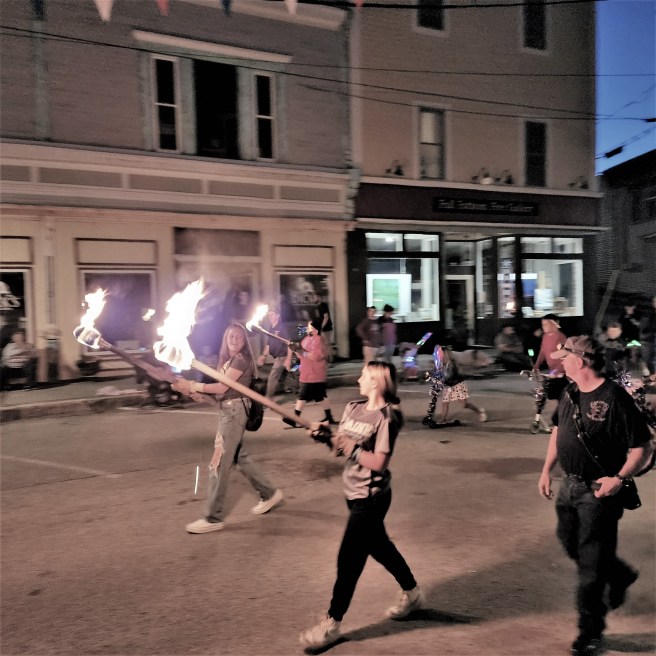
Kids and families, mostly. It’s a traditional part of our big multiday Fourth celebration.
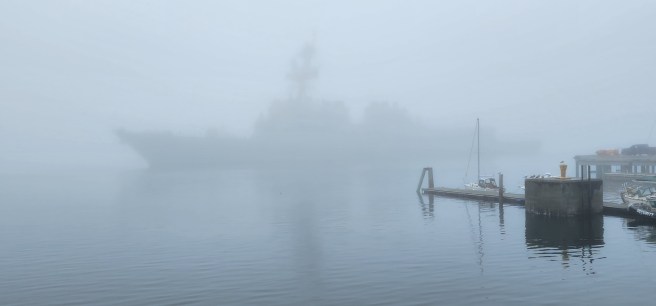
For the first time since the outbreak of Covid, Eastport is being graced by the presence of a U.S. naval vessel at the Breakwater for the city’s big Fourth of July festivities.
The USS Oscar Austin arrived in heavy fog Friday morning and will depart for Norfolk on the 5th.
The community rolls out a big small-town welcome mat for the crewmen, especially when the landing gives them their first taste of American soil in many months. (Not so, this time; they instead sailed up the coast.) The arrival is rather quaint, actually, even if their focus sometimes seems to be on the local bars. There is a basketball game between the sailors and the high school alum, too, though I doubt the stakes are high.
Eastport does claim to have the biggest Independence Day bash in the state, and the Navy’s destroyer is just part of it. .
Many of the sailors are being joined by their families, who will then continue with them on the final leg of this voyage.
Bringing such a vessel to dock is no small venture. The skipper of such a ship doesn’t just spin the compass to see where he’s going next. Rather, the itinerary is planned months in advance, with many protocols to be observed. In our case, that includes both U.S. and Canadian officials. The pilot’s plan document reads like a small phone book, minute by minute, and it’s not just about tides and currents at the expected time of arrival.
Heavy fog was a complicating factor, and we could hear the ship’s bold horn booming long before we could see the massive vessel emerge nearly alongside the Breakwater.


Holy Land Mart
rolls of steel ingots
Potluck House
 Jnana's Red Barn