I have to wonder whether my book Quaking Dover is my way of saying farewell to my Friends and congregation in Dover – or of staying in touch, now that I’ve moved further east.
Only time, of course, will tell.
You never know what we'll churn up in cleaning a stall
I have to wonder whether my book Quaking Dover is my way of saying farewell to my Friends and congregation in Dover – or of staying in touch, now that I’ve moved further east.
Only time, of course, will tell.
That is, PFAs, as we’re known among the locals.
I haven’t encountered the negative reaction some report, but feel myself among those warmly welcomed.
Part of it is, I believe, an openness to approach what’s here without wanting to totally “improve” it. I mean, if you can’t stand the smell of cow manure, you shouldn’t move into farm country. Or, for much of Maine, the stench of a paper mill.
That doesn’t mean we don’t have a lot to contribute, but we need to be respectful in acknowledging what’s attracted us as well as the dirty work that needs to be done. You know, the equivalent of washing dishes.
Or loving someone warts and all.
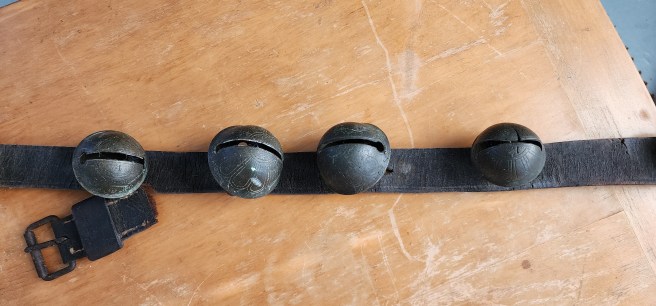
These belonged to the wonder horse Prince, who appears in my genealogical blog Orphan George. As a figure in our family, he was owned by my grandfather, who picked him up from two older brothers in succession. And now they’re going on to my daughters. Bet they cost a pretty penny, back in the day.
That’s what I keep telling myself. And others.
I really don’t know if I have the energy or endurance to tackle another big draft and round of revisions.
On the other hand, I do have a lode of material already in hand, waiting to be better organized and presented.
Lead me not into temptation, right?
Touring a Roman Catholic church that’s known for its graves, the ones inside around the sanctuary and in chambers off to the side and, presumably, in the basement. The ceiling is relatively low and the dominant color a light yellow. Feels something like a Mount Auburn Cemetery and may have been surrounded by the like.
Noticing a man who’s obviously perplexed (he may have even been in clerical garb, I now sense), I approach and offer my help. He has a map that may simply have some directions, but he’s looking for such-and-such Avenue. Together we circle the inside of the building and come upon a stone wall that’s been painted black and both agree that’s where we should have found his destination. We’re both baffled.
We then join a small group in a chapel or, considering the slanted floor, lecture hall auditorium where a nun’s doing an end-of-tour kind of Q&A session. She keeps overlooking any questions hands up from either me or the man; I’m three rows back and in the center, he’s at the back about four rows behind me. Finally, I shout out my question about the black wall. “It’s the Williams family,” she answers, as if everyone should know they owned the property long before the church was erected.
We scatter to make way for some kind of ecumenical program in the sanctuary that evening.
Our Greek Orthodox priest is already there, sitting on the floor, his back to the wall, with his family.
how asocial
how essential

Incredibly tender and tasty, served here with rice, a carrot salad, and fresh parsley. In case you’re looking for a dependable holiday hit.
To counter the effects of a boring conversation from the get-go, be the more interesting person by asking questions like:
By taking the initiative and making the conversation about the other person, this selfless act of shining the spotlight on someone else first gives you the edge – making you the more interesting person in the room.
Gee, I am wondering where I copped this.
I was tempted to make that “stoned age,” but I was of a more tempered side of the hippie era.
When it comes to high tech, though, I’ve leaned more toward neo-Luddite. You know, face-to-face and keeping people employed. That’s why I go inside to a teller at the bank, rather than an ATM or drive-thru. Ditto for fast food.
One way my family has of nudging me in the other direction is in their Christmas and birthday gifts to me.
Well, my clumsiness therein is another matter.
Here are some examples.
Is the Queen going to move with the King or in some opposition to him?
Shuffle and deal again.
 Jnana's Red Barn