Something I’m deeply appreciating in my new community is how much depends on people who step up in public service. One person can truly make a difference. What’s amazing us is that some individuals seem to be everywhere we turn.
Some are born and bred here. Others are high-spirited “people from away” who transform the town in unique ways while respecting is core character.
One of the newer arrivals is Joan Lowden, better known as the Bass Lady jazz host on our community radio station. She loves to give shout-outs to others, so here’s one for her.
The former Silicon Valley ventures whiz is much more than a voice. She’s an organizer, fundraiser, website consultant, active volunteer, and cheerful doer who makes things happen, often behind the scenes.
This weekend’s ArtWalk offers some fine examples.
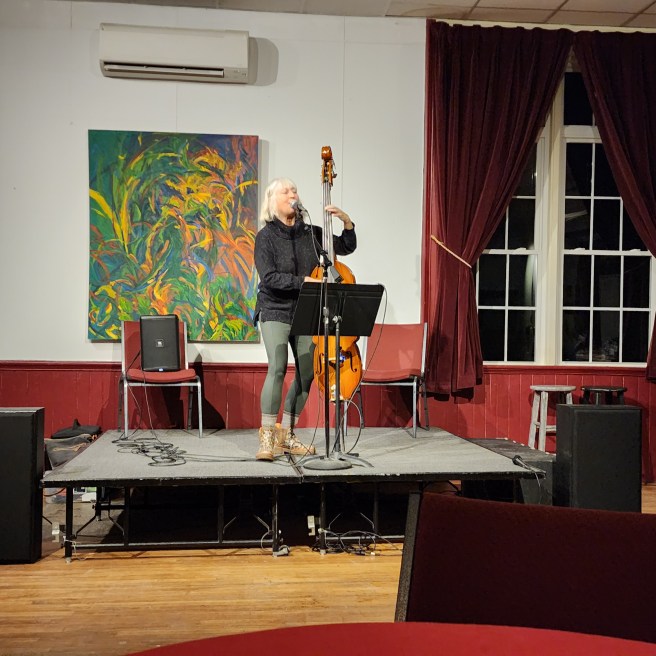
Here Joan is at our monthly open mic event, both singing and playing bass. She’s also a key player in MICE, the Moose Island contradance band, and a welcome member of varied combos. She even starred at our Mardi Gras night at the senior center while definitely lowering the median age.
Visitors on the street sometimes ask me about good places to hike around here, and looking at them, I don’t always want to recommend anything too strenuous. On my part, I do miss the old carriage road up Garrison Hill back in Dover, New Hampshire, but you can’t beat some of these.
Quoddy Head State Park in Lubec. The parking lot is close to an iconic lighthouse, spectacular bluffs, and an Arctic peat bog. Not a bad combo as an introduction.
Shackford State Park in Eastport. It almost became an oil refinery. The central trail leads to an incredible panorama of Cobscook Bay and a high probability of seeing bald eagles.
Matthews Island. Also in Eastport, this Maine Coastal Heritage Trust site can be reached only at low tide. Getting there will give definitely give you a sense of mudflats. MCHT also has nearby Treat Island, which we intend to explore by renting a water taxi to get us there and back.
MCHT includes other personal favorites, starting with Boot Cove in Lubec. If you like Acadia National Park, you’ll love these lesser known opportunities. Nose around in this Red Barn blog, you’ll find photographic evidence why.
The Bold Coast public lands in Cutler. This is for the serious hiker, one willing to walk 1½ miles to get to the rugged ocean. From there, though, there’s a six-mile breathtaking clifftop trail along the restless ocean, and even primitive camping on a limited first-come, first-served basis at the end. The trailhead parking lot can be overflowing in prime season.
Cobscook Shores. Thanks to a newer family trust, 15 small waterfront sites provide public opportunities for investigation. Most have outhouse or indoor plumbing facilities as well as picnicking, sometimes in screened-in pavilions around a single table. My favorite to date is Morang Cove.
Moosehorn National Wildlife Refuge. So far, I’ve sampled trails at its Baring and Calais district but there is more in Edmunds township. Former roads, now used only for ranger access, make for broad, easy pathways through a variety of ecosystems. My big caveat for inland trails is to be prepared for black flies from late April into July. They can definitely spoil and outing.
Downeast Sunrise Trail, atop an abandoned rail line. I see it primarily as ATV and snowmobiling in season, but it does offer insights in inland ecologies. Again, note the black fly warning.
Mowry Beach in Lubec and Roque Bluffs State Park south of Machias. Sandy beaches in Downeast Maine are rare. Here are two wonderful exceptions for those who want to indulge in a long barefoot walk.
Back in Eastport, the Hillside Cemetery is worth nosing about. It’s newer than many classic New England burial grounds, but the engraved stones add up to some fascinating stories.
With the Canadian border now reopened, I’m looking forward to some treks on Campobello Island, both at the Roosevelt international park and a few other sites.
As I’ve discussed in previous posts, book cover design is a challenging art form. It needs to convey a sense of what the volume is about, of course. Or, as one observer has said, it needs to make a promise to the reader. Or, as shaded by others, offer a mystery. But it also has to “read” accurately for a curious buyer, rather than leaving them scratching their head in bafflement.
Quite simply, it can’t be too subtle and must clearly state the title and author.
A memorable cover is a joy to have in your hands or even the screen in front of you, but I find that few meet up to that measure. I like clean, with a striking visual image and tasteful typography. I find most are cluttered and often fussy, trying to work some cliché genre clue into the background.
Frankly, I’m proud of many of the covers I’ve designed for my own books.
One of the problematic ones, though, has been for my novel What’s Left. The story spans nearly 20 years in Cassia’s life, from the time her father vanishes in a Himalayan avalanche into her thirties. She’s Greek-American in a Midwestern college town. And it’s about emotional recovery and growth. Beyond that, extended family is a major ongoing theme. How do you encapsulate all that in a two-dimensional object?
In the first cover, I went for a striking egg yolk being poured from a broken shell. I was reaching for the idea of being broken open to newness but despite its strong graphic impact wound up failing to convey the book’s contents. (Egg? Her family did run a restaurant. Too much of a reach, though.)
Turning instead for the sense of grief, I found hands covering tearful faces, but none of those wound up hitting the age right. Her real work comes about in her teen years, not the preteen who was openly tearful in the available images.
There’s the argument of whether to show a face at all. I generally side with the view that a face limits the reader’s imagination. Apart from an earlier cover of What’s Left, the only face on my novels is the blissful yogi on Nearly Canaan, and there the emphasis is on the aerial pose she’s manifesting. The face has to match any description in the text, of course. No curly blondes for a long-haired raven, for example.
Within a daughter’s own living Greek drama
Recently, while passing through one collection for another project, I chanced upon a portrait I feel captures much of what I’ve been seeking for What’s Left, so much so I’ve decided to run with it for the ebook at Smashwords.com and its affiliates like the Apple Store, Barnes & Noble’s Nook, Scribd, and Sony’s Kobo.
For technical reasons, I’m leaving the more troubled goth-girl image on the print and ebook editions at Amazon. It will be interesting to compare reactions to the two versions.
Having a very low budget, naturally, means that I’m not commissioning artwork but instead selecting from affordable stock collections. While that can mean going through thousands of images, finding the right one remains a challenge. Although I generally lean toward photographs, I still love the paintings I found for The Secret Side of Jaya, Daffodil Uprising, Subway Visions, and Yoga Bootcamp.
We marked Western Easter last Sunday with a crab, spinach, mushroom, baked egg, and hollandaise dish, followed by strawberry mousse.
And today, for Orthodox Easter, we’re having grilled lamb, after a face-to-face Quaker Meeting. (We’re alternating weeks of worship online at home and in-person at the meetinghouse in Whiting.)
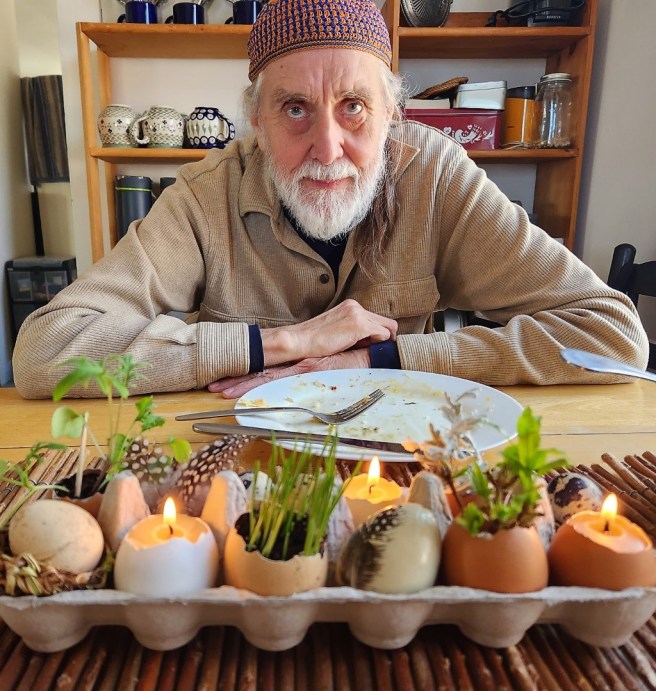
My wife created the centerpiece from blown shells from our daughter’s chickens, plus a few quail eggs. The tiny homemade candles are a special touch.
Do I look contented? Spring’s definitely in the air.
Popped into the Chamber of Commerce the other afternoon, thanks to the Public Restroom Inside board set up out on the street, and immediately found myself awash in pirates.
They were assembled for some kind of banquet, which I later learned was one of the fundraising murder mystery dinners in advance of our pirate festival.
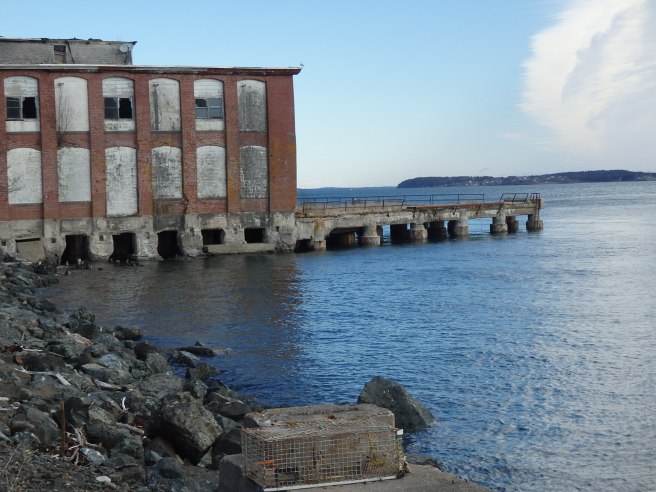
The first sardine canning in America happened in Eastport in 1876, and at its peak, 18 canneries were packed in against the waterfront downtown, along with the fishermen’s dories and fishing boats at the docks.
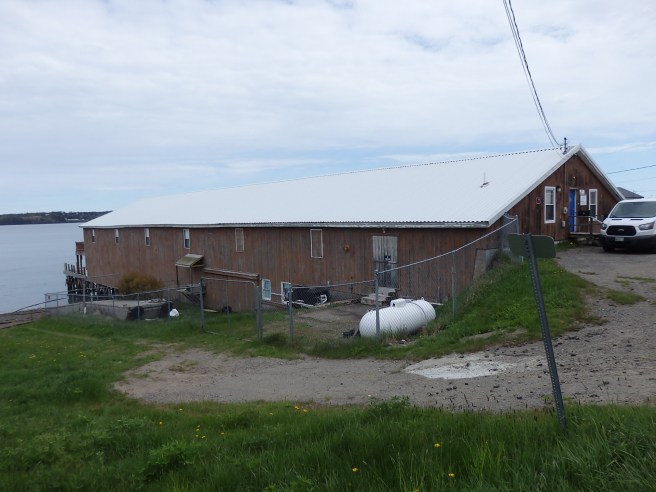
One of the few surviving cannery buildings. This one was small in comparison to others right downtown.
The largest of them, the L.D. Clark and Son factory, extended far into the water from the north end of Shackford Cove only a block where I now live. It was the world’s largest sardine cannery, employing 500 men and women who packed 4,000 cases of 100 cans daily when the small Atlantic herring were available.
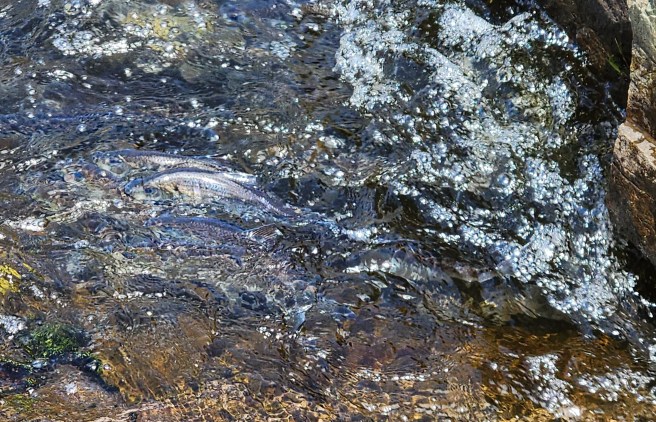
Heads and other parts were cut from the fish and dumped into the harbor, where they were devoured by bottom-feeders that then attracted whales close to shore.
Over the years, though, the fishery was depleted, though whales can still be seen in season.
And then the market and American tastes changed.
Does anyone eat sardines anymore?
Few signs remain of the city’s once flourishing industry.
The 1908 Seacoast Canning Co. plant, which made sardine cans.