Ten notable American religious communes

While monasteries with wider church support are a longstanding institution in Christian history, independent, self-sustaining faith-based communes have made their mark in America. Unlike a monastery, not all of them were celibate.

Here are ten.

  1. Ephrata Cloister. Pennsylvania, 1732-2008. Founded by Johann Conrad Beissel, the pietist group broke off from the German Baptist Brethren (or Dunker) denomination, which largely continues as today’s Church of the Brethren. It had the second printing press in the American colonies. Its celibate emphasis was gradually eliminated.
  2. Moravians. Bethlehem, Pennsylvania (1741), and Salem, North Carolina (1753). The denomination dates to Jan Hus (1369-1415), a Czech reformer years before Luther and Calvin led the Protestant Reformation. The American communities initially had common ownership of all property by the church, supervised housing for single men and single women, and likely other communal aspects.
  3. The Shakers. Founded by Mother Ann Lee, it settled in Watervliet, New York, 1774, and spread from Maine to Indiana and Kentucky. Best known of the communal movements, in part for its beautiful furniture and architecture. One village remains.
  4. Hebus Valley. Pennsylvania. Founded by George Rapp, 1824-1906. Christian theosophists and pietists.
  5. Hopedale Community. Massachusetts, Adin Ballou, 1842-1856. “Practical Christianity” with a Universalist base. Utopian ideals included temperance, abolitionism, women’s rights, and spiritualism. Attempted to be part of the surrounding community.
  6. Amana Colonies. Originated in Germany in 1714 and arrived in Iowa, 1855. Communal system ended in 1932.
  7. Bruderhof. An Anabaptist denomination arising from the Hutterites in Germany in 1920, it has communities in Paraguay, Europe, Australia, and the United States (from 1954). Its beliefs are similar to Mennonites – peace, simplicity, adult baptism, and so on. There are currently 17 communities in the U.S.
  8. Hare Krishnas. The best known of the ISKON (Krishna Consciousness) communities is New Vrindaban, West Virginia, settled in 1968.
  9. Friends Southwest House. McNeal, Arizona, opened in 1976. I didn’t even know of this Quaker community, much less of its long life.
  10. Eighteenth Avenue Peace House. Portland, Oregon, opened in 1986. Ecumenical Christian.

Any you’d add to the list?


Top Ten, Religion, Spirituality, History, Inspiration,
 

Ten notable American communes

Talk of pooling income and possessions thrived in the hippie era, though it rarely took form in practice – and, when it did, the results were often disastrous.

More common was the kind of shared rent arrangement like the farm I describe in my novel Pit-a-Pat High Jinks.

Here are ten from American history. Utopian socialism was a common theme.

  1. New Harmony, Indiana. Robert Owen, 1825-1829.
  2. Oberlin Colony. Ohio, 1833-1843.
  3. Fourier Society. Based on the ideas of French philosopher Charles Fourier, communes existed in New Jersey, 1841-1858; New York state, 1844-1846; Wisconsin, 1844-1850; Ohio, 1844-1845.
  4. The Transcendentalists. Brook Farm, George and Sophia Ripley, 1841-1846, and Fruitlands, Amos Alcott, 1843-1844, both in Massachusetts.
  5. Oneida Colony. John H. Noyes, New York state, 1848-1880. The first of a series of communes with radical ideas about free love and open marriage. (I love the name of one of those in Ohio, 1854-1858: Free Lovers at Davis House.)
  6. Icarians. Followers of French philosopher Etienne Cabet established communes in Louisiana, Texas, Illinois, Iowa, Missouri, and California, 1848-1898.
  7. Home, Washington. 1895-1919, based on an anarchist philosophy.
  8. Twin Oaks. Virginia, 1967 to the present.
  9. The Farm. Stephen Gaskin, Lewis County, Tennessee, 1971 to the present.
  10. East Wind Community. Ozark County, Missouri, 1973 to the present.

Any you’d add to the list?

Ten reasons I love my electric lawnmower

  1. Starts easily. Just push a button rather than trying to yank that cord.
  2. There’s no cord to break. (Ever had that happen?)
  3. I don’t have to buy gasoline.
  4. It’s far less polluting. Lawnmower emissions are notorious.
  5. It’s quiet. I won’t wake the neighbors.
  6. Lightweight and easy to maneuver.
  7. And it folds up easily, for storage or transportation.
  8. If it needs to go in the car, there’s no gasoline to spill.
  9. Never needs sharpening. The blades are designed with rounded edges. For that matter, there’s no annual tune-up.
  10. The rechargeable battery also fits my weed whacker and other yard gadgets I’ll likely be adding. I’ve heard some good things about the chainsaw.


Anyone else running on rechargeable batteries?

Ten conversational Greek words or phrases

Since these are transcribed from the Hellenic alphabet, their spellings in Latin script can vary.

Here are ten.

  1. Yasou. Hello.
  2. Kalos orises. Welcome.
  3. Ti kanete. How are you?
  4. Ine kalo. That’s good.
  5. Ne. Yes.
  6. Ohi. No.
  7. Signomi. Excuse me.
  8. Efharisto. Thank you.
  9. Parakalo. Please. Also, you’re welcome.
  10. Goodbye. Andio sas.

I’ll leave the swear words to Cassia in my novel What’s Left. Especially the ones she learned at church camp.

Ten facts about the Jenny Thompson outdoor pool

Since my indoor pool pass is good year-’round, I don’t spring for an extra pass to use the city’s outdoor pool each summer. Instead, I get to go there for free during the final two weeks of the season, when the indoor pool is closed for annual maintenance and upgrades.

The outdoor pool, though, can be a glorious experience. Here are ten points to consider.

  1. Though a Massachusetts native, Jenny Thompson calls Dover her hometown. She’s among the most decorated athletes in Olympic history, having won eight gold medals among her 12 despite numerous setbacks. On top of that, she became an anesthesiologist is Boston and now works as a pediatric anesthesiologist up the road in Portland, Maine.
  2. It’s the only 50-meter swimming pool for miles around. The closest neighbor is the Raco Theodore pool in Manchester, New Hampshire, an hour to our west. The only one to our east is at Colby College in Waterville, Maine, three hours up the Interstate. And to our south, it’s the Beverly, Massachusetts, YMCA on Boston’s North Shore or, further south, at the Massachusetts Institute of Technology in Cambridge or at Hanscom in Lincoln. In other words, ain’t many of ’em around.
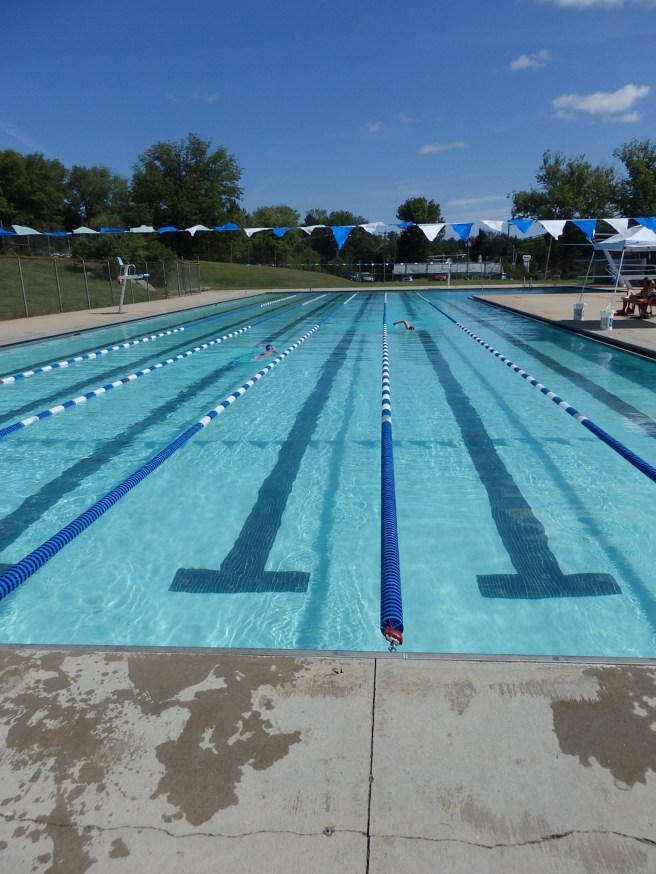
  3. It feels endless. A half-mile is eight laps, meaning round-trips up and back. I love hearing the rippling banners overhead in the distance, meaning I’m getting close to turning back in the other direction.
  4. It has a 10-foot-high diving board. Kids love it. Insurance companies hate anything so risky.
  5. It’s heated, except on the hottest days. Evaporation cools the water. Somehow, though, it seems to warm enough once I’m in it but still refreshingly brisk. Talk about a fine balance.
  6. Overhead, contrails of jetliners heading into Boston’s Logan airport often come a minute apart. That’s in addition to some gorgeous clouds I love to watch on my backstroke, along with the occasional bald eagles in the distance.
  7. As I just said, keep an eye open for bald eagles soaring in the distance.
  8. The Seacoast Swimming Association, which drew Thompson and her mother to Dover in the first place, is its biggest supporter – as they also do for the city’s smaller indoor pool through the rest of the year.
  9. Big swim meets take place here. Why not? From a distance, it always looks like a mob scene.
  10. The pool is 41 years old and has maintenance issues. Which leads to the next matter. Efforts are under way to replace it with a 10- to 22-lane indoor 50-meter pool. Dr. Thompson is solidly behind the effort and promises to come down often to test its waters.
It’s longer than it looks. See the swimmers?


Ten facts about the Romani

The more she learns about her great-grandmother in my novel What’s Left, the more reason Cassia has to be curious about her roots.

  1. Romani or Roma: The preferred terms for “Gypsies.” They are ethnically and genealogically different from other Europeans. They originated in northern India and migrated about 1,500 years ago as a group.
  2. Roma subgroups differ in language and variations of customs: These hold social distance from each other.
  3. They are a dispersed population: They have significant concentrations in Egypt, Turkey, Romania, southern France, Spain, and Hungary.
  4. Population in U.S.: Estimated at one million. Largely centered in southern California, the Pacific Northwest, Texas, and the Northeast./
  5. Population in Greece: Between 200,000 and 300,000.
  6. Population in Brazil: 800,000.
  7. Roma slaves: They were shipped with Columbus in 1492. Spain sent Romani slaves to Louisiana, 1762-1800.
  8. Romania: Abolished Roma slavery in 1864.
  9. Marriage: Couples generally wed within their tribe. The parents of the boy customarily select his bride, and a bride price would be paid to compensate her father for his loss.
  10. Community: When a Roma male marries a non-Roma, she may in time be accepted by the community, if she accepts their way of life. For a Roma female to marry a gaje, however, is a serious violation of marime or marimhe code originating in Hindu purity laws.

Ten points about Brooklyn

Brooklyn has long been overshadowed by its more commanding neighbor, but it is undergoing a renaissance among trendsetters.

Here are ten random bits about the borough also known as Kings County.

  1. If New York City were dissolved and the borough became an independent city, it would be the nation’s third largest, after Chicago and Los Angeles. It was merged into New York City in 1898.
  2. Forty-five percent of the population speaks a mother language other than English.
  3. The Brooklyn Museum houses the city’s second-largest public art collection. It is especially renowned for its Asian collection. At least on the days when those galleries are open. There are serious budgetary problems.
  4. The Brooklyn Children’s Museum, founded in 1899, is the oldest such institution in the nation.
  5. Coney Island on the Atlantic has undergone a rebirth an amusement park. It’s also famed for Nathan’s hot dogs.
  6. Prospect Park, 585 acres, was designed by Frederick Law Olmstead and Calvert Vaux. It includes a zoo and a 60-acre lake.
  7. The Pratt Institute, one of the leading fine arts schools, is situated in Clinton Hill.
  8. Subway stations: 157.
  9. Public schools: 540.
  10. Crime: The acting district attorney declared 2017 the safest year in the borough’s history in terms of homicides, shootings, and shooting victims; 101 homicides occurred in the year. (If Dallas, Texas, were the same size, the figure would have been 332.)


Ten points about New York City

It’s not all Manhattan, you should know. Most of the population sleeps in the other four boroughs. And then for even more bodies we have Long Island to the east, Jersey to the west, and Westchester-Rockland to the north.

By the way, Brooklyn – not Manhattan – is the most populous borough.

Now, for ten more bits.

  1. Ethnic diversity: It’s 44 percent white, 25 percent black, and 12 percent Asian descent. Hispanics claim about 27 percent. The city has the largest number of Italian-Americans in the nation (nearly 700,000), the largest Jewish population outside Israel (1.5 million), and the largest Chinese population of any city outside Asia (573,000). About 800 languages are spoken in the city.
  2. Open spaces: About one-fifth of the Bronx is given over to parkland, including the New York Botanical Garden. Staten Island has thousands of acres of parkland and about 2,000 wild whitetail deer.
  3. Largest borough in size: At 108 square miles, the Queens wraps around more populous Brooklyn. Its population of 2.3 million is the second-largest in the city – nearly half of them foreign-born.
  4. Smallest borough in size: Manhattan. Its 22 square miles are dwarfed by Staten Island’s 58 square miles.
  5. Restaurants: The city has an estimated 24,000 eateries – including delis, pizzerias, and take-outs. As for sit-down-and-be-served, the number’s closer to 8,000. One enterprising guess says that at one a day, you’d need 22½ years to hit them all. By the way, a fourth of them are in Manhattan. As for home cooking? We’ll have to ask a greengrocer.
  6. Runways: You think people fly straight in Manhattan? Think again. Most domestic flights work out of Newark Liberty International in New Jersey, serving nearly 44 million passengers a year. JFK, on the Atlantic shore of Queens, gets the bulk of the international flights, nearly 30 million passengers a year. LaGuardia, in a tight corner of Queens, is the most convenient option and serves nearly 30 million passengers annually. MacArthur in Ronkonkoma, Long Island, serves about two million passengers a year plus commercial traffic.
  7. Housed animals: The Bronx Zoo and Staten Island Zoo, plus Tisch Children’s Zoo in Manhattan’s Central Park, house a world of animals. Brooklyn is also home to the New York Aquarium. Brooklyn Wildlife Center and Queens Wildlife Center also offer displays. That’s in addition to rats, pigeons, and endless humanoid varieties.
  8. Stage life: The celebrated Great White Way on Broadway has 41 theaters as the heart of live American theater. Manhattan’s off-Broadway and off-off-Broadway stages offer more offbeat fare. Not all actors and actresses are working as restaurant wait staff.
  9. Professional sports: Both football teams play in New Jersey’s swampy Meadowlands. The Yankees still play baseball in the Bronx, while the Mets remain in the Queens. The Knicks basketball team and the Rangers hockey team both perform in Manhattan’s Madison Square Garden, but the Brooklyn Nets basketball squad and Islanders hockey team both call Barclays Center in Brooklyn their home. So it’s all over the place, not just Manhattan.
  10. Parking tickets: UPS, FedEx, and other delivery services receive up to 7,000 parking tickets a day, contributing up to $120 million in revenue annually to the city. The tab on unpaid tickets by United Nations diplomats, meanwhile, was put at $16 million, with Egypt as the worst offender, $2 million overdue.

~*~

Oh, yes. One out of every 21 New Yorkers is a millionaire. Or so I read. Did they mean just Manhattan? Or the whole shebang? Either way, it’s a lot.

Ten things we miss in Portsmouth

When I say “we” here, I’m acknowledging a widespread sense of loss voiced by friends and neighbors. Some of these places I know by reputation only, though I still see signs where they were. And others are places I valued.

When I first came to New Hampshire more than 30 years ago, Portsmouth still had a funky feel through much of its downtown. But real estate prices have been soaring, and that’s taken a toll. Ouch!

  1. The J.J. Newberry’s store. A real old-fashioned five-and-dime emporium with its classic soda fountain, knickknacks, and distinctive aroma downtown. Its closure meant many items could no longer be purchased within walking distance.
  2. Seavey’s Hardware. This was one of those family-owned hardware stores where you could find just about anything you’d need if you owned an old house. They could find old fixtures in original packaging and offer it to you for a fraction of what you’d have to pay, if you could locate it at all anywhere else. Alas, when a new generation failed to step up, the buildings were sold … for a constantly changing lineup of boutiques.
  3. Ciabatta bakery and café. Yes, real bakers rising way before dawn to create artisanal breads, pastries, and cakes. And great coffee long before Starbucks was anywhere near our corner of New England. Again, owning its own building helped. But the toll of long hours with few breaks finally led its owner to move on. Boo-hoo. I see it as an emblem of many other dearly departed eateries. Sakura, a small Japanese spot, and the inexpensive Stock Pot overlooking the harbor (great pies, by the way) are two I especially miss.
  4. A real downtown grocery. I don’t remember its name, but it was handy, especially if you were about to go out on the water or wanted an impromptu picnic in the park.
  5. The Pick’n Pay. Within walking distance of downtown, this family-run grocery built a loyal following for all of its special little touches and its personal sense of a social gathering spot. Everybody seemed to know everybody, so I’m told. Many still lament its sale in 1999 to the Hannaford chain after five decades of independence.
  6. Funky, cheap stores. The storefronts have almost all gone upscale now. How many pricy clothes do people need, anyway? How many souvenirs and gifts? How many real estate brokers?
  7. The old Prescott Park arts festival. Yes, the programs continue but they just don’t seem the same. Is it the lineups? Or just us?
  8. Community spirit. Something in the laissez-faire bohemian air I recall has turned bourgeois, even puritanical. The children’s museum had outgrown its original space but was rebuffed repeatedly before leaving town altogether for Dover a few years ago (Hallelujah!), but the pattern continues. We hear story after story of sourpusses and grumblers who are upset by the ice skating rink at Strawbery Banke (it’s pure Currier and Ives, for goodness sake) or the self-deputized posse searching brown paper bags at the Prescott Park concerts and calling police. It’s the old “we got ours, now get out” attitude that will soon make the town unwelcoming even to itself.
  9. A small-town scale. One historic neighborhood, just north of downtown, that didn’t escape urban renewal long sat as a bizarre quasi mall in the middle of a big parking lot. The houses it replaced had been, I’ve heard, elaborate Victorians whose craftsmen builders had filled with stone carvings, fantastical woodwork, and fanciful windows. What was left, admittedly, was an eyesore. Initially, nobody seemed to object when plans were announced to redevelop the site. What’s gone up, though, is a few square blocks of relentless four- or five-story rectangular structures befitting a big city but alien to the architectural character it borders. These monoliths with national chain retailers and eateries on the ground floor and residential condos above just don’t fit in. Well, considering that the city also banned buses from downtown – to get one to Boston, for instance, you have to take a “cute” trolley out to the transportation beside Interstate 95 – you just might start wondering how long it will be before someone tries to convert the whole place to a gated compound.
  10. Easy parking. Yes, the parking garage has long been a sanctuary, considering the shortage of street parking downtown, but now even that’s usually overflowing, especially in tourist season.

~*~

What do you miss in a place you’ve frequented?

~*~

Well, the vibe’s right …
… even if the shots were taken on a Sunday afternoon in Tamworth, New Hampshire.


Ten things we still like in Portsmouth

Nearly all traffic to Maine passes through Portsmouth, a smaller but more affluent city to our south – and much of the traffic stops off for a meal or shopping break. It’s a picturesque place bordering the ocean, which makes it both a vacation destination on its own or chic place to retire. For years, it was the heart of New Hampshire’s seacoast region, although that’s shifting more and more to Dover as Portsmouth loses its blue-collar base and state university students at nearby Durham are priced out of its rental market.

Still, we heart it. Here are some reasons:

  1. The Music Hall. Within its unpretentious exterior, this restored 1878 auditorium is jewel of 895 seats and a horseshoe shaped balcony that’s become the principal venue for live music, classic and art films, lectures, and more in the seacoast region of New Hampshire. Simply stepped into the hall feels like stepping back in history.
  2. A vibrant theater scene. Despite its modest population, the Port City is home to an unexpected number of live stage companies. Our favorite is the Pontine Theater, founded by a duo in 1977. They do just about everything from writing the scripts to designing and building the sets and costumes to performing most of the shows each season.
  3. The harbor. Situated at the mouth of the Piscataqua River (with its treacherous currents), Portsmouth and Newington just upstream form the principal port of New Hampshire. The historic downtown wraps around Portsmouth Harbor, and overlooks its clutch of tugboats, commercial fishermen, ocean-going freighters, sailboats, motorboats, even yachts, plus cruises down the river and out to the Isles of Shoals or upstream to Dover (the latter limited to September and October). It’s a gorgeous view from many angles.
  4. Historic houses and neighborhoods. Like many other New England ports, Portsmouth was home to wealthy merchants and traders, and they built homes to match. A living history museum, Strawbery Banke, offers tours and programs featuring a selection of homes and small businesses from the mid-1600s to the beginning of the 1900s. The site, once scheduled for urban renewal demolition, is itself a miracle. It’s not alone, though. Spread throughout town are other historic houses open for public inspection, including the 1664 Jackson House, governor’s mansions, signers of the Declaration of Independence, the John Paul Jones House, and others. Strolling some of the side streets can feel just as impressive.
  5. Prescott Park. Set along the river adjacent to Strawbery Banke, this park is scene to a summer music and theater series, an All-America selection floral display, a lush public garden, sculpture, and dramatic views of vessels as well as the U.S. Navy shipyard and its nuclear submarines on the opposite shore. Next to the park is a small Colonial-era burial ground well worth examining.
  6. Tons of restaurants and nightlife. Downtown probably has as many eateries per capita as Manhattan, many of them veering toward upscale. It’s a constantly changing list.
  7. The new Memorial Bridge and new Sarah Long Bridge. The two drawbridges between New Hampshire and Maine have been recently rebuilt to handle more vehicular traffic and to better accommodate the oceanic freighters and barges. The new structures are pretty impressive.
  8. Third of July fireworks. With its annual pyrotechnics show the night before Independence Day, this city offers a great example of an artistic, well-planned visual production. Maybe it helps to have a central site like the park along the South Mill Pond, but this crew knows how to use the entire sky as a canvas.
  9. The Water Monkey. About the last surviving funky retail outlet downtown, which was once filled with hippie action. Lots of fun in a small space.
  10. The Brattle Organ. Said to be the oldest playable set of pipes in the country, this circa 1665 instrument was imported before 1708 for King’s Chapel in Boston. It now sits in a corner of the balcony at St. John Episcopal on a knoll downtown and is played on rare occasions. It’s a small instrument, fewer than 200 pipes. It must have been thought quite exotic at one time.

~*~

Think of a place near your home that you like to visit. Tell us one of things you find appealing.

~*~

Just to be contrarian, here’s a view of the Cocheco River just above the dam and falls in downtown Dover. The river flows right through the arch in the mill, where the tide rises and falls about eight feet every six hours. Portsmouth has nothing like this. (Photo taken from Thompson’s deck.)