Qualities I most like in a woman

In no particular order:

  1. Sensuality.
  2. Unconventional beauty. Think of waking up and opening your eyes in the morning and this is the first thing you see.
  3. Grace.
  4. Playfulness. Which I also sense as a dimension of creativity, which enlivens me.
  5. Scent.
  6. Intelligence. Extending to curiosity and an artistic awareness, in my mind.
  7. Understanding.
  8. Cleanliness.
  9. Self-control.
  10. Peacefulness.

~*~

Well, that’s what’s first coming to mind …

As for you?


Some house maintenance that remains to be done

Good luck to the new owners. They’ll have their plate full. As I’ve said, we bought the place as a fixer-upper, and two decades later, after a lot of big work, it’s still a fixer-upper.

  1. The roof, again. If they’re really ambitious, they’ll go for standing seam rather than asphalt shingles.
  2. Replace the upstairs windows. Winter gets cold.
  3. Paint the exterior. We had a tradesman lined up, but he backed out after his wife died.
  4. Scrape and paint the hallway. Caulk the floor, too.
  5. Repaint the floors. The interior rooms could also use refreshing.
  6. Retackle the mother-in-law apartment. When we added it when we first moved in, it was the nicest room we had. But a two-pack-a-day habit took a toll.
  7. Downstairs toilet. Minor, but annoying.
  8. Regrade and repave the driveway.
  9. Minor landscaping issues, but they add up. I’d start by felling the trees next to the house.
  10. Improve the insulation. Seriously.

According to some owners, a boat is a hole in the water where you pour endless amounts of money.

In the same vein, an old house is a hole in the ground where you pour endless amounts of money.


Ten big things to tackle right away in our new project

The Cape we bought was listed as circa 1865, but from some of the detailing, we’re guessing it was more likely around 1835. A bird’s-eye view map from the 1835 shows a house on this site, though maybe not this one.

Many potential buyers passed on the place, for whatever reasons. It is definitely a fixer-upper, but it feels good, and we like its in-town, close-to-the-ocean location.

One chimney was in peril of collapse, and it’s already been removed. The fuel-oil tank had to be replaced. Also done.

We’re looking at the work ahead in two stages.

The first, of course, is more essential. The second, renovating the place more for our dreams.

Not that I especially wanted another This Old House kind of series, but this time we think we can tackle the project more comprehensively, rather than piecemeal.

Here’s what’s on our plate as soon as possible:

  1. Insulate exterior walls.
  2. Repair foundation and cellar. Work from the bottom up.
  3. Level the flooring.
  4. Rewire, to accommodate more electronics and appliances, especially, and add grounded outlets.
  5. Replace windows.
  6. Straighten and fix gutters.
  7. Touch up and repaint exterior trim.
  8. Add a garden shed. We really miss our barn and need more storage space.
  9. Remove the old fireplace iron insert (now sitting in the middle of a room) and the big wood cookstove.
  10. Remodel and update kitchen.


What I don’t like about gardening

If you’re still on the fence about breaking some sod and scattering seeds or selecting six-packs of young plants, think about this.

  1. Gardening is time-consuming. There’s a lot to do before planting and harvesting. Even before and after. Wouldn’t you rather be doing something else?
  2. Heartbreaking. There’s always a sacrificial crop each year. You never know which one it will be.
  3. Demands weeding. And more weeding. Especially if you’re largely organic. They’re back in a flourish overnight.
  4. Messy. You have to have someplace out of sight to hide all the pots and bags you’ve pulled out of the shed or garage. As for those weeds you uprooted? They get thrown somewhere.
  5. Debris-producing. You can’t compost it all, especially the woody stuff. And, yes, you can put that in those big brown-paper bags and haul them to the dump, or you can find somewhere to establish a brush pile. And then, at some point, you’ve got to do something with that brush pile before it requires a building permit.
  6. Anxiety-producing. Just listen to my wife watching the weather report or me anticipating the water bill when we’re having to water intensely through a dry spell. And that’s before hailstorms or frost warnings or …
  7. Unforgiving. For example, when a crop arrives, it’s often a flood that must be picked pronto or spoil. And just picking it isn’t enough. You can’t eat it all, so somebody has to can or freeze it. Now! Before it starts rotting or wilts.
  8. A magnet for invaders. Birds, picking out sees and later berries. Slimy garden slugs, taking bites out of anything fleshy, like strawberries and tomatoes, or greens. Squirrels digging mindlessly, often planting walnuts as they go, which then sprout into stinky treelets with tenacious roots. Woodchucks, which can devour a row of their choice overnight. (See item 2.)
  9. Costly. Those bags of potting soil and additives and pesticides (even organic) add up, as do the flats of seedlings, even once you’re past the round of catalogue orders at the beginning of the year. As I was saying about the water bill?
  10. Let’s not overlook replacing broken tools. Or lost ones.

~*~

Well, all those benefits do come at a price. Best you know now!

Fellow planters, be frank. What other downsides would you acknowledge?


Some facts related to Prairie Depot

My novel Nearly Canaan starts off in a railroad crossing called Prairie Depot. It’s imaginary, of course, a blend of several small cities I’ve encountered. But, for the record, let’s say this.

  1. It was a dozen or so miles from the nearest Interstate Highway.
  2. It sat in what had been the Great Black Swamp that covered roughly 1,500 square miles before being drained to open up some of the best farmland in the world … and some of the flattest, stretching for miles.
  3. There really were some surviving patches of original prairie nearby, as well as new reservations harboring restoration. The ecosystem had reached westward to the Rocky Mountains, especially in a broad swath through much of the Midwest.
  4. Five different railroads once interconnected in the town. It could lead to frequent delays for drivers and pedestrians alike, as well as interrupted sleep.
  5. It was also a good place for grain elevator dealers to ship from.
  6. The real center of town was a small restaurant owned and operated by two brothers and their wives.Back to the novel!
  7. The town library had a translucent marble exterior wall and a fine collection, thanks to a resourceful director who managed to deflect criticism. He could be a fictional character all in his own.
  8. The region was the scene of a big oil boom, back in the early 1900s. Petroleum was still being pumped at the time of the novel, on a smaller scale, though the grade was lower grade than the market desired.
  9. The place was best known for its collectible glass, before the company relocated to West Virginia, where the name lives on, if not the quality, at least in the estimation of some.
  10. The most celebrated resident dwelt quietly on a shaded side street, her secrecy preserved by the locals, even though she was rumored to have been gangster Al Capone’s mistress. Yes, the one.
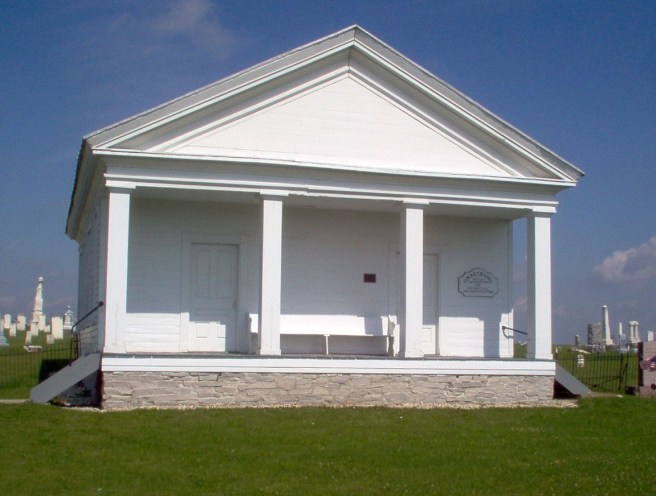
The astringent Greek Temple Revival appearance of Omar Chapel, in Seneca County, Ohio, not far from the prompt for Prairie Depot in my novel Nearly Canaan, continues to haunt me. It says so much about the dreams of its benefactor, out on what was then still frontier.


What I like about gardening

Candidly, I’m not the gardener in our household, but I still have to pitch in with the work. Let me look on the bright side. Plus, when it comes to dining, I definitely enjoy the benefits.

  1. There’s less grass to mow, thanks to the beds that take up at least half of what would have otherwise been lawn.
  2. The sequence of blossoms and produce give me a heightened seasonal awareness. Every week is different, from mid-March as far as mid-November, in the progression of blossoms .
  3. The selections and placement of plants reveals my wife’s mind with its shifting palate of color. She designs English-style clumps, unlike my straight rows. Yes, it really can be a feast for the eyes, even as we look out from our windows.
  4. Asparagus, in a permanent bed, is a delight to cut and eat almost immediately each day through the month of May. It’s the first of our you-can’t-buy-it-this-fresh revelations and reminds me of my years of living in the Yakima Valley of Washington state, where it sprouted like a weed. There, our goal was to sate our taste buds for the coming year. Besides, the delicate ferns are stunning foliage all summer.
  5. Fresh greens. Salads, especially.
  6. Berries, starting with strawberries and extending into blueberries and raspberries. We also have a bank of currants.
  7. Real tomatoes, not the poor substitute you find at the supermarket. We always raise a variety of sizes and shapes, and you’d be surprised how much their flavor varies. One year, I think we had 14 different kinds. Nothing surpasses a tomato and mayo sandwich every day through August and much of September. The king of France should have been envious. You can forget the bacon or even lettuce, as far as I’m concerned, they detract from the star attraction. Again, it’s enjoy it while it’s so gloriously available. (We also freeze a lot for deep winter – the soup, especially, can be heavenly while you watch the snow fall.)
  8. Weeding, which I’d normally avoid, has become a quick means to collect food for the rabbits, which they so greedily and efficiently compost.
  9. Which brings up composting, a lesson in patience and the importance of worms, as I feel virtuous in turning what would have otherwise gone to the landfill into a miracle mixture that’s revived much of our property from what my wife termed “dead dirt” into something soft, pliant, and fertile.
  10. Hummingbirds. They make their rounds through everything flowering, but you have to be alert to see them. Sometimes they’re even right behind your back.

~*~

Well, gardening does also serve as an item of conversation.

What would you add?

Ten big renovation and maintenance projects we did

In absolute numbers, I suppose you could say we lived in the place for free, once you compare what we paid for the place and added as renovations against the selling price two decades later, but I’m not sure that would hold up if we factored in inflation or what we might have earned if we’d placed much of that money in the stock market.

Even so, here’s some of what we had done:

  1. Reshingled the roof.
  2. Lined the chimney. And then the other.
  3. Replaced the cracked boiler.
  4. Saved the barn from collapse, created a mother-in-law apartment, later removed the second-floor deck from the house to the loft, and wired the loft.
  5. Replaced the downstairs windows.
  6. Remodeled the kitchen.
  7. Remodeled the upstairs bathroom.
  8. Restored the downstairs bathroom as more of a utility room and added a kitchen pantry.
  9. Replaced the sump pump, this time sunken into the floor.
  10. Replaced the rotten bulkhead with steel.

And that’s not counting all the garden beds and plantings or tree work.

People of today I admire

OK, I’m counting couples as one here. And I’m excluding some nominees I celebrated earlier in the year in my ten fine couples list. Here goes:

  1. The Obamas, of course.
  2. And my wife and daughters and the two guys they bring into my life. Natchurally. Think of this as a team.
  3. Noah Merrill, the ever patient and faithful field secretary of New England Yearly Meeting of Friends.
  4. Brown Letham, energetic painter and activist and father of one very fine author.
  5. Jim and Eden Grace, holy peaceniks on a global scale.
  6. Timothy and Nijmeh Curren, Orthodox priest and presbvtera.
  7. George and Althea Coussoule, welcoming stalwarts of Dover’s Greek community.
  8. Sherry Wood. See my dedication in Hometown News.
  9. Jay O’Hara, free-Gospel minister and Quaker activist.
  10. Gary Snyder, American poet and Zen Buddhist.

~*~

So what if this adds up to more than ten individuals in all?

Who’s high on your own list?

Just look at Upstate New York

You say “New York” to someone and the first thing they think of is Manhattan. Not even the rest of the city, where most of the population works, studies, and sleeps. Or Long Island, as an extension of The City.

Easily overlooked is the sprawling region of Upstate New York, with a population of more than six million people and the cities of Buffalo, Rochester, Syracuse, Albany, and more. A population that would make the region itself the 18th largest state in the U.S.A., if it were independent. Larger than Missouri, Wisconsin, Minnesota, Colorado, or a host more.

Besides, it’s a lot like the place where Kenzie alights in my novel Pit-a-Pat High Jinks.

Here are ten more facts to consider.

  1. Upstate starts right outside New York City, at the Tappan Zee Bridge over the Hudson River, where you can still see the towers of Manhattan when the pollution-induced haze abates. OK, the boundary is debated, let’s not argue. Maybe it’s just upriver at the Bear Mountain Bridge.
  2. The region has two major mountain ranges, the Catskills and more impressive Adirondacks, plus a lot of Appalachian foothills. It is largely rugged terrain.
  3. It was largely uninhabited by whites until after the Revolutionary War, when the Iroquois natives were pushed out. What it means is that the bulk of the region was then settled about the same time as much of the Midwest.
  4. The opening of the Erie Canal in 1825 turned the region into a hotbed of manufacturing along its route, as well as religious upheaval, leading it to be called “the burned-over district” because of its zealous waves of missionary activity.
  5. Many of those companies led to giants including General Electric, IBM, Kodak, Xerox, Bausch and Lomb, Carrier air conditioning, Endicott Johnson shoes, Gannett newspapers – manufacturing enterprises heavily hit by Rust Belt devastation in the past five decades. The region is still hard-pressed to recover economically.
  6. It gets a lot of snow. Nobody accepts the crown of the snowfall capital, which seems to shift each year.
  7. The Mormon movement took off when Joseph Smith reported having visions while living in the Palmyra area in the 1820s and ’30s.
  8. The Shakers first settled at Watervliet, near Albany, in 1776.
  9. The Catskills supply New York City’s water via an elaborate pipeline system.
  10. Welch’s makes a lot of grape juice in Chautauqua County, while the Finger Lakes Region is noted for wine making, including Manischewitz sweet kosher wine in Canandaigua.

Reasons I still love type on paper

Well, compared to ebooks and all this digital reading.

  1. I can caress it. Yes, even the texture and weight of the paper itself.
  2. Admire the spine on a shelf.
  3. Frame a page and mount it on a wall. (I’m thinking of a broadside, especially.)
  4. There’s marbling in some old editions, and end-papers. Nothing like that in ebooks.
  5. Underline and make notes as I read, enhancing the engagement.
  6. A sense of timelessness. Unlike a computer crash.
  7. Open an old book and there’s a special aroma. Hopefully not mold.
  8. Reading one works better at the beach, in full sunlight.
  9. Easier to find errors when correcting galleys or drafts.
  10. It really does feel finished.