Has anyone else noticed how quickly our language has added “coronavirus” to common usage and then, over perhaps a week, “COVID-19” has become equally common parlance?
It started as a synonym, and at first I would have said it made for a shorter word in headlines but now I’m thinking it’s about the same length. When it comes to newspaper columns, the shorter the word, the better, especially in headlines.
Watch for the next step, which is to make the acronym even shorter by going from all-caps to Covid-19, as it’s already appearing in a few places.
~*~
You’ve probably already noticed the panic rush on the supermarkets after the Tom Hanks diagnosis was announced. The shelves of toilet paper, especially, were quickly cleared out. The new deliveries have been limited to one package per customer, maybe two, depending.
My wife just came back from a quick trip to one store (for its special on butter). She noticed the guy ahead of her in the checkout line, a blue-collar type apparently stopping on the way home from an overnight shift and picking up a few more items for the duration. He had a package of toilet paper, not surprising, and a half-dozen cartons of Ben & Jerry’s. How’s that for priorities?
No surprise, everybody’s talking about it. Finally. What can we bloggers even add to the awareness?
In fact, there’s so much coming out, it’s impossible to keep up. My only conclusion is that what we’re reading and hearing is already two weeks behind where the outbreak actually is, thanks to the delay in the appearance of symptoms while an individual is still contagious – and that the spread of infection is already more severe than those in the White House are willing to acknowledge.
On the human level, it’s not just the mortality rate – 2 percent? that’s not the Black Plague, as cynics remind us – but the possibility of so much of the workforce being incapacitated, as well, meaning people with high deductibles in their health care coverage and minimum-wage jobs that preclude them from taking any time away from earning their meager paychecks without being homeless.
On a more abstract level, think about the speed with which it’s precipitated the stock market “correction” that was predicted for sometime after the November elections but now seems to presage recession. End of the bull market that ran through the Obama years and all that. (Glad I closed my IRAs when I did. The last recession cut their value in half, and recovering that took longer than we want to admit.) Now the market’s down roughly 30 percent in a week, nearly wiping out all of its gains during the Trump administration.
In fact, it seems impossible to talk about coronavirus without politics and finances popping into the discussion. I’ll spare you those rants.
In barely a week or two, it seems, the illness has gone from being “out there” in Seattle or even the other side of New Hampshire and suddenly started appearing much closer to home and those we know and love.
It really cut into my consciousness when I did a double-take Tuesday night while listening to a classical program streaming on Harvard’s FM station, just an hour down the road from here. The student program host was thanking her listeners for their four years of support of her on-air work, saying that this would be her last show. What? This was episode two of a six-week Tuesday feature, she had four more weeks to go. And then the words, “with the closure of the university, I’ll be heading home,” meaning New York, which coincidentally was the focus of that particular episode.
What, closing Harvard? Well, by now you know how that decision has already spread to a lot of other schools. Pack up your dorm stuff and be out of town by the weekend. I was standing with a University of New Hampshire student yesterday when his smart phone went off, informing him he was going to have an extra week off after spring break. (At a religious leaders’ gathering an hour earlier I had heard that the governor had overridden the faculty’s plea for a longer closure, like for the rest of the semester.) Is anyone else hearing from some outraged students? (Details for the virtual classrooms to be announced. Ditto, refunds or even housing for kids left in the lurch. And who wants to be confined to boring home?)
Meanwhile, in our faith communities, we’re having to make rapid adjustments. No more handshakes to close Quaker worship, for now, or food and fellowship after. For others, it affects how they celebrate the Eucharist. And what about the Friendly Kitchen’s two dinners a week for an already vulnerable populace, prepared and served by ten congregations on a rotating basis? Do we make the meals takeout to reduce social contact? How do we react to public school closures and childcare issues, especially for working parents?
As for the lockdowns in nursing homes and senior housing? Turn around, and there’s another surprise.
Let’s not overlook the panic runs on the supermarkets, either. Before the outbreak, my wife had started cutting back on our pantry backup, but now she’s feeling we should be able to sustain two or three weeks of lockdown, so we’re stocking up again, just not in alarm mode.
Think I need to get some quinine water, too? Maybe look at this as alternative medicine?
My assignment was to make sure we’d be set for my nightly martini and the rabbits’ pellets, should we go into self-isolation or official quarantine. You know, keep everybody in this household comfy for the duration. Having the state liquor store touting a 16 percent discount on purchases over $150 helped with the decision. The Bombay Sapphire was already on sale. You know, isn’t this stuff we’d be using anyway, eventually?
What I didn’t remind her is that I’m not touching alcohol until April 17, Orthodox Easter – seven whole weeks of abstinence. (Would those beautiful bottles strengthen my resolve to live, should I be afflicted in the coming weeks? Ay-ay-ay.)
So here we are, obsessing with the developments. I wonder what we’re going to learn today.
The conversation turned to a current problem many face in finding the right job.
Employers seem to demand college degrees for even the most basic positions, and then expect years of experience as well for what’s lowly paid entry-level work.
How does anyone get that requisite experience in such a setup?
That’s had me thinking of bosses who see something in a candidate and hire them, regardless of the credentials, and then guide them in their development. I’ve certainly had some fine examples as well as some crucial (paid) internships.
It’s also had me reflecting on the great inventor Charles F. Kettering, who once said that if he faced a metallurgy problem and had a metallurgist and a biologist on his staff, he’d hand it to the biologist – because the biologist would be more likely to solve it.
Why? The biologist wouldn’t know all of the things that weren’t supposed to work, unlike the metallurgist.
Of course, this is not just about jobs. I’ve noticed that we need mentors in the many diverse skills of living and in the practice of our own niches within it.
These days, I’m also realizing I’m at an age where I might be expected to be fulfilling the mentoring role, not that I often feel that capable. What I am noticing, however, is the gap in the circles I travel, where individuals in their twenties and thirties are scarce. A wider look finds them scarce in general, and those I know openly admit their puzzlement about connecting in real life with their peers. Where are they, outside of the Internet?
I can name a long list of mentors in my journey to here. Some were teachers or bosses, others poets or Quakers or Mennonites, even fine arts painters or folks a generation younger than me.
We were wide-eyed and innocent as doves though not wise as serpents, as the Bible would add.
We had room for exploration, certainly, and for some of us that included yoga or Zen. Hitchhiking was part of the scene, too. I touch on those in several of my novels.
I realize that in posing the question as “yogis,” I’m focusing on a corner of the hippie experience. The dream I’m thinking of is a better world for everyone, and not just a few who wanted to drop out altogether.
I don’t see that among today’s youth, who have good reason to be more cautious about the future. Besides, they’re shackled by college debt, an outrageous amount compared to their income realities.
But it’s not all economic. I’d say much of the current malaise is spiritual.
Without that element of hope and universal love, how can we possibly overcome the forces that are dividing and oppressing us?
I’ve long worried about the influence of political surveys on the elections themselves. That is, any scientific purpose they claim still pollutes the subject they’re investigating. And that’s before we get to candidates who remake their image and message to fit popular opinion, even if it doesn’t change their behind-the-scenes policies one whit.
As humans, we like to be on the winning side, after all, and published surveys add pressure in that direction. On the other hand, the opposing camps just might react by ramping up their anger and energy in a drive for an underdog upset. In that regard, the survey findings are more like the betting odds given on a sports event.
These elections should be more than a game or an entertainment ratings number. They’re too important for that.
I was happy to see that in New Hampshire’s first-in-the-nation presidential primary, many voters stuck to their convictions. Nobody saw Amy Klobuchar’s rise coming, but many were impressed seeing her face-to-face or in what they heard from others who had. The other supporters we met were generally soft-spoken but firm in their decision. Frankly, I was usually amazed to realize we weren’t alone, that there were others who had come to the same decision. I’ll confess we were bracing for the worst when the election results started pouring in. Now we’re feeling some vindication, and definitely smiling.
The irony here, of course, that her climb to a third-place finish now puts her in a spotlight that is expected to sway other primary results down the line.
Each presidential primary season, I’m amazed by the number of people who file to run in the New Hampshire race even though they have little or no political experience. Yes, we have them again this leap year.
They have no hope of winning or usually even adding anything useful to the conversation.
Even among the serious candidates, I’ve come to see that having good ideas is not enough to make for a viable president. A commanding presence, leadership skills (including an ability to listen and accept critical positions from your inner circle), and effective organization are also essential. Quite simply, is this someone with traction as a nominee?
Political experience is also crucial. Directing a major corporation is not the same as managing a public enterprise. Some states and cities have budgets and work forces rivaling big businesses, but the dynamics are quite different. I do wish some of the billionaire candidates, hopeful as they are, had chosen to run for a governorship or Congress first, get their feet wet and learned through OJT.
Anyone else struck by the number of presidential candidates running on a first-name basis? Pete, Amy, Bernie, Tulsi, Tom, Beto, and for a while Kamala. In contrast to those who run on their more formal surnames. You know, the folksy thing. Or at least something easier to remember. It works if your moniker isn’t too generic, say like John or Mike or Mary, I guess.
It’s not entirely new. I mean, historically there was Honest Abe and Teddy the Rough Rider and later Ike and Adalai and then Hillary. Or even the initials, JFK and LBJ.
In local elections, our neighbor recently won the mayor’s seat. Well done, Bob.
I had hoped that this would be the presidential primary year when I would finally be able to get out and meet the candidates – all of them – face to face. Get a measure of them. In the past, I was usually tied up at the office or in other scheduling conflicts.
In New Hampshire, many of the campaigns start out with house parties, where the candidates talk informally in people’s living rooms, or in fraternal lodges or town halls and the like, and then build up to larger venues. Since the televised debates often screen out those candidates struggling in the survey polling, serious voters will seek out opportunities to give everyone a chance to be heard and considered. This is, after all, grassroots politics.
Somehow, my calendar in the fall and early winter filled up with other activities. So I decided I’d devote the weeks just before and after the Iowa caucuses to the project. What I discovered, though, was that almost all of the remaining events were now scheduled in Merrimack Valley, over an hour away from the seacoast region where I live – that is, they’re in Manchester, Nashua, and Concord. And the U.S. senators in the running were all stuck in the impeachment hearings in Washington.
Well, there have been some surprises since then.
One was on Tuesday afternoon, the day after Iowa, when Amy Klobuchar spoke at South Church in Portsmouth. I attended and am glad I did. The sanctuary was packed, every seat on the main floor, and she really delivered. I had a much better appreciation for her as a presidential contender. Actually, she was amazing.
And Sunday afternoon, Pete Buttigieg appears at the middle school here in Dover. I’m planning to be there, for perspective, if nothing else.
I do regret not starting on this project earlier. I’m left wondering about those who simply failed to connect, what we’re missing.
Still, we’ve met with some interesting and devoted volunteers who’ve canvassed at our front door. And we’ve been following the local news. So it goes, down to the wire.
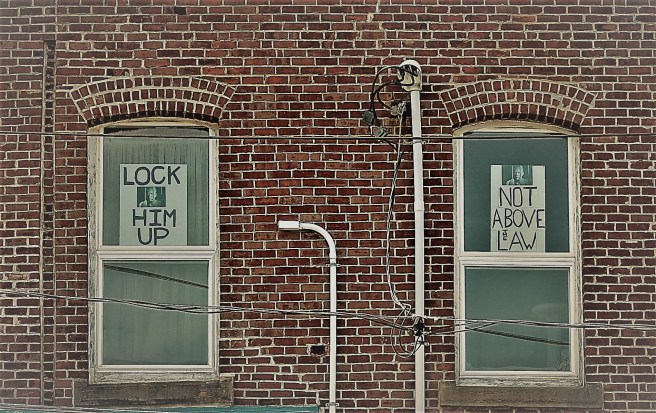
Two signs in a window give one view of the current occupant of the White House. My guess is that they’re in response to a banner flying over a lobster boat in the harbor below.

 Jnana's Red Barn