The site in south Boston where two Quaker missionaries were hanged less than a month after visiting Dover, New Hampshire, was eventually christened – get this – Dover Street.
The street was later renamed.
Another of the four who died on the gallows there had also apparently visited Dover a year or two earlier.
Who made the decision – and why? They couldn’t be that oblivious, could they?
Once the surrounding water was filled in, the street came to have a long history of immigrants and seedy characters, perhaps doomed by its bloody past, before part of the neighborhood was razed for the urban renewal that brought the Boston Herald newspaper plant and later removed the elevated subway station after the Orange Line was rerouted to the west in 1987.
Today it’s known as East Berkeley Street, hoping for a new image.
Check out my new book, Quaking Dover, available in your choice of ebook platforms at Smashwords.com.
Though Eastport was settled relatively late – that is, toward the end of the Revolutionary War – it was instilled with a Colonial flavor by prominent early residents who were resolute veterans.
A continuing spirit of Tea Party and Minutemen makes Independence Day in New England feel different than those elsewhere. It’s not just the place of the Shot Heard ‘Round the World. It’s the region where thickheaded Yankees have always doodled.
Quite simply, history is palpably alive everywhere across New England.
Boston, of course, is the epicenter, but across the six most northeasterly states, local observations uphold distinctive traditions. Think of musketeers firing a round ever so often along the town parade route, along with fifes and drums.
As an independently enterprising oceanside village, Eastport soon had a reputation as a hive of privateering – that is, legalized piracy – and not-so-legal smuggling. That independent streak gets its own attention in the city’s annual Pirate Festival a week after Labor Day.
How joyous!
Unlike much of America, the city had frontline experience of the War of 1812. Fort Sullivan atop the bluffs surrendered to the British Navy in 1814, and Eastport then remained under the royal thumb until 1818.
Two years after its reunification with the United States, Maine became liberated from Massachusetts for the first time since 1653 and began to breathe into its own unique character.
For its part, Eastport rocketed as a center of shipping, shipbuilding, fishing, and sardine canning before the big decline of the 1900s set in.
Today, the tiny city’s locals remember a vibrant past and close-knit community, one that spanned the shorelines on both the American and Canadian sides of the watery border.
Is a renaissance on the horizon? There are signs for hope.
All of these strands infuse the holiday here.
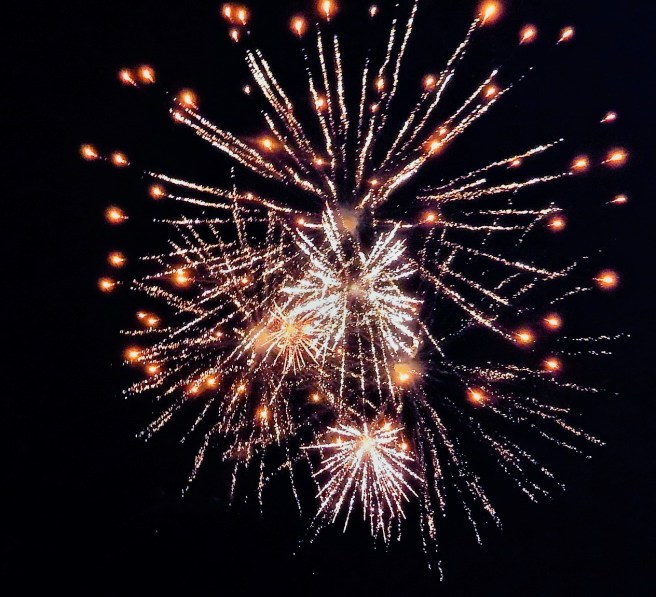
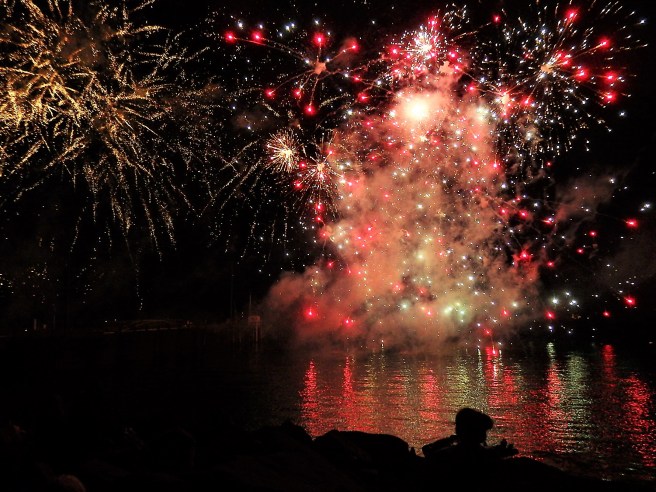
Here’s a taste of last year’s pyrotechnics fired off from the fish pier downtown.Yes, fireworks can be visually composed, leading your eyes around the sky.
The national holiday also marks the opening of New England’s short summer season. After a cold, dark, long winter, Eastport’s small year-’round populace can actually come out into the open air for long times together. The ocean and lakes are finally warming, to the extent that they do, and that attracts vacationers to join in.
After months when only a stray New Hampshire or Massachusetts auto plate is seen around here, I’ve now seen those of every state but Alabama, Hawaii, and North Dakota (not all at the same time), some seeming rather exotic.
And the Fourth includes the city’s Old Home Week, with high school reunions and the return of many summer residents.
A lot happens over a four-day span. There’s a doll carriage and wagon parade. A torchlight parade. Car shows, bike races, water games, pet show, rubber ducky race, festive all-you-can-eat blueberry pancake breakfast, free outdoor movie, contests, live music, and a street dance, all with a small-town flavor.
A traditional visit by a large U.S. Navy vessel failed to materialize, a consequence of being on Ukraine-related alert. Three different ships had expressed interest in landing at the Breakwater before the turn in world events.
While fireworks were displayed off over the harbor on the Fourth, America’s Independence Day (the beautifully designed and executed big show fired from the town’s Fish Pier was followed by a joyously rowdy encore from a diner’s smaller private pier), the companion July 1 presentation for Canada Day, in honor of our neighbors in New Brunswick, was still a victim of Covid cutbacks. Some residents, though, could view shows happening on Deer Island across the water.
Seems ever so fitting to shoot the works twice, considering Eastport’s dual connections.
Great ideas remain the heart of a revolution. The kind that strike the core of one’s being and inspire action.
They must have a foundation in irrevocable reality if they’re to succeed in the long run.
Not lies, which are shifting sands. Or dreams, which float far from their anchors. Instead, some touchstone that resonates and holds fast, even on the great prairie.
This time, it’s a Not in My Backyard reaction triggered by opposition to a wind-energy farm 20 miles offshore because it “would spoil the view.”
From what, the yacht?
Get real!
I’m sure they wouldn’t be as vocal if it were a coal-fired plant going up near neighborhoods next to industrial wastelands – the places poor people live.
The people and the places they’re trying to escape, along with the shared responsibilities and real community. And poor people are largely envisioned as Black, no matter that many are white.
Well, the NIMBY crowd might pipe up if they can see the development from the expressway into town. Heavens!
The fact is that if we want electrical power or sewers and water or trash removal, it all has to happen somewhere. Shipping it off to the less fortunate rings sour in more ways than one.
Less fortunate, indeed.
Just don’t try to put them in you-know-whose backyard.
In 1676, during King Philip’s War, a number of Natives fleeing from the Massachusetts Bay colony militia received shelter among the Pennacook tribe living around Dover. The refugees were part of what’s called a rebellion that began the previous year, the first in a series of armed campaigns between the colonists and the Indigenous peoples in and around Dover and beyond.
The existing accounts, of course, are one-sided, but the devastation afflicted innocent non-combatants on both sides.
~*~
Up to this point, most of the fighting was to the south, though there were fatal attacks in Oyster River, still part of Dover, among others.
Not all of the tribes aligned with the rebellion. The Narragansetts, for one, were neutral, yet more than 600 were killed by the colonists in revenge.
Dover’s Richard Waldron and Maine’s Charles Frost led colonial forces in an incursion on the Mi’kmaq in French-held Acadia – today’s Downeast Maine.
In the midst of this, two events in Dover added fuel to the conflagration. Until now, Dover had largely mutually positive relations with the Natives, Waldron aside.
Waldron was ordered to attack the Natives who had found refuge nearby and turn any combatants over to the Massachusetts militia. He instead invited about 400 Natives to participate in a mock battle against the New Hampshire militia. After the guests had fired their guns, Waldron took them prisoner and sent them to Boston, where the leaders were executed. Others were sold into slavery in “foreign parts,” mostly Barbados.
The usual take on the “mock battle” comes from Waldron’s account and often has most of the captives being returned peacefully. In contrast, the Indigenous version handed down orally has the event being an invitation to a feast. Only twenty of the Natives were armed, and at least 350, mostly women and children, were taken, sold, and never returned. Among the consequences was the fall of the peaceful, Christian Wonalancet as sachem and the rise of the warlike Kankamagus.
Major Richard Waldron masterminded the sham war game that led to the captivity of local Natives who came in peace.
Quakers were no doubt appalled by Waldron’s dishonesty and physical violence as well as the enslavement – New England Friends, including children, had faced being sold into slavery by Puritan authorities at the height of the persecutions. Moreover, Friends cherished good relationships with the Natives.
They were not alone.
“The local Indians were released but never forgave Waldron for the deception, which violated all the rules of honor and hospitality valued by both sides,” as one version, drawing on the colonial record, relates.
Despite its brevity, King Philip’s War is considered the greatest calamity in 17th-century New England and the deadliest war in Colonial American history. Within a year, many of the towns had been destroyed or damaged, and the economy of Plymouth and Rhode Island colonies was all but ruined. Hundreds of Wampanoags and their allies were publicly executed or enslaved, and the Wampanoags were left effectively landless.
For northern New England, it was only the beginning of a series of wars connected to European conflicts that would devastate the frontier until 1763, when New France was surrendered to Britain.
One of the fortified garrison houses built in Dover. Each one was surrounded by a palisade. When the neighbors arrived for the night, things must have been pretty crowded.
Along the Piscataqua, the Natives were patient, waiting 13 years for revenge. As historian Jeremy Belknap related: “Friday the 28th June, 1689, was the fatal day in the morning of which Major Richard Waldron was murdered and the destruction of Cochecho perpatrated by the Indians of Pennycook and Saco. This caused the absence of Mr. Pike for some years.”
Was the town’s minister permanently injured in the attack? Or suffer mental illness as a consequence?
~*~
The Reverend John Pike noted “the eastern Ind joyning with those of Pennicook (thro the Instigation of Hawkins & a Sagamore) suddenly seized on Cochecho, about break of day, wn all things were silent & secure. Killed 23 persons … and carried captive 29.”
This was the beginning of King William’s War, a series of massacres orchestrated by Jean-Vincent d’Abbadie de Saint-Castin and Father Louis-Pierre Thury.
In New England, the conflict originated in the failure of the settlers to adhere to the treaties and agreements made at the end of King Philip’s War, but the renewed outbreak of hostilities was also the North American theater of hostilities originating when King James II, the last of England’s suspected secretly Roman Catholic kings, was deposed and replaced by Protestants William and Mary. Hence, the “William” in what was also known as Father Baudin’s War and Castin’s War. Baudin was a French Sulpician priest who had trained to become a musketeer and later ministered in Acadia. This segment would continue for nine years, ending in 1697.
Waldron had dismissed concerns about renewed hostilities, telling residents to go and plant their pumpkins, and he would take care of the Natives.
Instead, in the attack, the sword-wielding elderly Waldron was cut across his belly with knives, with each warrior saying “I cross out my account.” Five or six dwelling houses were burned, along with the mills. Fifty-two colonists, a full quarter of the entire population, were captured and carried off to Quebec or slain.
One view of the attacks.
The Indigenous account of 80-year-old Waldron’s demise is more detailed. His nose and ears were cut off and stuffed in his mouth, as were his thumbs. To the Natives, he had turned his nose to injustice, refused to hear all sides, and cheated on weights in trade – placing his thumb on the scale. He also avoided trading them useful goods they desired and instead paid them in rum or trinkets.
The garrisons were houses that had been fortified from 1675 and on, set within palisades and designated as places of shelter in the event of attack. At the time of the 1689 attack, there were an estimated fifty such sites within and around the sprawling town.
The most extensive toll came at Richard Otis’s garrison, where the 64-year-old blacksmith, his son Stephen, and daughter Hannah were killed. His third wife, Grizel, three-month-old daughter Margaret, three daughters from his first marriage, Judith, Rose, and Experience, and at least two grandchildren were taken captive. One adult son, Richard Jr., escaped. The garrison was burned.
Eastport is smaller – much smaller – than the model for my fictional Prairie Depot was, and I thought that place was small. Yet somehow Eastport feels more vibrant and whole.
At least in summer.
For a little perspective, the entire winter population could ride a single New York City subway train.
It’s edged out by Vermont and is a hair ahead of New Hampshire, according to 2014 figures from Pew.
It also has the oldest population in the nation and not much in the way of other civic associations and social clubs these days, from what I see. Are people even getting together anymore? What’s been happening with traditions like hunting and fishing or the Grange?
When I say “unchurched,” I’m referring here to active attendance and membership, not the buildings, institutions, or hierarchies. It’s the interactions of a body of believers.
Somehow, I view the decaying landmark white churches and spires as mirroring a general decay in employment opportunities and a fraying social structure. As for families and friends? They’re not what they once were, either.
This is New England, after all, with images of Minuteman patriotism, Puritan uprightness, and democracy-in-action town meetings, not the Far West. “The way life should be,” as one of Maine’s travel slogans proclaims while overlooking some serious and troubling realities.
Are there any viable alternatives on the horizon?
How do we care for “the least among us” when we all seem to be racing to the bottom line?
My immersion in yoga and meditation in the early ’70s left me with a deep appreciation for what poet Gary Snyder dubbed the Old Ways, “the wisdom and skill of those who studied the universe first hand, by direct knowledge and experience, for millennia, both inside and outside themselves.”
It’s something quite different from simply old-fashioned, though it’s found in many different traditions. Call it spiritual, even mystical, if you will, but it often has a practical intensity as well.
I’ll even call it countercultural, across history.
One of its streams has survived among the Indigenous peoples of America, though often by a mere thread.
Passamaquoddy dancers in Maine.
I remember visiting Vincent and Elinor Ostrom in Indiana after I left the ashram and, awakening in the morning, sitting cross-legged in meditation on one of their magnificent Navajo carpets. (The Navajo call them blankets, rather than rugs, by the way, but I’d find them too heavy to wear or sleep under. At the time the Ostroms started collecting, these antique artworks were cheaper than wall-to-wall carpeting. Now they’re priceless.) As I opened my eyes, the lines and colors radiated out from me in a design that I could only describe as a living mandala. Its creator had been more than a weaver, then.
A few years later, I was living near the fringe of the Yakama Reservation in Washington state and delving into the mythology and artistry of the Pacific Northwest Native peoples. My longpoem, “American Olympus,” reflects that, as do many of my shorter poems and parts of my novels “Nearly Canaan” and “The Secret Side of Jaya.”
That experience, though, was cut short 42 years ago and revived only last year, when I landed in Eastport with its neighboring Passamaquoddy people – 258 households, 700 members.
The Passamaquoddy’s Pleasant Point Reservation sits along Cobscook Bay on one side and Passamaquoddy Bay on the other.
I can’t exactly explain it, but I do sense that practitioners of Old Ways change the vibe of the surrounding landscape in a positive way. Not just American Indians, either. I’d say the same of the Amish.
One of the traits that seems to be common among these practitioners is reserve, close observation, and an economy of words. The character Marilyn Whirlwind, played by Elaine Miles in the television series “Northern Exposure,” embodied that to perfection.
There is also a sense of place as sacred, and a desire to live in balance with the land.
The word Passamaquoddy itself translates as People of the Dawn. Even Gatekeepers of the Dawn. And it definitely fits this part of the continent, on both sides of the U.S.-Canada border, which they have always spanned.
The first I had even heard of the tribe was when Fredda Paul, one of its traditional healers, and his apprentice Leslie Wood stayed with us a few nights in Dover. For me, it was a close insight into another way of thought and feeling.
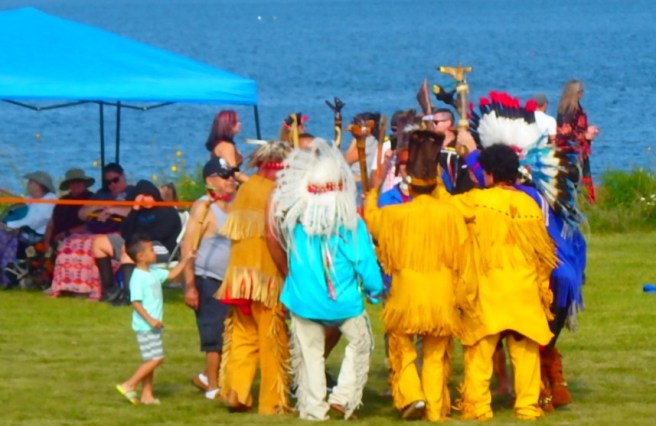
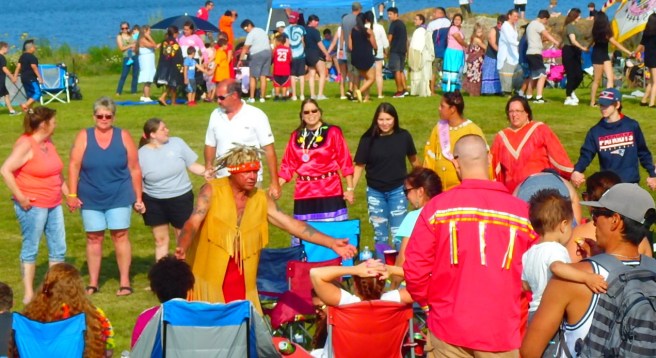
So far, I’ve refrained from photographing the Passamaquoddy, at least apart from their annual powwow. Maybe I’ve learned that from the Amish, except for the powwow part.
A drumming circle is something shared across tribes. It’s a complex interaction, loud vocally and instrumentally.
For an introduction, I’d suggest touring the exhibits at the Wabanaki Cultural Center in downtown Calais. It’s free and includes hands-on displays.
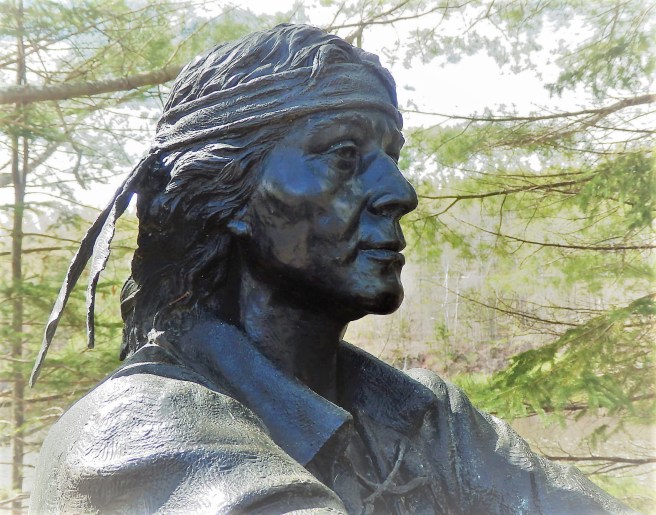
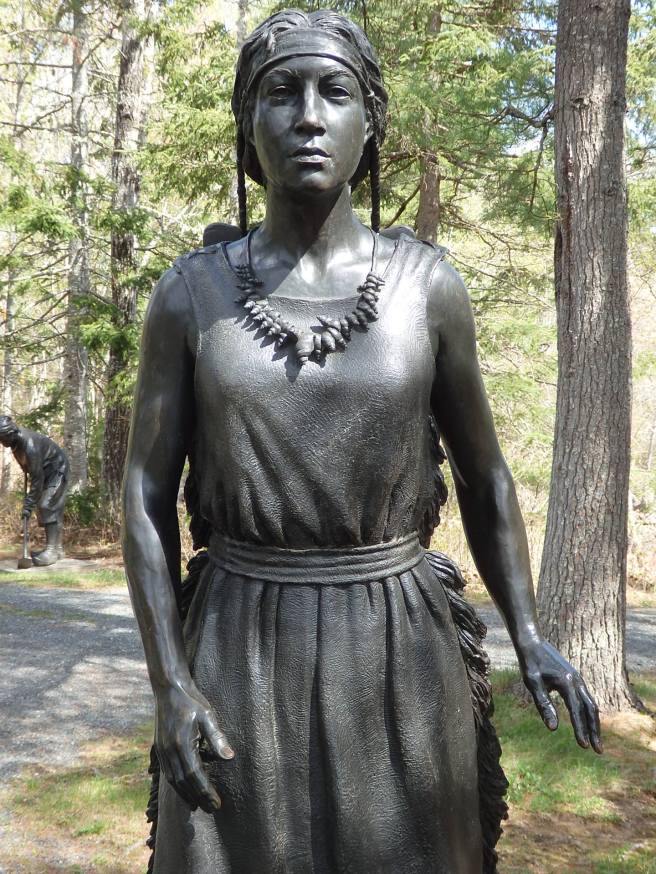
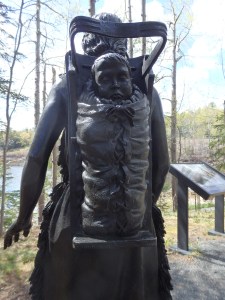
Sculptures by Ivan Schwartz and Studio EIS at the St. Croix Island International Historic Site in Calais honor the Passamaquoddy role in saving the remnant of the French venture in 1605.I do wonder about the sculptor’s choice of models. As for the clothing?And the future?Just about everyone at the annual Passamaquoddy Days celebration is invited to join in the snake dance. Saying no is not an option.
I’ve not yet been able to visit the Waponahki Museum and Resource Center on the Pleasant Point Reservation, with its work by award-winning basket makers, canoe builders, carvers, and contemporary artists, as well full-body castings of tribal members made in the 1960s.