We all know the boost the Covid shutdown gave to online shopping and delivery. Ordering from the comfort of home, when everything went well, could be a pleasure. For some of us, it even meant being able to find exactly what we wanted, even after we had tried without success to find the item in a bricks-and-mortar store.
Of course, it could also be exasperating, as I discovered when a promised item failed to arrive before Christmas, even though it had been ordered more than a month before, and cancellation and refund weren’t available, due to the fine print that the product was being shipped from an independent source rather than the classy brand name. It was finally delivered in February, even after I had finally got the retailer to cancel the purchase.
As we also know, not every website is easily navigated, either.
~*~
I think about that when I look at the vacant storefronts in Eastport’s historic and charming downtown. Just what would fit in here efficaciously? Retail, of course, is the heart of it, along with a mix of offices and studios.
It’s a situation we share with many other communities, where the pleasures of being able to stroll from one option to another are countered by the expectation of easy parking. Just what do we really want or need, actually? More possessions? Services? Treats for the eyes or taste buds?
If you open a store, you’re not going to get rich at it, even though retailing requires a special insight and savvy. To be successful, you’ll also need value-added lines in ways the online rivals can’t compare. Think of the personal touch as a shopper when you’re not quite sure what you’re looking for to fix a particular problem.
Eastport has the additional complications of a small year-round population that swells in the summer, meaning the retail season can boil down to half-dozen prime weeks with a long slowdown in between.
~*~
You’ll hear people talk fondly of the old Woolworth’s or Newberry’s, with their lunch counters and swivel chairs or their extensive fabric selection or whatever, or the way these emporiums anchored the block. Not so for the dollar stores or Walmart.
I’m well into a stage of de-collection and downsizing, so I hesitate to add more possessions. Still, when I walk into a place like the Rock & Art store in Ellsworth or Bangor, I can be tempted.
Obviously, I don’t have the answer for what will revitalize the district, but my guess is that it will be an array of things not currently in our vision. Who would have thought of brewpubs a decade or two ago, for instance?
Or, as they used to say in the days of black-and-white television, “Please stay tuned.”
As I ask just what made Dover so ripe for the Quaker message, I see how much earlier conflicts over the town’s official church open the way for an alternative congregation, once itinerant Friends visit town.
Dover’s first minister, solidly Puritan William Leveridge, arrives in 1633 and conducts the first religious service in New Hampshire, but he’s gone in 1635, leaving “for want of adequate support,” meaning salary, which he then finds around Boston and on in Long Island. His surviving scriptural notes are in Latin.
Perhaps two years later, maybe earlier, George Burdet shows up in the pulpit, while also taking over as “governor,” the proprietors’ agent, overseeing the northern half of the New Hampshire province. He feigns sympathy with the Puritans but secretly corresponds with Church of England Archbishop William Laud, who will eventually be executed by the Puritans. Before Burdet flees in adulterous disgrace in 1639 – or a year or two later – things get really interesting, though I’ll spare you the details now. Among other things, he gives the settlement the name Dover, not reflecting the famed English town with the white cliffs but rather an anti-Puritan wit and attorney who also founded the notorious Cotswold Olimpick Games, which included horse-racing, coursing with hounds, running, jumping, dancing, sledgehammer throwing, fighting with swords and cudgels, quarterstaff, wrestling, and gambling.
In contrast, the main sports New England Puritans accepted were hunting, fishing, and the mock battles the militias used for military training.
Dover’s first church probably resembled the one at Plimoth Plantation in Massachusetts. (Photo by Swampyank via Wikimedia)
How did Burdet become the pastor in Dover, in the first place? Specifics are often lacking or blurred in the available records.
The Puritans organized their churches on a congregational structure, where the members themselves managed the affairs, including the selection and dismissal of ministers. The concept also grew into the New England town meeting system for managing secular affairs. It’s about as democratic as you can get.
The Church of England, in contrast, relied on an episcopal hierarchy, where the Archbishop of Canterbury and subordinate bishops ruled.
The differences between the Puritans and the Anglicans go far beyond organization and polity. They include baptism, marriage (a civil contract for Puritans at the time), funerals and burial, prayer (the Anglican Book of Common Prayer versus extemporaneous), liturgy (hocus-pocus, as some Puritans would say) or none at all, rituals and genuflection (superstition to the Puritans), the Virgin Mary and saints (ignored by the Puritans), Christmas (no holiday for the Puritans), and, especially, eternal salvation or damnation (the Puritans being certain that at least some of their brotherhood will be among the Elect God had chosen at the time of Creation). I’ll venture that the Church of England offers more creaturely comforts to its faithful than do the Puritans.
Quite simply, there are tensions within Dover and beyond. The Massachusetts Bay colony has just banished Roger Williams, Anne Hutchinson, and Samuel Gorton, who all scoot off to the new refuge of Rhode Island – and Hutchinson’s brother-in-law, John Wheelwright, heads north to found Exeter, New Hampshire, near Dover. They’re all major figures in American dissident history.
Two mysterious figures then approach a newly arrived minister in Boston and lure him to Dover.
As a young Anglican priest in England, Hanserd Knollys had suffered a religious crisis that led him to resign from the pulpit and begin a quest that brings him to a Mr. Wheelwright, “a silenced minister,” near Lincoln, England. Yes, the same one who founds Exeter. Something in their discussions rekindles a flame within Knollys, liberating him to preach again but with such an intensity that he’s soon imprisoned in Boston, England, until he somehow escapes and sails in 1636 during a difficult voyage with his wife and only child, who dies en route, to Boston, Massachusetts. While living in impoverishment there, and prevented from preaching because of his antinomian theological views, he’s met by “two strangers coming to Boston from Piscattuah, hearing of me by a meer accident, [who] got me to go with them to that plantation, and to preach there, where I remained about four years.”
The only problem is that Burdet is still minister or at least physically present, but the governor’s role has been handed to John Underhill, himself in flight from Massachusetts after leading the militia in the Pequot massacre and running his mouth off.
Burdet forbids Knollys from preaching in Dover but is countered by Underhill.
Within this backdrop, Knollys is credited with formally organizing in 1638 the First Congregationalist Society, now known as First Parish, United Church of Christ (Congregational), and out of its longstanding worship together from 1633, it is regarded as the oldest church in the state.
If only it were that easy.
Hanserd Knollys
Adding to the conflict is Knollys’ evolving theology which will lead to his becoming a founding father of the Particular Baptist denomination, though he’s not yet quite there during his time in the Piscataqua parish. Otherwise, Dover might have been the first Baptist church in America, rather than the one in Providence, Rhode Island, founded in 1639.
From a later Baptist perspective, Knollys “preached with much acceptance upwards of three years. … However, his church in New Hampshire was split on the issue of infant baptism. This brought persecution on him by the Congregationalists. He, with others from his church, fled to New Jersey and eventually back to England.”
To put it mildly.
More directly, from a Baptist point of view, “America does not seem to have been a peaceful place for … Hanserd. While in New Hampshire, conflict arose between Hanserd and another minister, Thomas Larkham, who had arrived in New Hampshire in 1640. Larkham had wealth and influence, and had very lax standards for membership. This produced much division within the congregation, and Larkham at one point had Knollys removed from the pulpit. Many congregants then removed Larkham and restored Knollys as pastor. Larkham had armed men march up from nearby Portsmouth [still known as Strawbery Banke], conducted a trial which found Knollys guilty, fined him, and ordered him to leave. During his time reports circulated that Knollys was also censured for having a ‘filthy dalliance’ with some young females living in his house. Records indicate that this was a false report as other ministers spoke of Knollys with respect. There is also a record that Hanserd had filed suit with a claim of slander. It was never prosecuted, as the Knollys did not stay in the colonies.”
There were even reports of an armed skirmish between factions of the church.
But Larkham, too, suddenly departed from Dover in 1641 and returned to England.
There’s more, as Jeremy Belknap’s History of New Hampshire, reveals:
Larkham “came to Dover, and being a preacher of good talents, eclipsed Knollys, and raised a party who determined to remove him. He therefore gave way to the popular prejudice, and suffered Larkham to take his place; who soon discovered his licentious principles by receiving into the church persons of immoral characters, and assuming, like Burdet, the civil as well as ecclesiastical authority.” Except that Larkham was never “governor.”
Belknap continues: “The better sort of the people were displeased and restored Knollys to his office who excommunicated Larkham. This bred a riot in which Larkham laid hands on Knollys, taking away his hat on pretence that he had not paid for it; but he was civil enough afterward to return it. Some of the magistrates joined with Larkham, and forming a court, summoned Underhill, who was of Knollys’s party to appear before them, and answer to a new crime which they had to allege against him. Underhill collected his adherents; Knollys was armed with a pistol, and another had a bible mounted on an halbert for an ensign. In this ridiculous parade they marched against Larkham and his party, who prudently declined a combat, and sent down the river to Williams … at Portsmouth, for assistance.
“He came up in a boat with an armed party, beset Knollys’s house where Underhill was, guarded it night and day till a court was summoned, and then, Williams sitting as judge, Underhill and his company were found guilty of a riot, and after being fined, were banished from the plantation. The new crime which Larkham’s party alleged against Underhill was that he had been secretly endeavouring to persuade the inhabitants to offer themselves to the government of Massachusetts, whose favor he was desirous to purchase, by these means, as he knew that their view was to extend their jurisdiction as far as they imagined their limits reached, whenever they should find a favourable opportunity. The same policy led him with his party to send a petition to Boston, praying for the interposition of the government in their case: In consequence of which the governor and assistants commissioned Simon Bradstreet, Esq. with the famous Hugh Peters, then minister of Salem, and Timothy Dalton of Hampton, to enquire into the matter, and effect a reconciliation, or certify the state of things to them. These gentlemen travelled on foot to Dover, and finding both sides in fault, brought the matter to this issue, that the one party revoked the excommunication, and the other the fines and banishment.”
Yes, once again, religion and politics mixed.
George Wadleigh, reviewing the events, adds an extra element to the conflict. Larkham and Knollys “fell out about baptizing children.” Remember, Baptists would insist it was for consenting, informed adults only.
Let it not be said that Dover was a sedate fringe habitation.
Dover’s second meetinghouse was something like this, surrounded by a palisade. It was erected in 1654, before the Quakers further stirred things up.
And I’m certain these events all lead up to the faction that welcomes itinerant Quakers a decade later. After all, Dover would have a ready audience and prime examples for the Quaker criticism of “hireling priests” who saw the position as a rewarding salary more than as utter discipleship.
Until then, lingering tensions simmer.
~*~
Check out my new book, Quaking Dover, available in an iBook edition at the Apple Store.
With a population of only 31,121, Washington County is essentially rural and small town. It’s 90 percent white, five percent Native American, and has a fourth of its residents over age 65.
At first glance, then, it’s not the kind of place you would expect to be suffering a homicide in each of the past six months.
The entire state reported only 22 in 2021 – two of them in Washington County, starting the six-month count. Quite simply, the county can currently be seen as the murder capital of the state.
Back in November, the victim in Machias was a 17-year-old male from New York. We could shake our heads and assume drugs had something to do with the case.
The rest, however, have been unmistakably local.
Several were domestic violence. One of those, the death of a valued employee, resulted in a family decision not to reopen a popular lobster pound in downtown Eastport, so we see these events having public consequences.
The latest instance had a 43-year-old Passamaquoddy woman as the victim and two of her neighbors arrested on homicide charges. Investigators have been unusually tight-lipped, leading to widespread speculation. Happening within a community of about 600, this takes a hard toll, ripping through at least three extended families.
The news, coming on the heels of a heavier than usual number of funerals in the tribe, adds to the grieving.
We can ask what is prompting this wave of violence and death.
Poverty is no doubt a factor. Individual and household incomes are only two-thirds of the national average, but probably skewer sharply down on one side or up the other, creating a gulch in real practice. The Covid-related closures of the international border to and from Canada have taken a toll on businesses, employment, and families, too.
The despair leads to drug abuse, as is related in everyday conversations around here.
As much as this region can be a paradise, it’s not problem-free. Not by any means.
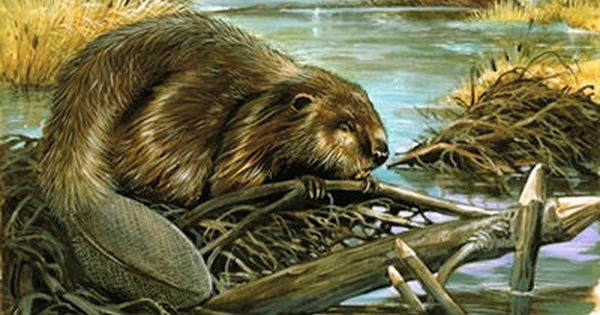
The fur traders’ hot market for beaver pelts in colonial New England soon reduced beaver populations, and fewer beavers meant fewer beaver ponds, an important source of the local Native diet, including roots and waterfowl.
Beavers were only the first of many species afflicted by European settlement in the Piscataqua watershed.
That was followed by the construction of mills, which were powered by water, and that meant dams. Some impounded incoming tides for release a few hours later. These were tricky to operate, though, and changed speeds depending on the strength of the incoming tide or the level of the water during its release.
Dams at the waterfalls became more common.
Either way, dams impeded upstream migrations of fish trying to return from the sea to their spawning grounds. These included salmon, sturgeons, eels, and river herring. Their reduced stocks afflicted both the Natives and the English inland fishing industry.
The mills also produced copious amounts of sawdust that choked river bottoms, reducing and killing off additional species.
The demand for timber itself cleared land all the way back eight to ten miles from the riverbanks, further eliminating wild game. The wood was needed not only for the sawmills but also as fuel for brickmaking, domestic cooking, and warmth through winter. Heating a house commonly required 40 cords of wood a year – no small feat of labor.
And runoff muddied and silted the streams.
Let’s not get too sentimental about the bucolic nature of the era, OK?
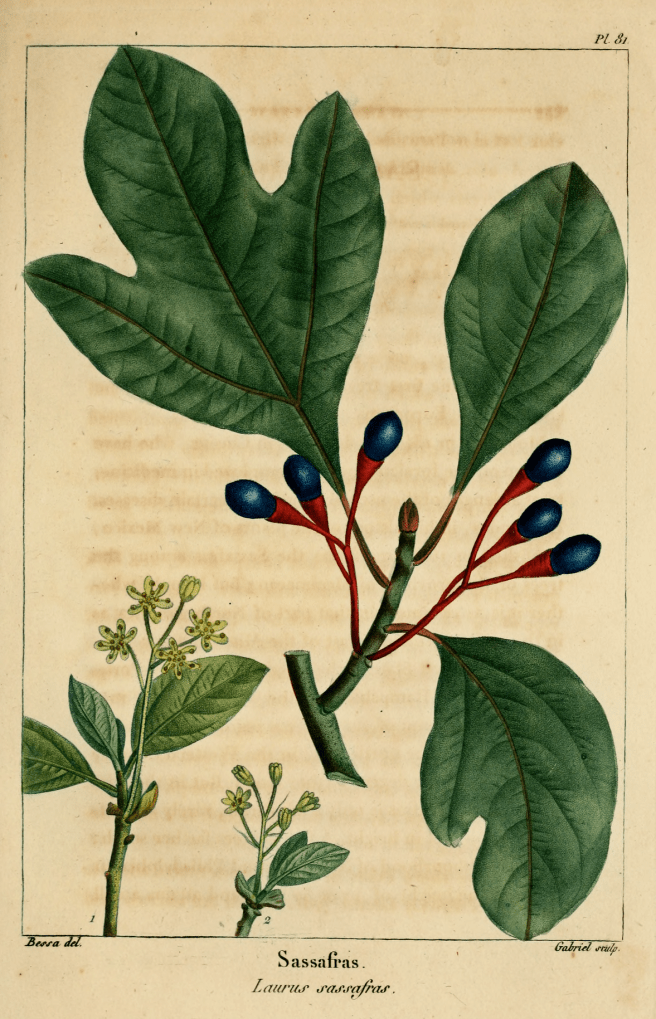
Martin Pring, after becoming the first known European explorer of the Piscataqua River in 1603, then continued south to Cape Cod, where his party engaged in harvesting sassafras tree bark and roots, “a plant of sovereign virtue for the French pox,” as he elaborated in his journal. It was highly lucrative back in Europe and would handsomely repay the Bristol investors backing his journey.
French pox, do note, was what we now call syphilis. If only it worked as a remedy or a cure.
Sassafras was also touted as “good against the plague and many other maladies,” as well, just in case. And you thought it was merely a “tonic” served as tea or the flavoring for root beer?
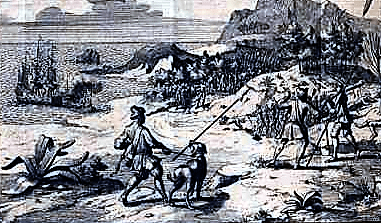
During their six weeks ashore at Truro, Pring’s crew built a barricaded encampment. It was often visited by as many as 60 Wampanoag at a time, sometimes bringing different kinds of food to the party.
In one instance, in response to the playing of a kind of guitar, groups of up to 20 broke into dancing in a ring and singing “lo, la, lo, la, la, lo,” which works when you don’t know the words. For his part, the young musician was rewarded with gifts of tobacco and pipes, fawn skins, and snake skins up to six feet long, “which they used for girdles.”
But it was an uneasy relationship. Pring’s two mastiffs in particular terrorized the Natives. Anytime the sailors felt threatened, they’d release the big canines. As Pring recorded, the Wampanoag were more afraid of the two dogs than they were of 20 men.
The tension finally exploded when about 140 “savages armed with their bows and arrows” approached the barricade and a “a piece of great ordinance” was shot off in response as a warning and call to arms.
Recognizing that they’d worn out their welcome, the Englishmen quickly packed up and scooted off behind the protection of the mastiffs and set off for home while the Wampanoag set a mile-width of forest aflame and chased the ship in their canoes.
Of course, we’re never told what so soured the relationship. I doubt that the mariners were very tidy or respectful in their ravaging the forest, and I suspect that may have had something to do with their reaction.
Still, when the Pilgrims arrived in 1620, remains of Pring’s palisades were still visible.
What do you imagine had so enraged the Wampanoags?
Whatever it was, it seemed to set the pattern for much of what followed.
~*~
The episode is rarely told in American history, and, when it is, it’s quickly skimmed over.
Like so much of the New England record that follows, we’re rarely given the Natives’ side of the events.
One thing we can be sure of, though, is that there were huge differences in expectations and values, to say nothing of hygiene or manners.
For instance, as I’ve heard, the Wampanoag word for “treaty” translates as “making relatives,” which is hardly what English settlers had in mind for their part. Far from it. Something similar no doubt happened when the colonists “purchased” land from a sachem.
As the Wampanoag believed, “the land knows you,” more than the other way around.
Quite simply, from their end of these transactions, they were betrayed.
~*~
These days, residing in Downeast Maine – that is, Passamaquoddy country, which stretches over into Canada as well – I’m learning of another series of these one-sided deals.
Joe Clabby’s excellent A History of Eastport, Passamaquoddy Bay, and Vicinity chronicles much of the federal and state maltreatment, misrepresentation, and mismanagement regarding the tribe and its members. One instance, by no means the most outrageous, is this, from 1950: Indian Agent “Hiram Hall allowed the state to charge the Passamaquoddy Fund $8,000 per home for home construction (the homes are worth only $2,500).” This came more than a year after the tribe requested that the state remove him for misappropriation of state aid, favoritism, and disinterest in tribal government.
Driving to and from Eastport, I pass many of these houses, now in serious need of repair. Don’t blame the residents.
As I relate in my new book New England relations with the Natives got off on the wrong foot, starting with the kidnapping of Squanto and four others. (Virginia hadn’t done any better.)
One of the first thing the colonists typically built was a sawmill. From what I’ve seen to date, it always came before a gristmill. I would have thought food would have been the priority, but there are suggestions they imported their flour or even bread instead.
That raises questions of just exactly what their meals were. The Puritans were devoted to their beer and tobacco – and that extended to even their children.
For that matter, how early was Beantown a synonym for Boston?
More than a dozen years after the settling of Hilton Point just across the river, Alexander Shapleigh built the first of two tide mills at his Kittery House estate. Water from the incoming tide was impounded and released later in the day to power the mills. Here’s the site today.The mill pond remains in today’s Eliot, Maine.
So why sawmills? The early settlers along the Piscataqua apparently erected log cabins, along with fortifications. For that matter, the sole surviving garrison house, preserved at the Woodman Institute, was essentially a log cabin built around 1675.
But flat boards were needed for shipbuilding, wharf planking and bridges, and barrels – for shipping dried fish, especially. Perhaps lumber itself was also an export to Barbados, the Bahamas, and the West Indies.
Let’s remember, too, the construction of dams and mills and their operation required sophisticated skills.
I’m guessing that few of the early English settlers along the Piscataqua were menial day laborers.
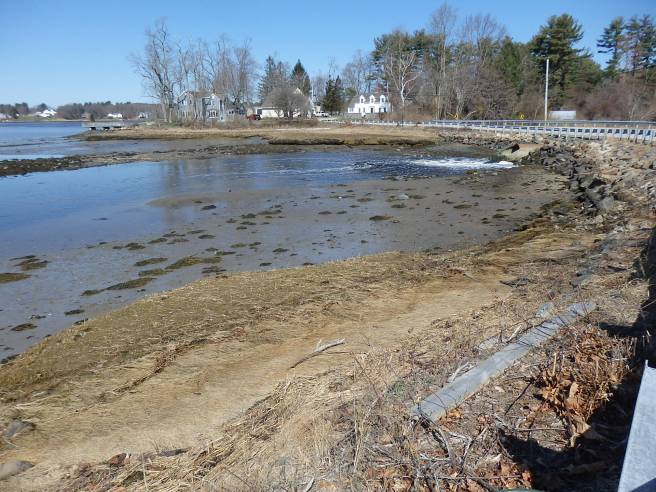
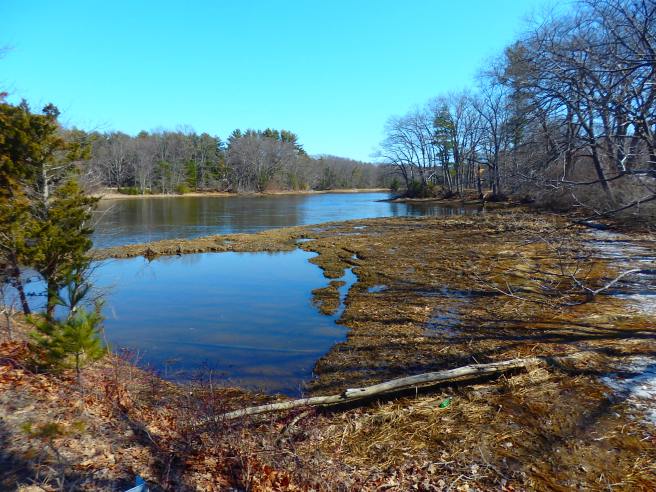
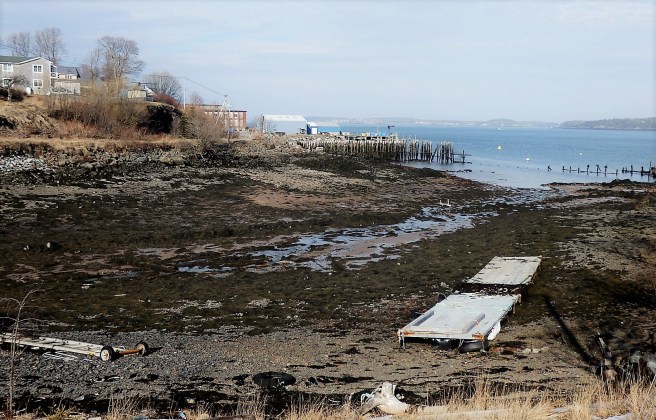
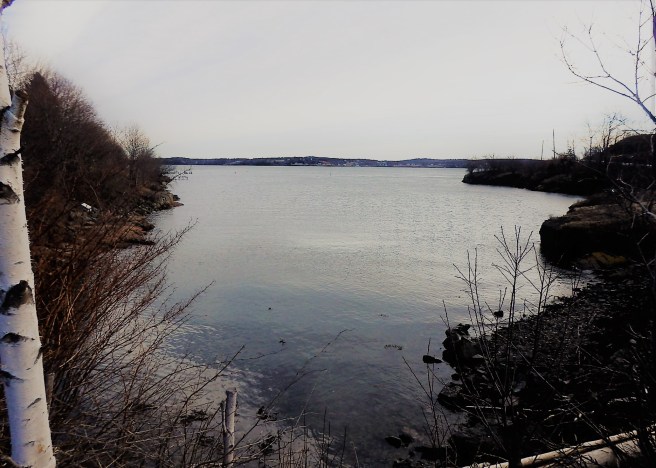
This cove is where Caleb Stetson Huston became Eastport’s most noted shipbuilder and marine architect. Here he created more than one hundred vessels from 1840 to 1870, surpassing the number of his father, Robert Huston, had built. He was no doubt responsible for repairing many more.
A third-generation shipbuilder, C.S. Huston at one point owned four shipyards on Shackford Cove – his father’s, on the south side of the water, and the William H. Hall and Jacob Shackford yards on its north side, as well as Aymar’s spar shop at the South End bridge, which has long since been filled in.
And how it can look six hours later.
As an innovative entrepreneur, he early on erected a steam capstan to haul boats out of the water, along with a 600-foot marine railway made of thick beams set up as interlocking boxes filled with stones.
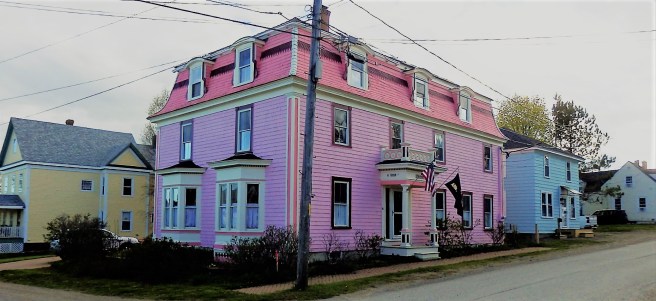
Huston lived in a Second Empire style house overlooking the yards, which he purchased from Hall in the late 1850s.
Part of the C.S. Huston house on Third Street incorporates a section of the “Red Store” that John Shackford erected in 1787 at the foot of Shackford Street.
The shift to ships built of steel rather than wood changed everything. Maine had seemingly endless lumber at hand, but not steel. That also allowed for bigger vessels, meaning fewer could suffice for shipping. Finally, with the advent of the automobile, passengers stopped relying on steamships and that, too, ceased at the corner of this cove. But not before the world’s largest sardine cannery extended from its shore – a building 250 feet long.
This is what I got in the mail from our cable company, a month or so after it had hiked our broadband fees by 30 percent. He they were now, returning with a pitch to cut the monthly bill to $5 under what we were paying earlier but with television channels included.
The first problem? We don’t have TV and don’t want it!
“Redeem your upgrade today.”
Who are they kidding? You can bet that a year from now that monthly bill will skyrocket. Trying to scale that back to where we were would be with just the broadband becomes the second, and bigger, problem.
Of course, the third problem overshadowing all of this is the inefficiency of unchecked monopoly. Where are the Teddy Roosevelt Republicans when we need them?
How do these companies justify their rates, anyway?
One of the things the Dover 400 project is doing is raising an awareness of the Indigenous peoples who inhabited the region for millennia before European colonists arrived.
The tribes were far more varied than the generic “Indian” label conveys. Sometimes they were in open conflict with each other, and there were many differences in language, culture, and lifestyles. There were also alliances with other tribes, creating subtle but significant relations across the region.
Some lived in permanent villages, often along streams. Others ranged from ancestral site to site through the year in a cycle of fruit, vegetable, and animal fare.
As hunters and fisherfolk who often traveled by water and lived in villages along the shores, many of their names for places are often translated as some variation of “water,” with distinctive nuances that are lost to Western ears but still hint of sharp observation of the character and advantages of each site.
Their name for Hilton Point, for example, is something along of the lines of “place encircled by water,” while Cochecho is more like “foaming falls,” each one, however, unlike other points or coves or waterfalls.
As for our own names applied to these places? I doubt we give them a second thought other than perhaps their spelling.
And, to our loss, we have none of their mythopoetic stories in their original richness – narratives rooted in their unique environment. At least we can begin to listen to those told by surviving tribes in neighboring Maine.
There are good reasons the Abenaki and other New England tribes didn’t dress like the High Plains Natives far to the west.
~*~
WHEN THE ENGLISH ARRIVED in New England, most of the tribes had been decimated by pandemics, many of the illnesses resulting from contact with earlier explorers and traders. The sharp loss of population gave the Pilgrims an opening in their settlement at Plymouth.
The first traders brought items the Natives appreciated as useful – metal pots, knives, blankets – that could be obtained in exchange for furs.
As we know, the dynamic changed. We’ve rarely heard the Indigenous voices tell their side of the struggles. The English, French, and Dutch all have barbaric actions to atone for.
The marker at Ambush Rock on Route 101 in Eliot, Maine, for example, makes it sound like the victims were an innocent party on its way home from church one Sunday in 1697. There’s no mention that the prime target, Major Charles Frost, was Richard Waldron’s cohort in the notorious “games” of 1676 that ended up in the arrest of nearly 400 Natives who were then executed or sold into slavery. The Natives waited 21 years for revenge. Frost was the highest-ranking militia officer in Maine.
For me, the missing details change my view of the event entirely. It’s not an isolated instance.
~*~
DOVER WAS IN PENNACOOK COUNTRY, a tribe closely related to the Abenaki – the identities are sometimes merged, suggesting change over time. The Pennacook spanned over much of New Hampshire, neighboring Maine, and parts of Massachusetts. The English jurisdictions didn’t match theirs.
Another consideration is how many of the English settlements occurred at earlier Indigenous villages, as seems to be the case both at the falls in today’s downtown Dover or neighboring Exeter, Newmarket, Durham, Rollinsford, Somersworth, and South Berwick.
A wigwam at the Plimoth Plantation living history museum allows visitors to explore a typical Indigenous winter dwelling. The interior is bigger than you’d expect. (Photo by Swampyank via Wikimedia Commons.)A Pennacook encampment much like those in the Piscataqua watershed.
~*~
ONE THING THAT WAS OBVIOUS TO ME in a visit to the Plimoth living history museum in Massachusetts was how superior the Wampanoag’s communal wigwams were for living through winter compared to the Pilgrim’s drafty cottages of 1630.
I’m sure the same can be said of the shores of the Piscataqua.
As our City in the Bay has been redefining itself, in part thanks to its lively arts scene and surrounding natural wonder, tourism has been ticking up, even in the face of Covid-19.
Part of Eastport’s appeal is the deepest natural harbor in the continental U.S., a port that at one time, back when there was a lot of smuggling, was the second-busiest in the nation – something a shift in federal tax laws and heightened enforcement soon curbed.
Still, we have a long history of steamship travel, right up to the auto age.
And now, this year, hooray, we’re even anticipating the return of passenger vessels, albeit of the increasingly popular “small” ship variety rather than the floating cities that can overrun a seaport.
First, the 210-passenger, 325-foot Pearl Mist is scheduled for five visits, most of them 3½ hours ashore, as part of a seven-night round-trip out of Portland. Other stops on its Fundy Bay circuit include Rockland and Bar Harbor in Maine, and St. Andrews, St. John, and Grand Manan Island in New Brunswick. Fares run from about $4,000 and up.
Second, in September we host the innovative 530-passenger, 459-foot Roald Amundsen expedition ship on a 10-hour stopover. Originally, this was to be part of an adventurous 44-day navigation across the Arctic Ocean in a Northwest Passage venture from Vancouver, British Columbia, an ultimate bucket-list voyage. But the fares, starting around $57,000, may have been too pricy for the Covid-antsy market, causing it to be broken up into segments – the first ending at Nome, Alaska, and the second continuing from there on to Greenland and ending at Halifax, Nova Scotia. Eastport is now tucked in as the cherry in a shorter, more affordable, New England dessert.
More exciting is the news that the Amundsen is now scheduled to return next year as part of an even more audacious 94-day cruise – a Pole-to-Pole adventure that will originate in Vancouver, British Columbia, and traverse the Northwest passage before coming to Eastport and then continue on to equatorial warmth, the Panama Canal, the Pacific coast of South America, and finally shore visits on Antarctica. Think of going from icy summer to the edge of autumn in New England to the tropics and on to spring while exploring three continents. The lowest fares figure out around $600 a day.
And little Eastport will be part of that.
In Maine, the bulk of the cruise action hits Bar Harbor, at the edge of popular Acadia National Park, where frequently two ships a day debark during the summer season, and in Portland, which gets especially busy during the fall foliage season.
We’re really not set up for the mega-cruise vessels that have dominated the industry. Let’s see how our emerging niche shapes up.