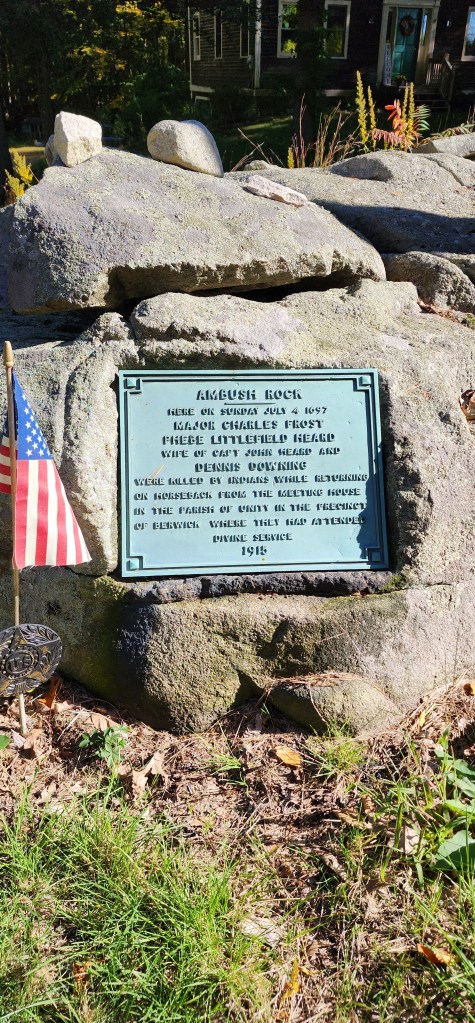
Ambush Rock

What the marker in Eliot, Maine, doesn’t mention is that Major Charles Frost and Dover’s Richard Waldron concocted the mock wargame that led to the hanging of Native men sent to Boston and the sale of about 350 Penacook women and children into slavery in the West Indies.

This was hardly an attack on an innocent party, then. The Natives waited years to extract revenge, and did it at a time and place that spared others.

My history Quaking Dover adds details.

English relations with the Natives were strained from the very beginning

One of the troubling revelations I found in researching my new book Quaking Dover is the depth of the English injustice and violence toward the Indigenous people of what we know as New England. It goes all the way back.

Forget the happy images of that first Thanksgiving feast where the Natives are portrayed as the special, very welcome, guests of the Pilgrims.

Squanto, after all, had been kidnapped, enslaved, and spent five years in England before the first English settlement took hold on Plymouth Bay.

Explorer Martin Pring, who established a fortified camp at Truro on Cape Cod in 1603, fled under attack by enraged Natives after he had set his mastiffs on them and fired his cannon in their direction.

The Pilgrims’ military leader, Myles Standish (not one of their faith, by the way), led the 1623 Wessagussett massacre, prompting Natives to abandon their villages for safer ground.

The Pequot war, 1637, was ultimately a land grab ending with the construction of New England’s first slave ship to trade the Native survivors into slavery in the West Indies in exchange for Africans.

And that’s before King Phillip’s war, with the mock wargame in Dover, or the waves of combat across northern New England until the treaty ending the French and Indian wars in 1763.

The outlook, of course, of “savages” and “heathens” was only part of the problem. The English insisted on addressing legal conflicts only in colonial courts. Not surprisingly, the decisions all seemed to come down against the Natives, with no independent course of appeal.

The pressure finally exploded in 1689 with the devastating raid on Cochecho Village and then Oyster River, both in Dover – hostilities that would continue another seven decades.

Are you ready for a fuller story?

When you see someplace you’ve known now in the news

The train derailment in East Palestine, Ohio, has me mentally revisiting a part of my landscape from forty years ago.

At the time, I lived two counties to the north but was a member of one of three old-style Quaker Meetings in Columbiana County, where the accident took place. So I was down there at least once a week most of the year. The county was a mix of industrial and suburban, especially where it bordered Rust Belt Youngstown, and rural Appalachia along with touches of New England. One corner abutted the Ohio River and West Virginia.

The rail line in the headlines was like those running through a small city where I had worked in another corner of the state, a place I call Prairie Depot in my fiction. And East Palestine itself could be adjacent to the city at the core of my novel, Hometown News.

Churches included Mennonite and Brethren, in the peace tradition, as well as Evangelical Friends at the other end of the Quaker spectrum.

Retracing the terrain via satellite maps, I was struck by how much I’ve forgotten, even parts I had known fondly. Others were pretty gritty, even back then.

From a distance now, it’s like encountering a ghost in a haunted house I thought I’d left behind.

As an alternative to ‘they’ for just one body?

I’m sorry, but I have real difficulty in using a plural pronoun to refer to just one person. I don’t want to get into the political ramifications here or gender limitations of our language or other arguments. To call one person “they” has me looking for the rest of the group. And when that “they” is being discussed at the same as “their” family or coworkers, I’m left with no idea who’s really being discussed. Life’s already confusing enough.

How about a whole new set of pronouns?

Let me offer “vey,” “vem,” “veir” for consideration. (I actually misheard “they” as “vey,” which got the ball rolling.)

It’s a way we can tell vem apart from veir family, household, even team.

Yes, I know the gender identity objections, especially when all (collectively) are placed under a masculine pronoun. I can even object to that practice by noting the confusion at times of ambiguity when trying to apply it specifically to males-only.

What can we do to gain greater all-around clarity rather than muddy the language further? 


Massachusetts’ treasonous coins

One of the many surprises I encountered in researching my book Quaking Dover was the fact that the Puritan authorities in Boston were ready for revolution from the git-go, way before Paul Revere.

I’d like to see more of their history presented from that riotous side.

There were the cannons they set up on Boston Harbor in 1634 to fire on Royal Navy vessels, should they come to follow up on the king’s voiding their charter. As things developed, Charlie the First got distracted from his problems over here and thus those volleys were never fired.

For another example, we can look to the coins John Hull produced from 1652 plus others for the next 30 years, even though the new king, Chuck Two, soon declared the practice treasonous.

Yes, treason. Off with your head or mere imprisonment in the Tower of London, that sort of thing.

Leap ahead, I’m wondering how he would have handled credit cards and their depths of debt and to me, at least, usurious rates.

Looking at some of those figures today, is anyone ready to say “Off with their heads?”

Maybe ancient history isn’t so far back there after all.

On top of it, the colonists had no representation in Parliament. That had to chafe on their identity as Englishmen through and through.

That was compounded by the costs London imposed on the Americans in defending themselves from the attacks by the French and their Native allies in the decades of warfare prompted by petty European royal succession and alliances. The New Englanders were definitely on their own.

A big question is what made the ruling Virginia Cavaliers turn from Loyalist to revolutionaries? Plus, why did it take so long?

How to lose customers, chapter something or other

Perhaps you’ve called your auto dealer for a service appointment and been surprised to face a two- to three-week wait in the schedule. Yeah, yeah, blame it on the supply chain issues and the worker shortage.

Our nearest franchise has responded by limiting appointments to cars purchased there. Everyone else can be put on a waiting list, should a cancelation create an opening. Never mind that I’ve been a loyal customer for two years since moving from New Hampshire.

What miffs me is that when I bought my car before the opportunity for our relocation developed, my choice of the American-made brand was based on an awareness that it was the core of the only new-car dealer in Washington County. Its nearest competition is 2½ hours away or somewhere over in Canada.

I’ve been happy with the service department, even if it is a haul up the highway and back. Frankly, though, the car itself has left me wishing I’d stayed with Toyota.

Adding fuel to the fire is the coupons for discounts that show up in my inbox, sent from Detroit but applying only to the brand’s service departments.

Instead of encouraging me to buy my next vehicle there, I’m feeling ill will. In today’s business world, that’s not a good thing. You spend a lot on advertising to get a new customer. Maintaining an ongoing relationship is much cheaper.

As for those annoying “How are we doing” surveys that show up after an appointment, I do wish I’d get one now so I could say just how peeved I am.

I’m still in the dark about how they actually conducted business

There were no banks and you couldn’t write checks.

Were dried fish and lumber so valuable in Britain and the Continent that you could still make a fat profit shipping them across the ocean? Furs, I can understand, as well as the hunger for gold and silver, which may have fueled speculators who were inevitably disappointed. Plus fish, likely dried.

As for paying your workers? A daily portion of rum or the like was apparently often part of the deal.

By the way, Quakers were in the forefront of developing banks and insurance and even packet shipping in time.

The early colonies had layers of ownership, starting with those demanding annual quitrents for the land you would clear and build on or have “purchased” with any improvements. Then there were the chartered investors, like Lord Saye and Sele and Lord Brooke in New Hampshire’s case, who somehow expected to make a profit overseeing the place. They still had obligations to other investors, like the Council for New England. I’m really unclear how all of that worked in practice or what they got from “selling” their charter to Massachusetts.

The best I can come up with is that it was a kind of private enterprise tax, though I’m not sure what was offered in return. Like Mafia “protection” or layers of graft?

And that’s even before getting to England’s heavy mercantile system that hampered American entrepreneurial opportunities. The colonists were expected to provide raw materials for manufacture in England before being sold at hefty markups in the New World, too.

How did the colonists ever thrive, all their hard work aside?

I’m thinking it’s almost as vaporous as bitcoins.