Singing together without masks at last

As we came together in a shared physical space after Covid, we continued to wear masks as a safeguard against resurgences of the virus. Choirs were, after all, a major source of contamination.

We even gave several concerts donned in special masks that gave us extra breathing room. But they did muffle our sound and diction while also fogging our glasses.

What a relief, then, when our director agreed about a month before our last set of concerts that we could go without the masks, if we individually desired.

What a difference it made! We were clearer in tone and lyrics, and our sound projected better. Our ability to hear each other also improved. It was like being unshackled.

It was like declaring the pandemic over, though we knew the virus was lingering.

What single move gave you that ah-hah! Breakthrough as we came out of the Covid onslaught?

As a reminder from the dominant side

The ruling Puritans in New England had reasons for opposing the Quakers, something I need to remember in the midst of my Quaking Dover arguments, They don’t get much sympathy in their objections, at least from my audiences.

As Dover First Parish historian Donald R. Bryant put it, “The Quakers did not conform with the orderly practices of the Puritan churches. They would not join in fellowship, and met among themselves, propagating their own beliefs. Many of them did not do this quietly, but in a manner that was disturbing to regular church members. They were apt to interrupt a meeting or a preacher, or to even interfere with the proceedings of a court. They insulted church order and disturbed the peace. Their conduct was described as ‘indecent and provoking.’”

Some of these points still sting as I look at today’s political and social polarization.

Sawyer Mills usually get overlooked

The town’s textile mills don’t get a lot of attention in my book Quaking Dover, in part because I haven’t found a lot of interaction between the emerging industry and the town’s Friends. Indeed, the Quaker Meeting was seriously aging about the same time the thriving mills transformed the town into an industrial power.

Dover’s conventional histories, on the other hand, have good reason to focus on the big brick mills along the Cochecho River, world famous for the quality of their calico and their stunning print designs and execution.

You might be surprised to learn, though, that they were in operation much earlier than the legendary cotton mills at Lowell, Lawrence, and Manchester on the mighty Merrimac River.

Largely overlooked, as one Friend reminds me, are the woolen mills on the Bellamy River south of Dover’s downtown and only a few blocks from the Quaker meetinghouse. These operated from 1824 to 1899 and were often innovative, employing up to 600 workers before being sold and continuing till 1954.
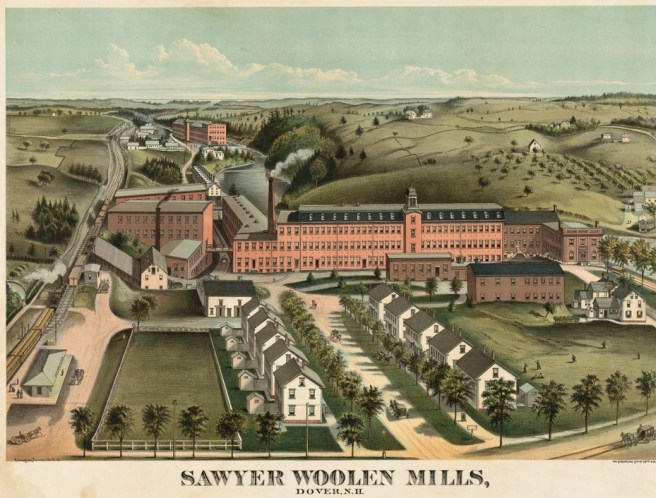
They were renowned especially for their flannel and were, at stretch, the largest woolen mills in the Granite State.

Today the mills and their historic housing have emerged as a charming residential district.

While there were some Sawyers in the Meeting, I’ve not yet found any connection to those owning the mills.

Based on the naming of some of their children, those were apparently Methodist.
My range didn’t expand to the whole state

Statehood for New Hampshire was accompanied by growth in the Merrimac Valley and western side of the state, including Quaker Meetings.

Weare, especially, became a Friends center, with two large meetinghouses in town and another in neighboring Henniker. There was also the Clinton Grove academy.

Much of that growth, however, came from Massachusetts, not Dover, and so it fell outside the focus of my Quaking Dover story. They were even in a different Quarterly Meeting than the one encompassing the communities emanating from Dover.

Just in case anyone was wondering.

As for a broad history of New England Quakers?

It would be an ambitious project, and I’m not sure quite how one would structure it, spanning six states and many subjects as it would from early colonial times to today.

Dover Friend Silas Weeks’ book of meetinghouses and burial grounds remains my go-to volume, but it’s mostly about buildings rather than people.

I’m still surprised to hear Rhode Island Yearly Meeting as the body’s early name, rather than New England Yearly Meeting. When did it change officially?

Well, I have seen some genealogies that get impossible to follow after, say, the third generation.

I even feel something like that in Dover, once the textile mills take over.

Still, the conventional histories of Quakers in America focus on Philadelphia, overlooking or slighting the unique challenges and characters of New England, North Carolina, Ohio, and more.

For now, my Quaking Dover is a microcosm of the bigger picture. I’m hoping it will prompt more.

It’s been a slow season for tourism, and even the summer rentals are down

From the start of our travel season, things here have felt slow. I haven’t seen as many cars as I have in the past or as many states represented in their license plates, for one thing. While there are people on the streets, they’re not crowds.

Even down on Cape Cod, summer homes are available rather than reserved long in advance.

Somehow, we’re hearing that retail sales have been holding up, but we’re also seeing more vacancies in the Airbnb options, too. (The latter hits us as good news, considering how the investment buyers have been skewering the home market away from working families we desperately need.)

Still, visitors are the key to retail businesses in our part of Maine – our version of Black Friday has already passed or soon will, unlike the day after Thanksgiving push elsewhere. Maybe the visits by cruise ships in the foliage season will provide a much needed boost.

Could much of this reflect the reality that inflation is finally pinching family budgets?

That record flooding gets personal  

Looking at the news of Vermont’s flood damage, I’m seeing places I know and have traveled. Towns I pass through on my way to and from Quaker Yearly Meeting sessions at Castleton University, for instance, all now heavily hit. I wonder about some of the covered bridges I anticipate visiting or places I stop for a stretch, too.

I’ve been waiting to hear from a dear friend, especially, though I know his home is high above the stream running through town. Still …

My wife and I retain strong impressions from seeing the devastation from Hurricane Irene nine or ten months after it delivered its wallop. You wouldn’t believe the extent unless you saw the evidence.

The mountains become a funnel for the falling water, and many of the roads have nowhere to go but beside the streams. People, of course, live along the roads … many of them at the foot of natural chutes from the hillsides.

It’s not just water, either, but the boulders and gravel it unleashes.

There are real stories that will unfold long after the TV cameras and breaking news headlines have moved elsewhere.

But it does make a difference when events do somehow seem to reflect home for you. Or when you look for what I think of as “slow news.”

So where were the Baptists in New Hampshire?

Dover’s third minister, Hanserd Knollys, no doubt laid a foundation for the Quaker message two decades after his brief tenure in the town pulpit. He was beset by controversy and even a physical skirmish or two, but he organized the church as a Congregational society even as his own theology was evolving into Particular Baptist.

Some of New Hampshire’s early Baptists did relocate to New Jersey, where they named a town Piscataway, in honor of Dover’s Piscataqua River. And Knollys himself became the pastor of London’s first Baptist church, once he had fled New Hampshire and the New World.

By the way, the number of colonists who returned to England from America still amazes me. How could they even afford it, much less the time involved?

Some of his challenges to conventional Christianity, like rejecting the baptism of infants, opened the way for Quakers to build on, once they arrived.

Still, I couldn’t get a clear picture of the existence of the Baptists as New England’s other dissident denomination in the colonial era. Was it all down in Rhode Island, where they contended with the Quakers over the governance of the colony?

My own book, Quaking Dover, concentrates on Dover Friends Meeting and its families, once they’re established, but the Baptists seem to be largely invisible until the Revolutionary War or so.

Carla Gardina Pestana’s Quakers and Baptists in Colonial Massachusetts now provides an understanding of the faith north of Rhode Island. Essentially, it was long comprised of one church in Boston, and its members were scattered across the region, rather like a network of solitary souls. The church underwent an evolution over the years, from lay ministry to ordained pastors, and ultimately presented less of a threat to the Puritans/Congregationalists than did the Friends.

Still, their insistence on a separation of church and state and their view of a church being comprised of fellow adult believers rather than a place one had to attend regardless of one’s heart and thinking were liberal and revolutionary.

Pestana’s description of the impact of the Great Awakening on the Baptist movement gives me a clearer understanding of why so many of its churches appeared in and around Dover – and the rest of New England – in the early 1800s.

Adding to the memories

Sailors who visited Eastport for the Fourth of July voiced their amazement at the pilot who guided their U.S. Navy destroyer vessel at the Breakwater pier in some very dense fog.

They could hear the conversational voices of humans on the pier and shoreline but couldn’t see a thing. We could hear them but not see them, too.

And then they were landed, gently and safely.

They told us he was a magician, and from my angle of observation, it was true. Even the commanding officer was most amazed, in what became a memorable experience.

Oh, those clean starched white dress uniforms

The 350 U.S. Navy sailors who descended on Eastport for our extended Independence Day festivities were the first to uphold the longstanding tradition since before the Covid pandemic.

They were a welcome contingent in our small community, often appearing in their pristinely ironed white uniforms, which do look impressive even though, as I was told, they can be a challenge to keep clean. You have to lean way over while eating, for instance, to keep from spilling anything on yours. Not that we noticed any dirt when they marched as a big bloc in the grand parade Tuesday afternoon. At least the sailors and officers who fielded teams in the very messy cod relay contest the previous day were more practical in their dress.

What they got was a six-day taste of small-town America having summer fun.

As the police chief reported, “the Fourth of July was relatively quiet, aside from a couple of fights involving sailors … which were handled by the crew from the Navy ship.”