Oh, those clean starched white dress uniforms

The 350 U.S. Navy sailors who descended on Eastport for our extended Independence Day festivities were the first to uphold the longstanding tradition since before the Covid pandemic.

They were a welcome contingent in our small community, often appearing in their pristinely ironed white uniforms, which do look impressive even though, as I was told, they can be a challenge to keep clean. You have to lean way over while eating, for instance, to keep from spilling anything on yours. Not that we noticed any dirt when they marched as a big bloc in the grand parade Tuesday afternoon. At least the sailors and officers who fielded teams in the very messy cod relay contest the previous day were more practical in their dress.

What they got was a six-day taste of small-town America having summer fun.

As the police chief reported, “the Fourth of July was relatively quiet, aside from a couple of fights involving sailors … which were handled by the crew from the Navy ship.”

As for Happy Hampton?

In New Hampshire, Hampton is often touted as Happy Hampton, at least in summer, reflecting its long, broad, honky-tonk ocean beach and the rock concerts at the casino. Let me warn you it can be pretty crowded this time of year. Inland a bit, it’s also known for the Hampton Tolls on Interstate 95, which can be a major travel delay.

In the colonial era, Hampton was renowned for its saltmarsh hay and related agriculture.

It was also the center of the colony’s other Quaker Meeting, one at least as old as Dover’s, as far as I can tell.

As I was researching my book, Quaking Dover, I kept wondering what happened to the Hampton Friends over time. And then I discovered that, like Dover, Hampton had small, neighborhood worship groups, or “preparative meetings,” that came together once a month to address their joint affairs and personal conduct. The monthly sessions rotated among the meetinghouses under the Monthly Meeting’s care, in Hampton’s case including Amesbury, Massachusetts, which became home to the celebrated poet John Greenleaf Whittier.

Amesbury continues, while Hampton fell away long ago.

Since the boundary line between New Hampshire and Massachusetts kept shifting in the colonial era, sometimes reaching down to the Merrimack River – or Merrimac, as Massachusetts insisted – I feel safe in saying New Hampshire had two Monthly Meetings, while the Bay colony had only one, at Salem.

Either way, it could be a rich story in the telling.

Dover and Hampton were largely overlooked in Quaker histories

In the conventional telling of the early Quaker movement in New England, the focus soon centers on Rhode Island and Cape Cod. One was an independent colony; the other, in Plymouth, slightly less harsh than Massachusetts Bay to their north.

In contrast, the three northern Meetings – Salem, Hampton, and Dover – are largely overlooked or dismissed as agricultural and poor.

Well, a historian goes where the records are, and those three northern Meetings were largely underground before 1680, when religious toleration came to Massachusetts-governed districts.

Arthur J. Worrell’s Quakers in the Colonial Northeast is slim pickings when it comes to those three Meetings, and Carla Gardina Pestana’s Quakers and Baptists in Colonial Massachusetts helps rectify that with her concentration on Salem, but her references to Hampton and Dover are few and often cryptically sketched as “New Hampshire and Maine.”

Well, Dover served both sides of the New Hampshire-Maine line, and for decades, it was the only Quaker presence in Maine.

As I keep calling out: Hello!

By the dawn’s early fog

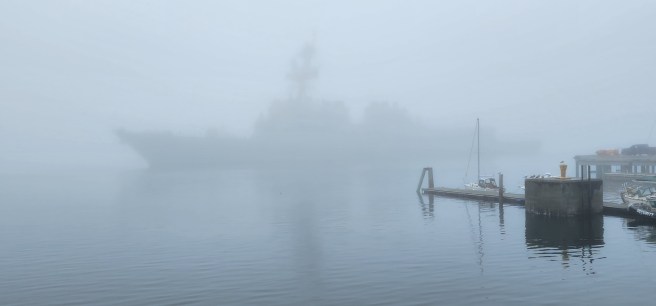
For the first time since the outbreak of Covid, Eastport is being graced by the presence of a U.S. naval vessel at the Breakwater for the city’s big Fourth of July festivities.

The USS Oscar Austin arrived in heavy fog Friday morning and will depart for Norfolk on the 5th.

The community rolls out a big small-town welcome mat for the crewmen, especially when the landing gives them their first taste of American soil in many months. (Not so, this time; they instead sailed up the coast.) The arrival is rather quaint, actually, even if their focus sometimes seems to be on the local bars. There is a basketball game between the sailors and the high school alum, too, though I doubt the stakes are high.

Eastport does claim to have the biggest Independence Day bash in the state, and the Navy’s destroyer is just part of it. .

Many of the sailors are being joined by their families, who will then continue with them on the final leg of this voyage.

Bringing such a vessel to dock is no small venture. The skipper of such a ship doesn’t just spin the compass to see where he’s going next. Rather, the itinerary is planned months in advance, with many protocols to be observed. In our case, that includes both U.S. and Canadian officials. The pilot’s plan document reads like a small phone book, minute by minute, and it’s not just about tides and currents at the expected time of arrival.

Heavy fog was a complicating factor, and we could hear the ship’s bold horn booming long before we could see the massive vessel emerge nearly alongside the Breakwater.

It materialized out of the fog and a very loud booming horn.
Details, including the crew, slowly came into view.
The ship was pushed to the dock by tugboats.

Massachusetts was primed for Revolution long before Paul Revere’s midnight ride

Quite simply, Britain betrayed the settlers in her colonies, from Ireland onward. The American plaint, “Taxation without representation,” reflected that all too succinctly. Where were the colonies’ representatives in Parliament or the House of Lords? What voice did they have?

The colonists identified as English but must have seen they were definitely second-class citizens. Or maybe third.

As I note in my book Quaking Dover, the Massachusetts Bay colony’s Calvinist intransigence had been at odds with the Crown from its inception. The first shot heard ‘round the world could have erupted at any point.

My pivotal question is just what turned the Loyalists in Virginia so far as to reject the monarchy as well and then join in taking up arms in the revolutionary cause by 1776?

The other colonies moved somewhere in between.

Not that all of this falls much within the scope of my little 400-year history volume as I try to keep a focus.

I hate having to admit an unexpected ugly side of the hippie outbreak

The ’60s and early ’70s unleashed a revolution, one I tend to see from the progressive side of the experience.

But after writing about it in many of my novels, I’m having to acknowledge a dark underbelly.

There was a strand of ghouls who opposed any kind of common action, including politics. They were deeply angry but wanted to hide in a hole rather than celebrate oneness with each other and the greater universe and then work to advance that awareness.

That points, unfortunately, to the Trumpist ultra-right wing or Libertarians with no broader community sense other than what they can get out of it directly – or otherwise get out of supporting, period.

What I’m having to see as anarchy.

Yup, I’ve overlooked those who just wanted to escape any, well, Peace & Love revolution outside of their own turtle shell.

Maybe that’s the side the younger generations have perceived all too clearly in their negative view of hippie, despite the many other aspects they openly pursue.


As for another taste of scandal?

Dover’s second minister, the Rev. George Burdet, made a quick exit from town amid scandals, quickly followed by more in York, Maine. He had even briefly been “governor,” or the agent in charge of the New Hampshire province, making him in charge of both its religion and politics. Or, as historian George Wadleigh quipped, a wannabe pope.

Beyond that, as I observed in Quaking Dover, Burdet “was obviously on a downward spiral, as Thomas Gorges wrote to John Winthrop in 1641, noting that Burdet was at Pemaquid and ‘is grown to that height of sin that it is to [be] feared he is given over. His time he spends in drinking, dancing, singing scurrilous songs, and for his companions he selects the wretchedest people of the country. At the spring I hear he is for England.’ Later that year, the younger Gorges added of Burdet, ‘the dishonor of his profession and monster of nature, is now gone for England by way of Spain.’ That description of drinking, dancing, and singing rather seals the Robert Dover connection for me, even if Merrymount’s Thomas Morton, the more obvious reveling partner, wouldn’t return to Maine for another year or two.”

I do have to wonder where the wild tavern sat in the early Maine settlement here.

So here’s where he spent that wild binge – 110 miles or so from Dover, or a two-hour drive away today.

Recent research has come up with a site for the jail. I do have to wonder if the Rev. Burdet ever served time therein.

As for Robert Dover, who gave Burdet the inspiration for naming the New Hampshire settlement? He was an anti-Puritan wit and attorney. That, in contrast to the South English port famed for its white cliffs.

Reports of the cleric’s subsequent movements vary, possibly ending in Ireland, “where he was named chancellor and dean of a diocese. He died in Ireland in 1671, ‘after founding a much respected county family.’ Had he reunited with the wife and children he’d left behind?” As I say in my book, “Or was he, in fact, a bigamist? Also, there’s no mention of prison.”

Turn to Quaking Dover for the details.

What my Pemaquid visit made me realize is how little history of early Maine I had encountered in drafting my book, and how tenuous so much of it I’ve found since remains. Yes, the early settlements, including Pemaquid, were obliterated and abandoned during the decades of warfare with the French and their Native allies, but there had been significant settlement before that, something that kept getting swept away.


One site, three successive forts in colonial history

Coming to Colonial Pemaquid’s state-maintained historical site in Maine, I wasn’t prepared to find this.

It was far more than the wooden palisades found across much of early New England. It looked to me far more like something out of Scotland or a Monty Python movie.

This wasn’t even a reproduction of the first fort there, but rather the second.

The first was Fort Charles, built 1677 after the village had already been destroyed. That fortification was overrun and destroyed by the French and their Native allies in 1689.

Most of the usual attention to warfare between the English colonists and the Natives focuses on King Phillip’s war, which heavily impacted southern New England. Much of the heaviest toll, however, happened in the decades after that when the tribes allied with the French to the north. Those outbursts afflicted northern New England, including Dover, New Hampshire, for decades later.

That’s where Pemaquid, fortified to hold the Maine at the edge of English claims in the New World, comes into play with my story, Quaking Dover.

Dover was often on the frontier of English settlement, a thin ribbon along the coastline but barely reaching inland and thus nearly impossible to defend, at least much north of Boston.

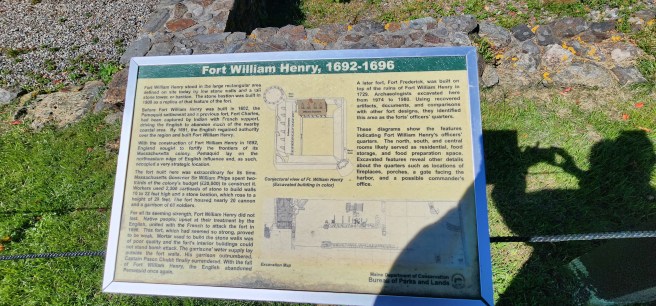
Once the English did reclaim this stretch of Maine from the French, the New Englanders built a new, second fortification, Fort William Henry, erected in the large rectangular area defined on the site today by low stone walls and a tall stone tower, or bastion. The stone bastion you see was built in 1908 as a replica of that feature of the fort.

As Maine’s online documentation explains, before the second Fort William Henry was built in 1692, the Pemaquid settlement and the previous fort had been captured by the French and their tribal allies, driving the English to abandon much of the nearby coastal area. By 1691, however, the English regained authority over the region and built Fort William Henry.

(I am fascinated by the tenacity of those who kept returning despite the costly odds.)

As you will find, with the construction of Fort William Henry in 1692, England sought to fortify the frontiers of its Massachusetts eastern district. Pemaquid lay on the northeastern edge of English influence and, as such, occupied a very strategic location.

The fort built here was extraordinary for its time. Massachusetts Governor Sir William Phips spent two-thirds of the colony’s budget (£20,000) to construct it. Workers used 2,000 cartloads of stone to build walls 10 to 22 feet high and a stone bastion, which rose to a height of 29 feet. The fort housed nearly 20 cannon and a garrison of 60 soldiers.
(Note that the costs were born by the New Englanders, not the British Crown.)

For all its seeming strength, Fort William Henry did not last. Native people, upset at their treatment by the English, united with the French to attack the fort in 1696. This fort, which had seemed so strong, proved to be weak. Mortar used to build the stone walls was of poor quality and the fort’s interior buildings could not stand bomb attack. The garrison’s water supply lay outside the fort walls. His garrison outnumbered, Captain Pasco Chubb finally surrendered. With the fall of Fort William Henry, the English abandoned Pemaquid once again.

(If this were fiction, I can’t imagine what to do with a name like Captain Pasco Chubb. Especially as an Englishman.)

Well, that’s an official account, one I for now I find no reason to quibble with. What does change my earlier perspective, however, is Fort Frederick, erected in 1729 and dismantled in 1775 to keep it out of British occupation in the Revolutionary war.

It never faced hostilities with the Natives, which seriously makes me reconsider a much earlier reoccupation of Maine by English settlers, something I had largely ruled out before 1763, the end of the French and Indian wars. Now see that’s not quite accurate, though it still seems to apply Downeast, where I now live.

So much for these confessions of an amateur historian.