Our annual salmon festival has me thinking of sardines

The American Can Company factory, now a hulk out over the water, had a daily output of more than a half-million cans for sardines. It employed 300 people. It was at the end of the line for the railroad, too.

In the adjacent canneries, sardine-packing women had hands moving so fast in cold water you saw only a blur, according to a friend who was a teen at the time and couldn’t begin to keep pace when he worked there.

I still have no desire to eat a sardine, though. Consider that the statement is coming from someone who’s learned to appreciate anchovies in his old age.

The Salmon Festival always takes place over the Labor Day weekend. 

The demise of AM radio

In all of today’s media upheaval, many younger users are puzzled by the term AM radio, while automakers are even considering eliminating the bandwidth from new vehicles altogether.

When I was a teen, this would have been entirely inconceivable. AM was king, period.

Dominated by clear-channel 50,000-watt stations that covered half of the country at night – and many having staffs of several hundred – they ranged down to much smaller voices that aired only during daytime hours, and even those frequencies were highly coveted by investors or niche nerds.

In contrast, FM was more limited in range and quite fringe. Many of the stations simulcast the AM sister’s programming. Others specialized in classical or jazz or “elevator music” for medical offices and retail store backgrounds.

Flash forward to today, when FM is where the audiences are. Not just for music, either, though much of the classic rock was crafted around the sound of AM top-40 formats. The shift of talk radio to FM sealed the deal.

I’m still surprised when traveling to find how little is available on AM, at least in English. More surprised, actually, to hear of station licenses being laid down and going idle, even in rural areas like the one where I’m living.

Gee, we might even begin wondering about the era of radio drama and comedy. Those really were something.

What are you listening to today?


As for Underground Railroad connections?

While Quakers were active in the Underground Railroad for fugitive slaves, the practice wasn’t universally embraced within the Society of Friends. In fact, much of the illegal action across the North was undertaken by evangelical Protestants who even created the altar call at revivals to enlist fellow workers.

Yes, it’s one more story in the American experience that needs to be better known, in all of its gritty reality.

As I describe in Quaking Dover, the Cartland family farm in Lee is believed to have been a stop on one of those lines to freedom. While documentation of such participation is rare, escaped slaved turned abolitionist Frederick Douglass was a frequent visitor to the farm, and like also its small Quaker meetinghouse and school.

The bigger question would be how did the fugitives get that far and where did the route head from there? Not everyone along the way was sympathetic, after all. Newburyport, Massachusetts, for one, was downright hostile and thus an unlikely place to jump ship. As for Portsmouth or Dover?

Establishing reliable yet invisible connections every ten or 20 miles would have been quite an accomplishment. What prompted households to risk everything to the moral cause? They were, after all, a threat to a vast economic system and its wealth.

It’s one more another interesting twist to develop in future research through New Hampshire.

Refreshing our salmon pens

Sunrise County – more formally, Washington County, Maine – and neighboring Charlotte County, on the facing waters in New Brunswick, are the center of some serious salmon farming. Cooke Aquaculture, a pioneer in the field, is a major employer in both places.

Without getting into the surrounding controversies, millions of salmon are shipped to market from these farms and are one reason the protein-rich anti-oxidant species is no longer a luxury item for most people. It’s a surprisingly healthy option, if you’re so inclined to investigate.

The local enterprise has even spawned Eastport’s annual Salmon Festival over the Labor Day weekend, which includes narrated boat trips to farms in our coves, typically clusters of 16 pens, and explanations of their care. Some locals describe the event as drawing an NPR kind of crowd, in contrast to our Pirate Festival the following weekend, which may be seen as more of a NASCAR following or its biker equivalent. (Please stay tuned.)

What I’ve found fascinating this summer is the flock of working boats busy around two of the farms in our fair city. The pens have been vanishing!

The reason, I’ve been told, is that every few years, the pens and their nets need to cleaned and repaired. And then they also lay fallow for a season or two.

Don’t know about you, but I’m impressed. Each pen starts out with a million and a half baby salmon. Maybe more.

And the filets we get do make for some impressive sashimi – raw fish that are a favorite in Japan, expensive in restaurants, and surprisingly easy to make at home. If you’re interested, check out some recipes online. My between-the-lines improvised sauces remain delightful, at least as far as me and my sons-in-law are concerned. (Pardon the English there, I’m yielding to their generation. Those boys really can skin a fish, by the way.)

From here, we’re most curious to see about how Cooke’s efforts at oyster and mussel harvests from our waters are also progressing.

The advice to eat local remains a spiritual discipline, as far as I’m concerned, not that it’s always practical where I’ve lived.

Now, what’s on your plate tonight?
Reconsidering a nest for alternative social progressive witness

One of the sides my Quaking Dover presentation for Cape Cod Friends awakened in me was a nagging awareness that some of the elements that encouraged social progressive action could also be used to sustain reactionary conservative activism from the other sides as well.

This could be seen especially in the U.S. Supreme Court’s overturn of the Roe decision, the result of a long-term resistance movement, where reactionary forces could claim  a victory.

Quite simply, both side have deep roots, perhaps unlike the middle.

My big question now is what makes one morally superior to the other.

The answers, I suspect, can be quite humbling. As well as a point of common engagement.

Of note across the street from Dover’s Quaker meetinghouse

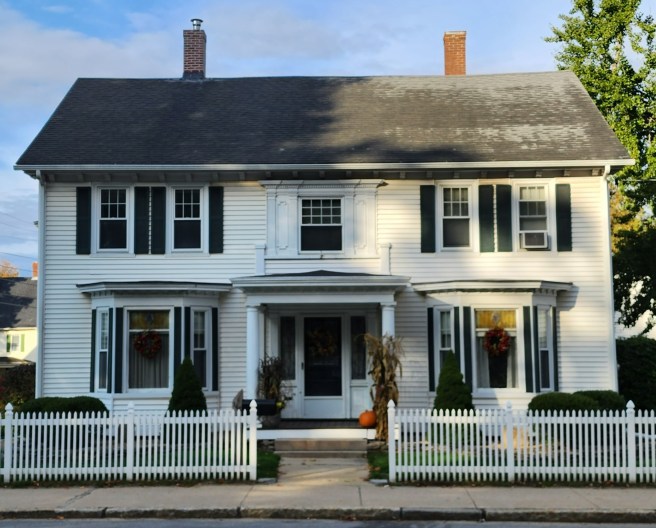
The home Isaac Wendell built by 1827 sits across Central Avenue from the Quaker meetinghouse.

I often parked next to it on the side street and admired the bird boxes and woodworking details on the ample barn and house additions.

He’s most noted as the cofounder with John Williams of the Dover Cotton Factory, the forerunner of the big mills downtown, but of interest to my story, he had married Anna Whittier, a close cousin of the celebrated poet John Greenleaf Whittier.

We can assume Greenleaf was a welcome guest there on his many visits to Dover.

Let me add, the relatively humane working conditions in the mills deteriorated drastically after Williams and Wendell lost control to new investors, leading to the first labor strike by women in America in 1828.

Wendell also shows up in the founding of the Sawyer Mills, which I discussed a week ago, as well as a foundry.

One of the many ways the dynamic of American society has changed in my own lifetime

As Dover First Parish pastor David Slater wrote in 1983: “Christianity is becoming more and more counter-cultural. In the 1950s public values were largely Christian values (even Protestant Christian values). Today we are more religiously pluralistic, but even more importantly, more secular. We can no longer assume that the values of the church will be shared by the larger society.”

How prophetic, considering where American society is today.

And how ironic, considering that his congregation embodied the common culture the Quakers in my book were countering.

Singing together without masks at last

As we came together in a shared physical space after Covid, we continued to wear masks as a safeguard against resurgences of the virus. Choirs were, after all, a major source of contamination.

We even gave several concerts donned in special masks that gave us extra breathing room. But they did muffle our sound and diction while also fogging our glasses.

What a relief, then, when our director agreed about a month before our last set of concerts that we could go without the masks, if we individually desired.

What a difference it made! We were clearer in tone and lyrics, and our sound projected better. Our ability to hear each other also improved. It was like being unshackled.

It was like declaring the pandemic over, though we knew the virus was lingering.

What single move gave you that ah-hah! Breakthrough as we came out of the Covid onslaught?

As a reminder from the dominant side

The ruling Puritans in New England had reasons for opposing the Quakers, something I need to remember in the midst of my Quaking Dover arguments, They don’t get much sympathy in their objections, at least from my audiences.

As Dover First Parish historian Donald R. Bryant put it, “The Quakers did not conform with the orderly practices of the Puritan churches. They would not join in fellowship, and met among themselves, propagating their own beliefs. Many of them did not do this quietly, but in a manner that was disturbing to regular church members. They were apt to interrupt a meeting or a preacher, or to even interfere with the proceedings of a court. They insulted church order and disturbed the peace. Their conduct was described as ‘indecent and provoking.’”

Some of these points still sting as I look at today’s political and social polarization.

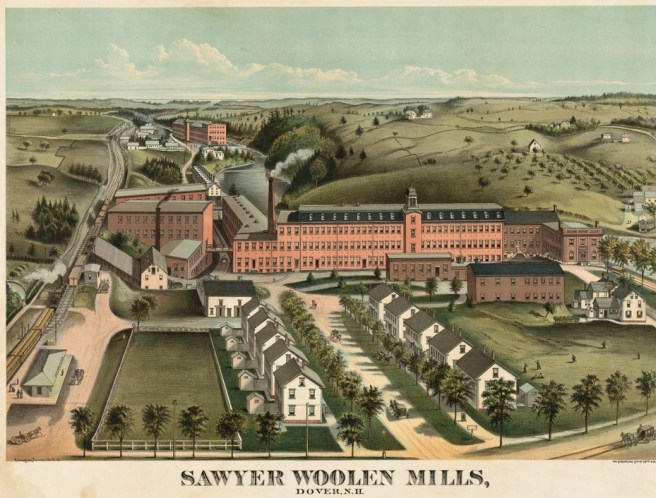
Sawyer Mills usually get overlooked

The town’s textile mills don’t get a lot of attention in my book Quaking Dover, in part because I haven’t found a lot of interaction between the emerging industry and the town’s Friends. Indeed, the Quaker Meeting was seriously aging about the same time the thriving mills transformed the town into an industrial power.

Dover’s conventional histories, on the other hand, have good reason to focus on the big brick mills along the Cochecho River, world famous for the quality of their calico and their stunning print designs and execution.

You might be surprised to learn, though, that they were in operation much earlier than the legendary cotton mills at Lowell, Lawrence, and Manchester on the mighty Merrimac River.

Largely overlooked, as one Friend reminds me, are the woolen mills on the Bellamy River south of Dover’s downtown and only a few blocks from the Quaker meetinghouse. These operated from 1824 to 1899 and were often innovative, employing up to 600 workers before being sold and continuing till 1954.

They were renowned especially for their flannel and were, at stretch, the largest woolen mills in the Granite State.

Today the mills and their historic housing have emerged as a charming residential district.

While there were some Sawyers in the Meeting, I’ve not yet found any connection to those owning the mills.

Based on the naming of some of their children, those were apparently Methodist.