Our fair little city has its tribulations, too

Heaven forbid I give anyone a false impression of the place I’m now residing. With all of its isolation from much of the rest of the nation, Eastport can be way too small for many people, though for a few others that adds to the appeal, even in the depths of a very long winter, which for some of us has a charm all its own.

For a sense of our life, find and then stream the Northern Exposure television series, and throw in a demographic that skewers heavily toward retirees and too many summer people, many of whom we’d love to have year-round. We’re not even as faraway as Cicely’s Alaska, either.

One of the unanticipated dramas is at the local government level. While Eastport is organized as a city, our ruling council has had more than its share of friction going, well, far back, as reflected in the ongoing turnover of our city managers and police chiefs. Last I heard, the assessor/building code inspector was also open.

Pay scale is only part of the problem.

Council meetings are often reported, in print and by word of mouth, as contentious, so much so that one member was forced off the council altogether after obscenity-laced outbursts, another fine councilor resigned in utter exhaustion, and one resident once again started recall petitions after being cut off in public discussion.

There are good reasons a popular bumper sticker does say “Don’t New York My Eastport.” However you want to interpret it. I hope it doesn’t include poetry in our monthly open mic sessions.

Not only is there a tension between the born-and-raised here locals and those of us who are from away (PFAs), or those who pinch pennies and those who see investing in the future, the tension can be seen between paying the bills now versus long-term vision.

~*~

One bit of contention that came up since my moving here has been the painting of a downtown crosswalk by a volunteer group. Their color scheme was a rainbow, emblematic of their identity. I thought it was great, in part because drivers wouldn’t be able to overlook it. Safety first, right?

But then the blowback came, and the council backtracked.

I can understand the opposition, which saw the colors as a partisan statement, something I would resent if someone were in turn to paint a crosswalk in some kind of Trump support. Perhaps, more neutrally, a sexual abstinence outside of marriage stance? These were, in other words, gut-level issues that led to a slippery slope or the proverbial can of worms.

Not that there are easy solutions.

~*~

I’m not about to run for city council or the school board – we need younger blood than I’d offer, and someone more focused on detail than I’d muster these days.

But I’ll certainly back others who are willing to embrace the challenges openly.

How long did wooden ships last?

In one recent historical society presentation looking at locally constructed ships, we learned that a working span of 50 years or so “was a long time” for such vessels.

Many went down at sea, of course, and captains routinely expected to lose a proportion of their crew to death on each extended voyage.

I suspect hard numbers are hard to find, though I’m curious.

Besides, are there really as many retired boats propped up in yards and boatyards around here as there are people? Sometimes it seems that way.

And I can think of the remains of three sailing vessels that are visible at low tide.

So here I am, out on the waters for the better part of the week on a 152-year-old schooner, assuming that the odds are in our favor.

Wealth and fine housing along Midcoast Maine

So much of what you see driving along is picture-perfect New England, reminding me of Cape Cod, if you’ve ever been there. Or maybe looked at a coffee-table photography book or colorful regional wall calendar.

As admirable as I find it, the landscape also stirs up a tinge of depression when I consider all the wealth this represents along the Seacoast well up into Maine these days. No home in neighboring Portsmouth, New Hampshire, for example sells for under a million, no matter how modest. And then there’s all the new construction, too. Even a half-million for a new condo in what looks to me more like fancy tenements. What a leap from the $13,000 waterfront home one friend bought there 35 years ago!

Moreover, as I think about all of the poverty and decay in much of Maine up my own way, I’m stuck wondering:

Who can afford this?

Just what’s their secret to living?

What’s wrong with being elite?

As an editor on newspapers where, in an attempt for excellence everyone was giving of themselves totally (many unpaid hours of overtime, etc.), I was always appalled by the charge of “elitism,” which comes to mean “give me mediocrity – not the truth, but pleasantry” – from the same people who would not accept such standards in their professional football quarterback or automobile.

In many religions, however, the “world” of common subservience and society or what some today are more accurately seeing as “empire” is ultimately a mortal trap. In spiritual practice, then, only total effort is acceptable in seeking a holy transformation of this life. If only we can rise to even a portion of it.

As an ancient New England hymn reminded, “Broad is the way that leads to death / and many trod thereupon / but Wisdom shows a narrow way / with here and there a traveler.”

I see that lyric, by the way, as the root of Robert Frost’s road less traveled.

When I ask what’s wrong with being elite, I’m not talking about social status or wealth but something more elusive – something much more humble and loving.

It’s not all about food or forestry, either

As long as we’re at the Common Ground Fair in Unity, Maine, let me mention a few presentations today that go beyond the solid fare of food, forestry, livestock, fleece and fiber.

For instance, a home funeral demo is followed by discussions on green cemeteries and community death care teams for those interested in alternatives to costly funeral traditions. There’s also a blacksmithing demo and a hands-on assembly of a ¼ scale timber barn. Chicken first aid could be amusing, as could the basic of breeding your own pigs.

Of special interest to me are the two contradances, a traditional shape-note sing (hope I remembered to pack my Sacred Harp hymnal) alas at the same time as an Indigenous storytelling session, and three Maine legends appearing together: folksinger Noel Paul Stookey, comedian Tim Sample, and guitarist David Mallett.

I’ve sung in the choir behind Stookey twice and can say he’s an amazing person and musician.

Here’s a taste of what’s on tap

Many of the presentations at the annual Common Ground Fair in Unity, Maine, focus on healthy garden and kitchen practices.

Today’s workshops and discussions include seed saving for the home gardener, my love affair with garlic, stories of climbing fruit trees, weird and whacky wire weeders you can make, beekeeping, honey harvesting and winter preparation, cider apple tasting, growing curcubits, unusual edible plants in the landscape, three-season gardening, year-round vegetable production, building and maintaining healthy soil, green manures, heritage tomatoes, and running a “from scratch” kitchen. There’s also canning, cooking your way to health with mushrooms, health and healing with products from the hive, medicinal uses of tannins, a panel answering your questions about herbs, a solar cooking demonstration, a children’s apple pie contest, and judging of baked goods and dairy and cheese entries. Remember, that’s just one day out of the three and there are plenty of other things happening at the same time.

Among the specialties being offered by the 43 food vendors you’ll find maple fried dough, Zylabi fried dough, sausage and chicken gumbo, jambalaya, red beans and rice, chai tea, traditional empanadas, Maine fish tacos, hummus and falafel pita sandwiches, spiced beef and lamb bowls, bialys, sourdough bruschetta, tofu fries, seaweed salad, sambusas, oysters on the half shell, eggplant and hummus sandwiches, pad Thai, Asian rice bowls, festival sweet dumplings, lamb shawarma, elote (street corn), switchel, fried shitake mushrooms, chicken tikka, aloo palak, chicken and lamb flatbreads, vegan egg rolls, and wild blueberry crisp. Maybe there’s only one way to find out what some of those are.

The lamb and oysters definitely have my attention.

For more conventional tastes, there are Italian sausages, burgers, smoothies, French fries, lemonade, cheesecake, thin crust pizza, soft pretzels, Belgian waffles, popsicles, and coffee and tea.

If that’s not enough, tomorrow includes growing rice in Maine(!) and yesterday had a future of psilocybin in Maine (21+ must have ID).

I think it’s a good example of ways America’s cuisine has expanded in the past 50 years. Back in my youth, mushrooms were an exotic item that came out of cans.

How about you?

We’re off to a most uncommon country fair

There’s no Ferris wheel, no cotton candy, no neon lighting, no celebrity performers – for years there wasn’t even coffee, until fair-trade organic became an option – but the three-day event still draws roughly 60,000 folks to a two-lane road toward its grounds in the rolling farmland of central Maine.

For the first dozen years I lived in New Hampshire, I heard about the most recent gathering and spotted its current T-shirts at contradances and farm markets afterward, but my work schedule didn’t fit attending.

And then, newly remarried, I took some precious vacation time that gave me a first-hand experience – including the now legendary traffic jam that rivaled any big city. Once there, we encountered a number of people we already knew, even though we lived three hours away.

Another dozen years passed before we returned, from the other direction, and this year’s an encore.

It’s the Common Ground Fair, a three-day weekend affair held a few weeks after Labor Day – more or less an equinox celebration held by the Maine Organic Farmers and Gardeners Association, or MOFGA,  the nation’s oldest and largest statewide organic organization in America.

It’s like a Whole Earth Catalog come to life. Of, if you’ve ever wondered where the hippies went, a good place to see places the movement has evolved and continues in practical ways.

Not all of it’s back-to-the-earth, either. Sustainable living, local economies, and spirituality augment the emphasis on organic agriculture and food use. There’s even a workshop on organizing a labor union.

Here’s hoping for some prime fall weather.

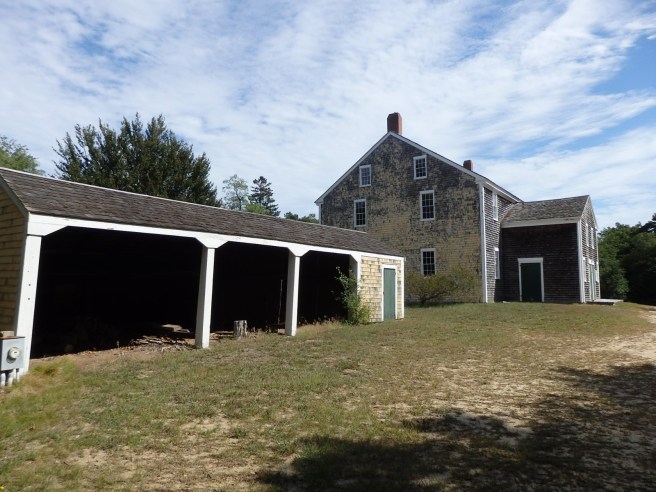
Where were the schoolhouse and horse sheds?

Or maybe a large outhouse, as one map indicates.

I keep wondering if the Pine Hill school, at the fringe of the city cemetery, was originally one of Dover Friends early schoolhouses.

The Meeting apparently had a second one in Maine.

But horse sheds were also common around Quaker meetinghouses.

East Sandwich on Cape Cod, which has a lot more

Not that I’ve found any evidence of these now.


I’m rather glad I waited to read the First Parish history

As a parent, you really try to keep your kids from a lot of painful encounters but they never listen to your advice, as far as you can tell, which seems to be futile no matter how hard you try, and then the next thing you hear is crying.

Maybe that’s a good thing, if from their experience they learn more than you knew.

There are several books that fall into that model. Had I read them before completing Quaker Dover, I might have overlooked some fresh insights. But now that my book’s out, I really appreciate what else I’m finding.

Donald R. Bryant’s History of the First Parish Church is one of them. The 160-page volume, first published in 1970 and enlarged in 2002, offers another side of my argument of the Quaker invasion in town, for one thing, while relating other parts of the early years with, well, perhaps more discretion. And, my, I do admire his resources and tenacity.

One of my favorite sections is the profile of John Williams that Bryant works into the narrative. Williams, a member of the parish, was, as he says “a visionary, a leader in bringing textile manufacturing to America,” and a cofounder of what became the big millworks in today’s downtown.

But he also became part of the faction of 26 male members who announced in 1828 they were leaving the church to join the Unitarian Society in establishing a new congregation. The split among the heirs of the Puritans into Unitarian or Trinitarian Congregational at the time paralleled a similar one among American Quakers into Orthodox and Hicksite. New England somehow remained Orthodox, as far as Friends went.

The plot within First Parish further thickens over the kind of minister it needed along with the construction of a new, and present, house of worship. What follows in the parish history is a turmoil that includes the changing economics of the town I haven’t yet found in the Quaker Meeting.

Bryant’s history then turns largely to the successive ministers rather than the congregation’s members and their influence in the community.

Still, I appreciate the comments by David Slater at the end of the book. He was First Parish pastor when I first came to Dover and quite engaging. He offered a checklist on how church life was changing that remains relevant, though nothing hit me more than this:

“Christianity is becoming more and more counter-cultural.”

That takes me back to the Quaker invasion into Dover, back in the mid-1600s.

As for the city’s other congregations? I’m anxious to hear more.