PENDLE HILL PAMPLETS

Some of the most helpful or inspiring writing I’ve encountered has come in short volumes. In poetry these are typically called chapbooks, while in prose they’re often pamphlets or booklets.

Among them, the rack of Pendle Hill pamphlets in our meeting library presents an astonishing array of Quaker wisdom. Published by subscription (currently five volumes a year) at the retreat center in Wallingford, Pennsylvania, the series now numbers more than 400 titles. Admittedly, there are some duds among the jewels, but somewhere in the collection is likely to be a reasoned answer to your nagging question about Quaker faith and practice.

Some, like Margery Mears Larrabee’s Spirit-Led Eldering and Sondra L. Cronk’s Gospel Order: A Quaker Understanding of Faithful Church Community, focus on vital aspects of Friends’ community. Others, like William Taber’s The Prophetic Stream and Four Doors to Meeting for Worship, serve as guides for the experience of our hour of open worship. John Punsheon’s Alternative Christianity finds in Quaker practice itself a different expression of Christian faith than is found elsewhere (that is, he looks at the results, while I’ve been looking at foundations). Peter Bien’s The Mystery of Quaker Light parallels some of what I’ve been uncovering in the revolutionary aspects of this central metaphor of our faith. Brian Drayton’s Getting Rooted: Living in the Cross, a Path to Joy and Liberation, spring from personal practice.

The series has also included a wide range of social action issues, like Pat Schenck’s Answering the Call to Heal the World or labor lawyer Richard B. Gregg’s A Discipline for Non-Violence, as well as volumes on art and theater, prison work, nurturing children, and Quakers’ experiences in yoga and Zen.

There’s even a Quaker Pamphlets Online project to provide free downloads of classic early issues.

For now, I’d like to take a more extended look at four volumes that came in around the same time:

  • Benjamin Lloyd’s Turnaround: Growing a Twenty-First Century Religious Society of Friends is an exciting and challenging argument of extending Quaker faith to younger generations. Funky interracial ads on the sides of city buses, anyone? With his theater background, Lloyd’s right in contending we need to reach out, vigorously, and shake off unnecessary baggage. He’s right in sensing we need celebration and true community. And he’s refreshingly candid about our weaknesses.
  • John Lampen’s Answering Violence: Encounters With Perpetrators is a hard-nosed blueprint of the author’s work as a peacemaker who moved into a land of engrained conflict. The incidents he relates are difficult, dangerous, courageous, sometimes leading to tragedy, sometimes bridging opponents trapped against their own heart’s desires. Yet he also marks important turning points in the time-consuming drive to pacify Northern Ireland.
  • Framed by an enigmatic old English folksong, Richard Kelley’s Three Ravens and Two Widows ponders the modern Society of Friends through the quite different legacies of his mother, with her urbane Philadelphia outlook, and his paternal grandmother, with a Holiness-based pastoral Quakerism in Ohio. Somehow, they had to find ways to live together after the deaths of their husbands. By implication, so do we, as a diverse community of faith.
  • Brian Drayton’s James Nayler Speaking considers the brief, prolific outpouring of early Quakerism’s most important minister. More articulate, mystical, and systematic than George Fox, Nayler was at the forefront of bringing the Quaker message from the north into London and all the upheaval that followed. No one else has written more powerfully of the Light or embedded its metaphor into Quaker thought so thoroughly.
 

THE CUSTOM OF QUAKER JOURNALS

The custom of publishing the journals of influential Friends was no doubt intended to encourage others to strive for exemplary service. The journals themselves form a curious genre – part diary, part autobiography, part memoir viewed from the vantage of advanced age, part travelogue (often tediously so, unless you’re looking for individuals and places being visited), part glimmers of spiritual brilliance – often published after the specific Friend’s death and at the direction of a yearly meeting. Closely related is our custom of memorial minutes.

Best known are the journals of George Fox, spanning the initial decades of the Quaker movement, and John Woolman, whose lifelong mission essentially ended the ownership of slaves among Friends before the Revolutionary War. Both works are in our meeting library and highly recommended.

But there’s a host of others, as you’ll find digging around.

Like the journals themselves, collections of writings or of journal excepts serve as similar prophetic inspiration. For instance, Terry S. Wallace’s A Sincere and Constant Love: an Introduction to the Work of Margaret Fell allows us to look into the remarkable thinking of the woman who became George Fox’s wife and confidant and did much to shape the emerging Friends organization. (How I wish we had a similar cache of material for Elizabeth Hooten, who mothered Quakerism from its very beginning! No such records, unfortunately, are known to have survived.)

For now, let me name one other volume in our collection: Wilt Thou Go on My Errand? Three 18th Century Journals of Quaker Women Ministers edited by Margaret Hope Bacon.

There’s also a host of books and pamphlets that put the lives of Fox, Fell, and Woolman in context or add to their outpouring – too many, in fact, to detail here.

COULD IT BE?

Glancing out the dining room window this morning, I realized there was something my wife should see.  So it was something like, “Hey, Honey, you need to take a look.”

There was no snow in our yard. None. Nada. The last of it had melted overnight.

Even by New England standards, this has been an exhausting winter. Usually, it’s either below-normal cold or above-average snowy. Not both, not like this one. I don’t remember this many single-digit and subzero nights, and here on the seacoast, our year’s total snowfall came to more than nine feet. Boston, as you may know, had the most in its weather history, beginning somewhere in the 1880s, I think.

And then there were all the Sundays when church services were cancelled — it was just too dangerous to get out on the slick roads. Well, I’m told we did have a few people show up on cross country skis to sit in silent worship.

New Englanders are usually a hardy lot and simply suck up to the weather. But for the past month, there’s been grumbling. Lots of it. This endless oppression really dampens the spirit. Do I want to write? Nah. Read, nah, except that I have read some powerful novels lately. I am finally swimming laps indoors, but that’s a big effort that leaves me ready to do … nah. As for the indoor house projects? Where’s the energy?

On top of it, this has been a winter of funerals for us. A few parents of high school students. Others my age or older — cancer, pneumonia, Parkinson’s, a brain infection. It’s not our usual experience.

I’ll have to check, but my memory suspects we had snow in November and I know there was more in early December, which unfortunately melted off by Christmas. But the pattern returned in January and just kept coming. Just as we thought we were seeing light at the end of the tunnel, three fresh inches hit us Wednesday and Thursday, which means snow’s fallen here in six straight months. And you thought winter was three?

As a matter of clarity, let’s remember the greenhouse warning was not “global warming” per se but “climatic instability,” which we’re seeing in aces. Many of our snowfalls had me wishing the precipitation was instead piling up in the Cascade Range of the Pacific Northwest, where it’s needed to sustain the orchards as irrigation water all summer. Those folks have solid reason to worry.

Here, spring’s coming late, contrary to some of the photos I’ve been posting — the one’s showing what would be happening in a normal year. The ones I scheduled based on past calendars.

Still, the warmth is returning. The sound of lusty birds greets the dawn, along with Harley-Davidsons through the day and early evening.

Two afternoons now have been warm enough to sit in the loft of the barn and curl up with a martini and a Paris Review — and look up through the open hay door to view a parade of dogs walking people past the end of our driveway.

At the moment, it’s mid-morning gray and drizzle — a reminder of Puget Sound, for me — with temperatures in the 60s. Good opportunity to run to the beach to collect seaweed for mulching the garden.

Now that’s a true sign of spring.

KEEPING IT NEAT

Barb Knowles of the blog saneteachers has nominated me for a Real Neat Blog award, and I thank her for the nod. If you’re not yet familiar with her site, let me tell you that anyone who knows what an Oxford comma is ranks high in my book — especially after all of those years as a journalist when I couldn’t use them on my paying job, contrary to my own standards. Here, though, things are different.

Allow me to confess, though, I’m of mixed mind when it comes to these awards. On one hand, WordPress (especially) is filled with marvelous bloggers who deserve wider recognition. On the other hand, I’ve found that trying to nominate others can be, well, embarrassing when you find they’ve already received that award somewhere in their past, even before coming up with fresh questions.

A while back I resolved to pass on these things, but then the temptation of participating can be fun. And then there’s that matter of time itself, which on this end will soon involve some major home and garden projects. Alas.

So here I am, looking at the seven questions, which I’ll tackle. But for now, I’ll wait before nominating others or coming up with seven new questions for them. Unless, of course, you’d like me to nominate you (go ahead, be bold and ask). After all, if you’re dropping by the Barn, you’re already cool — in all due humility. Any volunteers?

real-neat-blog-award1Here goes:

If you were alone on a deserted island with only one book, which would it be? 

Make it the Bible. Not for the reasons most folks would assume — like what God’s trying to tell us. Rather, there’s plenty to chew on here about just being human, pro and con. And Wycliffe and Tyndale (those courageous early translators) do shape our English language, more than Shakespeare, actually. Your followup question would be which translation to pack, and there I’m stumped — I use many, each one adding nuances to the close-to-the-grain sources. By the way, are we to assume it’s a long stay on that island?

What is your favorite color and why?

Blue. Intense electric blue, the shade befitting Aquarius, the color of the clearest sky. Or its cousin, cobalt, the call of the North Atlantic on a clear day a few miles from where I live.

I like favorites, so what is your favorite song?

Since you didn’t ask about symphonies or sonatas or operas or chamber works, I’ll look at song as something that’s sung — in a form other than the traditional A-A-B-A musical form plus verses. (Bet you weren’t expecting that response!)

As a baritone in a choir, I’d put Sicut cervus, a Palestrina motet from the Renaissance, up there, along with a fuguing-tune anthem, Euroclydon, by the Colonial American William Billings.

Now you have me wondering about having the whole choir on that desert island. The plot thickens.

If you could make a memory, what would it be?

Our first grandkid. Leading to my learning to change a diaper. (I jumped in as a stepfather, later in the game.)

If you could join a TV show (present or past) and be a new character on that show, which one would you choose?

Mozart and the Jungle could use a third conductor. Maybe a sane counterpoint, mentor for Rudolfo? Or maybe just to send the older one back to Cuba?

What’s your ringtone?

Ringtone? Tracfones have them? Mine’s whatever I inherited back when.

Where were you born?

Ohio.

BAD BOYS, GOOD GIRLS

As I said at the time …

Came across a fascinating insight a while back, something that might continue our “bad boys/good girls” dialogue. The writer, a mother, was observing that even in second grade, teachers automatically divided the class into bad boys and, you guessed it, good girls. By extension, then, coming as this does around the time that most boys are undergoing their sexual and emotional separation and twisting away from Mother, a different path from the girls’ formation, the very model of boyhood becomes, by definition, to be bad! To be a “good boy” is in effect to be a sissy, a girl. To be bad is to push the limits, be independent, be a leader, take action, grow up fast.

Perhaps this is when the boy really needs the mentor figure Robert Bly envisions, to take the boy into wilderness beyond the camp. Maybe it was the same writer (newsroom means little time to read closely, and often not to make a printout either) who was warning that American society has a real time bomb in the making as boys are being subjected to some very confused expectations and accusations. To be virile is taken to translate as promiscuous; strong, as violent; and so on.

Incidentally, David Hernandez’s “Bruises” demonstrates one side of this boy/girl outlook marvelously: when you were a child, did girls ever compare their signs of toughness like this? (So who are the “bad girls”? Tomboys? Or loners at the edge, exploring their own imaginations? Diane Wakoski has pursued this as well as anyone I can think of, but the field still seems wide open!)

Oh, well, I can only open these issues in a poem; resolution comes somewhere else!

~*~

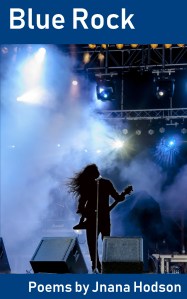
Blue Rock

My collected poems are available in Blue Rock. The ebook’s free in the platform of your choice.