Author: Jnana Hodson
In downsizing to a remote fishing village in Downeast Maine, this eclectic writer feels everything's coming together.
As we return to port
the fog’s burned off
but still hazy
with another schooner far off to the left of the Angelique
a sailboat comes between us
another windjammer’s way off on the horizon
while we skirted a sandbar
Camden grows as we approach
the Congregational spire for navigation
perhaps there’s a third behind her

entry into crowded harbor even in shoulder season
a bit tricky
especially when a pleasure boat backs into our path
shouts of “get back!” or “keep moving” finally heard
Coast Guard a bit more astute
the transom of one sailboat ASTARA also the name of our messmate
should they get acquainted sometime
haven’t seen a Kroger product for ages till now
the logo popping above someone’s pack
My messenger bag has a conspicuous stain
its first
remaining as a badge of honor
or oarlock grease
as I’m getting off, “This is all you have?” as in surprised
while I’m realizing how much I overpacked
now to send off a deposit for next year
(which I did)
Settling on Moose Island
John Shackford senior definitely explored what would become Eastport in 1782, and, as one account expressed the encounter, “determined to remain and make provisions for the safety and comfort of his wife and children preparatory to permanent settlement.”
The early years of Eastport and its Moose Island are generally fuzzy. Legally, the pioneer white inhabitants were squatters. Captain John initially settled at Broad Cove at the neck of what became known as Shackford’s Head, and soon afterward built a mile-and-a-half away, at the edge of today’s downtown and what was soon known as Shackford’s Cove.
In one version,
“The Shackford family originally settled on Shackford Head, where Revolutionary War veteran Captain John Shackford began a homestead in 1783. … He built accommodations for curing the fish he hired caught by the Indians and some white fishermen … He also erected a strong storehouse of logs, where he kept and sold such merchandise as met the requirements of the fishermen and Indians; the fishery and storehouse were in full operation, and he set about building a dwelling house and planting part of his farming lands. Everything being ready in 1784, he set out in his small sailing vessel, the Industry, for Newbury, and brought to their new home his wife and two children, John and William Shackford.”
The Indians, mind you, were Passamaquoddy, who are still vital component of the community.
In the other version, “In 1787, having built a dwelling-house near the shore, at the foot of Shackford Street, he brought his family, consisting of wife, sons John and William, to their new home in the wilderness …” Not only is the date different, but also their address or its equivalent.
As I said about fuzzy? The consensus for the Shackfords’ arrival seems to be 1783/1784, the end of the Revolutionary War.
Jonathan D. Weston’s recollections had the Shackfords as one of the first six white families in town, arriving in the spring of 1784. Five years later, Weston calculates, the number of households had increased to 22 or 24, “the heads of one-half of these families were either men of English birth or those who had adhered to the royal cause of the war.” Either way,
“John’s little craft was the first vessel owned in the place, as the fishing business up to that time had been done in open boats. Among the vessels subsequently owned by him were Delight, Hannah, Sally, and Patty,” two of them apparently named for his daughters. Patty, meanwhile, “plied between Eastport, Portland and Boston, and was the first freight and passenger boat employed on this route. She was commanded by his son, John.”
While that jumps ahead in our chronology, it does reflect the family’s identity as shipmasters and perhaps also shipbuilders. Shackford Cove wound up with four shipyards along its short shore.
From the start, even before being named Eastport, the small frontier community on Moose Island comprised of a handful of families gained a reputation for “sheltering and sharing the gains of adventurers, smugglers, and gamblers.” Not to cast a shadow over the Shackford family integrity, right? Or making a nice profit?
Welcome to America’s Wild East.
When there’s new snow
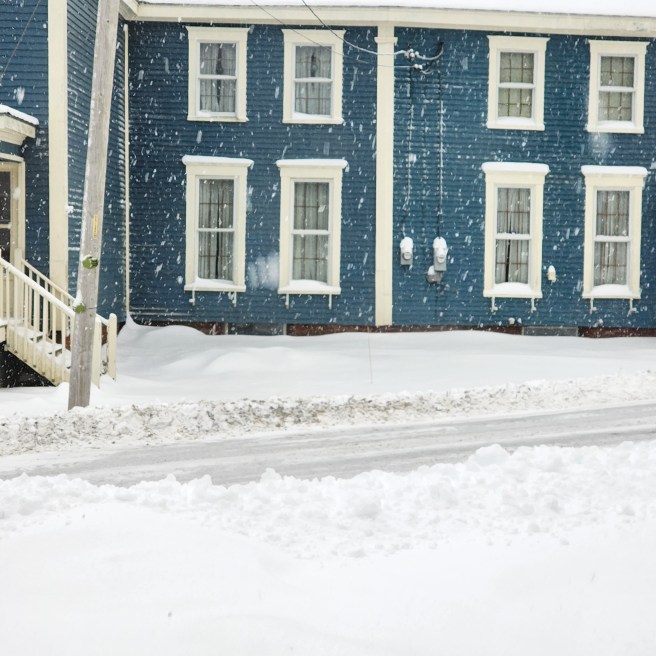
It’s that foot-tall wall of compressed flakes at the end of the driveway that concerns me. The stuff the city’s snowplows leave us in clearing our streets.
Not that I don’t appreciate having cleared pavement once I get out.
It’s my story and I’m sticking to them
Looking back, I am surprised to realize how much of my fiction remains, at heart, reporting. Yes, despite elements of surrealism, fantasy, even absurdity.
Do I regret all the time and effort that have seemingly gone nowhere?
Sometimes, yes, but there’s also a sense of pride and a better sense of identity because I have these in hand. The sense of loss would have been greater otherwise.
Along the way, family and friends were slighted, along with public service or political activism. Even outings to the mountains or beach became less frequent. From what I’ve seen, writers make lousy spouses or partners. Consider yourself warned.
I am surprised by the amount of labor that took place in my odd free hours after my sabbatical. Also, by what a bold and risky move taking that year off had been. It did nothing to enhance my resume, for one thing. And I’ll return to the lack of health insurance but spare you the rant about how the current system, even with Obamacare, inhibits entrepreneurial advances. It’s something I couldn’t have done if I weren’t single, not unless I had a very supportive partner. (And then I would have felt guilty. Go figure.)
Let me confess my obsessive (Pollyannish?) looking for natural beauty, wherever; my need to have a connection to soil and water while overlooking the obvious ugliness. Applicable to the hippie thing, too.
And then there was the emotional pain buried in my psyche, a deep well to tap.
I’ve said nothing of the years of therapy since leaving Baltimore or the ways they’ve enriched the writing. Here I had thought such “healing” would impair my writing, but it’s not so. Both long rounds instead opened emotions to me, not just the intellect.
I’m still baffled by the lack of novels by others closely reflecting the places and experiences I encountered.
Jeffrey Eugenides has come closest, though he was still off in the future. Not just his Greek-American perspective, but his Midwest roots not that much different from mine.
Richard Farina’s Been Down So Long It Looks Like Up to Me and Norman Gurney’s Divine Right’s Trip catch other corners. Tom Wolfe’s Electric Acid Kool Aid Test misses altogether, and, besides, it wasn’t even fiction. Or was it?
Well, I can go back to Richard Brautigan, at the outset of the ‘60s, including his Pacific Northwest flavor.
Beyond that, though, I turn to the poets.
Also, what if I had recast my novels more as a genre? Or even taken the big books apart for shorter series?
Well, it’s still one writer’s life. Make of it what you will.
You don’t have to stand on your head for this bliss
Some folks actually came to the ashram for their holiday breaks, and now through these pages, you can, too – for free. If you think this means getting away from it all, though, you’re in for a surprise. The real intent is to pare away to essential truths of life and the universe.
The answers, surprisingly, are often more down-to-earth than any mystical platitudes you were expecting.
In my novel Yoga Bootcamp, chaos and humor are essential components of their spiritual quests. The guru is better known as Elvis or Big Pumpkin than by the long Sanskrit formal name he officially goes by. As for tradition? Theirs is essentially American maverick, centered in the hills not far from Gotham.
This may even come as a refreshing turn after all of the frantic ho-ho-ho rushing this time of year.
The ebook is one of five novels I’m making available to you for free during Smashword’s annual end-of-the-year sale. Think of it as my Christmas present to you. It’s available in the digital platform of your choosing.
You may even want a stick of incense when you sit down to read it.
Hari Om Tat Sat and all of that, then. Namaste!
For details, go to the book at Smashwords.com.

Santa fisherman

The hat makes all the difference.
Keeping leaders on a leash
The genius of Republican liberty, seems to demand on one side, not only that all power should derive from the people; but, that those entrusted with it should be kept in dependence on the people, by a short duration of their appointments; and, that, even during this short period, the trust should be placed not in a few, but in a number of hands.
James Madison in Federalist No. 37
My necessary extravagance
A fine old house
where I fit
finally!
Scallops by the gallon

It’s how we buy them in season down at the dock.
They freeze perfectly, too, with none of the added liquid you get at the store.

 Jnana's Red Barn