Usually, it’s to get either the spiders she fears or the dust she’s allergic to.
Yes, some chores can be seen as acts of love or devotion.
Even if I would rather avoid housekeeping altogether.
You never know what we'll churn up in cleaning a stall
Usually, it’s to get either the spiders she fears or the dust she’s allergic to.
Yes, some chores can be seen as acts of love or devotion.
Even if I would rather avoid housekeeping altogether.
Immaculate
Misconception
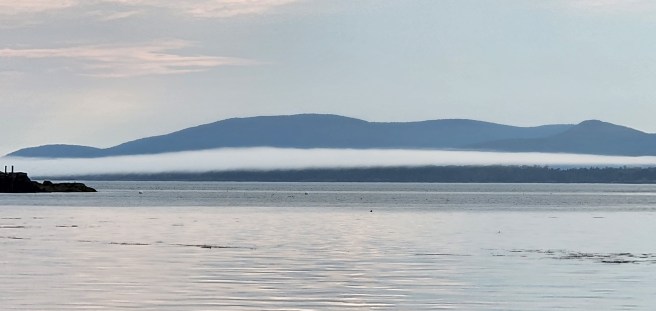
With the Camden Hills as a backdrop, a late afternoon fog rolls in over Maine’s Penobscot Bay.
For more schooner sailing experiences, take a look at my Under Sail photo album at Thistle Finch editions.
In the renovation, we had periods were seemingly nothing was happening but then, BLAM!, things suddenly moved on all fronts.
This was especially true when we were at the mercy of other tradesmen and their schedules – plumbers, high on the list.
One of those involved the crew that would do the sprayed foam insulation on the front half upstairs. We decided to go with a different company than the one that had done the back, in part because the new one got back to us with a bid promptly, unlike the other. Not only that, they could get to work for us sooner than later.
That did put some pressure on Adam to get the electrical wiring and outlets in the framing before the crew showed up, so it was crunch time there.
But then the electrical panel in the basement blew out.
We were without power going into the weekend. And without heat.
Adam did have an amazing storage battery that we plugged the refrigerator into while he patched the old system.
As he said, the only thing holding the panel together was rust and spider webs.
This came only months after he had rewired the pretty much the whole house, everything but the panel and circuit-breaker box. They were scheduled for later.
And then, the whole town lost power for a few hours, all just before the weekend and the foam-spray guys on Monday.
As a further complication, we had to be out of the house for 24-hours after the foam application. We got a two-night reservation near West Quoddy State Park, in a delightful cabin overlooking Lubec Channel and all the way up to a corner of Eastport. We were so close to home and yet a world away.
The bad news came when we determined the extent of damage done by the power surge. Four of our surge protectors were fried, as was the outlet to our washer (for a while, we thought it was gone), and then a unit in our furnace was also kaput – requiring a night call for service.
It was quite a whirlwind for us.

We still needed a new electrical panel and, while they were at it, a new circuit-breaker box, too. Adam called in some allies to tackle that, and they got to us quicker than usual. The problem was getting the electric company to come promptly to cut off the power to the house and restore it.
Whew, it did happen, though the utility forgot to include a ladder with the first truck it sent out.
~*~
Perhaps this is the time to explain why we passed on the Generac backup when we moved to town. You might get a charge out of this.
Most of us, at least in the industrialized world, take reliable electrical wiring for granted. An old house, especially if you’re updating it, can remind you otherwise.
I’ve already mentioned the hot topic that Maine is prone to widespread electrical power outages. The state does have some arcane accounting details that likely abate the problem, but I’ll spare you the common rants about our utility companies and their higher-than-average rates.
One upshot is that many houses around here have emergency generators emplaced to kick in at the outbreak of an outage. Sometimes we hear that before we realize our lights and other conveniences are out.
We nearly got one ourselves, despite the high price. The tripping point turned out to be where to put the unit itself, its concrete pad etc., but especially the propane tank – a much bigger one than we thought necessary. The only viable site in our yard was in the heart of our best full sunlight, a spot we deemed more valuable as a future garden bed.
That didn’t rule out a smaller portable Honda generator in the future, though it wouldn’t go into service automatically and requires attention for the duration of an outage.
Better yet, the portable battery Adam lent us looked like the ideal solution for us, especially after we found one on sale.
We’re thinking between that and our wood stove we can ride out the typical outage.
We’ll see.
Rather, so much arises in the intersections with so many others. It’s part of the role of the artist as a witness.
We could consider the death of my ex-spouse’s second husband, for example, or the death of my current spouse’s first. Some hit closer to home than others.
Even the activities of others in our own households that aren’t exactly ours individually.
Add to that the ways others would see us, in contrast to our own versions.
These are typical of things that still impact our own individual life stories. Our lives could have led to so many other possible outcomes, after all.
Let me admit that my life is enriched by what others do around me, even when I’m not actively engaged. I want to share in their glory … or whatever. The way a sports fan does.
A writer is ultimately an observer, not just a participant.
For example, as a poet and professional journalist, I found that the police radio scanner in the newsroom more accurately reflected romantic relationships in America today than any collection of English love poems. You didn’t have to sit next to a police scanner to perceive how sexual relationships had taken a peculiar turn.
Or, from another perspective, growing up in Ohio, I had thought our family had no colorful traditions or legacy. Only after moving on to both coasts and, by chance, embracing the faith of my ancestors did I come to see how much Grandpa and Grandma were discarding the very things I was reclaiming and how thoroughly they were adapting to a changing urban environment. Despite all the time my sister and I spent with them, I came to realize I really didn’t know them, after all. Just who are grandparents, anyway? Does anyone’s fit our idealized image? Only recently, learning that Grandpa proudly advertised himself as Dayton’s Leading Republican Plumber, did I find the key to unlocking their story and its place in history.
I had no idea Grandpa’s lines had been Quaker through North Carolina, Pennsylvania, Northern Ireland, and Cumbria, England. There was nothing of the pirate attack that left an orphan to arrive in the New World, where he eventually settled on the frontier of Pennsylvania and later the Carolina Piedmont. Nothing of our gold mine or the pacifism in the face of the Confederacy, either. Grandma’s lines, meanwhile, had been Dunker – another pacifist denomination – and a pioneer family settling a corner of Montgomery County, Ohio, that up until the First World War was as Pennsylvania Dutch as the Lancaster and York counties it had left. These are not the American histories we typically see.
What kind of person would describe himself as Dayton’s Leading Republican Plumber? My grandfather did, though it was only years after his death that that tidbit finally allowed me to know who he really was. It’s really a remarkable story.
As for the others who crossed my path in college or the upheavals after?
I have no idea where most of them have gone.
Of the others, the results aren’t always what I anticipated.
I do know that none of what I see around me is being faithfully examined on television or the movies, something I’ll argue is cultural impoverishment.
Being a classical music fan induces a peculiar sense of history. If you love fine paintings or theater or literature, you may encounter something similar.
I found some of this being stirred up while sitting through a concert where Debussy was the oldest music performed. He was still considered “modern” when I began attending concerts in 1959 or so. He died in 1918, shortly before my parents were born. Not that far back, then.
For additional perspective, some major Romantic-era composers like Tchaikovsky, who died in 1893, or Saint-Saens, 1923, or Puccini, 1924, weren’t all that distant from me at the time, though it seemed they were much more ancient, say closer to Mozart. The span between them and me at the time would fit into my own life now.
I do recall hearing a live performance of the Tchaikovsky fourth symphony under Lukas Foss and the Buffalo Philharmonic and during the rapturous applause afterward have the gentleman sitting beside me lean over and say, “You should have heard it under Reiner in Cincinnati, as my wife and I did.” That would have been only 50 years after its composition, and this was 30 or so years later.
What is striking me is how much harder it’s been for new music to catch on since then. I don’t think it all has to do with the attempt to write in more original – and often strident – styles.
There’s also a looping of generations, as would happen when a ten-year-old heard something from someone who was 80 relating something he or she had heard at age ten from an 80-year-old’s encounter at age ten with an 80-year-old from age ten. It wouldn’t be hard to have two-century span at hand.
Now, as for naming compositions from the last 50 years that have entered the standard repertoire, it would be a shockingly short list.
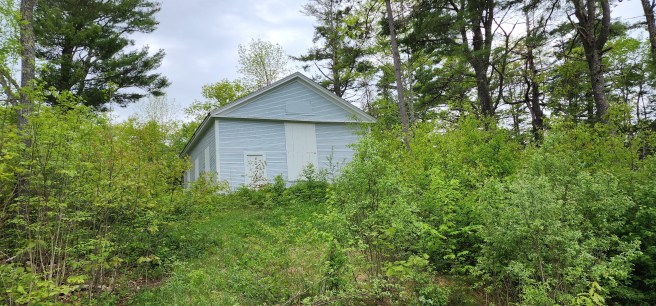
The former home of Methodist Episcopal congregation in Edmunds, Maine, once looked out over the Lower Bridge across the Dennys River. The bridge disappeared after U.S. 1 was routed a quarter-mile to the east. The church, meanwhile, is being encroached by forest, a reminder of a more populous and more prosperous time. Its square belfry is long gone.
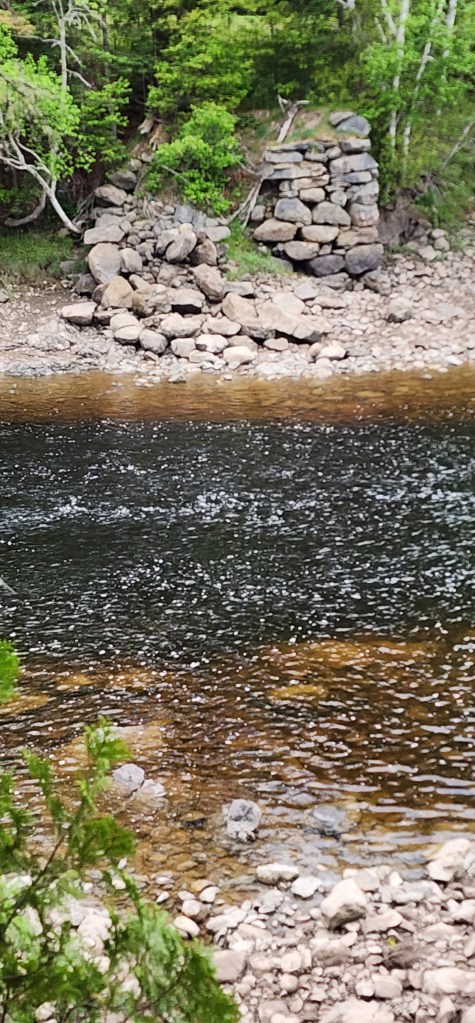
Below, remaining stone abutment of the bridge is seen on the Dennysville side of the river at low tide.
If you think that pirates are a long-ago thing or are cute and romantic along the lines of Disney’s Pirates of the Caribbean series or actor Johnny Depp, think again. This Tendrils won’t even attempt to name the ten best pirate movies ever or ten best pirate actors or ten examples of the crazy language employed there. Egads, matey?
Instead, let’s take a look at what’s taking place in the 21st century.
Online and intellectual piracy is a whole different matter.
This thing of feeling a day off, morning after morning. You know, thinking it’s Wednesday when it’s Tuesday … or the other way around.
Or feeling you’re a month behind the calendar. You rarely feel you’re ahead, do you?
Sometimes we’re even on the same page that way.
Apple
Atchya
Mountains

