Our house as an early landmark

While Eastport had a twisting trail into the village, the first real road was Water Street, laid out in October 1803, “from Mr. Todd’s house to Mr. Shackford’s.”

The Todd house, most recently known as a bed and breakfast inn, is believed to be the oldest surviving dwelling in Eastport. It was built around 1781 — some say as early as 1775 as a cabin – by John C. Todd and has early additions. Unlike ours, it had a large central chimney with multiple fireplaces, a colonial New England architectural signature. Ours had two smaller chimneys, including a precariously collapsing brick arch in the cellar when we bid on the place. That had to go before the rest of the bricks caved in.

When I began this investigation, I didn’t feel our house goes back quite that far, though I’m now convinced that Captain John had some residence on our lot by the time Water Street came along. For now, let me simply say the plot has thickened. No pun intended.

As historian Jonathan D. Weston describes,

“Water Street was laid out, 24 feet wide, after opposition by those who contended that 18 feet was ample width as it would allow two wheel-barrows to get by each other with room to spare, and, at the suggestion that it would be too narrow for horses and carriages to pass, scouted the idea that the idea that strange curiosities would ever be seen on Moose Island.”

That does explain the traffic congestion downtown today, long after horses and carriages yielded to automobiles and delivery trucks.

Key Street, bordering Shackford’s northern property line, came along in 1805, and then Shackford Street. Third, meanwhile, appears to the third east-west street in the Shackford tract. It is the only numeral street in the city.

Do note that Water Street was interrupted by gates and bars until 1808, when the town ordered their removal.

Up to 1820, as Weston observed, the town had only four public ways and no suitable places of worship. The annual town meeting was conducted in a small meetinghouse on today’s Clark Street..

The 1855 and 1879 Eastport maps show the main section of the house situated as ours is on this property. In the 1855 map, above, there were two ells but only one, larger than the current mudroom, in the 1879 map. Thus, for a time, a small courtyard existed, a common feature of the period. We have no way of knowing their use, for now. Sheds for horses or firewood are possibilities, as are a kitchen and common room.

The cellar, though, has thick stone walls, a serious undertaking.

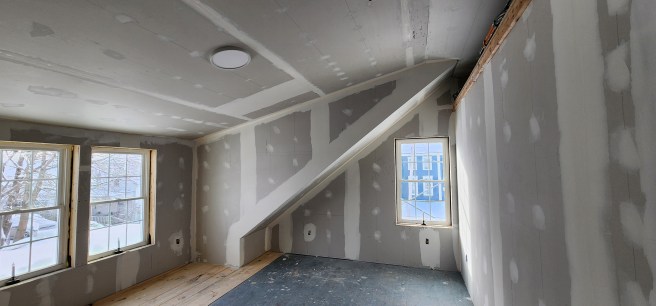
As our renovations work has confirmed, the house is timber framed — what you may think of as post and beam, except that pegs were used rather than metal brackets and bolts. The nails, by the way, were hand cut.

That rules out Weston’s mention of the second framed house in town being built shortly after 1812 by John Shackford but removed shortly before 1888, perhaps the one John junior had a block further south on Water Street. (It may have been moved across the street sometime after 1835, if we go by the maps.)

Other evidence of an early origin of the house are the hand-split oak lathing, found in the ceiling. and the hand-cut nails. Those lathes disappeared from common usage by 1830, or so we were told.

All of it, of course, has relevance on the house we bought.

On my own, I was writing contemporary literature, except that it turned into underground history

When I was starting out in my career and sitting at the edge of the semi-circular copy desk, one broad story I kept seeing in the headlines didn’t reflect what I was finding in daily life. It was the hippie experience, told one the public side as drug busts, antiwar protests, and rock concerts, while the personal side I sensed something much broader and transformative, which was largely ignored.

Tom Wolfe, who had come to prominence as a newspaper columnist, was right in saying that the great hippie-era novel needed to be written, though he was wrong in thinking a single book could cover it.

From my perspective, a traditional facts-and-quotes approach couldn’t touch the emotional reality, pro or con. Interviewing celebrities posing as leaders wouldn’t work, either – they largely betrayed us, maybe like never-a-hippie Trump would do later. Hippie was a grassroots movement on many fronts, many of them outside of the big media headquarters in the biggest cities.

In previous Red Barn posts, I’ve touched on many of the hippie movement’s continuing influences, things our kids and grandkids take for granted, but so much – especially of the broadest nature – remains to be examined and presented. I’ll leave that to someone else who can give it full and fresh attention.

For my part, I leave four novels as foundations for others to build on.

I’ve looked hard for work by others but found little yet faithfully left reviews online where I’ve could. Those works are, alas, slowly vanishing. Yes, we are passing.

I am haunted by a definitely hippie copy editor from the year I interned as what we called the rim, but he was gone when I returned a year later, perhaps after pressing for union organization. A lot had changed in those nine months. I wish I knew more about him, other than the ticket for Woodstock that I couldn’t accept, considering the scheduling and my bicycle as my only transportation.

~*~

The core of my perceptions remains in four novels to my credit.

 Daffodil Uprising: I was on campus when the repressive constraints of institutional America blew apart in the late 1960s. Crucially, many of the radical currents emerging on both coasts began connecting in academic nerve centers in the Midwest – places like Daffodil, Indiana, where furious confrontations exposed positions that later generations now take for granted. My novel revisits the upheaval and challenge, both personal and public, triumphant and tragic. As I still humbly proclaim.

Pit-a-Pat High Jinks: The hippie movement that is usually thought of as the Sixties actually appeared most fully during the Nixon administration, 1969-74, and brought changes that younger generations now take for granted. Yes, the ‘70s. In my case, that was Upstate New York where I lived in bohemian circles near the downtown and then on a rundown farm out in the hills where a grubby assembly split the rent and a bit more. My, we were so green and so wild-eyed.

Subway Visions: There were good reasons so many of my freaky housemates and new friends came from the Big Apple. My jaunts to The City, as they called it, provided high-voltage flashes of inspiration that ranged from grubby to psychedelic. It was a whole new world to me, even as a frequent visitor.

What’s Left: So much remained unvoiced and unexamined in the aftermath. I drafted a series of essays that came together as a creative non-fiction volume, but that went nowhere. But then I had the flash to reshape it from the encounters of the hippie protagonist of the previous three books but explored by his curious and snarky daughter. My intention for a big book about the revolution of peace and love turned into one asking what is family, primarily. Hers was quite the colorful circus.

~*~

I still believe there’s much in these that’s “still news” despite the dated surfaces that usually pass for the era.

This year, though, I’m finally saying good-bye to maintaining an effort to engage in an awareness. It’s ultimately in others’ hands.

You can find my novels in the digital platform of your choice at Smashwords, the Apple Store, Barnes & Noble’s Nook, Scribd, Sony’s Kobo, and other fine ebook retailers. They’re also available in paper and Kindle at Amazon, or you can ask your local library to obtain them.

It’s not just ‘Amazing Grace,’ either

With Robert Burns Day coming up Saturday, attention turns to things Scottish, and that includes bagpipes, not that you need them when singing his songs.

Here are ten related notes.

  1. Though best known as Great Highland bagpipes, related reservoir wind bag woodwind instruments have long traditions throughout Europe, Northern Africa, Western Asia, the Persian Gulf, and South Asia.
  2. Pipers usually refer to the instrument as “the pipes,” “stand of pipes,” or “set of pipes.”
  3. A bagpipe has one chanter pipe (played with both hands) and one or more drone pipes. The melody is played on the chanter while the drone holds a single – distinctive – lower tone as harmony.
  4. Most blowpipes into the wind reservoir have a non-return valve that keeps the bags inflated. Otherwise, the tongue has to do the job.
  5. Bellows applied to some bagpipes beginning in the 16th or 17th century supply air to the bag for a more even tone than would happen with the warmer and moister human breath. The modification allows for more delicate reeds and smaller instruments, such as those found in the Lowlands, Ireland, Northumbria, France, and Poland.
  6. Airflow to the reeds is controlled by the player’s arm pressure.
  7. The air bags are commonly made with the skins of goats, sheep, cows, or even dogs, though synthetic materials like Gore-Tex are advancing. The bags do need periodic cleaning to prevent fungal colonies from developing as a result of condensation.
  8. There’s no easy way to stop the sound once it’s started in most instruments. That’s why bagpipe music is heard as one long legato until the air runs out.
  9. The British Empire placed Highland pipers at the head of its military processions, spreading the sound worldwide. Leading the units into battle, however, resulted in a high mortality rate. The quip, “Shoot the player,” didn’t always refer to a pianist.
  10. Bagpipes have become features of funerals and memorials for police, fire, and military personnel throughout the English-speaking world. They’re also the official instrument of the World Curling Federation, should you be feeling sporty.

We’re becoming a destination for cruise ships

As Bar Harbor, at the gateway to Acadia National Park, tries to limit the number of cruise ships coming to town, tiny Eastport has been reaping benefits.

For the past two autumns, as some of the ships have ventured our way, we’ve welcomed their arrival at our downtown Breakwater pier. As I’ve previously posted, they’ve extended our brief retailing season and brought delighted walkers to our byways, shops, eateries, and galleries.

Supporters point out that these guests and supporting staff don’t add traffic congestion to our narrow roadways, and their arrivals can be spaced to avoid times of busy events. The town is also limiting arrivals to one ship per day, unlike Bar Harbor or Portland.

It’s still early in the planning for the upcoming travel season, and things can change rapidly, but here’s what’s already slated.

At his point, we’re expecting ten ships to come calling, 23 arrivals in all and up to 55,000 day-visitors. A few are spread out over the summer, too.

  • Azamara Quest: 593-foot length / 702 passengers / October 2
  • Brilliant Lady: 908 / 2,800 / September 18 and 27, October 9
  • Le Boreal: 466 / 264 / October 17
  • Le Champlain: 431 / 184 / October 19
  • Majestic Princess: 1,082 / 4,450 / August 24
  • Norwegian Getaway: 1,068 / 4,028 / August 21 and 28, September 4, 11, and 25, October 16 and 23
  • Pearl Mist: 324 / 210 / November 2
  • Viking Neptune: 749 / 954 / April 27
  • Volendam: 780 / 1,432 / June 14, July 13, September 5 and 20, October 4
  • Zuiderdam: 936 / 1,916 / June 16, August 25

Three of them are too long to dock at the pier. Instead, they’ll anchor in the channel and relay passengers and crew to and from the dock.

The Zuiderdam, seen here in Rockland Harbor last year, will be making two visits. You can see one of its tenders in the water, conveying passengers to the town and back.

As for the windmill?

Once the war was over and Eastport returned to the United States in 1818, the Shackford family thrived anew.

The heart of his activity seems to have been an old log store built at what would become Steamboat Wharf. Described as being at the foot of Shackford Street, it would more accurately be placed right below our house. When the store was constructed, the Customs Office was south of Shackford Cove, rather than to the north of the eventual downtown and its docks. That first store was standing as late as 1840 but being used as a stable.

Its replacement, the so-called Red Store, was removed from the waterfront around 1833 by John Shackford junior and still exists within the main part of the residence at the south-west corner of Third and Middle streets, an elaborate mansard house best known as master shipbuilder Caleb S. Huston’s residence.

Another portion of the old building went into a small, two-story frame house, “situated on the windmill lot” on Water Street, at the foot of Third Street — diagonally across the corner intersection from us. I’m told that the windmill foundation sits in the cellar of that house.

Windmill, you ask?

Windmill painting by Mrs. Bradish. Our Cape is at the upper left, though the artist omitted two windows on the front.  Note that there are no dormers.

Captain John junior is also credited with building a windmill upon the bluff at the entrance of Shackford’s Cove, one that “proved faulty in construction and was of no practical value, but remained standing on the bluff for many years as a conspicuous landmark.”

The small Cape at the left in the painting would be our house.

In the Kilby history, Samuel Shackford recalled, “The windmill which stood upon the bluff at the entrance of Shackford’s Cove for a generation or more was built for him,” John Shackford junior, “but, on account of location or fault of construction, proved a failure. In a moderate breeze, like a balky horse, it would not go, and in a gale of wind nothing could stop it until the wind abated. The old mill, after it had become dilapidated by wind and weather, was a picturesque object in approaching the town from the sea. It was taken down by its owner about forty years ago, much to the regret of the public.”

That is, dismantled around 1848.

~*~

But that leaps ahead.

All of it, of course, has relevance on the house we bought.