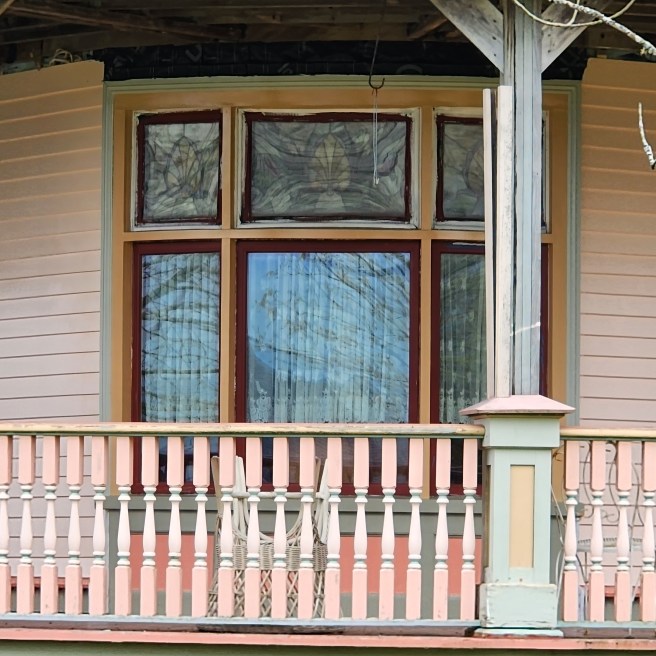
Do people really sit here, watching the passing view in warm weather? Did they ever?
Somehow, it’s still commanding, all these years later.
You never know what we'll churn up in cleaning a stall
Do people really sit here, watching the passing view in warm weather? Did they ever?
Somehow, it’s still commanding, all these years later.
It’s less than two miles away from our house. We even see it from our upstairs windows. But it’s in New Brunswick, Canada, and we’re in Maine, USA, separated by some serious ocean currents. As I proclaim when fog kicks and obliterates that view, “We lost Canada again.”
Before the border restrictions that resulted from 9/11 in 2001, visitation both ways was common. Just hop in a boat and land over there or over here. Families, employment, and shopping often spread across both sides of the border. At least one previous owner of our house was born on Campobello, a long time before Covid really shut things down.
Here are some details.

I’m reflecting on the list – a best friend ever, a lover who was more passionate about me than I was of her, a woman I dated once and then backed off, the leading anthrax researcher who stayed with us for a weekend or week, the PhD naturalist from my high school (and brother of my first real girlfriend), even my ex- fiancée’s scarred wrists. Add to that the LSD physicist attending our Quaker Meeting or the French-Canadian Catholic up the road in Gonic, and the list of suicides along my life pathway has more examples than I would have expected even without getting into the many people I’ve known along the way but who vanished after.
It’s a dark side that’s usually overlooked but probably more common than anyone admits.
More and more my curiosity involves the question of life itself rather than matters after death.
I’m taking one mystery at a time, as it happens.
night
note
knot

This one’s from to our west, in this case Penobscot Bay during my cruise last summer on the schooner the Louis R. French. You’ll be seeing more images from that week as this year progresses. And, yes, I’m already signed up for another week of cruising.
While Eastport had a twisting trail into the village, the first real road was Water Street, laid out in October 1803, “from Mr. Todd’s house to Mr. Shackford’s.”
The Todd house, most recently known as a bed and breakfast inn, is believed to be the oldest surviving dwelling in Eastport. It was built around 1781 — some say as early as 1775 as a cabin – by John C. Todd and has early additions. Unlike ours, it had a large central chimney with multiple fireplaces, a colonial New England architectural signature. Ours had two smaller chimneys, including a precariously collapsing brick arch in the cellar when we bid on the place. That had to go before the rest of the bricks caved in.
When I began this investigation, I didn’t feel our house goes back quite that far, though I’m now convinced that Captain John had some residence on our lot by the time Water Street came along. For now, let me simply say the plot has thickened. No pun intended.
As historian Jonathan D. Weston describes,
“Water Street was laid out, 24 feet wide, after opposition by those who contended that 18 feet was ample width as it would allow two wheel-barrows to get by each other with room to spare, and, at the suggestion that it would be too narrow for horses and carriages to pass, scouted the idea that the idea that strange curiosities would ever be seen on Moose Island.”
That does explain the traffic congestion downtown today, long after horses and carriages yielded to automobiles and delivery trucks.
Key Street, bordering Shackford’s northern property line, came along in 1805, and then Shackford Street. Third, meanwhile, appears to the third east-west street in the Shackford tract. It is the only numeral street in the city.
Do note that Water Street was interrupted by gates and bars until 1808, when the town ordered their removal.
Up to 1820, as Weston observed, the town had only four public ways and no suitable places of worship. The annual town meeting was conducted in a small meetinghouse on today’s Clark Street..

The 1855 and 1879 Eastport maps show the main section of the house situated as ours is on this property. In the 1855 map, above, there were two ells but only one, larger than the current mudroom, in the 1879 map. Thus, for a time, a small courtyard existed, a common feature of the period. We have no way of knowing their use, for now. Sheds for horses or firewood are possibilities, as are a kitchen and common room.
The cellar, though, has thick stone walls, a serious undertaking.
As our renovations work has confirmed, the house is timber framed — what you may think of as post and beam, except that pegs were used rather than metal brackets and bolts. The nails, by the way, were hand cut.
That rules out Weston’s mention of the second framed house in town being built shortly after 1812 by John Shackford but removed shortly before 1888, perhaps the one John junior had a block further south on Water Street. (It may have been moved across the street sometime after 1835, if we go by the maps.)
Other evidence of an early origin of the house are the hand-split oak lathing, found in the ceiling. and the hand-cut nails. Those lathes disappeared from common usage by 1830, or so we were told.
All of it, of course, has relevance on the house we bought.
When I was starting out in my career and sitting at the edge of the semi-circular copy desk, one broad story I kept seeing in the headlines didn’t reflect what I was finding in daily life. It was the hippie experience, told one the public side as drug busts, antiwar protests, and rock concerts, while the personal side I sensed something much broader and transformative, which was largely ignored.
Tom Wolfe, who had come to prominence as a newspaper columnist, was right in saying that the great hippie-era novel needed to be written, though he was wrong in thinking a single book could cover it.
From my perspective, a traditional facts-and-quotes approach couldn’t touch the emotional reality, pro or con. Interviewing celebrities posing as leaders wouldn’t work, either – they largely betrayed us, maybe like never-a-hippie Trump would do later. Hippie was a grassroots movement on many fronts, many of them outside of the big media headquarters in the biggest cities.
In previous Red Barn posts, I’ve touched on many of the hippie movement’s continuing influences, things our kids and grandkids take for granted, but so much – especially of the broadest nature – remains to be examined and presented. I’ll leave that to someone else who can give it full and fresh attention.
For my part, I leave four novels as foundations for others to build on.
I’ve looked hard for work by others but found little yet faithfully left reviews online where I’ve could. Those works are, alas, slowly vanishing. Yes, we are passing.
I am haunted by a definitely hippie copy editor from the year I interned as what we called the rim, but he was gone when I returned a year later, perhaps after pressing for union organization. A lot had changed in those nine months. I wish I knew more about him, other than the ticket for Woodstock that I couldn’t accept, considering the scheduling and my bicycle as my only transportation.
~*~
The core of my perceptions remains in four novels to my credit.
Daffodil Uprising: I was on campus when the repressive constraints of institutional America blew apart in the late 1960s. Crucially, many of the radical currents emerging on both coasts began connecting in academic nerve centers in the Midwest – places like Daffodil, Indiana, where furious confrontations exposed positions that later generations now take for granted. My novel revisits the upheaval and challenge, both personal and public, triumphant and tragic. As I still humbly proclaim.
Pit-a-Pat High Jinks: The hippie movement that is usually thought of as the Sixties actually appeared most fully during the Nixon administration, 1969-74, and brought changes that younger generations now take for granted. Yes, the ‘70s. In my case, that was Upstate New York where I lived in bohemian circles near the downtown and then on a rundown farm out in the hills where a grubby assembly split the rent and a bit more. My, we were so green and so wild-eyed.
Subway Visions: There were good reasons so many of my freaky housemates and new friends came from the Big Apple. My jaunts to The City, as they called it, provided high-voltage flashes of inspiration that ranged from grubby to psychedelic. It was a whole new world to me, even as a frequent visitor.
What’s Left: So much remained unvoiced and unexamined in the aftermath. I drafted a series of essays that came together as a creative non-fiction volume, but that went nowhere. But then I had the flash to reshape it from the encounters of the hippie protagonist of the previous three books but explored by his curious and snarky daughter. My intention for a big book about the revolution of peace and love turned into one asking what is family, primarily. Hers was quite the colorful circus.
~*~
I still believe there’s much in these that’s “still news” despite the dated surfaces that usually pass for the era.
This year, though, I’m finally saying good-bye to maintaining an effort to engage in an awareness. It’s ultimately in others’ hands.
You can find my novels in the digital platform of your choice at Smashwords, the Apple Store, Barnes & Noble’s Nook, Scribd, Sony’s Kobo, and other fine ebook retailers. They’re also available in paper and Kindle at Amazon, or you can ask your local library to obtain them.
Power flickering or kicking out briefly yet the laptops are OK.
One more sign of how times do change.
Back in the day of PCs, that would have created terror.

As glimpsed at the mostly takeout Vietnamese restaurant in Bangor, Maine, the token offerings to Buddha and his buddies are a reassuring nod in many Asian food retailers.
Jesus and all the saints, on the other hand, are typically left in fasting mode, East or West.
With Robert Burns Day coming up Saturday, attention turns to things Scottish, and that includes bagpipes, not that you need them when singing his songs.
Here are ten related notes.
 Jnana's Red Barn