
You never know what we'll churn up in cleaning a stall
Another consideration I haven’t mentioned was the upstairs flooring.
As much as we would have liked polished hardwood, our budget called for something more affordable.
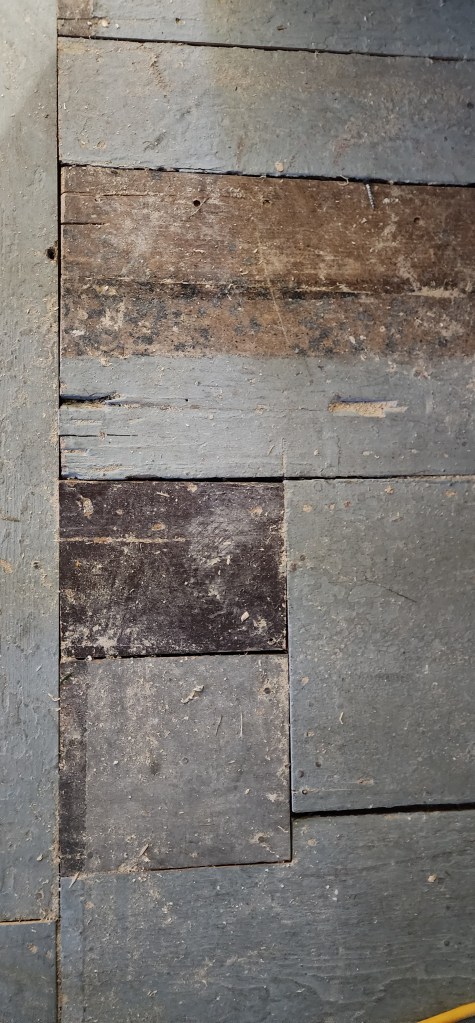
The existing flooring was more piecemeal, with unevenness and knots. It did speak of the rustic origins of the house and its historic character. Our contractor mentioned some flooring that would match it, and we were onboard. (Sorry for the pun.)
Refinishing those planks might have looked historically charming, though they were never great to begin with. Instead, we salvaged what we could and added fresh to continue.
The next question was how to treat it. Apart from two rooms and a hallway of vinyl flooring downstairs, the existing flooring, upstairs and down, had been painted a light blue that easily flaked. Could it be sanded and refinished in a natural finish? Did we have time to undertake that? Otherwise, what color of paint could we agree on, at least for the bedrooms? The bathroom and laundry room might be a different matter requiring something more waterproof.
I had hoped to decide on a paint color extending across all of the upstairs. Mine was the minority vote.
That left me facing a decision for my room. Please stay tuned.
Let’s start with the prompt: Imagine yourself in the position you desire.
For much of my life, that had two conflicting scenes, the newspaper editor in his community in contrast to the successful novelist in a tweed jacket in a New York study or a poet in something more funky.
Much less for the supporting people my life, starting with wife and children?
When I last looked at the question, it essentially asked me to consider my early retirement years. How curious! The newspaper editor, at least, was out of the picture.
At its core, I craved recognition (affirmation!) – after years of largely reclusive labor. But which circle did I most want to recognize me – hip, alternative culture? Quaker, international literary, Seacoast New Hampshire? At some level, perhaps, it was also wanting to visit Dayton and be known even there – or to hear again from many people I’d known and lost contact with in my relocations. The Quaker world is awfully small and restrained, especially with its three sharp divisions. The literary world, meanwhile, has so many high priests and exclusive emphases – could I move among them? Yet, if the Society of Friends is to survive and grow, I needed to move beyond its confines and reach out to a wider audience. In a larger sense, then, my recognition would be as one who brilliantly bridges these disparate worlds. If only.
I did imagine a significant amount of time would be engaged in travel – public readings, workshops, conferences. Eight weeks a year, split between Quaker and literary? Perhaps an additional retreat or camping trip? The travel could also include three-day weekends for symphony, opera, and galleries.
I also imagined having three books published on paper each year – one of poetry, one of Quaker practice, and one of fiction or memoir/genealogy. (They were already written.)
The rest of the time would be correspondence and basic living, including a social life, concerts/plays/etc.
I do believe such reflections are important in channeling what might otherwise be simply drifting through life.
So back to the questions.
Define what you are trying to accomplish. Be clear about what you’re setting out to do. What problem are you trying to solve? What new ground are you trying to break? What will happen if you manage this well? What will happen if it isn’t managed well?
I would have said, Brand myself as the leading new Quaker voice – or at least an original Thinker. (Think of Bill Stafford in the Church of the Brethren, Wendell Berry, even Mary Oliver the Unitarian – who has emerged since?) What I want to do is bring Quaker theology into the center of contemporary thought and discourse, and then to renew the life of the Society itself. The poetry and fiction add to my credibility as a writer.
Well, that has slipped past me.
Now for another hard question.
Who do you think would play me in the movie version?
~*~
You can find my surviving novels in the digital platform of your choice at Smashwords, the Apple Store, Barnes & Noble’s Nook, Scribd, Sony’s Kobo, and other fine ebook retailers. They’re also available in paper and Kindle at Amazon, or you can ask your local library to obtain them.
The big pink mansard a block from our house was owned by noted shipbuilder and designer Caleb Stetson Huston from the mid-1850s until his death in 1887. He also served two terms in the state legislature.
My question remains, how was it pronounced: Huss-tun, Who-stun, or Hugh-stun?

Just down the road from the birthplace of the U.S. Navy, the decommissioned Bucks Harbor Naval Radar station has an otherworldly presence, as if everyone had been taken away to another planet in the middle of the night.
The prolific inventor, entrepreneur, and civic influence Charles F. Kettering was still alive in the Dayton community when I was an aspiring chemist in my youth.
My career in science never materialized, but his influence as an inspired ideal of leadership remains.
You may recognize the name from the famed Sloan-Kettering cancer research hospital in Manhattan or from the city in southwest Ohio named in his honor. He also led the research teams that invented the electric cash register, the automobile electrical self-starter, and no-knock gasoline. Other work made the diesel engine practicable as well as the refrigerator and, in time, air conditioning. In all, he had 186 patents, second to fellow Ohioan Thomas Edison. He was a founder of Delco (Dayton Electrical Laboratory Company) and from 1920 to 1947 was head of research for General Motors.
As a power in the new General Motors corporation, he aligned with management pioneer Alfred Sloan – as in that Sloan-Kettering Hospital in Manhattan,.
Let me repeat, there’s even a city named in his honor.
Today we have another Double Tendrils.
Get ready to know him better. Let’s start with his perspectives on the creative process and problem-solving, especially as they apply to engineering and invention. Here’s what he said:
And now for his perspective on life itself.
He really was one who made America great.
She’s tired of talking socially
and so am I
We have calling hours
and a funeral ahead
I remember when he had a Willy’s Jeep
cool, like a square dance

Pleasure boats are everywhere in Camden Harbor at the height of summer. It’s iconic Maine, after all. This detail was noted aboard the historic schooner Louis R. French last summer as we set out for five days of prime sailing.
For more schooner sailing experiences, take a look at my Under Sail photo album at Thistle Finch editions.
People looked skeptical when they heard that we were living in the house during all of the renovation.
It’s not like our budget had enough of an edge for us to lease quarters elsewhere. Were we just more daring or more tolerant than others?
A key to the project turned out to be the translucent plastic “door” created at the top of the stairwell at the beginning of the work, the one with the zipper. It reduced the amount of dust that escaped from the construction and also kept much of our heat down on the first floor.
The sound of that zipper became a fact of life for us. All three zippers we had over the course of the project.
~*~
What awaited us on the other side of that veil went through a progression.
At first it faced a crowded set of shelves set in under the sloping roof, along with sliding doors to two makeshift closets and a narrow hallway running to each side.
After that came the demolition that revealed charred rafters and sheathing.
We briefly had a stretch of open sky followed by the raised roof and then the framing for the bathroom and laundry room.
What caught us by surprise, though, was the blank wall when the sheetrock went up. The stairs didn’t lead straight to another door. What would we put there? A large painting? A bookcase? A settee?
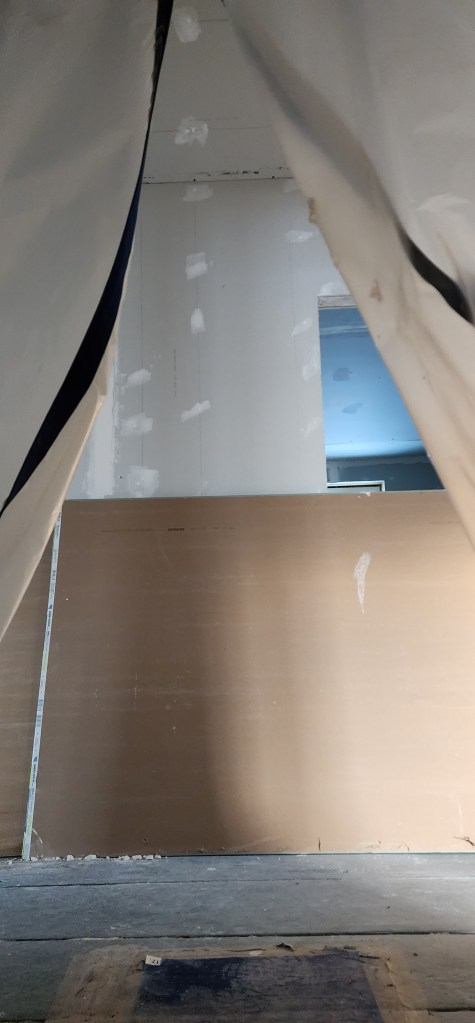
One of the coconspirators in our planning insisted on having a wide hallway, or perhaps more accurately, a landing – 6-by-16 feet, it turns out – conjoining the doors for the four bedrooms, the bathroom, and the laundry room. As a practical matter, this would make moving large items much easier, but aesthetically, the space feels wonderful, especially when we decided to keep the ceiling there running all the way to the crown of the house rather than having a low flat one.
No photo would get you a sense of that.
~*~
Somehow, Adam managed to keep the stairwell in place through all of the demolition and rebuilding. It did have that hand-cut oak lathing that predated 1830, for one thing, and the period molding.
For months, it stood like a dark ark at the center of all the action.
Once the new upstairs walls and details were in place, he turned to repairing the stressed stairwell walls and ceiling. One alteration we had envisioned was an interior window for natural light from the bedroom nook. Minor touch, but satisfying. Alas, one that was cut, in part for budget considerations.
We also gained storage space above in a kind of mini-attic accessed from a bedroom. It’s perfect for seasonal decorations that are needed just once a year. Easter, Halloween, Christmas, mostly.
~*~
As I had to confess by this point, the project was much more complicated than I had expected. I could now see why one contractor had just wanted to gut everything from the get-go, while another wanted to rip the top off and replace it with a gambrel roof. But I’m confident neither of those routes would have led to what’s emerged.

