If you haven’t noticed, I can be entranced by place names. So for ten around here, let’s go.
Bailey’s Mistake. Did they really land and then settle in the wrong spot?
Boot Head. Try picturing that.
Cutler. It even has a song about drilling into the bottom of barrels of wine confiscated during the Prohibition. And there’s a plank of wood as evidence.
Destiny Bay. Also at Cutler, but what a name.
Machias. Even as something-or-other disgusting kind of falls in the Native name.
Magurrewock Mountain in the Moosehorn National Wildlife Preserve. At a modest 377-elevation, it still deserves attention, even if you can’t pronounce it.
Meddybemps. It’s a town and a huge lake, but still, try repeating it three times.
Moosehorn National Wildlife Preservation. Moose don’t have horns but antlers, despite the naming of a small river.
Pope’s Folly. The small island just off the Old Friar monolith of Campobello Island, New Brunswick, seems to elude historic explanation. I’m not convinced it’s entirely religious.
Treat Island. Named for an early settler, no matter the consequences, it’s still part of Eastport. And a fine IPA brew exists in its honor.
As we looked for ways to personalize our bedrooms, I quickly settled on white as the dominant paint color for mine. We had already agreed on keeping the downstairs walls white, on the creamy side, especially for the way it enhances the marvelous natural light we have here on the island.
In my case, I wanted the purest white possible, a reminder of the incredible beacon at the fringe of the moon immediately before and after a full solar eclipse. On a more practical note, the white theme guaranteed that the line between the ceiling and walls would be continuous rather than jagged.
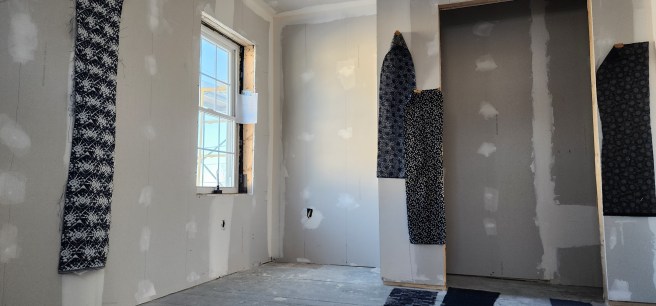
To close off the closet, I wanted a curtain rather than a door, in part to maximize space in the room and in part for a bold accent. I quickly gravitated toward indigo for the fabric. Yes, I have a taste for sushi and sashimi and Japanese design in general. The curtain inspiration, should you ask, springs from a few favorite restaurants. Besides, I have a long love of ascetic clarity, including the Shakers as well as Zen, even before I became Quaker and flirted with its historic Plain style, which can also be seen here.
The bedspread and bookshelves would add their own colors and textures to the mix.
~*~
Playing around with the blueness, I even did some online scans and duly noted:
My desired bedroom blue accent Somewhere around 13 red, 27 green, 54 blue, 100% opacity Just give me a name, somehow Hex #0D1B36, for starters As for the purest white of whites? Is it even possible?
Just so I’d be ready when it came time to trot off to the paint store or fabric shop.
~*~
Christmas intervened before the upstairs was ready for painting.
Gift-giving in our family often turns into an art, sometimes including items found at yard sales. Other times it includes items you never knew you wanted or needed, though you soon discover otherwise – I’ve often been advanced on high-tech edges that way.
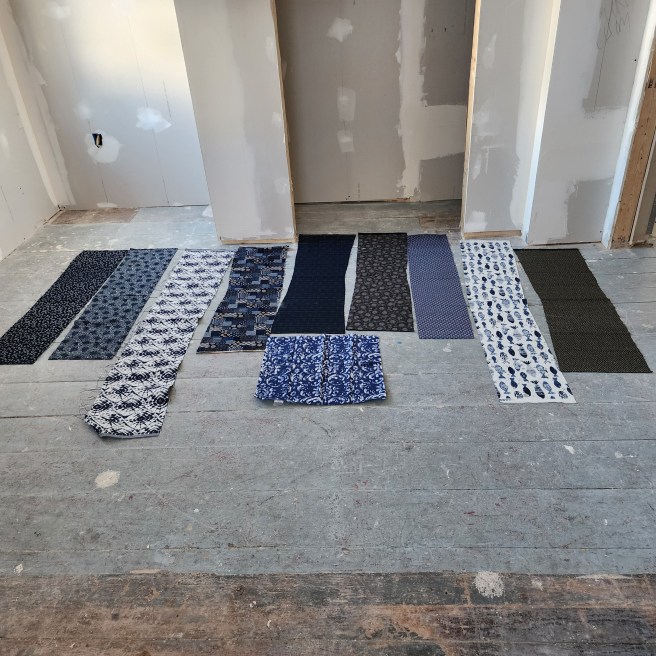
So, this past holiday, I unwrapped one box and encountered sample strips of cloth, all blue, nine in total, traditionally Japanese and dark blue. Along with an offer to make the curtain from my fabric of choice.
Just to see how they might work in the room.
I had no idea it could get this complicated.
They were darker than the indigo I originally envisioned, as well as more intriguing. How would each one interact with the rest of the elements in the room? I invited reactions from others in the family, and weighed those in with my own observations. What caught my fancy early on soon moved toward more subtle patterns. I’ll leave it at that for now.
The full array plus a batik dinner napkin that had started my thinking.
~*~
Beyond a café curtain on the double-hung sash window, I’m planning no “window treatments” in the room. (How I detest that term.) Privacy isn’t an issue, considering the height of the other windows, nor is direct sunlight in a north-facing room.
~*~
Continuing with the color choice palette and turning to the floor, online searches quickly convinced me that dark blue would be too much, even in small exposures. Dark red, which we had in Dover, would have resulted in a red-white-and-blue cliché. I started leaning on hunter green but began wondering if going lighter, as others in this project were thinking, might make sense.
However this turned out would be nothing like anything I had before.
Preparing my collections of poetry for release, as well as the shorter chapbooks appearing at my Thistle Finch editions blog, has been eye-opening, especially after spending so much time concentrating on the novels.
A lot has changed in my half-century at this. At first glance, my work has seemed to shoot off in every direction. But then, in spite of that, commonalities appear. Some of them, to some extent, apply to both the prose and poetry.
Despite all of the changes in my life and the differing approaches of my writing that accompanied that, I believe some underlying qualities run through my output.
Here goes, mostly from notes to self from way back and up:
No tolerance for fluff. Anti-romantic. Playful twists are another matter.
My quest for accuracy has invoked sharp focus – despite the blur and whirl of my own life.
I’ve relied on flashes, gathering. Like snowfall, curiously. A burst of storm, however brief or long the season.
Surrealism & absurdity can be more accurate than what’s seen on the surface.
Jagged and leaping make sparks, akin to my Kinisi here at the Barn.
As for what makes my work unique? What makes me unique? (My niche?)
In much of my writing, I’ve mapped organic geo-history, the overlapping energies of a locale and its spirit(s), as truthfully as I can, however fragmentary the result. Personal relationships, including marriage, hover within these landscapes, even as their own physical places as well as spiritual, influencing and influenced by the larger ecosystem. I try to comprehend this within a concern for the larger, more timeless harmony (Logos).
My investigation of invisible vibrations of specific landscapes has led me to cherish alternative cultures that embody healing energies – Native practices, Amish, Mennonite, Quaker, and so on – in contrast to our increasingly rootless, violent, unstable society at large.
An awareness of the wonder of the universe and an appreciation for our own unique places within it. Out of that, roots, a radiance of peace, and the sustaining nurture of a community of kindred souls.
Mine is a unique, distinctive name reflecting my originality (or eccentricities) in bridging many diverse currents. My writings, as I see them, are tightly compressed, radiating clarity, and highly polished with a raw edge.
What’s my trademark, my signature touch?
Starting with poetry:
Distillation. Compression. Radiance.
Lean and polished lines.
An aversion to formal forms.
A rejection of poetry as a hidden code requiring an interpreter.
A preference for allowing the images and details to speak for themselves.
Delight in allowing the individual reader’s interpretation to unfold on its own.
The land and the girl / spiritual landscape / the girl in a spiritual landscape. Somehow, they overlap.
An unexpected snap in each line. (Thus, lines long enough for something to happen.)
Silences as positive openings.
Writing as a means of discovery and deepened memory, more than to embellish or escape.
As a journalist, my touchstones have been Accurate, Informative, Useful, and Entertaining. I wonder how those apply to poetry, too.
To honor life and its wellspring.
Writing as an act of gratitude and humility.
To be audacious without subterfuge or scrabble or sleight-of-hand.
To be enterprising without deception.
To be daring without falsification / ruse / trickery or bombast.
Much of my writing emerges as an attempt to record and investigate the Hidden Way as it has opened and shaped my life. Often unconventional, prompting experimental inquiry, this unfolding has led me to its ancient roots and traditions, which in turn provoke contemporary responses.
And the fiction? You can add:
That aversion to formula or genre, especially when it comes to marketing.
A preference for allowing the images and details to speak for themselves.
I write to discover, and to remember, more than to embellish or escape.
As a newspaper editor, I have often found daily journalism to be better written than many of the novels and other books that crossed my desk.
An awareness of the artifice of linear, rational exposition and development. How do we get beyond that?
Deep Image is not confined to poetry.
Life as an experiment. So much variability with the basic laws and given conditions.
I’ve relied on flashes, gathering. Like snowfall, curiously. A burst of storm, however brief or long the season. Or even confetti or a ticker-tape parade.
I’ve preferred discovery to fabrication. Accuracy to cleverness. Mandala engagement over private code. What is brought forth in each individual reflecting on the icon, from deep personal experience, rather than the artifact itself.
Well, that’s how I’ve defined my efforts over time. Sometimes the results do startle me, all these years later. And some of my results come closer to my ideals than others, not that I’ll fault those, either.
~*~
You can my works in the digital platform of your choice at Smashwords, the Apple Store, Barnes & Noble’s Nook, Scribd, Sony’s Kobo, and other fine ebook retailers. Or you can ask your local library to obtain them.
One example: Snakes have no vocal cords! (So how’d he talk to Eve? Is this meant to be a joke? Or was his voice taken away afterward in punishment? If so, why weren’t Eve and Adam made deaf?)
By the way, the Serpent is one Biblical character who will likely always remain “male.”
The historic boatyard, now a booming submarine maintenance facility, is situated on an island across the Piscataqua River from New Hampshire’s Seacoast city of Portsmouth. It’s seen here from Kittery Foreside, the town with the military base gates.
As I’ve related in other posts here, ours is widely known around town as the Anna M. Baskerville house.
For a writer and editor like me, though, Baskerville was also an important typeface in the advancement of printing.
It was the body type of the first newspaper I edited, the Belmont Hilltopper. Yup, back in high school. Our headlines were mostly Bodoni, another classic that’s mostly vanished in the internet era.
Here’s an introduction to its founder and a bit more.
So here goes for this week’s dive into arcane wonders.
The typeface was designed in the mid-1750s by John Baskerville in Birmingham, England, as an intermediary between older styles, including one of my favorites by William Caslon.
Baskerville increased the contrast between thick and thin strokes, making the serif faces sharper and more tapered, and shifted the axis of rounded letters to a more vertical position. Maybe you take that for granted, but it does enhance readability. Trust me.
He was a wealthy industrialist who started his career as a teacher of calligraphy and a carver of gravestones before making a fortune as a manufacturer of varnished lacquer goods. You never know where you’ll encounter a true inventor or artist.
In 1758, he was appointed University Printer to the Cambridge University Press, where in 1763 he published his master work, a folio-size Bible. Glory be!
On his death his widow Sarah eventually sold his material to a Paris literary society, placing them out of reach of British printing, not that the move stopped imitations. The French, on the other hand, seem to have loved his openings.
Oh, my, the technical discussions lead to a true rabbit hole of fine distinctions. I’m not going there, though some of you readers definitely should.
John Baskerville is also noted for inventing a wove paper, smoother than laid paper that allowed for better printing impressions. One advance can definitely lead to another.
Even as an avowed atheist, he was appointed printer to the University of Cambridge where he printed The Book of Common Prayer in in 1762 and a splendid Bible in 1763.
By the way, you won’t find a town named Baskerville on a map. There is, though, a Baskerville Hall in Wales.
A more likely place to find Baskerville is in the novel by Arthur Conan Doyle, one of the most popular novels ever.