Henry Miller, quoting his grandfather (in fiction, Nexus, at least):
Why are the dead so stiff?
Because there’s no joy in them anymore.
(Do I file that under Jewish Humor?)
You never know what we'll churn up in cleaning a stall
Henry Miller, quoting his grandfather (in fiction, Nexus, at least):
Why are the dead so stiff?
Because there’s no joy in them anymore.
(Do I file that under Jewish Humor?)

Much of Way Downeast Maine stirs up echoes of the American Far West, at least in the eyes of some, and that includes impressions of ghost towns.
The downtown of Lubec has some prime examples, including this imposing waterfront emporium that was the headquarters for R.J. Peacock company’s wide-ranging sardine operations.
I think the structure has a slight resemblance to the long-gone steamship wharf that once welcomed passengers just below our house in Eastport. This one is still standing.
To explore related free photo albums, visit my Thistle Finch blog.
The famed English playwright was also an esteemed music critic, though he wrote under the pseudonym Corno di Bassetto, 1888 to 1889, before moving on to a more respectable newspaper for four years. There, he signed his reviews G.B.S.
For perspective, he was an ardent advocate of Richard Wagner, which put him in opposition to Johannes Brahms.
Here are some sharp notes.
I’m a plumber’s grandson.
And the son of an accountant.
I believe managers need to have hands-on experience of what they’re expecting from others.
to have the sense
to do things that make no sense
but to do them anyway

As seen from a cruise aboard the historic schooner Louis R. French last summer.
For more schooner sailing experiences, take a look at my Under Sail photo album at Thistle Finch editions.
As I posted a year ago, this would be the first time I’ve had a tailor-made personal space. How heavenly! Look at those two windows higher up on the wall, allowing for shelving below and cross-circulation of air in the warmer months in addition to natural light.
Roughly 12-by-14 feet, including the closet and writing corner, much of it would be taken up with a very comfy double-sized bed, but the room was also intended to enclose my 200-plus journals, rows of LPs and CDs, a turntable and Bose stereo, hundreds of books, plus clothing, filing cabinets, and a writing corner. Hey, I’ve been downsizing.
The room is isolated, tucked away from everything, unlike the previous space where I could keep an eye on passers-by on the street and deliveries to the back door, the entry that got 98 percent of our use. I could even see the deer in our yard. The new room, in contrast, feels more like a treehouse, even with that double-sash window that displays a corner of the ocean and all of its changes.
~*~
My bedroom is the smallest of the four, but it fits me like the proverbial glove. If I sometimes think of it as being like a treehouse, that was something I never had as a kid, though I did climb often to the top of the elm in our back yard. I can nearly clamber to its tippy top in my sleep, almost 70 years later, hundreds of miles to the east.
In our renovations, the room is also envisioned as a place for my continuing downsizing, a consideration for my heirs who have no interest in my journals, manuscripts, recorded music, clothing, or ancestral snapshots and formal photographs. I don’t want to burden them with any of that. Still, despite my previous efforts, there’s so much I still need to sort through in my remaining time. Back to those journals, manuscripts, recordings, clothes, and photos. Some of that labor may even lead to future posts here.
Back when we moved into our Dover house, the one with the red barn in New Hampshire, I needed tons of space for my literary projects – everything was on paper. Not so now, especially after so much of that paper is now available to readers in digital publication.
What we did with the wall between mine and the front bedroom is especially delightful. Originally, the space was supposed to be divided between the two bedrooms, but then she who must be obeyed ceded it all to me, except for the space overhead. Her reason was that this was the wall where she decided her bed should go, and the bed would have obstructed the closet. OK, then.
Gee, I had been thinking about what might go up my side of the space. Instead, I have a bit of upper wall, which makes me wonder what might be displayed there instead. My Far West cow skull, perchance? Or a moose antler rack from around here?
My proudest part of my upstairs quarters is the writing center carved out of what would have been closet, up against an outside window. Here I can see a corner of the harbor and yet also have so much at hand overhead.
~*~
The back two bedrooms – mine and the one we’re designating as guest room – are largely square in their floorplan but were to have a signature charred beam running upward along the exterior wall, a reminder of the 1886 downtown fire that charred our rafters but didn’t get further than that. For us, these are also reminders of a chimney fire or two that the house also survived. For the most part, the rooms are mirror images of each other, except for differences in the wall that has the closets. More on that in a later post or two.
When it came time for the drywall to go up, we yielded on preserving that detail and instead went for an unbroken wall, mostly because of the expense of the labor needed to execute the details. Alas.
~*~
In the renovations, my room took priority because so much stuff from where we were dwelling downstairs had to move up to make room for ongoing work as it shifted to the first floor.
Besides, I was tiring of trying to sleep and write in the same chamber as the clothes washer and its noise. That future dining room was getting very crowded. We would need it as a staging area for the next stages of renovation.
For whatever impulsive reason, I ended my first published novel, Subway Hitchhikers (now revised into Subway Visions) in a Greek family’s restaurant in Indiana. In a town I I’ve dubbed Daffodil, which shows up in the title of the next book in the series., in fact
At the time, I saw it as emblematic of East Meets West, especially apt considering its Tibetan Buddhist twist.
Little did I know, once I picked up the trail again not quite two decades after that publication, of the ways Greek-Americans interacted with my life, even in the Midwest.
Consider these tidbits:
My best friend’s mother was delighted by her neighbor’s repeated explanation, “Athens! She is beautiful. The rest of the country?” A spitting sound I could never ever spell out was accompanied by the open palms of both hands coming down side by side from overhead.
His other best friend was Greek-American, someone of a philosophic outlook who wound up living in my circle in Upstate New York after getting out of the Army. Yeah, some hippies were veterans.
Later faint details of a landmark restaurant passing into a new generation much like the one in the novel, still in Daffodil.
In the Pacific Northwest, discovering souvlaki on our forays to the University District of Seattle.
Back in Northeast Ohio, the Greek bakery in a small storefront surrounded by houses on a quiet street six or seven blocks east of our home.
In Baltimore, “All the pizza’s made by Greeks,” which seemed wrong – where were the Italians? And, in my salesman role on the road, “All the diners are owned by Greeks.”
In New Hampshire, the Athens restaurant downtown – popular but, to my senses, bland and tired – in contrast to one of my favorite takeout places where we ordered for the office – the menu that introduced me to gyros.
Add to that the cathedral’s big Glendi, which sent food to the newsroom in gratitude for our coverage, or the little frame St. Nicholas church I’d pass on one route to and from the paper.
One of our older coworkers, a photo lab tech, was Greek – kind, smiling, though I got to know little else. Later, one of the men I worked more closely with in the composing room was half Greek. His name, Perry, was after his grandfather, Pericles.
All of this fleeting, fragmentary, but coming together in once I moved to Dover and its annual, free-admission Greek Festival. From there, I picked up Greek dancing and the liturgy of the Orthodox faith, not that I converted. It still enriched my Quaker Christian strand.
And then there was Davos, in Watertown Square, a block down the street from my weekly choir practice. The restaurant was expertly run by Hispanics after its founders moved on.
It’s an element I miss living on this end of Maine. The closest Greek restaurants are in Brewer and Waterville, both blissfully satisfying.

For more of what they present, look to the Cassia’s World category here at the Red Barn or to the novel, What’s Left, which is available in the digital platform of your choice at Smashwords, the Apple Store, Barnes & Noble’s Nook, Scribd, Sony’s Kobo, and other fine ebook retailers. It’s also available in paper and Kindle at Amazon, or you can ask your local library to obtain it.
There are holes in the listings posted in the website. Individuals, perhaps, who want no contact, though their location is known. Perhaps others who have been ostracized, after prison or scandal. Others just fallen through the cracks.
I see, too, others have been added. Girls who left to have secret babies. Boys who maybe got their GEDs or returned to the fold through marriage. I’m glad to see them included.
In the meantime, I prepare a message. The one that says my location can be known, even if I’m not attending this year’s reunion. Even now, it’s a long road from here to there, and back again.
~*~
How curious, coming across that note a few decades after I wrote it.
I’ve reconnected with a few via social media.
But many holes still remain. Frankly, I don’t know what I’d say to them if they did show up. We have gone in quite different directions, after all.
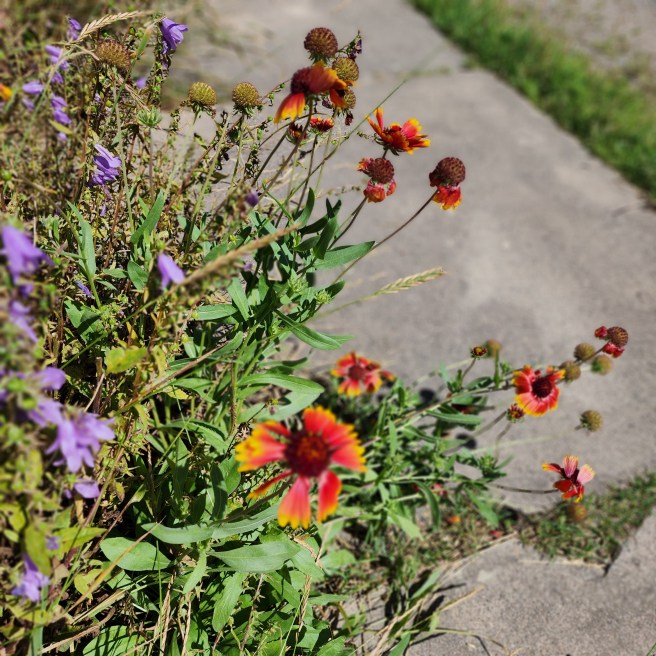
Just a block from our house. We do love walking strolling around the island.

