 One afternoon while anchored at Holbrook Island during a cruise aboard the historic schooner Louis R. French last summer.
Author: Jnana Hodson
In downsizing to a remote fishing village in Downeast Maine, this eclectic writer feels everything's coming together.
Theirs was a booming and closely knit family
Captain John and Esther’s adult children eventually built their own homes more or less within a half-moon crescent about a block away in each direction around our house.
John Shackford junior built on the southeast corner of what’s now Water and Middle streets. He married Elizabeth Batson (1790-1830), and probably remarried another Elizabeth afterward.
William built at the southwest corner of Shackford and Middle streets — just beyond the diagonal edge of our block. He married his sister-in-law, Sarah Ann Batson (1788-1837) in 1807, and then Mary Cutter Lincoln, who survived him. She was the daughter of Captain Jacob Lincoln, whose 1790 farm is now the Rossport by the Sea resort in Eastport’s Quoddy Village neighborhood.
Jacob Shackford, meanwhile, built at the southwest corner of Water and Key streets. He married Eliza D. Pearce/Pierce (1794-1869). She was the sister of Darius, husband of Jacob’s sister Hannah. Eliza was born in Rhode Island, like her brother, and died barely a month after her husband’s passing.
Samuel, probably the first male child born in Eastport, died in 1820 of yellow fever at Demerare, South America. He had married Elizabeth, daughter of Otis and Elizabeth Lincoln of Perry, before the Shackford siblings divided the holdings. His son Samuel received a half-share in Captain John’s will. More on him later. Elizabeth, meanwhile, is the Mrs. Eliza Shackford who married Captain Silvanus Appleby on October 16, 1825, officiated by Charles Morgridge.
The repeated surnames among the spouses continues over the next generation or two. Finding siblings in one family marrying another set of siblings is not uncommon in the period.
Darius Hannah and her husband, Captain Darius Pearce/Pierce, built at 9 Shackford Street, a block northeast of our house. Born in Rhode Island to a prominent family, he came to Eastport and, after marrying, was a surveyor by 1833, the customs inspector in Eastport by 1841, and a merchant.
Daughter Esther and her husband, Joshua Hinckley, lived on Key Street, just to the west of Jacob. She died, 1880, in Dennysville. Joshua’s father, Matthew, had died at sea in 1809 near Sulawesi Tengah, Indonesia; he was born in 1752 in Georgetown, Maine. (Also born in Georgetown and living in Eastport was John Hinkley (1764-after 1850), son of John Hinkley. Cousins?) The Hinkleys, we should note, were among the early returnees to Maine amid the devastating travails of the French and Indian wars. Joshua and his wife, Esther, were living in Portland in 1823 and relocated to Eastport shortly afterward.
Sarah M. “Sally” and her husband, Captain John Lincoln, remain largely nebulous. I had even wondered if they died at sea. Many captains’ wives accompanied their husbands on long voyages, typically serving as navigators as their children grew up aboard ships. What I did eventually find was a real estate transfer dated October 15, 1832, where “Sarah Lincoln, widow of John Lincoln, shipmaster” sold her one-sixth share in the 1826 land purchase to her brothers William and Jacob and brother-in-law Darius Pearce/Pierce for $150. She was born in 1795 and died in 1846.
The Lincolns, who originate in Hingham, Massachusetts, include a branch that came north after Benjamin Lincoln, a celebrated Revolutionary War General, and two others purchased 10,000 acres in to Washington County. His son Theodore arrived to oversee those holdings and, in establishing a related timber industry, was an original settler of Dennysville. Other portions of the tract extended into what would become the towns of Pembroke and Perry. His brother Jacob, came to Moose Island, as noted. And their cousin Otis was an early settler of Perry. They’re the source where the Shackford marriages fit in. Another branch led from Hingham to the 16th president of the United States, should you be asking.
Even before getting to John and Esther’s grandchildren and beyond, I had many loose ends of potential owners of our house who may have led to Lucy M. Hooper of Boston and Brooklyn, New York, and also Anne Dodge and Mary Roberts, both of Boston, the ones who sold the house in July 1875. Trying to run the deeds from them and down to the Shackfords had me stonewalled.
Who were they and how did they come into its ownership?
All of it, of course, has relevance on the house we bought.
On to the Pacific Northwest via the prairie and Ozarks
My second brace of fiction, ultimately three books in all, addressed the dozen years in the aftermath of the hippie outbreak, though I’ve tried to fudge the era precisely. I do think much of it is continuing.
Naturally, for me, they were semi-autobiographical, even though the protagonist is now a woman named Jaya who winds up with a much younger lover who becomes her husband.
The pivotal piece is Yoga Bootcamp, with her now as a central character, along with the guru they sometimes called Elvis or Big Pumpkin. My residency in the ashram was a transformative period in my life, even in the face of details I’ve since learned. We were a rogue outfit in the period when yoga took root in America. This down-to-earth story will probably scandalize your local yoga studio instructor, but the experience did reshape many of our lives, hopefully for the better. I’ve certainly carried many of its lessons far through some other faith traditions.
The central piece is now compressed into Nearly Canaan, originally an ambitious triptych that comprised the hefty novels Promise, Peel: As in Apple, and With St. Helens in the Mix. At the outset, a sense of place was central as Jaya relocated from a small town on the prairie in the American Midwest to the hardscrabble Ozarks to the apple orchard country in the desert of the Pacific Northwest, but the central theme now condenses as the question of how much influence one person can extend over others, hopefully for the better. I can ask now whether it would have been more compelling if she’d been conniving and manipulative.
The third book, The Secret Side of Jaya, is a set of three novellas, each one set in the places she lived after leaving the ashram. Each one, quite different, is premised on hearing and seeing figures in a locale that others don’t. Maybe you encounter them, too, where you are.
You can find these books in the digital platform of your choice at Smashwords, the Apple Store, Barnes & Noble’s Nook, Scribd, Sony’s Kobo, and other fine ebook retailers. They’re also available in paper and Kindle at Amazon, or you can ask your local library to obtain them.
Thinking of repeated-digit birthdays
11 – In an American Midwest industrial city during a gray period. Boy Scouts and chemistry were everything in my world. Hiking and camping, especially. Much of the rest was a blur.
22 – My senior year at Indiana University, deeply head-over-heels with my first lover and spinning into hippiedelic as a promising young journalist. But just ahead was an unexpected change of events, pointing my route into Upstate New York and then yoga. See Daffodil Uprising, Pit-a-Pat High Jinks, and Yoga Bootcamp for parallels.
33 – Back in Ohio, in a Rust Belt small city, after four years of what I considered my Promised Land, the interior Pacific Northwest. My marriage was rocky, but I was gaining recognition as a poet, despite the exhausting hours I was working as a management-level newspaper editor in some admittedly exciting work. On the other hand, I was also moving into Wilburite Quaker circles of deep spiritual grounding. See Hometown News for parallels,
44 – Now in New Hampshire after a round in Baltimore and a stint as a field representative for a major newspaper syndicate, I was recovering from a divorce and crushing engagement. But I did have a first novel in print and a trove of manuscripts in hand, along with being active in New England contradance circles and about to explode into my second summer of love – the first having been nearly half of my life earlier. The Quaker practice now had a tinge of Mennonite, too.
55 – At last, I had remarried, this time with children, and relocated to what we called our City Farm in New Hampshire’s seacoast region – the place with my Red Barn. What a whirlwind! I was being widely published as a poet, had a decent income for a change, and enjoyed union representation as a member of a Newspaper Guild local. Both ocean beaches and mountains were at hand. Life had never been better, apart from my getting older.
66 – Finally retired, I could focus what I considered the Real Work of literature, mostly. The blogging was underway, as were the novels as ebooks. I was even applying my Mennonite part-singing abilities to more demanding scores as a founding member of the Boston Revels community chorus. I was amazed to be surrounded by such fine singers and grateful it was not an auditioned choir.
77 – In the throes of downsizing, I’m now residing in a remote fishing village with a lively arts scene on an island in Maine. Yes, I’m feeling my age but not complaining. It’s been a remarkable span, overall. You’re reading about it here on this blog.
88 or 99 – I wouldn’t bet on either. I’d much rather take each day as it comes. However much longer.
Ice storm as frozen waves

Along State Route 9 (the Air Line Highway) in Wesley, Maine.
The rugged, sparsely populated town does sustain some impressive weather, not always off the Atlantic.
Anyone ready for a dark valentine?
Love, if you haven’t noticed, can be very hard to define. Really define.
Here are some examples. Add “Be Mine” at your own risk.
- “Love isn’t soft, like those poets say. Love has teeth which bite and the wounds never close.” – Stephen King
- “The pain of love is the pain of being alive. It is a perpetual wound. – Maureen Duffy
- “Love is a hole in the heart.” – Ben Hecht
- “Sex isn’t hard, but intimacy is terrifying.” – Tatiana Maslany
- “Love meant jumping off a cliff and trusting that a certain person would be there to catch you at the bottom.” – Jodi Picoult
- “But let there be spaces in your togetherness and let the winds of the heavens dance between you. Love one another but make not a bond of love: let it rather be a moving sea between the shores of your souls.” – Khalil Gibran
- “You are the knife I turn inside myself; that is love. That, my dear, is love.” – Franz Kafka
- “I will not have you without the darkness that hides within you. I will not let you have me without the madness that makes me. If our demons cannot dance, neither can we.” – Nikita Gill
- “Truth is, everybody is going to hurt you; you just gotta find the ones worth suffering for.” – Bob Marley
- “Never love anyone who treats you like you’re ordinary.” – Oscar Wilde
As a postscript, let me add this: “If I love you, what business is it of yours?” – Johann Wolfgang von Goethe
So how do you define love?
This one doesn’t seem that long
Or so I keep muttering to myself when I realize I’ve lived here on an island in Maine longer than eight other locations in my zig-zag life’s journey. Somehow, looking back, those others feel more action-packed, dramatic, even influential while this one seems to have flowed by more gently and quickly and, yes, more pleasantly overall.
This, of course, is Eastport, my remote fishing village with a lively arts scene at the easternmost fringe of the continental United States.
The mere idea of writing from an island in Maine strikes me as pretentious, yet here I am, far further east than the others, and I am here year-round, whatever.
My habitations of shorter duration were all in my 20s and 30s, largely career moves one way or another and mostly taken as professional stepping stones to something higher, though the next move was rarely the one I anticipated. This, in contrast, is in my 70s, with any dreams of next steps largely evaporated. Rather, I’m savoring an awareness of culmination, even if the big successes I desired ultimately remain vaporous. Especially the bestseller rankings or critical approval or genius grant recognition remain vaporous.
Add to that the fact of time going faster the older you get, something I’ve previously remarked on here at the Barn.
Returning to the thought of residency, the three longer locations in my route were my native Dayton (20 years) before I set forth to other fields, and then, finally, slowing down again in New Hampshire, with 13 years in Manchester and 21 in Dover.
I’ve been attentive to what I have in all the turmoil.
Kinisi 248
a cat, an iguana, and a white rabbit
saunter into a bar
Two boulders on Round Island
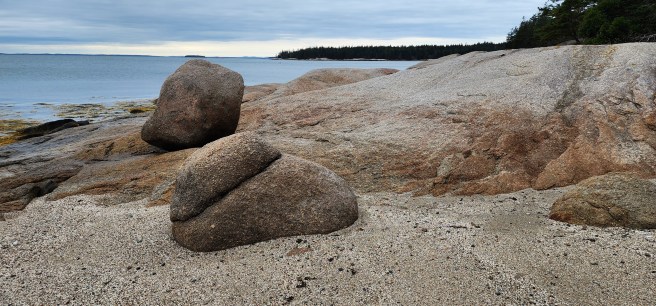 There are times when we could use a geologist on our explorations. At others, perhaps a Zen Buddhist master would be more appropriate.
This shot was taken during a shore visit from a cruise aboard the historic schooner Louis R. French last summer.
Turning to real estate
As the growing village took shape, John senior had his tract surveyed by Benjamin R. Jones, resulting in Shackford’s Plan of lots. A copy of that would help make sense of the wheeling and dealing that followed. Many of the purchasers were by John’s own children, individually or in combinations of partnership often formalizing land they had already “improved” and buildings they had constructed or sites where they would. Others went to Eastport’s new merchants and tradesmen. In all, I find 73 transactions, most of them as a grantor, or seller, recorded at the Washington County courthouse in Machias. I’ve probably missed a few, so take that as a rough figure.
It wasn’t just housing lots, either. Captain John’s waterfront properties were valuable sites for wharves, docks, and storehouses. He was even selling sites between the high and low tide lines. I’ll spare you the tensions between low tide mark claims today.
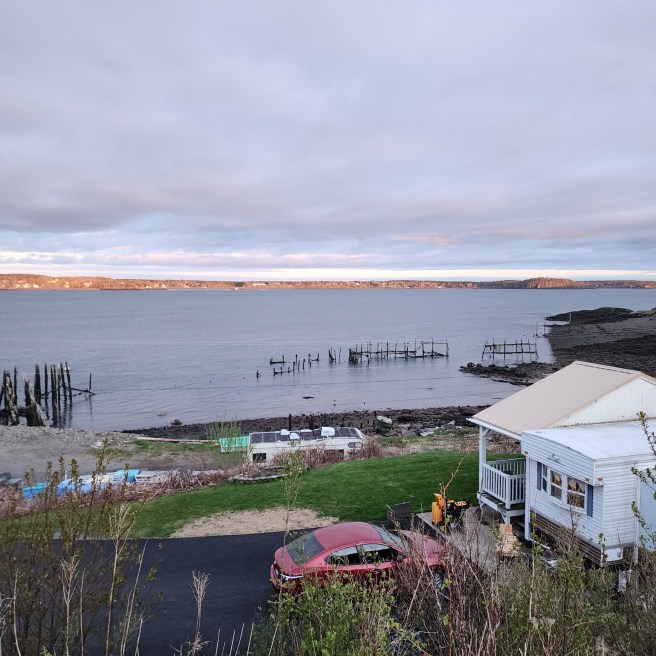
The one transaction I haven’t been able to track down is his title to Shackford Head. Was it simply overlooked by the indexers?
A significant deal took place on April 14, 1826, when his surviving offspring, all in adulthood, paid him $3,000 for the land between High (also known as Back) Street and County Road. And here I thought he had given it to them. Where did I get that idea? That was a huge figure for the time, by the way.
Was he a Scrooge with his offspring? Or merely cunning?
He still had plenty of lots left to sell.
Esther died on June 21, 1830, age 76.
All of it, of course, has relevance on the house we bought.
 Jnana's Red Barn