In the (still a dream) movie version of my new novel, What’s Left, who would you like to see play Cassia’s grandfather Stavros?

You never know what we'll churn up in cleaning a stall
In the (still a dream) movie version of my new novel, What’s Left, who would you like to see play Cassia’s grandfather Stavros?
My latest round of revising my fiction has felt somehow different from my previous encounters.
Well, I would include the round with What’s Left last fall, so maybe I can blame Cassia for my new experience. That novel, however, was always envisioned as a much less experimental work than my previous efforts.
The latest efforts have included deep cuts, including major sections I was quite fond of, and changing the tone. But these also meant creating page after page of new material, especially details to develop side characters more fully. Not just what they’re thinking, either, but rather what they’re feeling.
Much of my personal writing has functioned as an exercise to counter the dumbing-down editing required in the newspaper work that provided my income. You know, tone it down to what used to be seen as sixth-grade reading level.
Not just newspapers, either. I see too much pedestrian prose posing as literature and know language can have much more vitality and depth than that, thank you. Harry Potter, at least, has proven that many sixth-graders can read at much more advanced levels than they’re given credit for.
One thing, though. Five years after leaving the newsroom, I no longer feel that dumbing-down struggle as I write and revise, nor do I have to work my own writing into small blocks of time between everything else.
What I am surprised to see, though, is how much of the journalism influence was at work in the just-the-facts approach to my stories. I’ve seen much of my work – both poetry and fiction – as a kind of on-the-run graffiti, jazzlike, with an improvisatory tone and jagged edge. Daily journalism, for that matter, is typically done under deadline. Essentially, I saw the flow of clashing events as the core of the tale.
The biggest change in the recent revision has been the focus on the characters – and especially their feelings. Remember, in journalism, the only feelings would be through direct quotes. Anything else would be editorializing, not that you’d know in what passes for broadcast journalism on most American television stations these days.
Again, I’m going to credit my character Cassia for much of my shift. She’s having me examine that earlier work through her eyes as well as her voice.
In recasting her father’s backstory, for example, I’ve been continuing the present-tense emphasis as much as possible, with a more conversational tone than the conventional literary past-tense would carry. How would she feel about this or that development?
Oh, yes, one more thing. With her, it shouldn’t sound literary. She’s talking, remember?
The emotional element, though, has engulfed me. Engaging the characters on this level has consumed much of my time and thought, including my nights abed or my time on the treadmill or stationary bike during cardio therapy. It’s made for much slower going on my part as far as the revisions progressed. But it’s also led to a much more complete comprehension of the evolving story.
In the end, I’m hoping these move readers in ways the earlier ones didn’t.
Admittedly, I’m a pretty sedentary guy. I spent my career in an office. And a writer spends hour after hour at a keyboard or researching or reading. So here’s what I do when I’m in full-body motion. And remember, “favorite” here is all relative.
I hope to get bicycling back on the list. I loved it as a kid.
~*~
What keeps you in shape? More or less?

Continuing the poetry parade, see what’s new at THISTLE/FLINCH.
In the cardio aftermath, I was generally laying low, apart from my immersion in some serious revisions of my previously published novels.
And then? I looked at the window and saw an outburst of green – on the trees, especially. I had a sharp sense of having lost a big chunk of time.
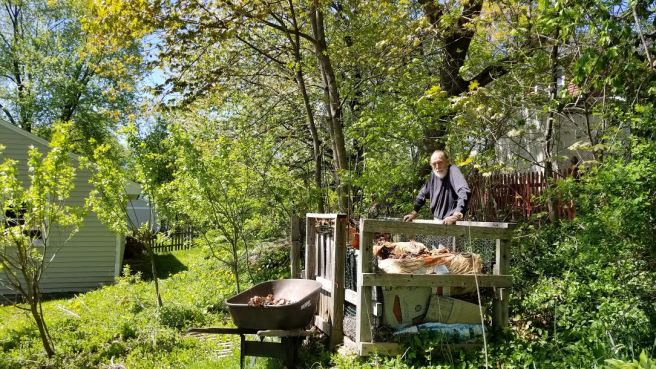
We had some hard storms this winter, and some major branches came down from our trees. We were lucky they missed hitting roofs, cars, or outdoor furniture.
Still, it’s meant a lot of cleanup, and there’s more work to be done with a chainsaw.
The gardens, too, are behind schedule. I never got to the beach to collect seaweed, back before the seasonal out-of-town parking ban kicked in. Hauling those buckets and extracting the collected bags from the car trunk takes exertion, beyond what’s considered safe during recovery. I mean, I’d hate to take a nitroglycerin pill at the beach while working alone.
Nor did I get to some interior painting and picture-framing, as planned this winter. Some? There’s a lot.
We are watching some big changes downtown, especially where the city is carving away a hillside to extend our riverfront park and open space for new housing as well as open direct access to a hilltop park above, which is also being expanded and developed. This development, which crept up on me while I was recovering and not heading down that way to the indoor pool, will greatly enhance the central focus of the city.
Downtown is also undergoing the razing of an old retail block to make room for a five-story retail and worker housing structure. It will also eliminate what’s been an annoying traffic obstruction.
Glad I’m back in action. Wonder what else I’ve been missing.
In my new novel, What’s Left, her aunt Pia is the epitome of bohemian possibility, even after being scorched by its downside. She’s the one who’s lived on communes; in contrast, Cassia’s father and aunt Nita had merely paid their share on an abandoned farm filled with other hip renters. Pia’s the one who witnessed drug busts and overdoses or worse, she simply went hungry.
As she recovers in the midst of Cassia’s extended family, her bohemian tastes find welcome expression in food and fabric and childlike wonder, especially. She’s hardworking and responsible, especially amid the circus she creates.
For Cassia’s generation, of course, hippie is old hat. But her aunt Pia is someone they see as special. Wouldn’t you?
~*~
Watching Pia was like watching a flower emerge from the soil and then bloom. The girl arrives destitute and broken and is given space to heal or regroup.
Whatever haven we offer is gratefully embraced.
She mends clothes. Tends the garden. Sits with us as we ride our White Cloud thrones.
~*~
I can’t evade the question any longer. What comes to your mind when you hear the word “hippie”? Do you prefer “boho”? Or does some other term work better these days? Is it positive … or negative?
~*~

In the family, Cassia may have had food like this.
When I wrote the four novels that formed my Hippie Trails series, Cassia was nowhere in sight.
But now that she’s taken center stage in What’s Left, she’s changed my perspective on those earlier novels. Quite simply, I’ve revised them to bring them more into line with her story. Drastically revised them, in fact – deep cuts, offset by new material.
Quite simply, they’re now her discovery of her father and his era rather than mine. Having a character take over a book is rather eerie, actually, especially when she’s livelier and more interesting and more critical than I’d be. Moreover, she wasn’t even present in those earlier works – they’re all before her birth. Before she was even conceived, as it were.
That hasn’t stopped her from pushing for more extensive revisions than I had anticipated. Not only are the novels all retitled – and two are even compressed into one – but many of the characters are renamed, a few new figures are introduced, and hefty cuts are offset by rich new detail and restructured storylines.
So what we have now is Daffodil Uprising, Pit-a-Pat High Jinks, and Subway Visions. And the series they form with What’s Left is no longer Hippie Trails but Freakin’ Free Spirits.
Well, quite simply, my wife hates the word “hippie,” says too often these days it translates as “loser” or “lame,” and I wanted something that might fit bohemians over time … in this case from Cassia’s Greek great-grandparents right down to today.
By the way, I’m still blaming Cassia for my putting so much else aside in the past five months. She just wouldn’t shut up, and she can be quite bossy. Admittedly, though, I’m much happier with the novels as they’ve evolved and finally emerged. Let’s hope she is, too.
As for you and other readers? That’s the real question.
I’ll have to leave detailed accounts of first-generation Greek immigrants to America to others who have truly intimate material to draw from. Simply portraying the relocation of my mainstream grandparents from a Midwestern farm to a nearby city would prove difficult to pull off.
Still, in my new novel, What’s Left, I find enough to suggest some of Cassia’s great-grandparents’ possible experiences and achievements. She has reason to take pride in what they’ve established for her extended close family. It was, after all, one place her father-to-be would fit well, despite his initial resistance. And now she’s struggling to make sense of it all, especially in her circle of siblings and cousins.
~*~
Not everyone who came to America dissolved into the melting pot concept. Still, they had to sacrifice something. The question just might be, How much?
Extend that to our own personal identities.
What’s your idea of “normal”? How well do you fit in?
~*~

Cassia’s roots included scenes like this.

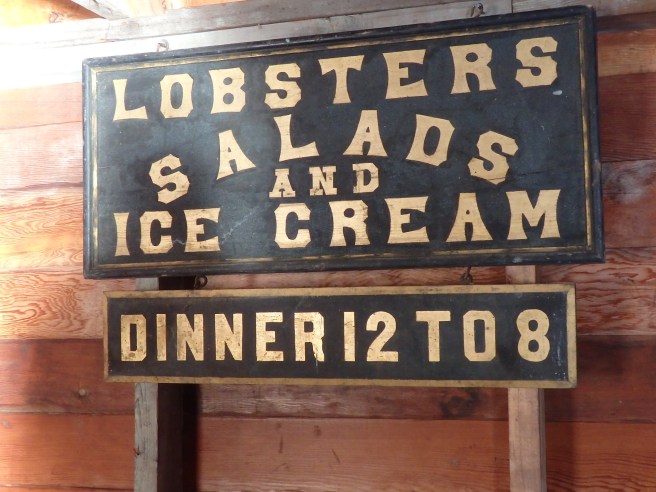
The daily soup special at the family restaurant in my new novel, What’s Left, was one way to introduce the now widely touted practice of local sourcing, perhaps with a hint of organic gardening. Here it begins when Cassia’s great-grandmother and her sister make rounds of nearby farms, gardens, and orchards in search of fresh produce, eggs and dairy, and perhaps meat. (I never get quite that specific, but a quick brushstroke will do.) The action picks up with her parents’ generation and its back-to-the earth movement – one in which I suspect some bartering might have occurred. Used cooking oil, for instance, has found value as motor fuel for some farmers.
~*~
What do you like about June?
Getting back into swimming laps – however gingerly – feels so good. As did the last few choir sessions before the ensemble took its break for the summer.
I’m still not up to my usual half-mile – 18 laps (or 36 lengths) in the indoor pool – but I am feeling secure as long as I don’t overdo it, and I am pretty much back in the water daily.
One thing I became aware of after the stent was inserted was just how close I’d come to having a heart attack in the previous months. I’d felt the breathing problem in the pool, for one thing, and also while carrying a three-year-old down off Mount Agamenticus in November. Am sure glad the event didn’t hit on either of those, I’d hate to traumatize either a kid or the lifeguards.
About a month ago, when I finally got the OK to return to the pool, I realized how much had passed since I last saw the guards or some of my fellow swimmers. Some are coming up on high school graduation, for one thing – and the banter is always a lift.
Even when one tells me that for the kind of obstruction I was having, had it turned into a heart attack, the odds weren’t in my favor. As she said, nine out of ten never make it to the hospital. And as I’ve been saying, I’m feeling very blessed.

