
Garlic takes off like rockets
You never know what we'll churn up in cleaning a stall
About four or five years ago, I returned to my car in the supermarket parking lot and found a magnetic strip attached to the door. Mine wasn’t the only one. Many other cars had them.
The message deeply offended me. Still does.
For perspective, let me change one word – and then a few others to match – to see how the logic flows, or doesn’t. Here goes:
So you support Trump-Pence. This means you …
“If we lose freedom here, then there is no place to escape to. This is the last stand on Earth” – Ronald Reagan.
~*~
The original, however, accused me of supporting a Socialist, along with an entitlement mentality, Collectivism, and Marxism, all because of my Bernie sticker.
The hit-and-run messenger was cowardly, of course. Presumptuous. Prejudiced (this person knew nothing about me, after all, except for a campaign sticker). A bully, trying to intimidate me or stifle my freedom of speech.
But I’m still deeply miffed about the bigger problem of a blinding power of labels to obstruct civil discourse and thoughtful consideration of public issues.
Socialist, after all, does not necessarily mean Marxist. To the contrary, it was an element of early Christianity, if you read the book of Acts and New Testament epistles closely.
We were reluctant to start packing up our final goods from the house until the new couple passed through their final checkpoint in the home-purchase process. You know, just in case we had to show the place again to a fresh round of bidders.
What it’s meant was less than a week to box or wrap all that remains and haul it off somewhere.
We had already done a ton of packing and purging to make the rooms look presentable, but we wanted to leave enough to make it look cozy and livable. So that part’s done.
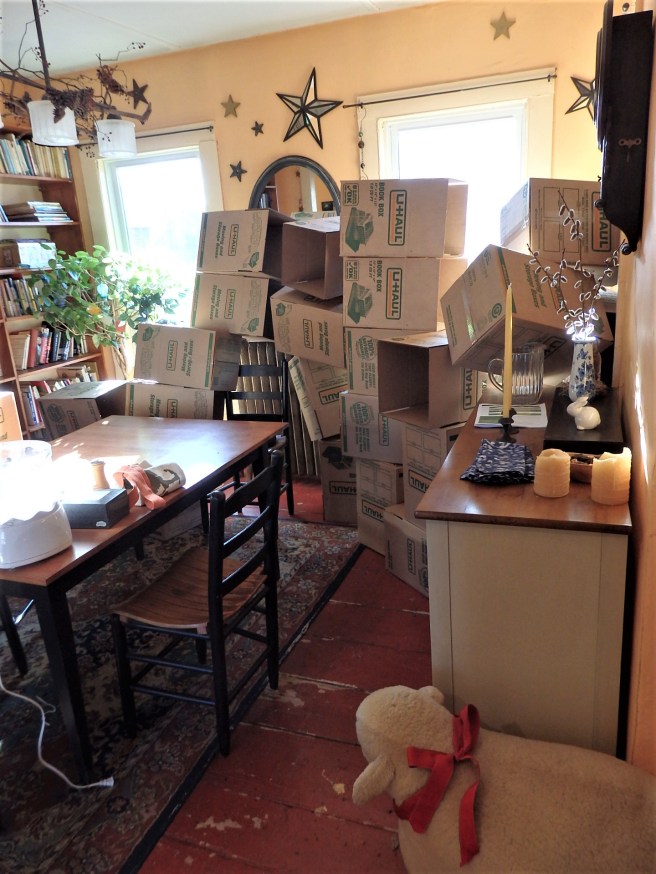
I’m a big believer in having uniformly sized boxes in a big move. They stack much more easily, for one thing.
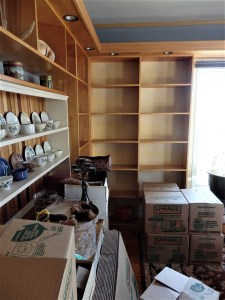
There’s no way it will all fit in our new Downeast address, especially before our anticipated renovations are completed, so we’re putting some in two storage units, in effect buying some time for some serious culling. More is going off to our daughter’s already stuffed barn in York, to come up later.
It gets emotional, of course. I’m surprised how much responsibility I feel toward the books I’ve read, and their authors. And then there’s my vinyl collection.
Of course, that’s only my tip of the proverbial iceberg. Take the kitchen and garden goods, especially.
Sometimes I used to joke that I couldn’t understand how people lived without a barn to hold all the overflow. Only now it’s not the least bit funny. Seriously, folks.
Candidly, I’m not the gardener in our household, but I still have to pitch in with the work. Let me look on the bright side. Plus, when it comes to dining, I definitely enjoy the benefits.
~*~
Well, gardening does also serve as an item of conversation.
What would you add?
They definitely weren’t suburban. A big pink Victorian house suits Cassia’s colorful extended family in my novel What’s Left. And guests, even guests of guests, are typically welcome.
Have you ever been welcomed in a home like Cassia’s? How does it differ from yours?
~*~

RANGER
ANGEL
ANGER
Sometimes I was searching for a new form or genre somewhere between a short story and an essay. Not that I successfully found it.
exactly what comes next? maybe it’s Chicago within multiple trajectories of impatience and boredom before connecting and charging ahead roughshod you take a swing, fan, and fan again in this curriculum of revelations from Old Friends everywhere standing on some pebble-strewn base of a mountain, watching a squall line of religious tracts form in oppressive humidity how am I to know this will play Boston, this season or next? maybe I’ll score, ah, yes, and speaking of Hope, give her my greetings the big picture emerges one pitch at a time, here come the Sox . whoops
In absolute numbers, I suppose you could say we lived in the place for free, once you compare what we paid for the place and added as renovations against the selling price two decades later, but I’m not sure that would hold up if we factored in inflation or what we might have earned if we’d placed much of that money in the stock market.
Even so, here’s some of what we had done:
And that’s not counting all the garden beds and plantings or tree work.

