Underfoot counts, too

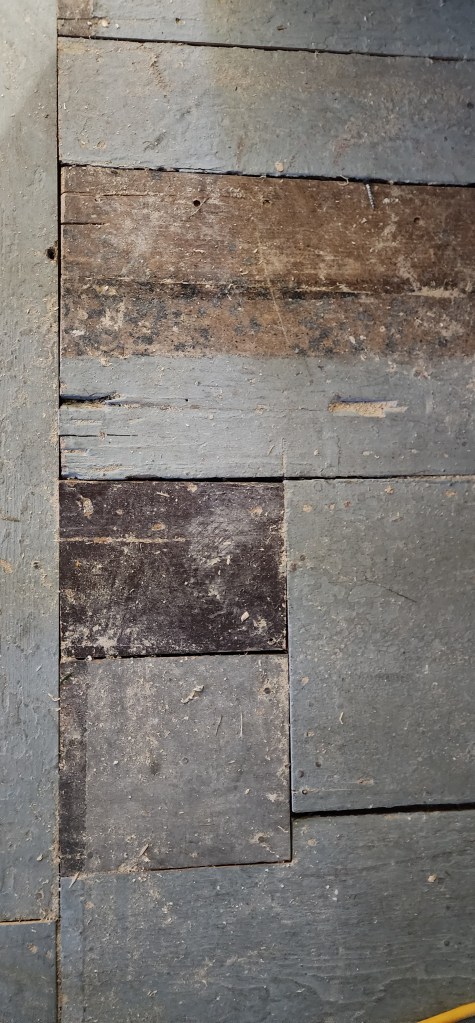
Another consideration I haven’t mentioned was the upstairs flooring.

As much as we would have liked polished hardwood, our budget called for something more affordable.

The existing flooring was more piecemeal, with unevenness and knots. It did speak of the rustic origins of the house and its historic character. Our contractor mentioned some flooring that would match it, and we were onboard. (Sorry for the pun.)

Refinishing those planks might have looked historically charming, though they were never great to begin with. Instead, we salvaged what we could and added fresh to continue.

The next question was how to treat it. Apart from two rooms and a hallway of vinyl flooring downstairs, the existing flooring, upstairs and down, had been painted a light blue that easily flaked. Could it be sanded and refinished in a natural finish? Did we have time to undertake that? Otherwise, what color of paint could we agree on, at least for the bedrooms? The bathroom and laundry room might be a different matter requiring something more waterproof.

I had hoped to decide on a paint color extending across all of the upstairs. Mine was the minority vote.

That left me facing a decision for my room. Please stay tuned.

How would I have envisioned literary success?

Let’s start with the prompt: Imagine yourself in the position you desire.

For much of my life, that had two conflicting scenes, the newspaper editor in his community in contrast to the successful novelist in a tweed jacket in a New York study or a poet in something more funky.

Much less for the supporting people my life, starting with wife and children?

When I last looked at the question, it essentially asked me to consider my early retirement years. How curious! The newspaper editor, at least, was out of the picture.

At its core, I craved recognition (affirmation!) – after years of largely reclusive labor. But which circle did I most want to recognize me – hip, alternative culture? Quaker, international literary, Seacoast New Hampshire? At some level, perhaps, it was also wanting to visit Dayton and be known even there – or to hear again from many people I’d known and lost contact with in my relocations. The Quaker world is awfully small and restrained, especially with its three sharp divisions. The literary world, meanwhile, has so many high priests and exclusive emphases – could I move among them? Yet, if the Society of Friends is to survive and grow, I needed to move beyond its confines and reach out to a wider audience. In a larger sense, then, my recognition would be as one who brilliantly bridges these disparate worlds. If only.

I did imagine a significant amount of time would be engaged in travel – public readings, workshops, conferences. Eight weeks a year, split between Quaker and literary? Perhaps an additional retreat or camping trip? The travel could also include three-day weekends for symphony, opera, and galleries.

I also imagined having three books published on paper each year – one of poetry, one of Quaker practice, and one of fiction or memoir/genealogy. (They were already written.)

The rest of the time would be correspondence and basic living, including a social life, concerts/plays/etc.

I do believe such reflections are important in channeling what might otherwise be simply drifting through life.

So back to the questions.

Define what you are trying to accomplish. Be clear about what you’re setting out to do. What problem are you trying to solve? What new ground are you trying to break? What will happen if you manage this well? What will happen if it isn’t managed well?

I would have said, Brand myself as the leading new Quaker voice – or at least an original Thinker. (Think of Bill Stafford in the Church of the Brethren, Wendell Berry, even Mary Oliver the Unitarian – who has emerged since?) What I want to do is bring Quaker theology into the center of contemporary thought and discourse, and then to renew the life of the Society itself. The poetry and fiction add to my credibility as a writer.

Well, that has slipped past me.

Now for another hard question.

Who do you think would play me in the movie version?

~*~

You can find my surviving novels in the digital platform of your choice at Smashwords, the Apple Store, Barnes & Noble’s Nook, Scribd, Sony’s Kobo, and other fine ebook retailers. They’re also available in paper and Kindle at Amazon, or you can ask your local library to obtain them.
Inside Charles F. Kettering’s mind

The prolific inventor, entrepreneur, and civic influence Charles F. Kettering was still alive in the Dayton community when I was an aspiring chemist in my youth.

My career in science never materialized, but his influence as an inspired ideal of leadership remains.

You may recognize the name from the famed Sloan-Kettering cancer research hospital in Manhattan or from the city in southwest Ohio named in his honor. He also led the research teams that invented the electric cash register, the automobile electrical self-starter, and no-knock gasoline. Other work made the diesel engine practicable as well as the refrigerator and, in time, air conditioning. In all, he had 186 patents, second to fellow Ohioan Thomas Edison. He was a founder of Delco (Dayton Electrical Laboratory Company) and from 1920 to 1947 was head of research for General Motors.

As a power in the new General Motors corporation, he aligned with management pioneer Alfred Sloan – as in that Sloan-Kettering Hospital in Manhattan,.

Let me repeat, there’s even a city named in his honor.

Today we have another Double Tendrils.

Get ready to know him better. Let’s start with his perspectives on the creative process and problem-solving, especially as they apply to engineering and invention.  Here’s what he said:

  1. If you want to kill any idea in the world, get a committee working on it.
  2. I don’t want men of experience working for me. The experienced man is always telling me why something can’t be done. The fellow who has not had any experience is so dumb he doesn’t know a thing can’t be done – and he goes ahead and does it. … The person who doesn’t know something can’t be done will often find a way to go ahead and do it.
  3. Every great improvement has come after repeated failures. Virtually nothing comes out right the first time. Failures, repeated failures, are finger posts on the road to achievement. One fails forward toward success. … 99 percent of success is built on failure.
  4. An inventor fails 999 times, and if he succeeds once, he’s in. He treats his failures simply as practice shots.
  5. Inventing is a combination of brains and materials. The more brains you use, the less material you need. … A problem well stated is a problem half-solved.
  6. All human development, no matter what form it takes, must be outside the rules; otherwise, we would never have anything new.
  7. A problem thoroughly understood is always fairly simple. Found your opinions on facts, not prejudices. We know too many things that are not true.
  8. Research means that you don’t know, but are willing to find out.
  9. We work day after day, not to finish things; but to make the future better … because we will spend the rest of our lives there.
  10. If I want to stop a research program, I can always do it by getting a few experts to sit in on the subject, because they know right away that it was a fool thing to try in the first place.
  11. When I was research head of General Motors and wanted a problem solved, I’d place a table outside the meeting room with a sign: “Leave slide rules here.” If I didn’t do that, I’d find someone reaching for his slide rule. Then he’d be on his feet saying, “Boss, you can’t do it.”

And now for his perspective on life itself.

  1. There is a great difference between knowing a thing and understanding it. You can know a lot and not really understand anything.
  2. The world hates change, yet it is the only thing that has brought progress.
  3. If you’re doing something the same way you have been doing it for ten years, the chances are you are doing it wrong.
  4. Where there is an open mind, there will always be a frontier.
  5. My definition of an educated man is the fellow who knows the right thing to do at the time it has to be done. You can be sincere and still be stupid.
  6. If I have had any success, it’s due to luck, but I notice the harder I work, the luckier I get.
  7. The whole fun of living is trying to make something better.
  8. No one would have crossed the ocean if he could have gotten off the ship in the storm.
  9. You can’t have a better tomorrow if you are thinking about yesterday all the time.
  10. Every father should remember one day his son will follow his example, not his advice.

He really was one who made America great.