Native crafts dying as television extends northward: work done at night as people sat around chatting now slips away.
It already happened in Europe long ago.
As for home life?
You never know what we'll churn up in cleaning a stall
Native crafts dying as television extends northward: work done at night as people sat around chatting now slips away.
It already happened in Europe long ago.
As for home life?
These notes were from a grad-level seminar, Frontiers of Public Policy and Action. Classmates included Brian Loveman, George Strump &/or George Stein, Paul Wogaman, and Major [his given name] somebody.
Takeaways:
Selecting one form of action as policy does not preclude other possibilities. So what causes policy to limit choices?
Soft constraints = a matter of choice, which leads to difference.
Hard constraints = invariance, operating across all political systems, including political inequality.
We assume that a dollar is a dollar. But is that true when dealing with the public treasury?
What happens when a dollar of yours is used to harm you? When you are taxed to harm yourself?
A public good may become a public bad.
A political price is assumed in all political systems.
Capabilities = potential assets.
Limitations = political liabilities.
Every decision reflects these.
With multi-tiered political systems, the concept of commons becomes ambiguous.
The bribe = the rich get richer; the poor, poorer.
Public entrepreneurs. Public goods and services.
Behavioral theory as an alternative to top-down management perceptions.
Unity of command: limited span of control. A belief the organization is always directed toward the center. (As for a bell curve?) (Or that which deviates from authority?)
Bureaucratic disfunctions. Formal versus informal policy/action.
Rules of procedure may dictate the solution.
Medieval epistemology quite at variance with contemporary perspectives. As in, spirits as an opportunity for Truth to be revealed, as well as magic and myth.
As for those who are negatively affected by an action (externalities) = direct consequences of actions.
A bilateral monopoly = oligarchy or other monopolists.
Water policies in the West as an example of a local matter that exerts much wider influence.
Trade associations within public agencies …
Dynamic of a hidden hand, an equilibrium without direct intervention.
How do we assure that rivalries between cities, states, or nations work toward a common good?
The aristocracy of the South became a military caste. State military colleges in South, not North, Midwest, or West.
Can bureaucratic professionals regulate their superiors? Or is a self-centered careerist more interested in pleasing the superiors who control his promotions?
As for strong client relationships?
Is what we’re buying with tax dollars in the national interest? (Block grants versus categorical grants.) Are these grants or are they purchases? Are we buying what we should?
Taxing capacity = real jurisdiction.
Politics as a subset of corruption.
Public education as a public good yet to the individual’s advantage.
Monocentric decision-making processes in a large city lead to
Mafia as a shadow bureaucracy versus government collective action.
~*~
From Spiralbound Daffodil, with commentary from now.
In season, we like interacting with the passengers from visiting cruise ships. Eastport does limit the ships to no more than one a day, and most of the ships come after the summer season and many of our retailers had traditionally closed up. For the restaurants and stores, the ships more than doubled the retail season and often provide the best days of the year. What a relief!
So here’s a sampling.
Some inquire about lighthouses or the Bay of Fundy.
The crew members, meanwhile, want to know how to get to the IGA and Family Dollar, where they stock up on snacks and junk food. They quickly establish a kind of ant trail moving in both directions.
My last two surviving college notebooks, from the period just before I began personal journaling, nevertheless offered some clues to my state of mind at the beginning of the ‘70s. From the cover, I see I lived in I lived in G253, an honors dorm in the Graduate Residence Center. Yes, some undergrads were allowed.
Terence Martin turns out to have been on his way to a distinguished career he ended as a professor emeritus. “His first book, The Instructured Vision: Scottish Common Sense Philosophy and the Origins of American Fiction, became a classic study of how Americans wrote fiction in a society deeply suspicious of the imagination.”
In addition to Seth and Diane Rubinstein/Rubenstein, my classmates included Monroe Anderson, Julie Harvey, and Jeff Hersh.
The reading list:
In retrospect, I’m seeing how much this course shaped my own attempts at fiction. Do note that there were no women and no Kerouac on the list.
For a closer look at the course and the authors, see While Their Novels Were Still New in Thistle Finch editions.
~*~
Mention of AFSC in Dayton – draft counseling?
Natt Thompson may have known Joe Elder.
Roy and Alice Leak or Leaky, faculty from North Carolina.
~*~
End matter had a page of journalism recruiters on campus, February 17 through March 11, from Chicago Tribune, Milwaukee Journal, Wall Street Journal, Miami Herald, Lindsay-Schaub papers (Decatur, Illinois), Louisville Times. Unfortunately, a wave of layoffs shortly afterward meant the job interviews were for nil.
There’s also a listing of Chekov pages for my Russian lit course (though taught by the Russian language department, the readings were in English).
Another page sketches plans for a “cell in the woods,” something with a glass roof and a cot or hammock. Buckminster Fuller had his geodesic dome; I was playing with a square-turned-diamond (from the gable end), the bottom corner sunk into the ground, diagonal width 12 feet at ground level – the overhang would leave two sides sheltered. Maybe I’d stack firewood there. The cot would be at one end, rather than the workbench I expect.
~*~
From Spiralbound Daffodil, with commentary from now.
In one notebook, only the first eight pages were used. The remaining pages remained blank. Somehow, I was now at Indiana University, Bloomington.
I’m confused about the time of these entries. Page 2 opens, “Tiempo comes out this week: it is beautiful, austere, and masculine. Will the effort to excise the cobwebs, the Romantic [Victorian?} cancer from this God-forsaken place be worth the effort?” On page 4 there’s a bracketed [November 14] entry, “at breakfast time, the puddle was frozen. At lunchtime, a butterfly flitted in sunlight; I thought it was a falling leaf.”
Yet the entries have me suspecting the entries might actually be from early spring or later, when my love life was in turmoil. The only notation on the opening page was a pathetic: “Poem to Nicki. Can I be your older brother / if I cannot be your lover?”
There’s also a description of our visiting Toad Hall with my sister and our driving to Bedford, with the Hoosier hills creased by naked trees and framed by blocks of farmed fields, rocks cut away by creeks, golden fallen leaves, and yellow cut limestone. Also, Cezanne quarries with mottled gray skies.
Still, these details also would fit November.
~*~
My reading stack included Steppenwolf, which I read half-drunk on one of my first bottles of wine, as well as Leviathan, Dark Ghetto, Hostettler’s Amish Society, Morning Watch, Einstein on Mozart’s piano concerti, the usual studies grind, Neibuhr’s Moral Man and Immoral Society, and the Kerner Report.
Story idea: Levithan (or the perfect ruler): the sovereign as an omniscient computer. [Remember, this was at the end of the ‘60s!]
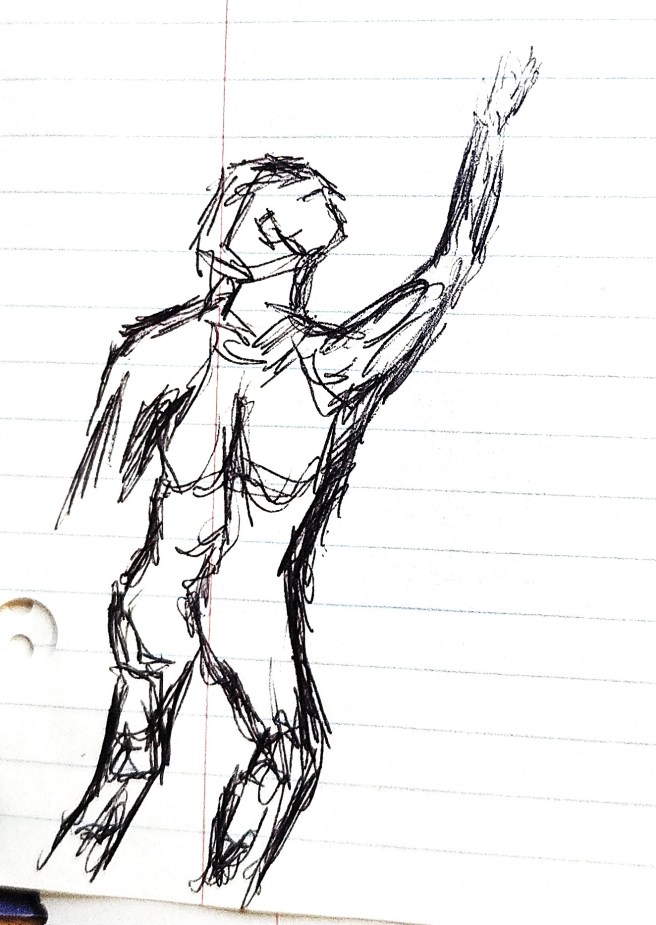
~*~
My primary focus was on Nikki or, more accurately, her absence. In the years since, I had forgotten that we had ongoing struggles long before the final split.
“The library on Saturday night is quiet: a great escape from couples.”
[I see I was using colons the way I now use dashes. One seems literary, the other journalistic, often as a substitute for parentheses.]
Sunday morning is for the purest music: Mozart piano concertos, the Shostakovich preludes, Herbie Mann, Beethoven’s sixth.
And then:
“This week has been weird. Nikki’s decision [whatever that was], then all night Wednesday after our tearful walk. My feeling suicidal playing dodge ‘em with cars. The beauty of being together, skin against skin, her breasts pressed into my arms. Pale sunrise, lavender against blue. Gut-torn scars exposed again. The same lines Fay gave. ‘But I’ll still want to know where you are, too, and know what you’re doing.’ ”
[Funny, neither of them followed up long on that.]
“She is so fucked up, makes herself unhappy when she should be the happiest,” despite the humor that makes my friends think she is so funny. … but I really don’t know her yet. …
“Her chemistry is different. She smells and tastes so different from other girls. Maybe it’s Jewish.” Hmm: “Fay and I had an unspoken language Nicki & I don’t. But Nicki is more human, more sensitive, more the artist and intellectual.”
More the child, actually. If only she would grow up Yet “she stabilized me …”
“Running the door into Paul, the pianist who has never heard of Von Karajan, as he carried hot chocolate.” Who was this guy in my dorm?
Or Jack, “who does not understand literature. I read him a few excerpts from Steppenwolf and understood nothing. Intellectual jerk.”
~*~
Artists do not make contented cows on the sidewalk.
As I was going to buy a baby-congratulations card:
Who might the mother have been? Kathy H?
three blue baby buggies
pushed by three
student-type mothers
Now I see that Nikki and I were having troubles before my trip to Florida. The trip, even so, went swimmingly.
Vietnam
Love it
Or leave it
Other bits:
The worst profs I’ve had hold doctorates from Ivy League schools.
One poly sci course offering was about why politicians must tell lies, keeping their constituencies in ideology and darkness.
Two nights a row, meatloaf. On third day, at lunch. The dieticians serve what no one else would dare do.
The best part of any book is the last half. The author has laid all his piddly groundwork: he is now ready to move, if he can.
Really?
Trout Fishing in America: big writing now. [Maybe this was my first awareness of the work, from a reference in Newsweek or Time, rather than actually having the book, something I think happened in my Montana trip in the spring of ’70, after graduation, about the time I started journaling seriously.]
This campus is filled with a bunch of would-bes: would-be writers, would-be lawyers, would-be scientists, all pretending and preventing others from getting ahead. Rah, mediocrity!
Conversation with V.O.: basis of Hobbes and of Kantian ethics is an assumption that good and the maintenance of the state are one and the same. … His wife is teaching what looks like a fantastic course on urban affairs, very problem-oriented …
Make every minute count. It will soon add up.
“I had to obey the rules of war and my flag. I am ready.” – last words of Adolph Eichmann, Nazi leader.
Her family’s Lake Worth rural route address and phone number occupied my back page. The ranch was essentially West Palm Beach.
~*~
From Spiralbound Daffodil, with commentary from now.
Journalist? Perhaps a very special secretary, in the old aristocratic sense of personal aide, except on behalf of the people …
First entry had dateline of New York but was from Upstate enroute to Montreal. I’m thinking this was from a family trip taking the Thruway to Syracuse and then I-81 due north to the Thousand Islands region. Pittsburgh, Toronto, and Cleveland were likely on an earlier trip.
Big, bossy women with rough, powdered faces. Big cars. Big-nosed men. The resorts, once elegant, rambling, now crowded, rundown, shabby. Poor cottages deface the landscape. Everywhere cheap tawdriness of sightseeing boats, lying pamphlets, expensive everywhere: highways, bridges.
And then MONTREAL.
Busy, cosmopolitan, the women proud to be women, they carry their heads high, proud, elegant, fashionable. Men handsome, dark, longish [styled] hair – many artsy, with sandals. Both sexes seem to enjoy themselves, full of life. The center of the city is vast, exciting, filled at night with people. The Place Ville-Marie is the most beautiful large-scale design I have ever seen: four tall office towers with a plaza, under which is a gallerie de boutiques, small but expensive shops that stretch under the street to the central subway station and the Queen Elizabeth Hotel, the city’s proudest. Everywhere construction of clean, modern glass-wall offices. But driving is nervous, quick, dangerous. Most cars are dented and crushed in, somewhere. Everybody parks in “no parking” zones. Little wonder so many take the legions of taxis or numerous buses (fare just 20 cents). Live theater abounds, as well as cinema. Visiting cultural events abound: New York Philharmonic, La Scala Opera, Hamburg Theater.
The city’s filled with apartments, many with outside stairs leading to the second and third floors. Everything in French, one finds difficulty in common communication. It is like being in Europe or some obscure corner of New York City.
We see the Expo area tomorrow. [Was it under construction? The fair took place over the summer of ’67.]
Sorry, janitor, restroom writers have struck again.
Montreal was the first city I encountered that wasn’t awash in suburbs.
~*~
Western Quebec/Eastern Ontario: Flat country that must be cruel in winer. Woods of birch, maple, and pine. Houses of brick, steep-roofed, and without ornamentation. The land is sparsely settled, with many unpainted, storm-beaten frame houses graying into ruin.
My guess this was the summer of ’66, perhaps at the end of summer. Our last family vacation?
~*~
From Spiralbound Years with commentary from now.
Often, writers’ advice can be extended to life beyond writing itself. Here’s a sampling.
So how is it my Dick Allen notes from Wright State were in an Indiana University 3-subject divider book? Or that it ended with apparently Nashville [Indiana] observations? Did we visit campus first? Not that I remember! Or was it a gift from someone? Now I must wonder about my first sight of the campus.
A gift from Fay, I suppose. No, I rather assume now. She had, after all, gone off to school at Purdue in another corner of the Hoosier state. Besides, she had a devilish sense of humor and could have given me one of those instead. The two schools were Big Ten rivals, after all.
My notes included advice on five-paragraph examination-essay model and counsel to use the prof’s keywords in it.
Symbolic logic notes, too, which I no longer understand yet still admire.
Every sentence is either true or false.
Of the 1,750 dailies in U.S. in 1967, 75% had circulations of less than 25,000; 30% of readers bought the paper for sports.
Women as accessories: disposable.
When sex doesn’t deliver the goods?
Essayists must write from minority viewpoint.
Self-doubt: YOU WRITE FROM YOUR GUT.
WRITER SHOULD HAVE AN OPINION, RIGHT OR WRONG.
[what a contrast to neutral, objective journalist!]
“You can never write a perfect sentence. The perfect sentence does not exist. If you spent all your time trying to perfect your writing, you’d never publish.”
Bev Strampher: “I’m getting sick and tired of reading about all these neurotic people with weird hang-ups who do nothing but fight and argue.”
What kind of effect to I want? Who is my ideal reader and how will I hit him? (Him? It’s HER! Maybe Nicki was my ideal reader, at least with my Indiana Daily Student newspaper column.)
BECOME AN AUTHORITY … so I have, Quaker!
Build career on chain of interests.
Writers are NOT discovered … it’s politics.
Journalism not conducive to good writing/reading, does not know what to do with art writing; love of words is taken away from readers; most people are not asked to become involved.
Writers are sex-obsessed (sez our prof).
Writer should have an opinion, right or wrong.
Few professors are intellectuals.
Allen: “In 20 years, you will be better than Tom Wolfe. … You’ll be wasting your time in newspaper work.”
Transitions are artificial.
Forbidden subjects are usually the funniest: sex, politics, religion.
INSTANT HISTORY.
My ballpoint-pen ink bleeding through the pages.
[Incinerated]
~*~
From Spiralbound Years with commentary from now.

