Nay does not mean no, except in oral voting.
Nark:
- From nok, nak, nose: Brit a spy, employed by police: informer, stool pigeon
- To act as an informer
- To become irritated, annoyed: “Hope you aren’t narked at me”
- Killjoy, wet blanket, an unpleasant and irritating person
- Nark it, meaning to cease, as command
Narky, ill-tempered and irritable
Mencken: “America has no institutions, only fashions.”
From Antioch Review, Summer 1970: “If everybody pleaded not guilty, the judicial system would collapse.”
And then: Laws “should not be understood as meaning what they purport to say, even after being interpreted in court. They can be properly considered only if one examines the intersection between the stated laws and the particular interests that are being served by it, in an actual setting.”
“Fairly obviously, then, the posted law … was intended and used for a purpose exactly opposite to the one stated in words.”
“A stable balance of illegality requires that the law, in practice, exclude from prohibitions the ‘normally’ illegal behavior of particular groups.”
“In this way, the customers get the law they want.”
“Law defends the rights of ownership.”
[Joseph S. Lobenthall Jr., “Buying Out, Selling Out, Copping Out: The Law in the City”]
~*~
Len announced he’s moving out, he can save $12.50 a month in rent and another $25 in food stamps. It hit me bad, at the wrong time: I’m broke, don’t want the hassle of getting a new roommate and getting to know him – most of the “character” here is Len’s: the lights, god-chair, dancing Victorian virgins. I’d like to live alone but can’t afford the extra $250.
Judith’s Wandering Minstrel says he loves her, she said bullshit but she loves him: three days during finals, no studying
[Later entry]:
She has decided:
- She hates Teddy, he’s really messed up
- She pities him (what did Spinoza say about pity?)
- She was crying after 10-minute confrontation when she told him to get lost
[Note that Teddy was in reality the same badass who would later cast a shadow over a promising fling with Stephanie of Bear Mountain.]
He condemned her because
- She likes school more than him
- She took him in to feed and shelter, “I don’t want that”
- She’s afraid of getting involved
- She won’t trust him
- She won’t take off with him to go nowhere
- She won’t give him anything, “I’ll give you anything you want”
- She’s not free
He’s 28, plays guitar and banjo, sings: no home, no income, and a parasite who believes everything should be free.
He doesn’t like classical, “It’s not people’s music, they can’t understand it.” As for opera, her major: “Why be better if you’re good?” Literature, ditto.
Looks like a sandy-haired, sad Allen Ginsberg.
She was crying: You shouldn’t see me like this.
Later, we were wrestling and laughing. Good! I can get through …
~*~
Marj G took Len’s room …
Mixed feelings about her moving in: a feminine touch, cooking, redecorating. A fear, too, of getting involved. She was going to be Polly and Molly’s roommate. Molly sez she’s fine. Tom O’S sez she’s funny, something about Baptist Corners …
Her friend Pebble, the Italian, so euphoric in a raucous way, promised to cook us a lasagna dinner
Adele, resembling Nicki’s sorority roommate of the polka-dot bra: very high strung, beautiful, into Ted. He keeps showing up, like bad karma, first at the old place, then Judith, then again tonight. Lives on Grand Avenue.
Still deep winter at this point of the journal, “it’s 2 degrees, my beard and mustache catch the water vapor from my breathing and it freezes”
I got a fat letter, with newspaper clippings, returned: insufficient address, addressee unknown, and no such street, it said. The Post Office knows so much but won’t disclose it. Are you dead or did you run away to British Columbia with him or merely to a country farm? It will not say. Goodbye, witch, leave me alone, my own life: do not come near me: you can destroy me, I hate you [or that] and fear you: my heart beats too fast. [Nicki? Or Fay? Or] …
Style is projection.
Judith called this morning, wanted my box number, said she wrote me a long letter and didn’t have time on the phone … she wants to move in with me and split the rent with Marj “and I can pick up after Marj, she’s not too neat” – yeah, neither are you, babe. And she sez Teddy isn’t so bad, “I know so much more now, I can control people better, I don’t have to worry” and her voice tightens, pinched, nervous, “Teddy and I might go away for a couple of days … could I come up a few days early and stay at your place? I can’t stand it here, I can sleep only seven hours” she’s grabbing again, “If I stay with Shayna, I won’t grow”
Mixed feelings I have [too].
Perhaps I should have dropped Nicki when Cox told me to, but then there would have been no loss of virginity, no Florida, no Montana-Utah … am guessing my changes/growth would have been lesser.
Len, who seldom does the dishes, frequently tells me to rinse them immediately upon using. Today he made an omelet (with my eggs, he never uses eggs, he sez); he left the milk out and the dishes, “Oh, yeah, I was too busy kissing Zeezy and tucking her in bed.”
He was also talking about Dr. and Mrs. [his last name] and about hitching out west this spring. He’s in future-possessive bigtime.
~*~
Friday, Judith was here, I called the neighbors to turn it down, “I’ve got a biddie here and she’s trying to study,” “a what?,” “I said biddie,” and she attacked my bare back with a magic marker and I started laughing and Tim on the phone started laughing, couldn’t stop, any of us
Next day, when I returned from work, she was playing records, broke the spin on my Max Rudolf Don Giovanni album, put the discs back in wrong order, slopped up my collection
I enjoy telling people about the books I’m reading before I actually do enjoy reading them
Wrote to Fay today: what an effort! Pain, fear, trepidation, desire.
At the post office, a letter from Judith, sez she’s so much together, stronger, etc., but the script is tiny, tight, 5th grade appearance … tried going downtown to try to get some arcade photos of myself, no luck finding a photo booth in any of the discount stores downtown
Pips was rushing a sorority … Polly and I were going down to the river by now …
Polly related that Esmeralda had told her the only time she’d seen me with my guard down was on our 4th of July attempted camping trip … and she felt a sexual power.
In conversation, even if someone makes a trivial flat comment, I have to intellectualize it, a broad interpretation, etc, make the speaker feel guilty for saying anything – sez Polly. Or as Dick Allen had said, I say more than is asked for; it’s great for the prof and me but not for the rest of the class.
~*~
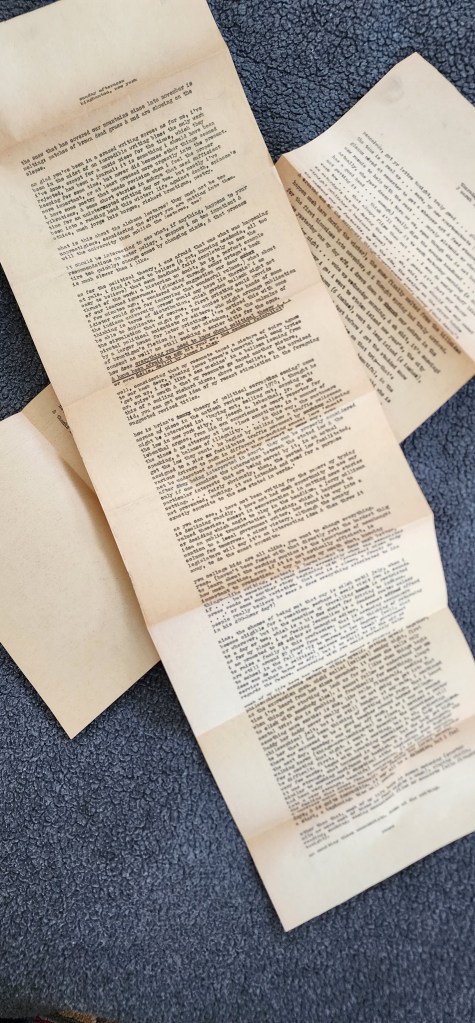
From Spiralbound Hippies, with commentary from now.