Perhaps you know the counsel, “’Eat to Live,’ rather than ‘Live to Eat.’”
Still, a big change has occurred in America in the past half century. While the impact of organized religion has declined, a quest for a rich, even exotic, cuisine has flourished. As I posted a few years ago, dining out became the major fine art form of our time, rather than music, theater, film, or dance. It’s the ethereal experience, the sensual transcendence, that’s the goal – ultimately, subjective rather than objective, heightened by long exposure to the field. Examples? Just look at the restaurant and wine reviews, along with their arcane or cryptic dialect.
Well, that also takes it into the realm of spirituality and religion, too, although that might also temper the feasting with periods of fasting. Maybe all of the limitations that have popped up, usually for health reasons or weight control, fit in here. It has been said that you can’t read the life of Jesus without getting hungry – there’s food or a food event at nearly every turn. (As a rabbi told me, that’s because Jesus was Jewish and in social settings, you always wind up with something to nibble in your hand.)
I’m left wondering how this translates to the home kitchen. Cooking skills, by and large, seem to be less universal than in the past, and time to devote to food preparation usually comes at a premium. Is takeout a kind of sacrificial nod to the food gods?
One thing I will say in all of the transformation. Thank God for the microwave oven.
Newspapers were in trouble even before the Internet. In general, fewer people were reading, period, and that included books and magazines as well. It was easy to blame television, but interests were shifting, too – and editors were at a loss when it came to hitting viable new directions that would capture attention.
Another factor was that the workplace and lifestyles were also changing. Fewer people were employed in factories, for one thing, and fewer were taking mass transit to get to and from work. Waiting for the bus, train, or ferry and then riding were prime time for many readers. Driving, then, meant less time for reading. More likely was the radio or even audiobooks.
When I entered daily journalism, afternoon papers generally had the larger circulation, fitting blue-collar work schedules that often let out at 3 or 4 pm. As the factories closed down, so did the afternoon papers in towns that had two or more newspapers. Most of the others shifted to morning publication, where they could be on the newstands all day and still look fresh. Thus, American dailies declined from 1,750 in 1970 to 1,279 in 2018.
The Internet’s whammy has been mostly to the papers’ business model, an arcane system I describe in my novel Hometown News.
What we haven’t heard much about is the bigger hit to commercial network television, where audiences have defected to cable content and streaming.
In fact, the best new programming is on those newer options.
The thought hit me while watching Only Murders in the Building was that such quality would have never appeared on a commercial network series. You no doubt can add your own favorites to the list. How many of those are on commercial networks? Any?
The meltdown of the monolithic mass media, both print and broadcast, is a mixed bag, of course. Here we are blogging, for one thing, but rarely does that get the same readership as a newspaper column in even a small-town paper. But we’re getting our say, anyway.
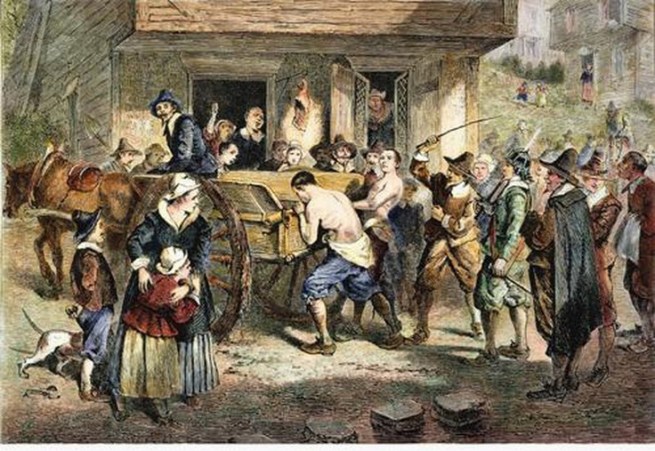
The three Quaker women who come to Dover in 1662 and 1663 are tormented principally by Major Richard Waldron. He and his brother William arrived from a staunchly Puritan family in Warwickshire in 1635, and after returning to England to marry a woman against her family’s wishes, Richard returns to Dover. History does not record her name, only his second wife’s. In 1642 he buys up rights around the dramatic waterfalls of the Cochecho River about five miles north of Hilton Point.
In building mills there and establishing a village, Richard consolidates power and wealth. He has, for one thing, obtained a monopoly on fur trade with the Natives and, for another, rises to head the colony’s militia, a politically powerful position. In addition, he serves 22 years as a deputy of the General Court of Massachusetts, its assembly, seven of them as its Speaker. He votes to impose the anti-Quaker acts of 1656 and 1657.
Richard Waldron was influential in the passage of the anti-Quaker Cart and Whip act and other punishments.
Dover is not his only residence – at least three of his children are born in Boston and he has ships on the sea. He’s also the magistrate who imposes the Cart and Whip sentence on the Quaker women who come to Dover – in effect, a death sentence if constables in towns down the road follow through on his order. Even his wife is appalled by his cruelty.
He’s also the mastermind behind the invitation to the Natives to participate in a mock war game and festivities in 1676. After the 20 armed Natives fire their weapons, they are surrounded and arrested, along with 350 or more, mostly women and children. Seven or eight of the leaders are sent to Boston and executed. The rest are sold into slavery in the Barbados or West Indies.
Major Richard Waldron masterminded the sham war game that led to the captivity of local Natives who came in peace.
The Natives do not forget Waldron’s deceit and cunning. Knowing they cannot trust the English, they form an alliance with France. Many of them convert to Catholicism under French priests.
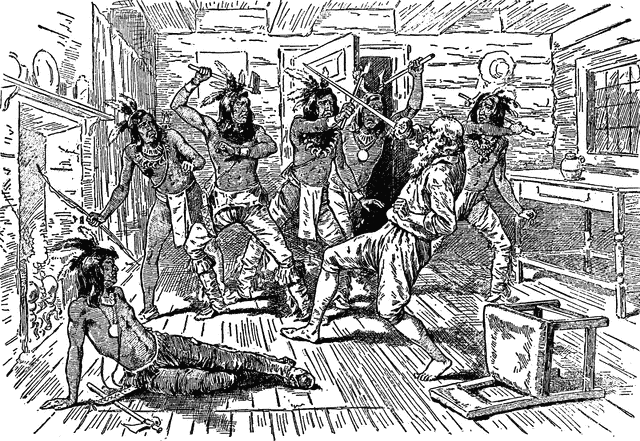
In 1689, they take their revenge, attacking and burning garrisons at Cochecho village, killing 23 and taking 29 captive to Canada. Quakers are not spared. Waldron, however, is singled out for torture and death.
The early morning raid is the beginning of devastating violence large and small across northern New England that does not end until the end of the French and Indian Wars in 1763.
Every family in Dover would suffer losses. They were far from the only ones.
Major Waldron was singled out in revenge.
Behind the scenes, an ominous shift in the settlement’s character had been occurring, centered on Waldron. The sixth son of a well-off Puritan family, he was “immensely able, forceful, and ambitious,” arriving with his oldest brother in 1635, when he was barely twenty. In 1637, he returned to England, married a young gentlewoman despite her parents’ opposition, and brought her to Dover. Her name and dates are unknown. He then married Anne Scammon and had eleven children.
By 1642, he had accumulated the rights to land around the falls in today’s downtown Dover and erected his first sawmill. Emerging as the town’s central figure, he eventually controlled much of the Native trade and amassed large land holdings. In pressing for Dover to submit to Massachusetts jurisdiction, Waldron placed himself in opposition to Thomas Roberts, who then lost office when the Dover province was subsumed by the Massachusetts Bay colony.
Waldron, in contrast, became a deputy to the Massachusetts General Court, or legislature, in 1654, where he served for the next twenty-two years, seven of them as its general speaker, one of the most powerful political posts in New England. How much time was he spending in Boston during this period, and how much in Dover? At least three of his children – Elnathon, Esther, and Mary – were born in Boston.
Brother William also held public office and eventually purchased a part of the Shrewsbury Patent in today’s town of Stratham. He was, according to Massachusetts governor John Winthrop, “a good clerk and a subtle man,” one who “had an inclination toward drink and contention,” which leaves me wondering about Richard as well. While crossing a small river at Kennebunk on his way back from Saco, Maine, in 1646, William drowned. Whatever his skills as a public official, his business dealings left him in debt to many creditors. Like the Hilton brothers, we have a case where the younger brother fared more successfully than his elder.
After his death, another brother, George, showed up in Dover after 1650, when he was a chandler in London. From 1659 through 1677, he was taxed as a resident of Dover. His domestic life, however, was strained. In June 1661, he was in court for being absent from his wife, and again in the fall of 1662, when she was reported dead twelve months. In June 1680, he petitioned the court to be rid of his son, “who instead of holding me hath rather destroyed me and what I had in drinking.” Impoverished, elderly, and nearly blind, he appealed for a guardian. Mrs. Richard Waldron took him in until her husband’s return.
Richard, on the other hand, flourished, not just in politics. He traded widely, as is seen in the death in Algiers around 1669 of his son, Paul, “probably on board one of his father’s vessels.” Another son, Timothy, died while a student at Harvard. Daughter Esther died on the Isle of Jersey. Quite simply, his family wasn’t stuck on the banks of the Cochecho or Piscataqua rivers.
The Cochecho Falls and the village that grew up around them were part of Richard Waldron’s power base.
As Jere Daniell observed, “By the 1670s the portion of Dover known as Cochecho had become something like Waldron’s personal fiefdom, and citizens in the other areas of settlement rarely challenged his social authority.”
A man like that had to have enemies and a capacity for revenge.
From everything I’ve seen, he was quite unlike Nicholas Shapleigh just across the river.
One of the cherished traditions among Quakers is the creation of memorial minutes for members who have served the Meeting faithfully.
The minute is a unique document. It’s neither an obituary nor a eulogy. Rather, it attempts to candidly reflect the movement of the Divine Spirit in the individual’s life.
Here is a recent example.
Earl ‘Chip’ Neal
(December 9, 1945-June 25, 2021)
When Chip Neal brought his family to Dover from Maryland in 1978, they loved everything about their new home except the proposed construction of a nuclear power plant in nearby Seabrook.
He had been hired by New Hampshire Public Television to do a nightly news show, having worked his way up from entry-level floorman in a pioneering community college television station to cameraman at WETA in Washington and then director/producer at Maryland Public Television.
Across the Granite State he became known for the segments he produced and hosted on “New Hampshire Crossroads,” where spent many years traveling every corner of the state bringing unique New Hampshire features and people to a statewide audience. It was in one of those stories that he coined the phrase “Yankee yard.” His curiosity was sweet-tempered and non-judgmental. He also produced segments for the popular weekly “Windows to the Wild” outdoors adventures series featuring Willem Lange.
Although he attended the University of Illinois during the Vietnam era, he did not earn a degree until he worked at the University of New Hampshire for NHPTV. He graduated from college the same year his daughter, Amanda, graduated from high school.
He never aspired to go into management. Rather, he always preferred to be hands-on, something son James inherited.
That was reflected in the family’s old farmhouse near the Cochecho River, where they began rearing a few chickens, sheep, and honeybees. After aligning with the Clamshell Alliance opposing the Seabrook Station, he realized the activists he admired the most were all Quakers, and soon he, too, was worshiping in the old meetinghouse, along with children Jamie and Amanda, while his wife Nell continued at First Parish just down the street. Over time, as she felt her spiritual growth being nurtured more through connections with Friends, she, too, became part of the Meeting.
Their social life included visits by boat with other Quaker families living downstream or around Great Bay. Inspired by what he had read about the Amish and a “why not” attitude, Chip determined to try a barn-raising of his own, resulting in a merry one-day celebration that did, indeed, accomplish the task.
Chip was commissioned to create a private documentary profiling Silas Weeks, who had been instrumental in the reopening of the Dover Friends meetinghouse. The interviews, now available on YouTube, remain a touching intersection of the faithful lives of both Silas and Chip.
Many of the qualities of Chip’s spiritual life also infused his professional career. A fellow producer noted that Chip possessed a brilliant communication talent in short-form and long-form storytelling. He not only saw the heart of a story, he let it speak for itself, time and time again. Where most producers tended to interpret meaning for the viewer, Chip had the unending patience – and absolute stubbornness – to never let that happen in his work. Thanks to his relentless focus, firm discipline, and above all a fabulous sense of humor, time and time again he would dig down until he found the light of truth hiding inside the most humble to the most exalted story, and to let it shine like a diamond in the wide open, all on its own, available and meaningful to the viewer.
As he grew and matured, he more and more thought deeply and broadly about events and phenomena, all with a spiritual bent. Often, this led to rising in the middle of the night to write down his ideas and insights, sometimes as haiku with a snap.
He emphasized the necessity of being centered in the present, explaining, “Life is that thing you’re doing right now.” From that, he had an ability to view difficulties from the side and then provide helpful alternatives to the knot before us.
During his terms as clerk of Dover Friends Meeting, Chip would stand after the closing of worship with the shaking of hands and then, gazing around the room, say simply, “Thank you for sharing your spiritual journey with us this morning – whether spoken or unspoken.”
He loved serving as clerk and treasured Quaker process, especially taking sufficient time in our labors together.
The advance of Parkinson’s interrupted his service to family, Friends, and the wider world, but not his presence. He had often reminded us that in trying to reach a destination while sailing, one had to constantly make adjustments – tacking.
He was also fond of a Navajo prayer:
All above me peaceful,
all below me peaceful,
all beside me peaceful,
all around me peaceful.
He passed over peacefully on June 25, 2021, in the comfort of his wife, Nell.
Memorial minute approved by Dover Monthly Meeting, November 21, 2021
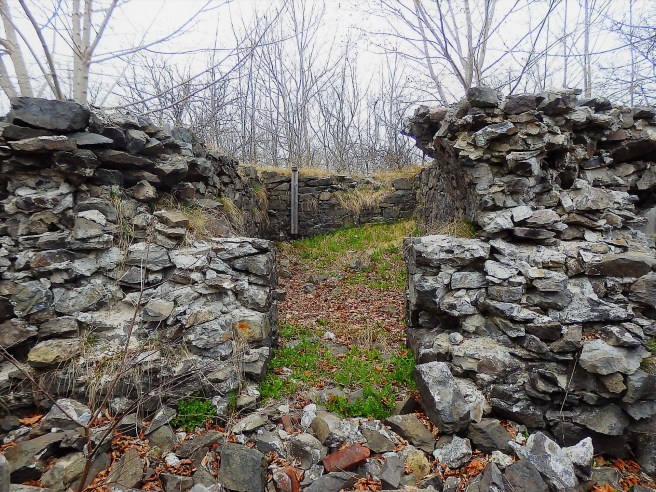
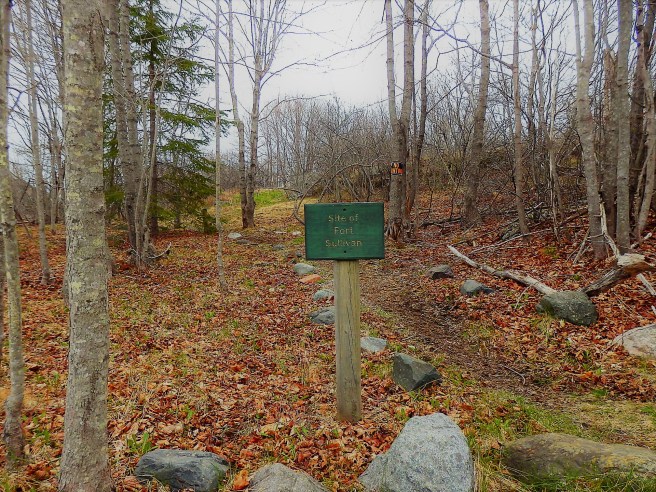
Built in 1809, this is all that remains of Fort Sullivan atop Fort Hill.The Americans surrendered to a British naval force in 1814, and Eastport was occupied for four years before being returned to the States.
My initial visits to eastern Maine back in the early 1990s shocked me with the prevalent poverty. I thought I was in West Virginia. A harsh reality is often overlooked between the picturesque coast and the wilderness adventures in the north.
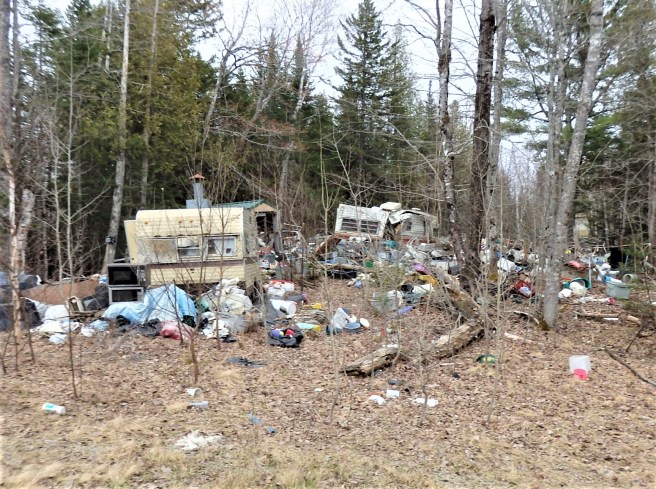
That awareness has been amplified after moving Downeast. Many rural homes are surrounded by debris, everything from boat hulls that will never sail again to earthmoving equipment that has gone to rust to a row of cars that would otherwise qualify as a junkyard.
Here’s an extreme case.
Maybe they thought they could salvage something of value?
Bangor, a 2½-hour drive from Eastport, is our closest metropolis this side of Canada. And getting there or back can be a bear in winter. Oh, yes, you need to keep your eye out so you don’t hit a bear. There’s even a lodge along the way that touts the services of a bear-hunt guide.
The city itself is about the size of Dover, New Hampshire – roughly 30,000 population, but unless we cross the border to St. John, New Brunswick, it still has the closest:
Interstate highway.
Major hospital and specialists.
Airline flights.
Mall and many big-name, big-box stores.
Daily newspaper.
Array of ethnic restaurants.
Cineplex.
Synagogue.
Greek Orthodox church.
Toyota dealer.
Smaller Ellsworth, gateway to Acadia National Park, is about the same distance to the south. It also offers some respite as a civilized alternative.