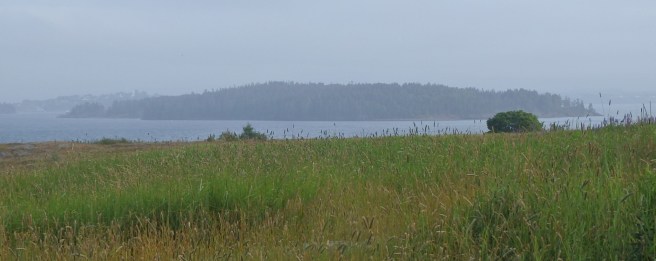
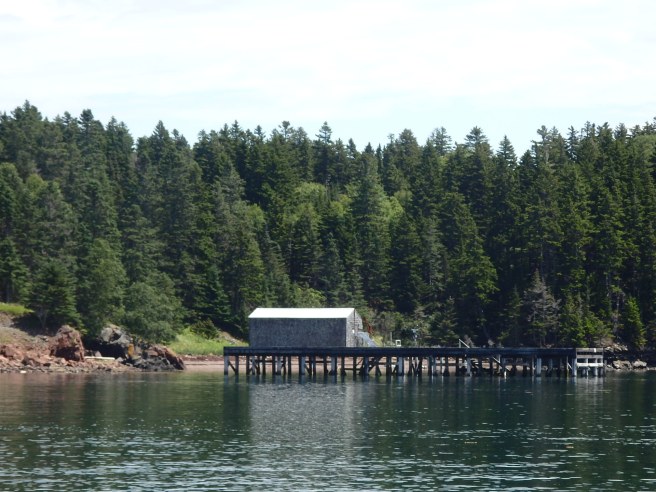
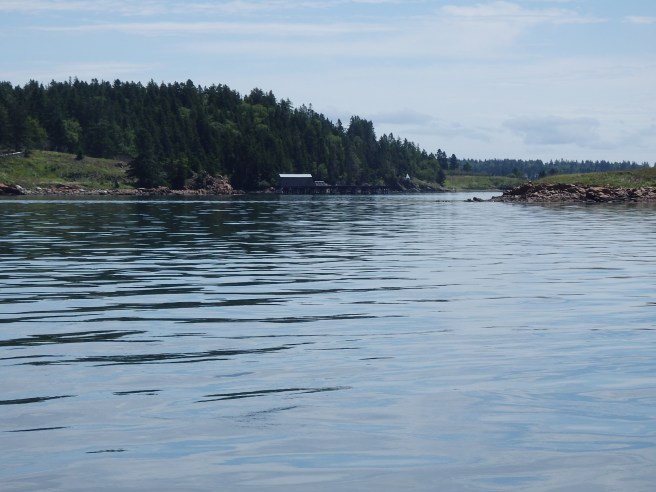
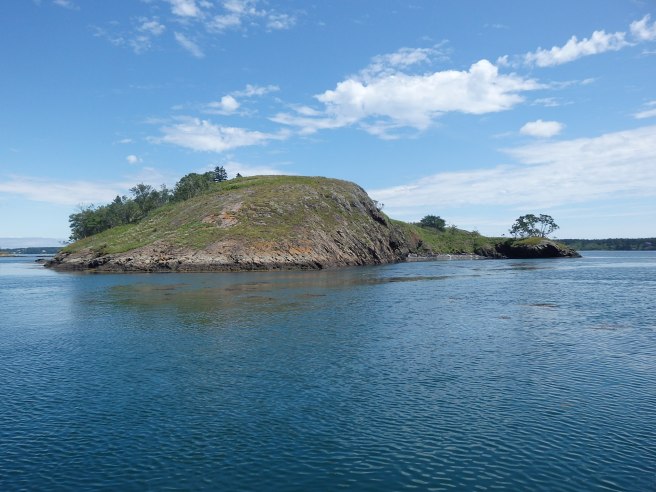
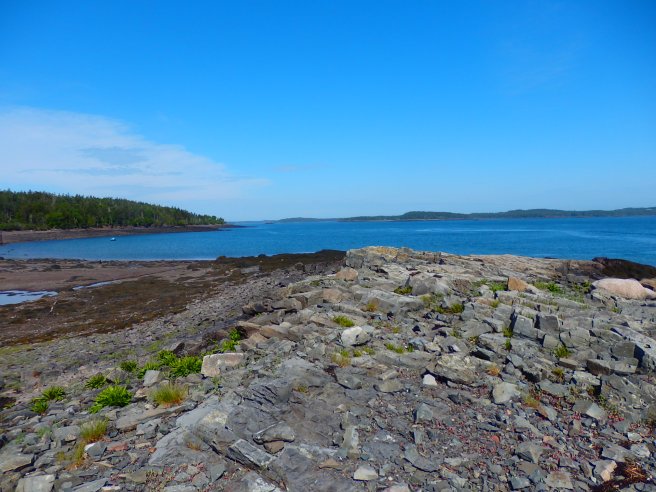
Named for Upham Stowers Treat, the island once housed a fishing hamlet and then a Civil War battery. Today, as one of the Maine Coastal Heritage Trust preserves, it’s open to the public and has a 1.2-mile network of trails offering stunning views of the surrounding bays.
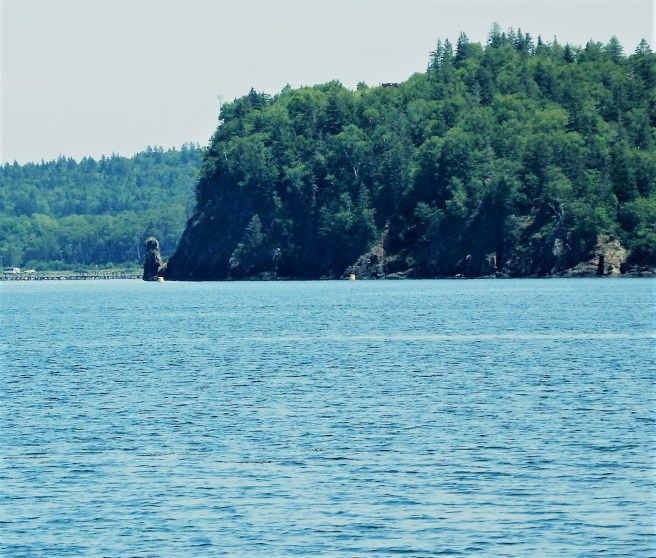
As seen from Eastport’s South Side.
The Army Corps of Engineers operates a marine concrete testing station on three acres on Treat Island’s northwest side.Officially, it’s the largest uninhabited island within the city of Eastport.Dudley Island adjoins Treat.
Kayakers are advised to get a guide who knows the waters’ treacherous currents.
Some early wag exploring the channel that separates Eastport and Campobello Island thought a rock formation visible only at low tide resembled an old monk and dubbed it the Old Friar.
To me, it looks more like an old hound. The poles to the left lead to the Franklin Delano Roosevelt summer cottage.
The headland behind it soon became known as Friar’s Head.
For a little perspective, note how small the Friar looks against the bluff.
As for the channel? It’s Friar’s Roads, curving along the island to its end on the Bay of Fundy.
The Old Friar himself may have lost some features during the Civil War when cannoneers stationed on Treat Island used the monolith for target practice. Canada, apparently, never complained, sparing the U.S. an international incident.
The Passamaquoddy, meanwhile, referred to the pillar as the Stone Maiden. The legend told of a young brave who left on a long journey after instructing his lover to sit and await his return. The distraught young maiden sat on the beach and waited for months. Alas, when he finally returned, he found her turned to stone, forever to wait and watch.
Across the country, pumpkin flavoring seems to infuse about everything on the menu come October, and something similar happens every summer in Maine with blueberries. The tourists and summer people, especially, seem to eat it right up. (Err, couldn’t help myself there.) So it’s not just lobster they come to devour.
Here are some facts about Maine’s in relation to the rest of the nation and world, mostly.
The local brewpub calls its obligatory blueberry ale Skul Clothes. The name puzzled me until I was told that’s how kids traditionally earned the money for their school clothes each year, at least before mechanized machines took over most of the patches. “It’s hard work, down on your hands and knees,” as one recent high school graduate told me. “But the pay’s good.” After that, I could tell the locals who walked in for the first time, looked at the offerings on the chalkboard, and broke out in a grin. They’d all done it.
Ours are lowbush, wild, unlike the highbush varieties cultivated elsewhere. We lead the world in lowbush production, though it’s a drop in the bucket compared to the highbush harvests of British Columbia, Oregon, or Washington state. While Atlantic Canada produces half of the world’s wild blueberry tally, that covers more than a single province – Nova Scotia is the leader there.
Lowbush berries are smaller but more flavorful, in our humble opinion.
They’re also preferred in making blueberry wine.
Blueberries are one of the few commercially-available fruits native to North America. The First Nations, some of whom called them star-berries for their blossoms and the tiny ring at their base, have been eating them for at least 13,000 years
They top the list as an antioxidant and are rich in Vitamin C and even manganese.
Wild blueberry patches are burned every two years.
Wild blueberries freeze in just four minutes.
Some research indicates they counter memory loss in aging. I’ll have to remember that. They’re also good for the heart, cancer-risk reduction, and lowering blood pressure.
I like mine fresh, with yogurt or cream. Pancakes, muffins, jams and jellies come next.
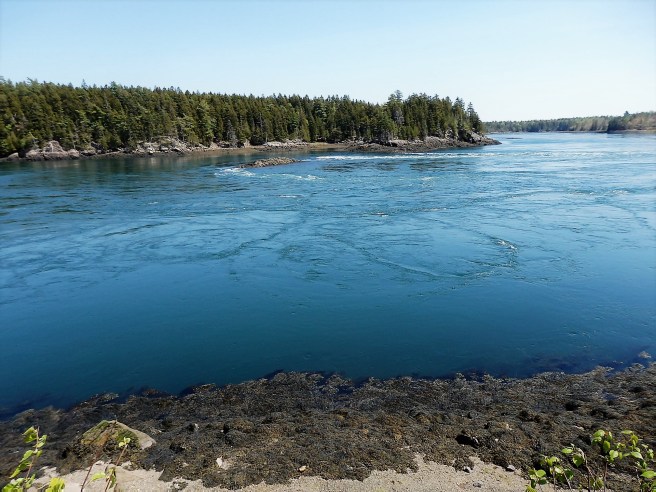
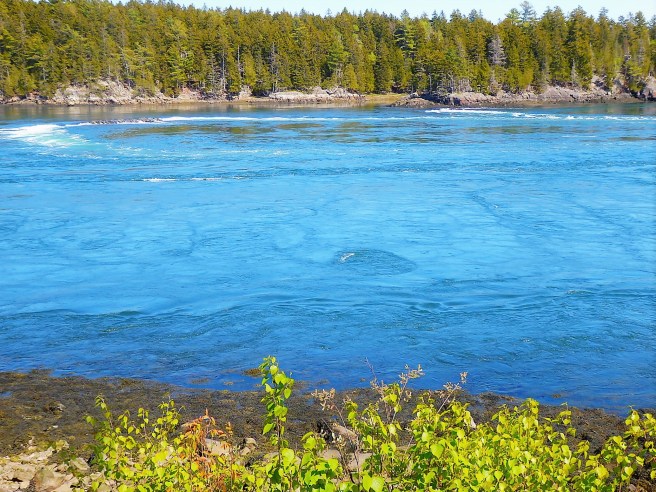
Still, the Old Sow can be seen about a mile away from Eastport if you time it right, about three hours before high tide on the biggest days of the month. The Western Hemisphere’s biggest whirlpool not only swirls but also shoots spouts into the air. As if I could capture that flash with my camera.
The current, though, often runs at seven knots, faster than an Olympic champion swimmer could manage in even a very short burst. It’s also treacherous for Scuba divers, waders, and sailors alike.
It’s by no means the only place to be mesmerized while watching the charge.
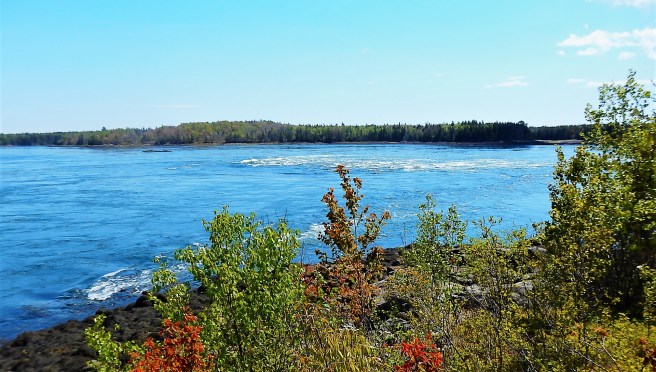
Tide pressing from the Atlantic into Dennys and Whiting Bays churns and ripples.
Another impressive sight is the Reversing Falls in Pembroke, though “rapids” would be a more accurate term. The sounds of the waters rushing from one bay to another are as mesmerizing as any waterfall, though.
As the level intensifies, a large whirlpool with a concave depression forms behind the rock ledge, setting off smaller whirlpools around it.The major action is a set of rapids I’d hesitate to call “falls,” though they’re just as noisy. Once the tide comes in, it has to go out, keeping the action going endlessly. As I was shooting this, a pair of seals lolled in the whitewater wings, diving and coming up with fish in their mouths.
Up to the American Revolution, despite opposition, some Quakers held slaves, and Dover was not exempt. Up to ten were manumitted, likely with the equivalent of a year’s wages.
~*~
Slaveholding was a particularly difficult issue. Initially, queries pointed slave-owning Friends to treat their subjects fairly, but that perspective evolved under the influence of ardent abolitionists. In 1731, as the minutes record, “Whereas some Friends signified at our last Monthly Meeting that they were uneasy with the practice of Friends buying or trading Negroes or slaves which was left to this meeting for consideration. After due consideration thereof the desire of this meeting is that all Friends that are clear of slaves may not be concerned with the practice thereof, but to keep themselves clear of practicing ye trade of buying or selling slaves.”
Nevertheless, that proved insufficient at the time.
Finally, on 9 mo 22, 1777, a committee was appointed – James Neal, Elijah Jenkins, and Jonathan Dame – “to visit those Friends belonging to this Meeting that hold Negroes as slaves, and advise them to set them free, and make report to our next Monthly Meeting.”
Doing so would not be easy. For Friends, manumission included payment of the equivalent of a year’s wages, a hefty amount. Elsewhere, it bankrupted some Quakers, who were then disowned for failing to keep their financial promises and their debts clear.
Still, three months later, “The Friends that were appointed to visit those Friends that held Negroes as slaves have made their report that that they proceeded likewise and obtained the manumissions from those that had Negroes in their possession. It is the judgment of this meeting that those manumissions should be recorded upon our minutes.”
Eight manumissions involving ten slaves were recorded.
Moses Brown of Rhode Island helped facilitate the freeing of slaves in Dover.
Assisting in the process was Moses Brown of Providence, Rhode Island, who had been appointed by New England Yearly Meeting to the manumission drive. He was an abolitionist who had separated himself from a prominent, wealthy family involved in the slave trade and instead joined Friends. Through his co-ownership of the Slater Mill at Pawtucket, he is considered a founder of the industrial revolution in America. He also helped establish Brown University, and the Quaker-affiliated Moses Brown School is named is his honor. He signed as a witness to most of the Dover manumissions.
One of them, Seasar Sanky, or Caesar, liberated in 1777 by James Neal of Kittery, had earlier married another slave, Sarah Sharp, among Dover Friends on November 23, 1774.
In the manumission, as Annie Pinkham relates, “Neal stated that he had some years since permitted Seasar to go and labor for himself, but received his wages, and applied same to his use in purchasing a piece of land with a house in Berwick on Oak Hill for which a deed was taken in Seasar’s name.”
However, when Seasar entered the Revolutionary War in 1777, he lost his membership as a Friend.
In another case, “I, Thomas Hanson of Dover, in the Government of New Hampshire, having for some years held Peter, a Negro man, as a slave, according to the tradition of the Country, but being convinced of the Error of the Practice, and the right of all men to be Free, I sometime in the past gave him his Liberty, but the more Effectually to Secure the same and to publish my Unity with our Christian Testimony in this Matter, I do by these presents Manumit, Release, and Set Free the Said Negro Man, Peter, in as full a manner as if he had been Free born, and hereby Warrant to Secure and Defend his said Freedom against the claim of all persons Claiming by, from, or under me, in Witness Whereof I hereunto set my hand the Twenty-First day of the Eleventh month 1777.”
The document was witnessed by Moses Brown and James Neal.
Others manumitted were Jack by Moses Roberts and Dinah by Keziah Roberts, the widow of Stephen Roberts.
The actions were part of a larger drive. By 1784, no Friend in America held slaves. In all fairness, I will also note that some of the wealthiest Quaker families had instead become Episcopalian or Presbyterian, in part as a way of avoiding the Quaker discipline, including its emphasis on equality, and in part to better enjoy a lifestyle of the rich.
~*~
Check out my new book, Quaking Dover, available in your choice of ebook platforms at Smashwords.com.
whatever abundance before the eye rests under that spirit of being guided through the wall after waiting through dry periods when you’ve voiced those personal, esoteric why must it be myself or the other when feeling a drawing away to that which I alone happen to sense when working and nodded without anticipating any fulfillment except in so many conjectures now absolutely engaged in the hand of accomplishment you definitely pursue now so romantic exciting perhaps with some overlap perhaps you too understand
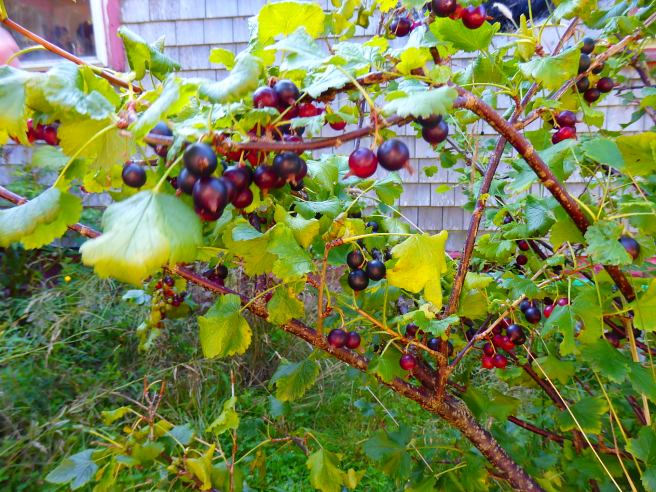
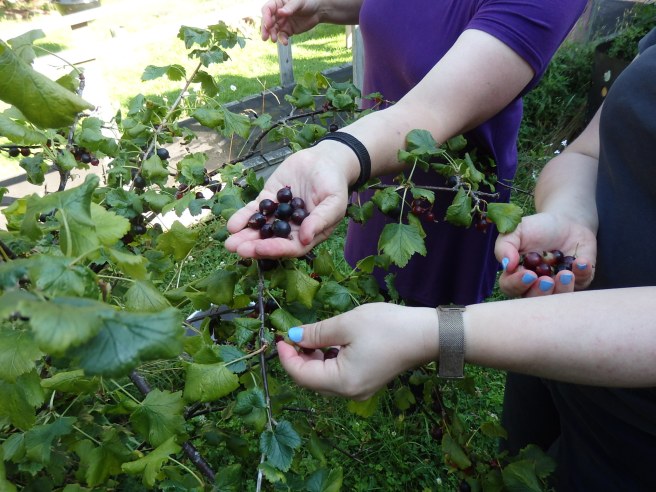
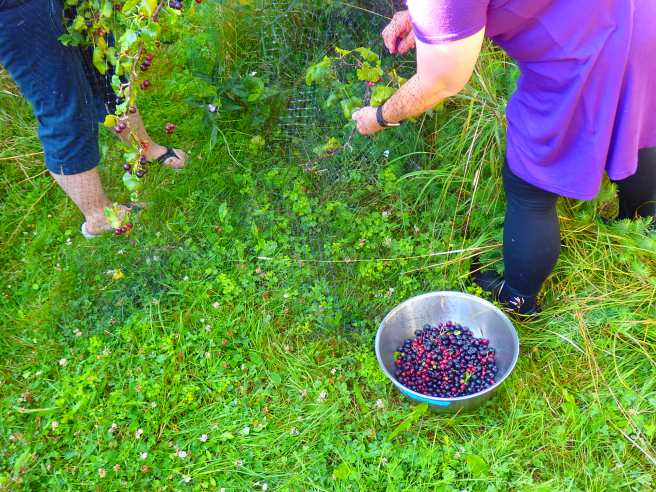
The currants we’re harvesting in Eastport are a different variety than we obtained from the conservation district’s plant sale back in Dover. They’re bigger and juicier, for one thing. And the bushes aren’t as thorny or sprawling, for another.
We got 4½ pounds from a single bush. Most of it will go into jelly.
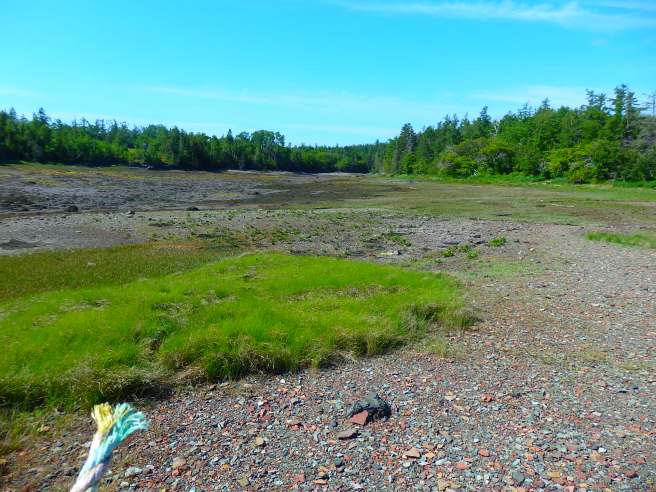
Funded by a family trust, Cobscook Shores is preserving waterfront lands around Cobscook Bay and its subsidiaries for public use and pleasure. One of its 14 sites is Pike Lands Cove, facing Eastport’s west side across the water from the North Lubec peninsula.
A trail leads out around tidepools I hope to investigate later.
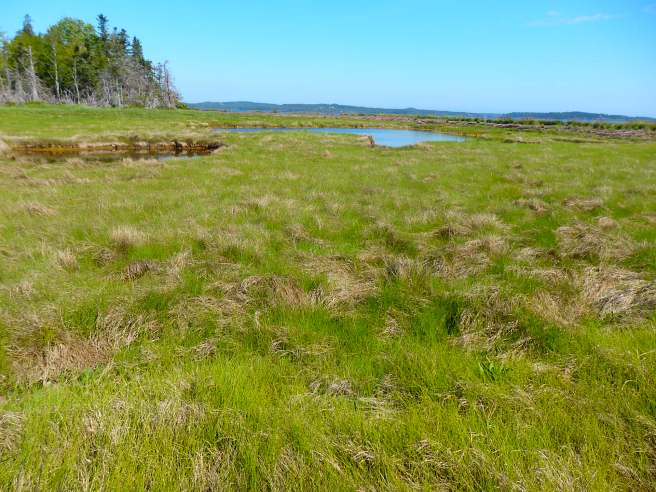
A saltmarsh can be explored up-close.
Here’s where that eagle nearly ran into me. It was being chased by an angry gull. Eastport is across the water.