When we think of many of the technological advances that impact our daily lives, we usually don’t know the names of their inventors, even when we know the businessmen who got wealthy as a result. Elon Musk did not invent the Tesla, for instance, nor did Bill Gates invent the internet or Henry Ford, the auto. The list is actually a long one.
Consider John William Lambert, mentioned in a previous Tendrils.
I remember visiting an early coworker and, upon seeing an old car with an impressive Lambert name in brass across the radiator sitting at an open garage door, I asked, “Ann? Is that car any relation to you?” She replied that her grandfather used to make them but otherwise conveyed no knowledge that he had been so prominent a figure.
Here are ten facts from his life.
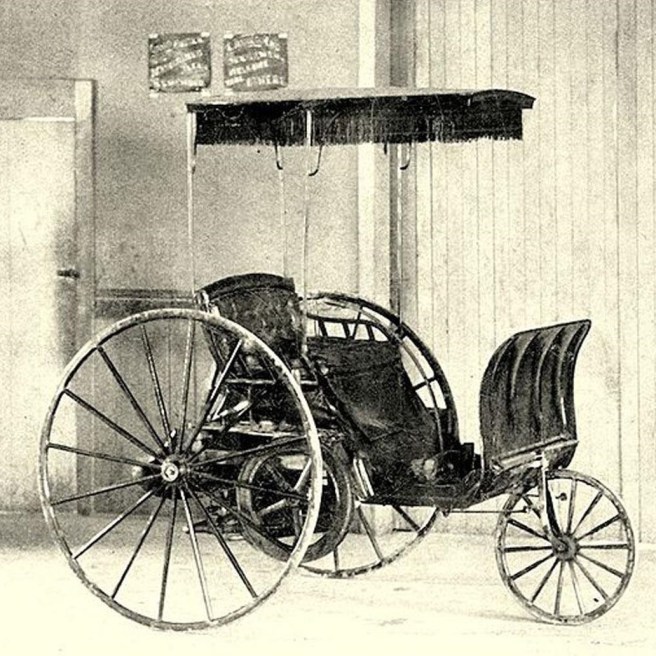
- He invented the first practical American internal combustion gasoline automobile in 1890 in Ohio City in Van Wert County, Ohio, where he tested it on the village streets early the next year. It was the Buckeye gasoline buggy, a surrey-topped three-wheel runabout with one seat. It had a three-cylinder, four-stroke engine.
- In 1891, that horseless carriage became the first automobile offered for sale in the United States. Priced at $550, it attracted no buyers.
- Undaunted by the buggy’s reception, he turned his attention in 1892 to making stationary gasoline engines for farm and industrial factory use.
- Lambert’s base of operations was the Buckeye Manufacturing Company, which he had founded in 1884 as a farm implement manufacturer and moved in 1892 to Anderson, Indiana.
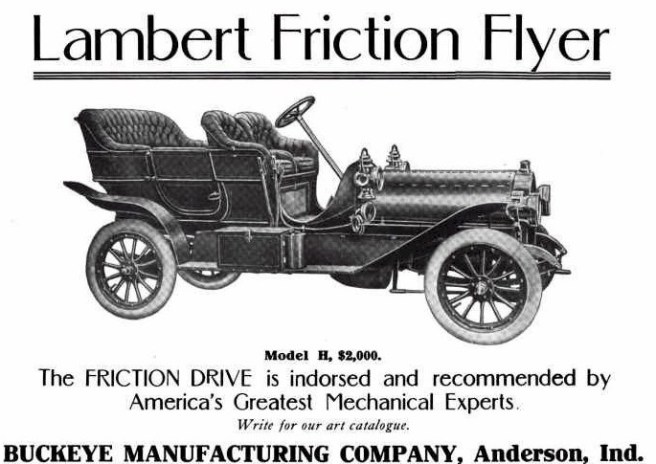
- His experiments with drive-train technology led to the Lambert friction gearing disk drive transmission. The gradual, or gearless, transmission became a signature feature on all of his future cars.
- His next attempt at an auto line came in 1895 with a model called the Buckeye. It was a four-wheel modification of the buggy but failed to find buyers.
- His first marketing success was the Union, released in 1902. About 300 of the tiller-steered cars were sold.
- In 1906 he introduced his first Lambert, establishing himself as one of the more successful automakers of the time. Production peaked from 1907 to 1910 with 2,000 cars a year.
- Buckeye Manufacturing, which built the cars, had moved by 1905 to Anderson, Indiana. The Lambert Automobile Company was one of its subsidiaries. Touting its Lambert Friction-Drive Automobiles and Trucks, the Buckeye factory mass-produced Lambert’s cars, gasoline engines, and auto components as well as fire engines, railroad inspection vehicles, and steel-hoof tractors before closing in 1917. At its height, the company had more than a thousand employees.
- Lambert held more than 600 patents and died in 1952, age 92, in Anderson.

 Jnana's Red Barn