Two Charles Ives quotes had me remembering that I borrowed the 2nd symphony from the Binghamton public library, but think it was the same Bernstein album of introduction I had perhaps taken out at my dorm’s library in Bloomington earlier or even before that from the Dayton Public Library while still in high school. It had a cool collage for a cover, which I’m unable to find online. Push Pin Studio? Oh, the days of vinyl, scratches and all!
I do remember being disappointed when the Cincinnati Symphony’s scheduled performance of the work conducted by Max Rudolf, which I could have heard on spring break, was instead replaced with a young James Levine at the helm in a different program, which a dear friend steered me away from. I still wish I had gone.
I would still love to hear it live, though that’s highly unlikely, at my age and remote location. It and its siblings should be in the repertoire of every American orchestra, the way Beethoven, Brahms, and Tchaikovsky are.
Still, I’ve had a custom of listening to the four symphonies each October, a private festival that usually spreads into the string quartets, piano sonatas, and so on. And I can even admit how much fun performing the songs in public can be.
~*~
As you can see, I admit to being a big Ives fan. He was not just a pioneering American composer but also a giant in the emerging insurance industry. If you want to know more, check out my longish Reflections at Chicken Farmer I Still Love You.
The Harmonites (Rappites) believed Christ, in his Second Coming, will carry a golden geranium. It became their sign, though they also used red geraniums.
“If thee needs anything and cannot find it, just come to me and I’ll tell thee how to get along without it.” — Etta Macy, Owen County, Quaker, in “Indiana’s Self-reliant Uplanders,” National Geographic, March 1976.
It’s something I’ve heard from others later, across the country.
~*~
Oh, my, one of my favorite off-the-cuff poems of all time wasn’t by the poet I’ve long attributed it to but rather our dear colleague, Richard Pflum. To wit: “In the garden / the women are pacing to and fro / speaking of fellatio.”
I stand corrected.
Reacting to an attack on “just folks poets” by an Iowa staffer in Kayak, criticizing those he looked down on in circles of poets who didn’t aspire to greatness but rather preferred comradery and “goodness.”
“All American poetry today sounds the same,” to which Paul Solyn replied, “not if you listen to it.”
“There aren’t any memorable lines in today’s work,” was equally glib. What was he expecting, advertising slogans? By the way, as one poet told me, “The lines I in my work I find most memorable, other readers don’t.”
[Gee, I found nothing about packing up everything or loading the U-Haul or farewells. Guess I was just too busy.]
~*~
Gleanings from my spiralbound journals plus commentary from now. .
The first of my extra-long spiral notebooks was a, Citadel, 8-by-12½ medium ruled with a 3-inch wide margin.
Begins on the new moon, 28 June 1976, “as we await our future.”
We were back house-sitting on Harrison Lake, just a sliver of that moon against caps of rosy storm clouds over the hardwood hills at the end of the water, one of a series of lakes backed into the first of the “Brown County mountains.” Elsie Sweeney’s palatial contemporary temple overlooked everything, facing the sunrise. [She was a spinster philanthropist from the Cummins diesel engine family.]
Also:
Nervous about job interview, Center for Law and Poverty. Bought new pants (fancy but I can live with them) and tie. Actually, for Yakima, if that works out but will do the dry run with this.
Indianapolis more active, dressier, cosmopolitan than I’d seen it before. The director was pretty mellow, surprisingly so. The job was $9,500 to $10,500 a year, with four-weeks’ vacation. I would have to develop contacts, write my own material, edit, etc. Doesn’t look too bad, if Yakima doesn’t come through. Some PR and video work, too.
Fourth of July fireworks in Woodsville, after worship in Waynesville earlier in the day. Different corners of the state.
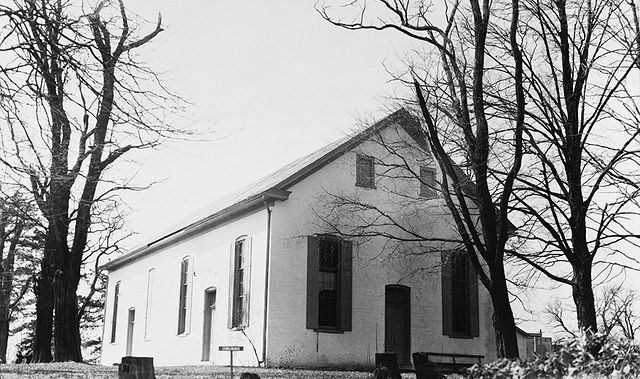
The Quaker meetinghouse in Waynesville, Ohio, in a 1937 photo by E. Schrand and J. Mitchell via Wikimedia Commons.
Waynesville Quakers — Miami Monthly Meeting. The house of worship was built in 1810, during Madison’s administration. It originated with South Carolina Friends (Quakers) who nearly all relocated north in reaction to slaveholding. Many came first to Waynesville and then moved on within western Ohio and all of Indiana. Miami Monthly Meeting held their memberships until new meetings were established, resulting in Waynesville’s being the largest monthly meeting in all of Quakerdom by 1805 and explaining the large size of the house, with three rows of facing benches (the ministers and elders’ gallery). It’s the oldest meeting west of the Alleghenies. (A detail that may allow Friends in Tennessee some leeway.) The meeting was central to the Underground Railroad, I was told.
Worshiping there was a fine way to spend the Fourth of July 1976, the bicentennial of the nation.
Do note, the Underground Railroad was founded and organized in the South.
Followed by limbo
Feeling of hopelessness, of inutility, a faith-draining thing. This waiting, suspension, is costly: can’t send any poems out (mss), we don’t expect to be here long. Kat can’t sign up for summer school, we need the funds and must be prepared to run. Plus the energy lost sending our job applications, etc. the money in samples and resumes (a quarter each) and postage. “We’ll be back to you in a week,” the liars, so polite.
Waiting for mail that doesn’t come, telephones that do not ring.
And then the whirlwind
Weir Cook airport, same rotunda where I departed on my first-ever flight (the Florida Easter). Put together the details for the Yakima trip yesterday afternoon.
Sentimentality now about Daffodil/Bloomington. Figured out what’s bugged me: everyone is so slow — the farmer syndrome.
Is the Waynesville Meeting working its magic again? (The Fostoria job came through after I worshiped there …)
Can we afford the move ($1,000 loan from my parents?). Will all of our goods fit into an 18-foot U-Haul?
Washington state newspapers seem to have the fanciest letterheads: color print jobs, imaginative graphics. A good sign, it seems.
Bill and Mig stopped in Chicago, hoping to see his brother still alive. Instead, Bill arrived in time to conduct the funeral.
The interminable earwash of airport lounges. Last time I flew American to the Northwest was breaking up with Nicki.
Bob Suter’s advice: “Don’t stick your finger in front of any turtles”
Long trek at O’Hare to new international section — Customs and all the rest — not much traffic, empty inside — airlines share the gates — glassed-in halls within halls — was beginning to wonder if this flight was going on to Japan or if I had the wrong gate designation …
Midwestern farming towns, seen from the air: two parallel tracks cut through: one the highway, the other the railroad tracks Can hardly tell which is which, shining in sunlight: white concrete, white gravel, plus white blazing roofs.
2½ more hours to Seattle
Over central South Dakota, at 35,000 feet the outside temperature was minus 59 — Centigrade!
Flying over Billings, Helena, Great Falls — echoes of that futile trip to lure Nicki back … my first Far West exposure …
~*~
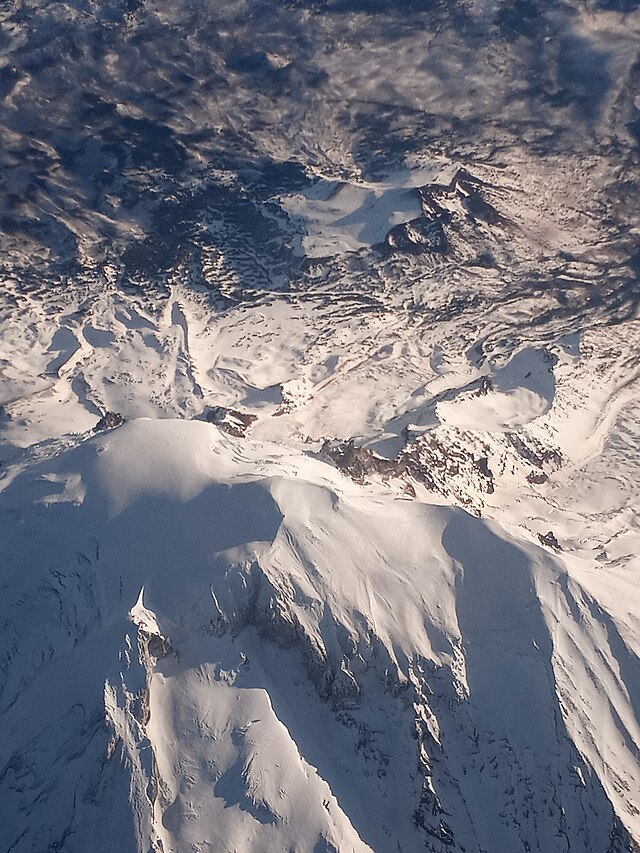
The sky scudded over from there. Only gray below me. But then, at one point, I looked down at something incomprehensible and amazing.
Rainier from above by Feed Me Paper at Wikimedia Commons.
Yes, we had flown directly over Mount Rainier and its glaciers.
~*~
As for the rest of the trip?
Don’t think things today could have gone much better. Spent six hours with Kent, the m.e. Lunch with him and Gil, the assistant m.e. (who was critical of some of my layouts with Marcy’s photos … and one pic I should have cropped). Gil telling about almost grabbing rattlesnakes beside lost golf balls … sluggish, unmoving bastards, sez he …
Good meeting with Human Resources, too. (Is the department always headed by a woman?)
A short meeting before I left. Accepted the offer, $260/week … more than double what I had been earning …
Sounds like I’ll be doing mostly editing, special sections and weekend news, as well as lead articles for Crossroads …
[I should note that this flight was also at my own expense. If the job had not come through, we would have been screwed.]
Back home
Received a letter from Indianapolis, no dice, as if everything were working with Divine plan …
Maybe they didn’t like my looks? You never know.
Indianapolis? I’d just as soon live in Scranton.
Got a few nice poetry rejection letters but mostly silence …
As you’ve noticed, I fell into the practice of journaling rather haphazardly. At times compulsively, even. I started to say the “habit” of journaling, but it was rarely that effortless,
I was still in spiralbound volumes — eight years before a stretch of using hardbound sketchbooks followed by a return to spiralbounds before the hardbounds took hold a dozen years after the journal at hand.
No. 45, for those keeping track, was the first of the 8-by-12½-inch books I’ve truly appreciated. The added inch-and-a-half of length fit my hand and pen well, though not the bookshelves or the milk crates that generally wound up holding my journals.
Eventually, there were 17 of those in all, plus three fat softcover sketchbooks, 15 black-cover spiral sketchbooks, and three bargain thin hardbound journals nearly that tall. Thirty-eight in all, out of 200-plus. Why did that shape vanish from the market? Probably because I preferred them. I have long run contrarian to the marketplace, not exclusively involving my tall, skinny clothing size.
Somehow, I had thought that my legal-size notebooks started at the Cornell bookstore, but it now looks like my first ones were bought in Bloomington.
In looking up what’s called “legal pads” (as if the others are clandestine?), I find most today have shrunk to 11¾ inches height, though at least one exists at 8½ by 14 for those willing to pay a premium. And that’s not bound. As for filing those in storage cabinets? I’m not a lawyer nor a legal secretary. It no doubt requires special filing furniture.
~*~
The first third of the volume covered our final month-and-a-half in Bloomington, aka Daffodil, followed by my flight to the Pacific Northwest.
As I look ahead, I see pages that were used to draft and refine poems that found publication as well as other entries that more or less became fiction in my novel Nearly Canaan and the third novella in The Secret Side of Jaya.
I’ll skip over those in this series and instead look for the unexpected.
VO showing the grave sites of two infants at the edge of his ravine: one stone left, the other one, dating to early 1800s, stolen …
~*~
I see now, 50-some years later, there’s actually a public-access trail around there.
~*~
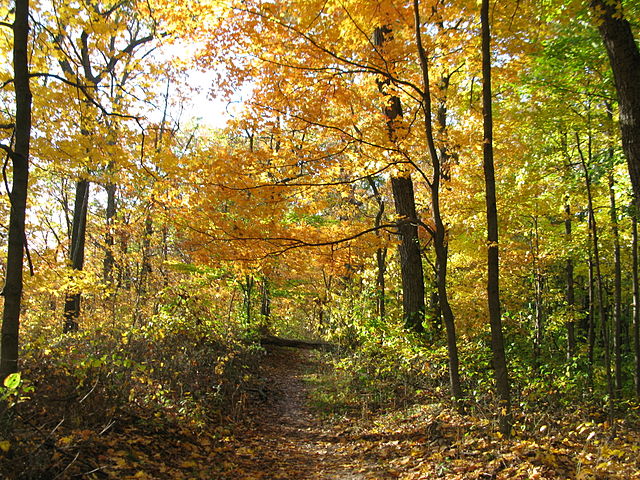
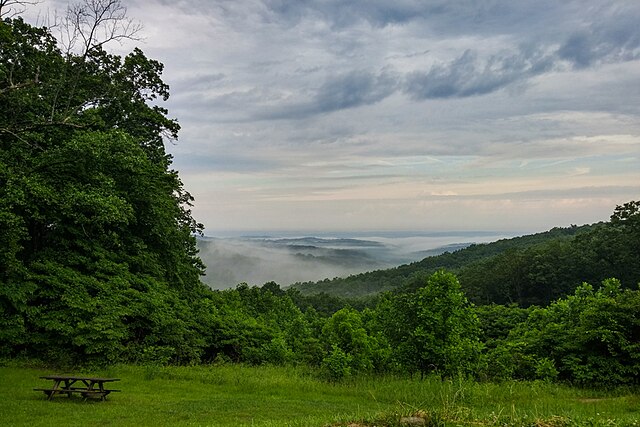
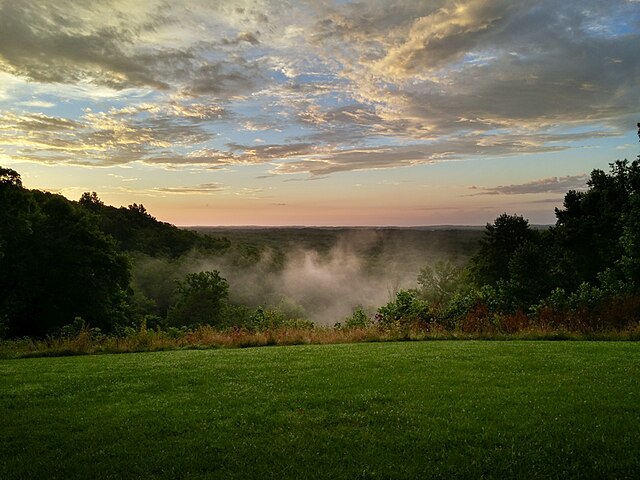
Further to the east was Brown County, with its rugged geology, state and national forests, and a large state park, making it Indiana’s outdoors destination. It definitely feels like stepping back in time. I have memories of hiking and camping there as a Boy Scout, even before my explorations during the time covered in my return to the university.
Hiking trail photograph by Kgirischandra via Wikimedia Commons.
Panorama views by Elizabeth Nicodemus via Wikipedia Commons.
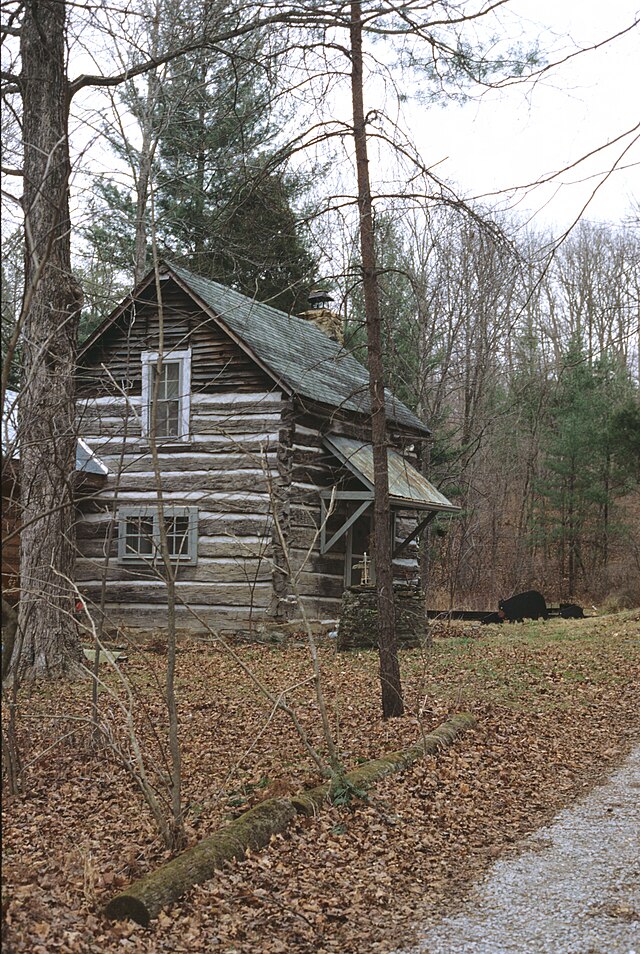
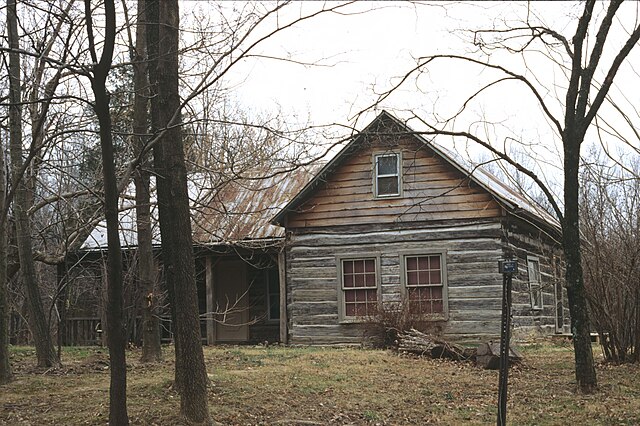
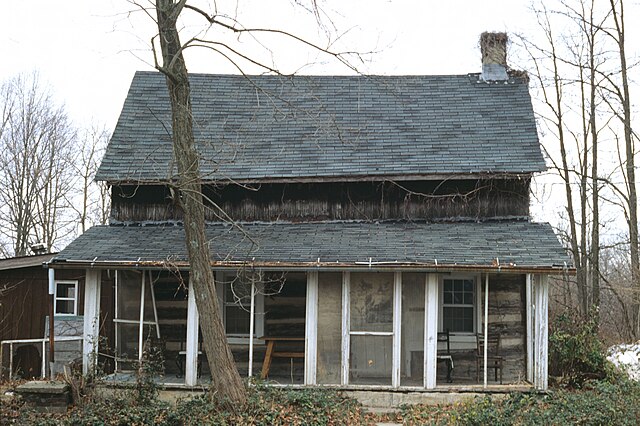
I had friends who lived in log cabins, which remain in widespread use in the southern part of the state.
As I’ve been seeing in this sweep through my journals, not all of my experiences in Bloomington wound up in my poetry and fiction.
Back when I switched my college major from journalism to “something that would expand my mind,” as one influential editor advised me, I chose political science because so much news coverage focuses on government and its impact. Somehow, I fell under the spell of Vincent Ostrom, especially his federalist perspectives of a compound republic and ground-upward rather than top-down action. My earlier posts reflect how this turned into a personal relationship, even before I was invited to join what’s now known at IU as the Ostrom Workshop.
His wife Elinor, better known to us as Lynn, was just beginning to teach at IU when I was an undergrad and I didn’t find the opportunity to enroll in her courses. (The fact the department scheduled her classes at 7:30 am was an additional problem for night-owl me, as I was as the time.) Despite obstacles erected because of her gender, she soon became a popular teacher and by the time I returned to campus, was a rising star. What I saw on my return was how naturally she functioned as the central figure in running our collaborative workshop, and how utterly amazing she was all around. It should be no surprise that she became not only the first woman but also the first political scientist to win the Nobel Prize in economics. Yes, the dismal science.
While I have never run for political office or served in a governmental role — I’m of the camp that believes doing so would compromise the neutrality or objectivity at the heart of serious journalism — I have carried many of the lessons from that training through the remainder of my life.
One is the ability to critically read a text, period. It serves well in literature, theology, proposing a course of action, as well as editing. A corresponding step then asks which assumptions can be relaxed or even removed from the paper under examination.
Another lesson involves management and associative structures. Many similarities exist in operating public, for-profit, and non-profit organizations. They are what make a civilization function. They were especially helpful when I was navigating the steps in the management ladder of corporate journalism in my moves to come.
The next question regarding any field of organization, of course, is how do we make it work better?
~*~
In this review of the experience, I’m surprised to see a parallel in the youthful enthusiastic personnel at the Workshop to the idealistic newsroom staff in my novel Hometown News. Most of the events shaping that book, be warned, come in the years ahead.
~*~
As I look back, I see how crucial this year-and-a-half became in my life.
My evolution from yogi to Quaker began, for one thing, though an overlap would continue for another year or two.
Through a circle headed by three very fine poets, my personal voice in that vein took shape, accompanied by appearances in literary reviews across the nation.
Kat and I settled into a life that was largely pleasurable and fulfilling. I’ll leave the details for you to decipher in my novel Nearly Canaan. The middle novella in The Secret Side of Jaya, “Miller at the spring,” was also inspired by this period but written 40-some years later and recast in the Ozarks.
There was a curious semester when Nicki and Kat were enrolled in the same weaving class in the art department. Did my ex-lover know my wife was a classmate? Eventually, they became acquainted and that led to a face-to-face of the three of us, allowing me some resolution to the past.
And I felt freer to move forward.
~*~
Vincent had grown up on a mink farm near Mount Baker in Washington state, and he was quite encouraging in our move to the Northwest. Living in the interior desert, I would finally understand the intricacies of water legislation and management, which had been one of his specialties. Another arose from being a writer of the Alaska state constitution, a place that also had close connections to Washington state.
After packing up and moving westward, I never returned to Indiana, apart from the brief drive crossing on the toll road in the north on our return to Ohio after the Pacific Northwest.
I’d say the book was closed, yet the writing and revision were actually still ahead.
~*~
From Spiralbound Hoosier, with commentary from now.
As my journals record, my return to southern Indiana took me well beyond the college campus. I’ve already mentioned my explorations of the wooded Leonard Springs and its cave system just beyond our house at what was then the fringe of the college town. Let me remind you that my Thistle Finch editions blog has free PDF downloads of the related chapbook of my resulting poems as well as a photo album I put together from online gleanings to refresh my memory.
I did encounter a lot in a short year-and-a-half, even beyond my paying employment. I do would how my writing would have evolved if I had been able to remain in place.