


You never know what we'll churn up in cleaning a stall
Once the renovations are finished in our old Cape, we’ll be looking to pick up where we left off in Dover, back before Covid interrupted travel and entertaining.
In no particular order, among the guests we remember fondly:
Who have been among your favorite guests?
It’s a common topic of conversation this time of year in New England.
How’s the foliage shaping up?
Are drought or wetness, heat or cold, or any number of other factors impacting it negatively?
Or is it going to be another banner month across the six-state region?
Vermont and New Hampshire tourism tries to capitalize the most from the colorful outburst, but they’re hardly alone in sometimes dazzling displays. New York and Pennsylvania can also be memorable.
So here we are, trying to make the most of the outdoors before winter cold sets in all too soon.
What’s it like where you are?
One of the factors in our decision to relocate to Eastport was the quality of the local newspaper, which appears every second and fourth Friday of the month.

There’s nothing flashy about its tabloid-format editions, but everything I see strikes me as solid, even compelling, community journalism.
The quirky – and unique – use of Tides rather than Times in its name is not just humorous but altogether appropriate. The paper reports on all of the communities the tides touch on in Washington County, Maine, as well as many in neighboring Charlotte County, New Brunswick.
One of my ongoing criticisms of American newspapers over the past half-century is that very few of them give you a feel for the place they serve. Ownership by out-of-state corporations is only part of the problem. Continuing cutbacks in coverage is another. (I play with those and other factors in my novel Hometown News.)
For most dailies and weeklies, there’s a generic look and taste in the stories. Everybody has city-council and school-board meetings, for heaven’s sake, and most car crashes are just as boring.
Somehow, though, that’s not the case with the Quoddy Tides.
Consider the lead on a report of the start of the important commercial scallop harvest, a story that was presented on Page 2 but teased from the front page by a dramatic black-and-white photo of a fishing boat plowing through rough seas:
“Winds gusting over 50 knots did not deter many Cobscook Bay area scallop fishermen from going out on the first day of the season on December 1. About three-quarters of the fleet of over 20 draggers based in Eastport and about 10 boats from Lubec headed out that day.”
Remember, it’s not just windy with choppy surf. This is December, blowing icy water. As for a feel of the place, just listen to the quotes in the next sentence:
“Lubec fisherman Milton Chute observes, ‘The tops were blowing off the water like it was pouring,’ and Earl Small of Eastport says that while it was ‘sloppy steaming back and forth,’ once the boats were on the lee shore either off Lubec or down in South Bay, it wasn’t bad towing out of the wind. ‘It’s not as dangerous as people think,’ says another Eastport fisherman, Butch Harris, noting that two or three boats will fish together in case anyone gets in trouble. ‘It was a rough ride out, but once you’re there fishing it’s not that bad.’ Harris points out that scallop fishermen have only so many days that they’re allowed to fish. ‘If you don’t go, you lose it,’ he notes.”
Much of their quotes, I’ll venture, is pure poetry. And off the cuff, at that.
The rest of the story fills out the page, detail after detail. I bet you’ll think of some of this dedicated labor, too, next time you eat seafood.
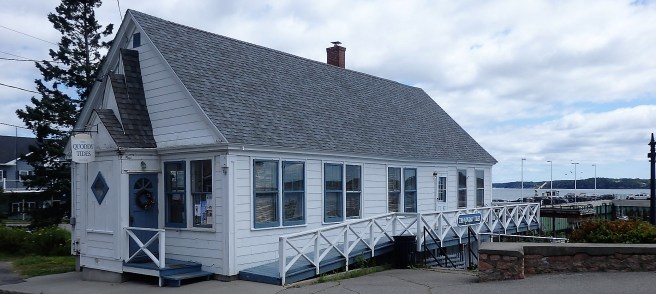
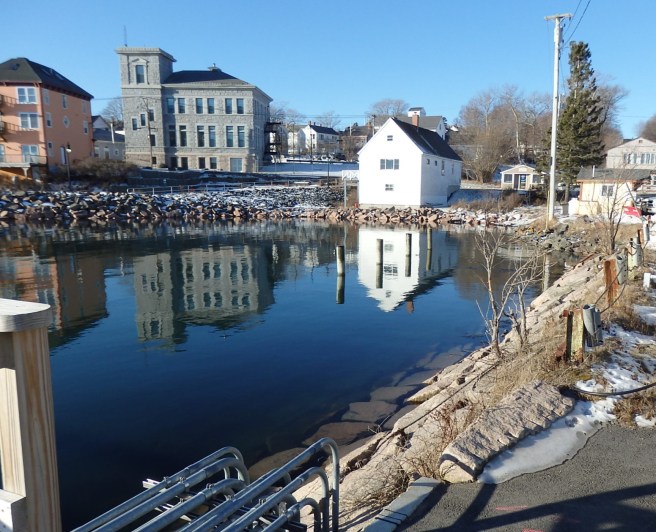
The Tides was founded in 1968 by Winifred B. French, the wife of Dr. Rowland Barnes French, M.D., and mother of five. They moved to Maine from Arizona in 1953 so he could help found the Eastport Health Center, itself a remarkable story in community medicine.
Winifred had no background in journalism, but she saw a need, studied hard, and ventured forth in launching and editing a small-town paper with a regional outlook. In 1979, for good reason, she was named Maine Journalist of the Year. Remember, the Tides isn’t a daily or even weekly newspaper, it’s every two or sometimes three weeks.
Reporters attend public meetings rather than chasing afterward by phone, correspondents provide meat-and-potatoes servings of neighborhood interest, Don Dunbar contributes top-drawer photography, and local columnists all weigh in for what becomes must-read pages throughout the area. The mix skirts the glib boosterism and doom-and-gloom morbidity too prevalent elsewhere.
Winifred died in 1995, but son Edward French and his wife, Lora Whelan, continue on her model. (Another son, Hugh, heads the Tides Institute and Museum – note that Winifred’s sense of “tides” continues there, too.)
I like the fact that the stories don’t carry datelines. Nope, the reader doesn’t get a chance to turn off on the basis of a single word. The region is closely interlinked by people living in one place and working in another or having family elsewhere, so it’s all of interest or should be – both sides of the U.S.-Canadian border.
I also like the fact that headlines come in just two sizes, with a serif face used for a touch of variety. There’s no need to scream to draw attention. Instead, we get an orderly and fair-minded sensibility.
So that’s an introduction. I could go on and on.
In some ways, it reminds me of Annie Proulx’ novel The Shipping News, without the dreariness and grimness.
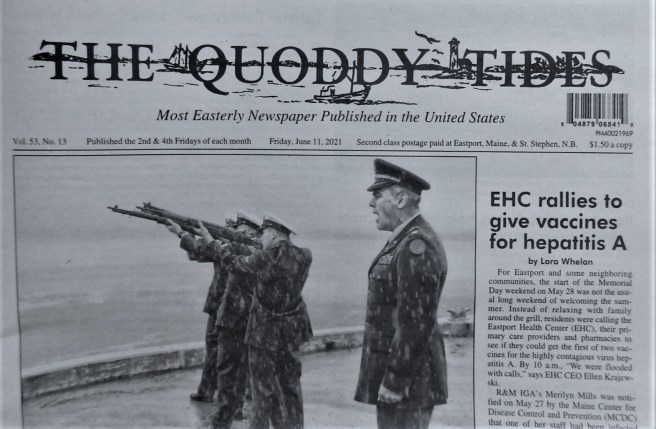
One thing I would tweak is the nameplate, which goes back to the first edition. That shoreline still seems to strike out the paper’s name.
Still, it’s a joy to be retired and not have to be in the midst of producing all this. These days I do delight in being able to sit back and simply enjoy what I’m reading – even if I do on occasion feel an urge to “fix” something on the page.
What – or whom – do you look forward to reading the most? On a regular basis. (Apart from this humble scribe.)
Holy Moses
Exposes
Roses
Noses
Poses
Hoses
Reposes
Dozes
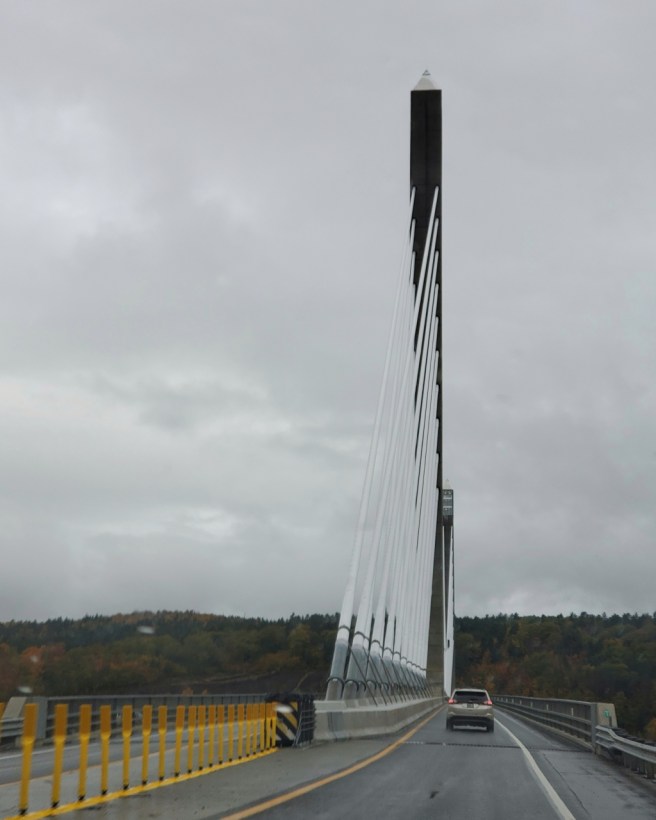
For many people, the dramatic wishbone bridge at Fort Knox, Maine, is the welcome to Downeast Maine, the portion of the Pine Tree State that sits east of Penobscot Bay and its river.
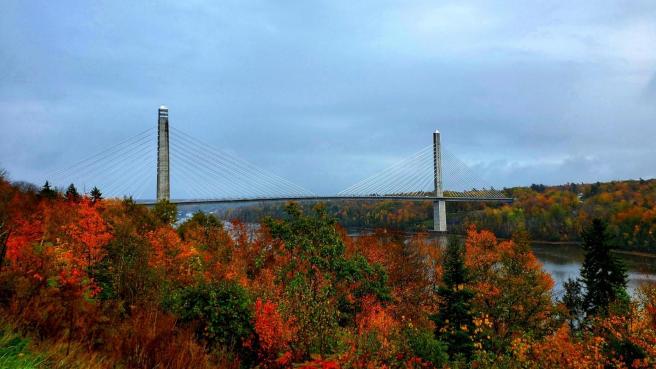
The big span carries the major highway to Acadia National Park, for one thing, and allows shipping to continue upstream to Bangor and Brewer. It’s also the slighter slower of the two routes from our home to the rest of America.
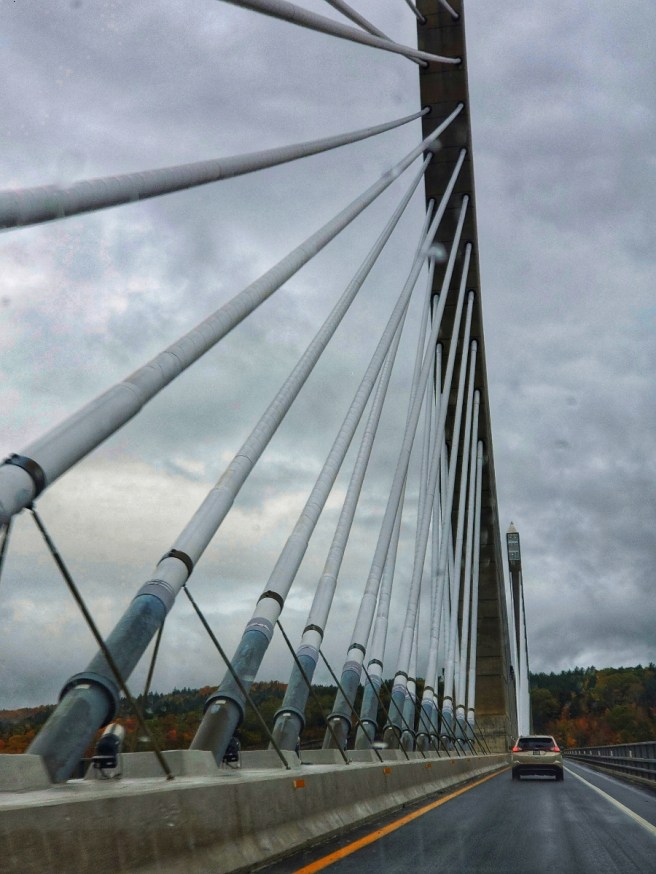
The glass pyramid atop the one pillar covers a public observation deck. It’s on our to-visit list.
Dover, New Hampshire, sits on the tidal waters of the Atlantic Ocean but that didn’t inhibit its influence on Midwest and then West Coast Quaker growth.
Consider the leadership of Dover Friends Meeting in the years leading up to the American Civil War. Benjamin H. Jones served as clerk for six years, 1841 to 1847, and also traveled in ministry. Olney Thompson then served a year as clerk, followed by John Meader, 1848 to 1851.
In September 1852, however, “Benjamin H. Jones, having removed with his family to reside within the limits of Salem Monthly Meeting (in Iowa), inquires after a Removal Certificate thereto for himself, his wife Mahalth E. and their children, Robt H., Lucy T., and George N. Jones.” This would have been a transfer of membership taking them west of the Mississippi River.
New England’s rocky soils – usually either clay or sandy, rarely loam – had long made for difficult farming, and railroads were making Midwestern crops and livestock competitive in eastern markets.
In 1855, James Canney, an overseer and assistant clerk at Dover, moved with his family to Minneapolis and later to San Jose, California.
The Beans, who settled in Gilmanton in 1772 from Brentwood, became a remarkable case. Among their descendants was John Bean, who wed Elizabeth Hill. The four of their five children who lived to adulthood – James, Joel, and twins Mary and Elizabeth – all headed west before the Civil War. Their education included terms at the Friends Boarding School in Providence, Rhode Island – today’s Moses Brown School.
John sold the farm in Gilmanton and moved to Rochester to become a businessman. Self-inflicted financial difficulties, however, resulted in bankruptcy despite the attempts of Dover Friends John Roberts, Thomas Roberts, Elijah Jenkins, Ken Graham, Daniel Meader, and John Estes to guide him. The experience embittered and devastated him.
That may have set all four of the children looking to horizons beyond New Hampshire. They would each move to Iowa and eventually on to California and Oregon, becoming recorded ministers along the way, as did three of their four spouses, too. Quite simply, they were crucial in the establishment of Friends Meetings west of the Mississippi River.
Before going, daughter Mary wed Charles H. Tebbetts under the care of Dover Meeting on January 19, 1854. Their clearness committee was Sarah K. Prentice and Cyrus Bangs. After a stint in Iowa, the couple moved on to Pasadena. Their son, Charles E. Tebbetts, would become a prominent Quaker pastor and president of Whittier College.
James Bean went with a wagon train to Iowa and Minnesota in 1855, returned to Rochester to wed Roanna Fox on August 16, 1858, and together they moved to the prairie, where he tried his hand at a grocery and a bookstore before becoming the U.S. government paymaster and clerk for the Chippewa Indian agent. In time, they landed in San Jose.
At West Branch, Iowa, Elizabeth Bean wed Benjamin Miles, a widower with three children from Miami County, Ohio. They would move to Newberg, Oregon, where his children would establish George Fox College.
Joel Bean married Hannah Elliott Shipley in Philadelphia, but they were introduced in Iowa when she was visiting. With her prominent Quaker connections, the wedding took place in the Orange Street meetinghouse on June 29, 1859. From there, they went straight to Iowa. In the spring of 1861, they set out as Quaker missionaries to Hawaii. On their return to Iowa, he rose to the position of vice president at a bank and served as clerk of the Yearly Meeting. He and Hannah also traveled in ministry to England, 1872-1873.
So much for four humble siblings from Dover Friends Meeting. They would, however, become embroiled with controversies involving Holiness movement evangelism besetting many of the Midwestern Friends, including a shift to full-time pastors, revivals, and hymn-singing. Joel and Hannah moved on to San Jose, California, in 1882. (Their granddaughter Anna Cox Brinton, widely known among liberal 20th -century Friends, continued to use Plain speech – mostly with her husband, Howard.) They were joined by James and Roanna.
Dover’s former clerk, Benjamin H. Jones, had returned east, to Lynn, Massachusetts, but was about to try homesteading in Montana with his wife. His son, George, was already in San Jose.
In the end, rather than join California Yearly Meeting, the San Jose Meeting remained independent. Officially, after being disowned by Iowa Friends after he had left, Joel and Hannah applied for membership in Dover Meeting, despite the distance, and were welcomed.
As far as pioneering went, they were way ahead of the high-tech revolution that would take place in their final locale.
~*~
Add to that Tom Hamm’s book, The Transformation of American Quakerism: Orthodox Friends, 1800-1907, which details the impact of railroads and commercial farming on Friends’ life during the nineteenth century, especially across the fertile Midwest.
During this time, the wider Quaker world underwent a number of modifications. Gone in some circles was the restrictive discipline, along with the requirements of Plain speech and dress and the marriage limitations, but sometimes it came with theological strife and new legalism.
By the end of the century, pastors had been introduced through much of the American Quaker world, including Gonic and Meaderboro. Friends had influential roles in interfaith organizations such as the YMCA, too.
~*~
In 1884, Asa C. and Emeline Howard Tuttle, along with their son, returned to Dover “after spending some years among the Modoc Indians in Indian Territory,” as James Bean observed. “They were both ministers of ability. They remained in Dover, beloved and respected by all until Asa’s death in 1898, when Emeline removed to Rhode Island. and later to Louisiana. After the removal of Emeline Tuttle and Lydia E. Jenkins, the meeting continued without a regular minister for some years.”
Emeline is credited with discontinuing the separate men’s and women’s business meetings in 1886 and merging them into one.
~*~
In 1913, the faithful remnant proved to be too small and too old to continue on its own and regular worship was discontinued in the meetinghouse. Officially, Dover Monthly Meeting went on at the Gonic meetinghouse, which had both a pastor and financial support from the mill there.
~*~
Check out my new book, Quaking Dover, available in an iBook edition at the Apple Store.
Welcome to Dover’s upcoming 400th anniversary.
normally, straight into the (meager) savings or IRA but with tax changes anyway thought I’d hold on to it for a while and for a switch dreamed and played, asking myself what I’d like to do with it? pay off on the car? (naw!) finally get a CD player, some Ives and Camerata discs, and those new Boston Acoustic speakers? (now that would be a wonderful self-indulgence!) or how about finally breaking down and getting those twelve-year-overdue cross country skis? gee, I could even finally throw in a ten-speed bike, too! not knowing what the IRS had uncovered but then, surprise
 Jnana's Red Barn