You’ve been seeing our duo, Salty and Pepper. Before that were Boo, especially, and Widgeon.
Now, for some details on the species.
Officially, they’re lagomorphs, though we find their chewing habits resemble rodents – you know, beavers, when it comes to wood. You’ve been warned.
Existing as an animal of prey, meaning a food source, makes them skittish. Boo, though, came to be a lap rabbit, sitting for hours in her someone special’s lap.
In short spurts, they can zip along at up to 45 miles an hour. As ours do when they’re first out of their cage in the morning.
In general, they’re silent. They don’t bark or meow or anything like that, though Salty has a whiffling snore while dozing. You’d think she’s in pain, but she’s not.
They’re meticulously clean and can be potty trained, like a cat.
Their ability to jump straight up, from all four legs, and twist and spin about in the air is called binky.
Born covered in fur, they can run from the start.
Their teeth and nails never stop growing.
They cannot vomit, which requires us to be careful in what we feed them. Even when they seem to eat almost everything we offer them. That, by the way, has been an incentive for more attentive weeding on my part. Those weeds suddenly become bunny treats, and watching those greens be so assiduously devoured is quite amusing.
Our local radio station is licensed to the high school. Seriously. And it’s as quirky as KHBR-AM 570 in the legendary TV series “Northern Exposure,” even without Chris Stevens as the DJ. Or I’d contend, even more.
The television show never got into young people, for one thing, but there aren’t many in Sunrise County, where the seven public high schools together have about 200 graduates a year, half of them from just two schools. A private academy adds another 100. It’s a long stretch, by the way.
Pointedly, Eastport’s Shead Memorial High has only about a hundred students, down from 300 a few decades earlier, and a faculty of 11, some of whom also teach at the junior high or elementary. The principal serves all three. The school proudly proclaims its emphasis on personalized education, which I applaud. What’s obvious is the incredible student-faculty ratio.
One big challenge is in trying to find ways to lure more of the younger generation into staying put here. Maybe the economic tide is changing in that direction.
In the meantime, the radio station gives them an opportunity to learn production skills. In fact, the station started out as a school club in 1983 and took off from there. Throughout the day, the station’s IDs feature the different kids, however bashfully, and it’s charming.
Much of the programming is a stream of music, a mix of blues, jazz, rock, country, bluegrass, and more, I’m assuming streamed from somewhere. Yes, and there are public service announcements as well as the honor rolls and other local touches. Truly. And then the DJs kick in, including some of the kids, with surprisingly sophisticated tastes.
They’re not the only ones.
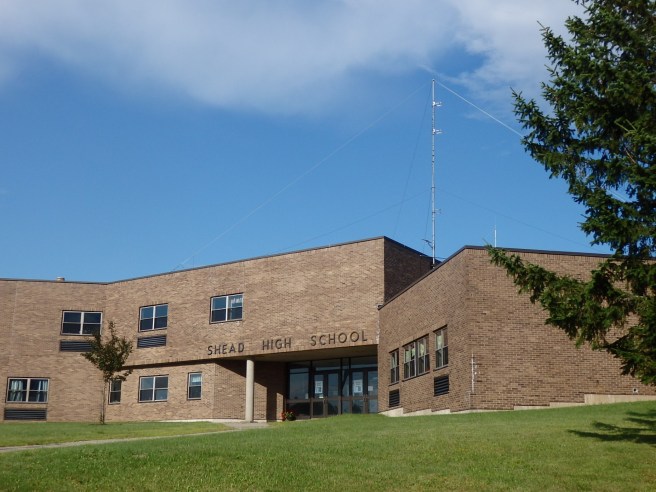
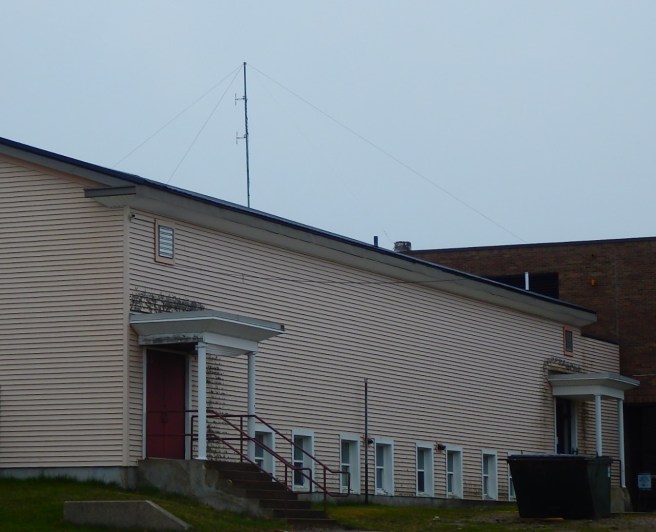
The station’s modest tower sprawls over the high school. Here it’s seen from the front.And from the back, by the gym.
The local demographics skewer sharply upward, and volunteers at the station are welcome. In fact, they create much of its most distinctive programming. As I was saying about do-it-yourself participation?
There’s Cracklin’ Jane, with only 78 rpms, a weekly theme, and radio dramas from a golden age, including commercials for brands that no longer exist. And others like Sam’s Caffeine Café, yes, it’s redundant, but mostly acoustic Americana two mornings a week; the Bass Lady’s informed insights into anything with a bass line, Chloe’s folksy Friday afternoon transition; Firedog’s Electric Doghouse, Boldcoasting; and the like.
Well, this is a town filled with eccentrics and geezers. Its low-power radio station reflects that. And to think, it all started as a school club in the ’80s!
I think of it as Radio Free Eastport, broadcasting to the free spirits on and around our islands.
First off, I should explain that few old houses in New England actually have much by way of closets. So I’m actually talking today more about personal wardrobe and style.
One of my long-term planning notes was this, for my shift into retirement:
Focused look: new jeans (black/green/gray); sandals (fewer socks; also, they travel better); blazers for the pockets.
What actually emerged was quite different.
I shifted from denim jeans to tan cargo pants, for their pockets, especially.
Instead of my customary oxford shirts, I wore turtlenecks in winter, and Aloha shirts in summer. (I still largely avoid T-shirts.)
Instead of that blazer, I rely on a messenger bag to hold my reading glasses, cell phone, emergency cardiac prescription, choral music scores, and so on.
My style, such as it is, has emerged from yard sales, mostly. These days my focus is on wearing them till they give out while also downsizing. You’d be surprised how many compliments I get.
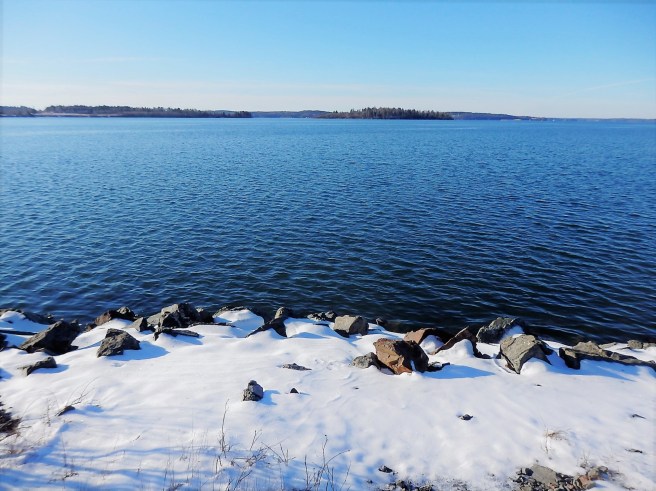
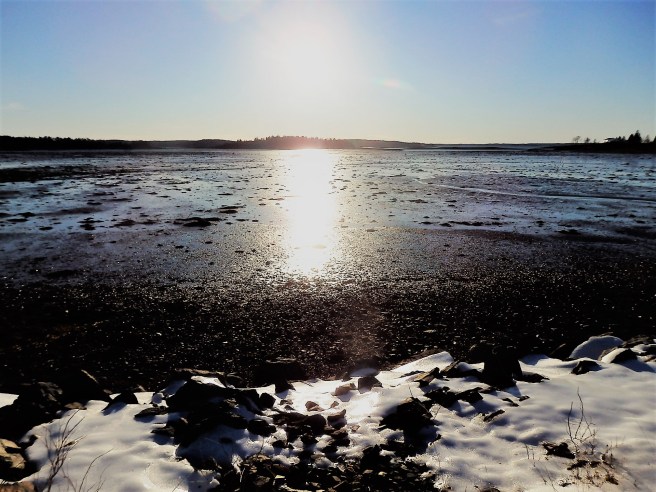
Our tides vary between 15 and 25 feet, depending on the moon cycle, and half of that change occurs in just two hours, halfway between high and low. It still amazes me.
This is what you expect to see at the ocean, right? Just stick around another six hours to see what happens to our high tide.At Carrying Place Cove, if often looks like somebody pulled the plug on the tub and let all the water out.
after three months I recognized the true nature of dining hall menus in their two-week cycle of institutional perdition now I’ve revolted by way of vegetarian practice and straight from the garden gratitude for herbs and spices, sauces, flavored vinegar, pressed oils, the religious dimensions of feasting and fasting as well as prohibitions, there are reasons apart from snobbery no wines accompanied those dinners, after all, what do kids know and who would teach of goodness : as in what God saw as good, as in good to eat? and so it was, grace before vittles / sweet tasty dreams
As I’ve been revisiting my earlier planning for retirement, I started to scold myself for not looking more carefully at finances. Then I remembered something I had anticipated but never noted: adding an overtime shift or two each month during my final five years of employment.
For years, management always seemed to have those openings, and the pay was good – time-and-a-half, often with a nighttime or weekend differential.
In the last five years, the kids would be on their own, for one thing. We would really build up our savings – by 25 to 50 percent, as I’m now calculating.
What happened instead was that the newspaper found itself increasingly financially strapped, to the point our pay was actually being cut. Officially, I was the copy desk chief, except that in the end there were no longer copy editors. They were all wearing other hats as positions consolidated. As for those overtime hours? We agreed to allow the hiring of part-timers.
So much for the big plan.
At least the stock market hadn’t crashed when my wife and I closed out our IRA to purchase the house in Maine.
A fair number of the Piscataqua’s early settlers were from prosperous, even well-connected, families.
The question is just what prompted them to relocate to the primitive, even harsh, conditions along the Piscataqua River.
David Thomson, the son of a Scottish minister, has the King’s ear and a debt of gratitude.
The Hiltons are part of an extensive and prosperous fishmonger clan.
Thomas Roberts’ father, by some accounts, becomes a baron. Even if he didn’t, Thomas still becomes a member of the powerful fishmonger guild.
The Hilton brothers weren’t exactly out of the loop, either.
~*~
Powerful? Take Francis Champernowne, a 1640 signer of the Dover Combination, a remarkable document stating the residents’ desire to be freed from being subjected to company-town decisions being made in England. While I see scant evidence that Francis actually resided in today’s Dover, he did have extensive landholdings in New Hampshire, including the current towns of Greenland – named for his Green Land farm – and Madbury, then part of Dover and named after his ancestral home, Modbury, in Devon, England.
His father, Sir Arthur Champernowne, owned at least eight merchant ships or privateers and had fished New England since 1622. In 1635, Sir Arthur financed a settlement under his son, Francis – likely the southern part of Kittery, Maine, which became known as Champernowne’s Island, today’s Cutt’s or Gerrish islands – as well as another on Braveboat Harbor in York. Francis may have also lived at Strawbery Banke (today’s Portsmouth) until 1640.
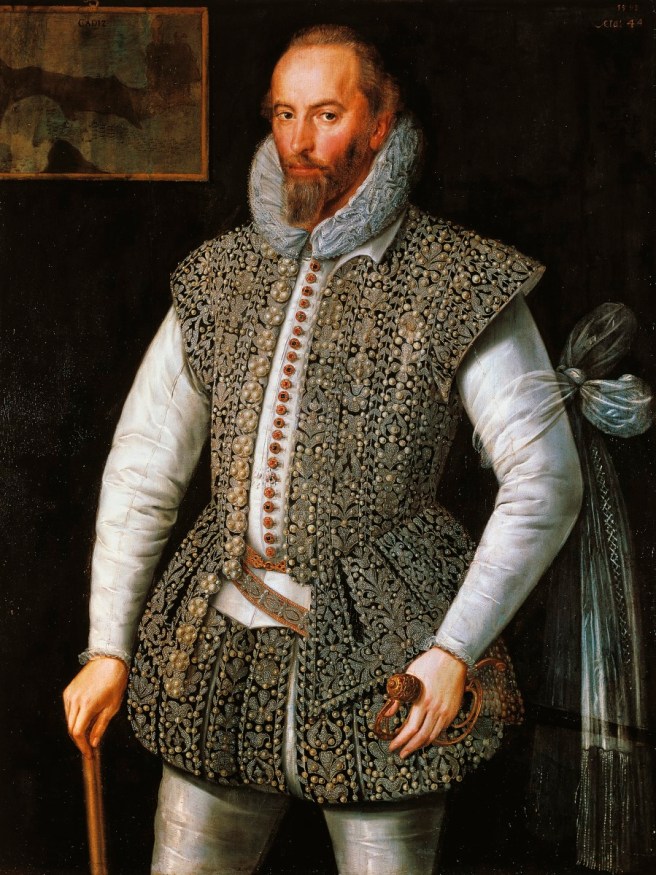
Sir Walter Raleigh. His nephew was a big settler along the Piscataqua, Did he dress anything like this?
Captain Francis was well-placed. His great-aunt Catherine was the mother of both Sir Walter Raleigh and Sir Ralegh/Raleigh Gilbert, an important explorer and adventurer of the New England and Canadian coastline. Captain Francis was also a “beloved” nephew of Sir Ferdinando Gorges, proprietor of Maine and unofficial godfather of New England itself.
Francis was often at sea, to England and Barbados, especially. During the early part of the English civil war, his Royalist leanings led him to join King Charles I’s fleet under the Earl of Marlborough. Returning to Dover by 1646, he left for the Caribbean in 1649 but returned to Maine in the early 1650s, where he later became a commissioner and justice under Charles II. In April of 1678, he signed the articles of peace with the Abenaki at Casco. He was an ardent Anglican and died in Kittery.
It’s enough to make me think living conditions back in merry old England weren’t that great, either.
~*~
The Waldron family that soon comes to dominate the growth around the Lower Falls, or today’s downtown Dover, came from wealth in Warwickshire, England. William drowns, but brother Richard turns Dover into something of a personal fiefdom while rising to become Speaker of the Assembly once New Hampshire is under Massachusetts rule. He builds the first saw mill and grist mill at the falls, has extensive shipping connections, dominates the fur trade with the native Pennacooks. He didn’t exactly start from scratch.
You’ll be hearing a lot more about him. Man, will you.
 Jnana's Red Barn