There are holes in the listings posted in the website. Individuals, perhaps, who want no contact, though their location is known. Perhaps others who have been ostracized, after prison or scandal. Others just fallen through the cracks.
I see, too, others have been added. Girls who left to have secret babies. Boys who maybe got their GEDs or returned to the fold through marriage. I’m glad to see them included.
In the meantime, I prepare a message. The one that says my location can be known, even if I’m not attending this year’s reunion. Even now, it’s a long road from here to there, and back again.
~*~
How curious, coming across that note a few decades after I wrote it.
I’ve reconnected with a few via social media.
But many holes still remain. Frankly, I don’t know what I’d say to them if they did show up. We have gone in quite different directions, after all.
After recently tweaking the cover for my Hometown News novel, I found my eyes zeroing in on another volume and once again questioning its effectiveness.
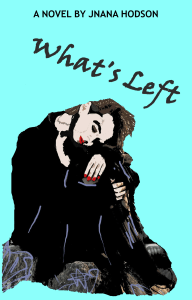
This design continues at Amazon. While Cassia goes Goth in the plot, I suspect this was a bit extreme for her style.
What’s Left: Within a daughter’s own Greek drama had been especially difficult to develop, as I’ve explained in earlier posts, but ultimately ended up following a girl who lost her father in an avalanche on the other side of the globe when she was only 11. She then continues on into her emotional recovery and growth, rounding out in her mid-30s.
By the time the book appeared in both digital and print-on-demand options at Amazon, the cover image had settled on a photo of a Goth girl.
For technical reasons, she continues at Amazon, while my cover at other digital retailers got updated.
I wanted a better sense of the initial suffering, or even an edginess in her development, but nothing worked perfectly. I am still taken with the daring in her stare at the camera, but is that enough? (I did a post about the earlier covers on December 20, 2019, should you want to explore my archives. I was quite fond of the first cover, the one with its falling egg yoke, but nobody else seemed to get the connection.)
The figure appears more ambiguous in my attempt to do something more in line with some of the Young Adult covers I saw. Ultimately, this was a mistake.
Furthermore, she’s genetically a mix of Greek and American Midwest and a tad on the pudgy side. I hate it when a story follows, say, a brunette but the cover shows an obviously dyed blonde.
Another challenge involved balancing the two words of the title. The second word, “Left,” should have the emphasis, but it’s only half the size of “What’s.” Nothing I tried corrected that. In many of the typefaces I sampled, “Left” simply didn’t read easily, either. It could have been “Lest” or “Lett” on first reading. In making a sales pitch, there’s no time for deciphering the message. “What’s” presented similar challenges in other typefaces.
The text had been difficult enough to nail down in a convincing voice, but the cover was equally problematic – especially finding an appropriate image. How do you summarize all this in a single graphic impression, especially one that works thumbnail size online?
Do note, there’s an ongoing argument about using a facial image on a cover, period. Does it grip a potential reader or does it turn one away? Will it even limit a reader’s impressions of the character at the heart of the book?
At last I had a photo that more or less captures her despair. The title and author presentation never quite matched.
Remember, my budget wasn’t generous enough for a graphic designer, the kind who would create a flowing dust jacket replete with insider clues for a potential reader. I’m not particularly fond of those designs anyway. In general, I think photos pack more punch in a first impression. Just look at magazines at a newsstand. Remember those?
Cassia, or more formally Acacia, goes into mourning after her father’s death and then morphs into Goth dress and appearance through her teenage years, where much of the story develops.
The book doesn’t fall neatly into genres – part of it could be Young Adult, but I’d say the core of it is New Adult and beyond. So how old should she look on the cover?
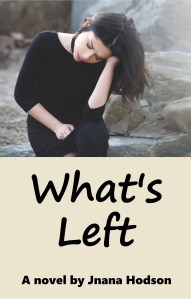
Finally, in the latest stab at this problem, I decided to run with an image I’d settled on earlier. This time, it would bleed off the cover at both sides for maximum impact. I then decided to run it off the bottom, too. Somehow, that left the photo square, a format her photographer father pursued.
At last, we have this.
My reason for cropping the photo tighter was to give it more depth, putting the focus more fully on the girl and her emotion. I’m now seeing that the rocky background I eliminated had actually suggested another kind of story. No more of that distraction now. An artist might have replace it with her extended family, by the way.
In leaving the top open for author and title, rather than separating those elements with the photo in the middle, she has more presence and gravity.
I’m also glad I stuck with an impulsive decision to not fill in the remaining cover with a background color. A new typeface for me, Yu Gothic Semibold, seemed to work best for the title, though I’m not exactly happy with the single-stroke bar apostrophe. But “Left” carries its own weight in the dance of letters.
Book Antiqua, meanwhile, a fallback for me, does nicely in italic for the author.
That’s all – clean, simple, and somehow daring in its starkness. Without an obvious border, the design declares its independence from paperbook constrictions. It’s also quite contemporary, in a confident way. It even pops out on websites. And there’s no question that it comes together more harmoniously the one it replaces.
This one’s now available on your choice of ebook platforms at Smashwords.com and its affiliated digital retailers. Those outlets include the Apple Store, Barnes & Noble’s Nook, Scribd, and Sony’s Kobo. You may also request the ebook from your local public library.
As she asks her aunt Nita for details about the hippie era, she gets an earful. Here’s a passage that was condensed before the final version of my novel, What’s Left:
You know, peace and social activism. Environmental and ecological awareness. Racial and sexual equality. Sustainable economics. The whole spiritual revolution, including yoga and meditation. Education reform. Well, I miss the music – the fact it got lost in time. Don’t forget the health and nutrition angles, either – not just natural food and vegan. Farmers markets? We’ve certainly been participants on that front.
Weren’t there some communes around our Mount Olympus?
They’re hanging on, actually. The survivors turned into cooperative housing, where the members own their own homes but share the land. An interesting concept. Land trusts, too.
Thea Nita, you know how Theos Tito rants from time to time about the Establishment’s interference with the counterculture?
You mean, beginning with the CIA’s role in moving hard drugs into the country to undermine the peace movement? And Big Money’s work to undermine radical economics? Sure.
What do you make of it?
It’s another big book waiting to be written.
So we come back to politics?
Yes, Cassia. The nation’s divided by the fact we won’t look openly and honestly at the experience. Why should we be embarrassed by our hippie identity? Our antiwar righteousness? Our desire for liberty? There’s no real public dialogue, and that’s a disgrace.
~*~
OK, open up: Do you think the hippie generation should be embarrassed?
~*~
A large Queen Anne-style house with a distinctive tower something like this is the headquarters for Cassia’s extended family in my new novel, What’s Left. If only this one were pink, like hers. (Manchester, New Hampshire.)
If we were making a movie version of my novel, What’s Left, who would you cast as her grandmother Bella?
This would be a big juicy part, starting with her romance with Nicky in the war years. And don’t overlook her working mom action with five kids in tow. By then, nearly everyone in town knew her.
~*~
A large Queen Anne-style house with a distinctive tower something like this is the headquarters for Cassia’s extended family in my new novel, What’s Left. If only this one were pink, like hers. (Manchester, New Hampshire.)
When she sets out in the task that’s become my novel, What’s Left, she doesn’t expect to be creating a family genealogy going back through her great-grandparents. But there’s no avoiding it.
As I explained in an earlier draft:
Theirs is a unique odyssey – one where the final homecoming is far from its point of origin. As a tragedy, the suffering comes at unmapped turns in the quest for the American dream. As a comedy, well, there are hot dogs, hippies, Hoosiers, and hope. Take your pick.
She gets insights on her parents’ generation:
Thea Nita notes that children in her generation grew up hearing of the woes of the Great Depression as a staple of conversation at big family dinners. In our case, that included the diner shooting.
A good genealogist doesn’t turn back when the details get disturbing:
By now I’m rather astonished at the events Thea Nita’s uncovered. Every family has things it wants to keep secret, but as a journalist, she’s driven toward disclosure. What did I tell you about listening closely to arguments? The dirt that comes up, even years later? Or even in what might transpire in mother-daughter confabs.
~*~
Does it work for the reader? I certainly hope so.
One reason, I suspect, is because Cassia is part of a family that holds many experiences in common. They live close to one another, work in the restaurant or related enterprises, play and grow up together, worship in one of two streams they’ve blended. Whatever they have flows from a shared source.
~*~
Speaking of family, Cassia’s oldest cousin, Alex, would be quite a catch. Where would you want to dine with him – romantically or just as a friend?
~*~
A large Queen Anne-style house with a distinctive witch’s hat tower something like this is the headquarters for Cassia’s extended family in my new novel, What’s Left. If only this one were pink, like hers. (Rochester, New Hampshire)
My novel, What’s Left, springs from the ending of my first published novel, where our hippie-boy’s troubled journey finally brings him to true love and an embracing community.
Part of his epiphany is brought about by his colleague and guardian angel, Nita, when she hangs two portraits of her younger sister on her wall. Even as a professional photographer, he’s riveted. You could say it was infatuation at first sight. Or something more primordial.
And then, when he visits their family, the romance blossoms.
In the (highly unlikely) movie version of my novel, What’s Left, who would you like to see as her best friend, cousin Sandra?
Of course, that also means thinking of her blended genetic heritage and who could embody it.
~*~
A large Queen Anne-style house with a distinctive witch’s hat tower something like this is the headquarters for Cassia’s extended family in my new novel, What’s Left. If only this one were pink, like hers. (Claremont, New Hampshire.)
Thinking of freedom, we can see it as personal expression as well as political opportunity. For some of us, that was a big dimension of the hippie movement.
The 50th anniversary of Woodstock is coming up next month. Normally, that would mark a jubilee, some even acclaiming it as a celebration of the dawning of the Age of Aquarius. Alas, the dark ages we thought had passed have returned from the dead, in intensified deadliness at that.
Jubilee, by the way, is drawn from the Biblical book of Leviticus, and it’s a most radical idea. Every 50 years, all the wealth in the land is to be redistributed. The scriptural passage is inscribed on the Liberty Bell in Philadelphia, so don’t tell me it’s not American.
~*~
One of the passages I cut before the final version of my novel What’s Left is one where she’s asking her aunt about the hippie experience:
I’ve never asked you about your own drug use.
OK? Can I say it was just enough to convince others I wasn’t a narc?
So were you really a hippie? I mean, you had such short hair!
You trying to say a hippie couldn’t have short hair? Don’t you know how radical my style was? You ever think I could conform to anything?
Well, you’ve indicated you weren’t stoned. I’m going down the list.
Have you considered the impact of the Pill? Or free love?
Oh, I’m so glad Cassia stopped talking like this! In the final version, she’s pretty snippy.
~*~
For the record, some of the truest hippies I’ve known weren’t promiscuous or do drugs. And some others never marched in a protest.
Still, as an image of the era, let me ask: What’s your impression of Woodstock? Have you ever been to a big, multiday festival? What’s your favorite music? How do you best express your free spirit?
In my novel, What’s Left, having her family own a restaurant opens another dimension to the story – the changing food tastes of the American public.
If Carmichael’s continued solely as a burger-and-fries joint, we’d have a much different type of story, one based on the day-to-day interactions of line cooks, dishwashers, wait staff, and a slew of customers. One of my daughters has already drafted an exciting and entertaining story based on her own experiences in the trade – now, if she’ll only get it published! Realistically, a restaurant like that would likely wind up in bankruptcy halfway through the novel – or maybe even the victim of arson, if not accidental fire.
So having Carmichael’s expand, as I do, shifts the focus to a revolution in the awareness of food itself. We have plenty to play with that way.



 Jnana's Red Barn