I’ve been meditating for more than 50 years now

Well, I haven’t been living as a monk in a Himalayan-mountain cave any of that time, but it does sound more impressive that being a “meditator” or someone who practices in a contemplative religious tradition that long even when it’s only once or twice a week.

The thought came to me in Quaker worship the other Sunday morning, the center of what has remained my spiritual discipline and community after the yoga-based version faded away over the years – even my rising before dawn to sit cross-legged in front of a small altar and its candle before I tackled poetry and then took off for the paying job for the rest of the day.

~*~

While I can no longer park myself on a cushion on the floor in the Asian style but rather settle in much more loosely on an old meetinghouse bench – do not call it a pew – the bigger change has been in the focus of my sitting.

The goal of the yoga exercise was to transcend, leaving behind mundane awareness altogether. Somewhere you might encounter your past lives, even. If not that, then a natural high, as an advanced version of a drug trip. At least an awareness of an altered state of consciousness that might even address authentic ethereal reality.

Instead, in the Quaker vein, what I’ve found is a time of being mentally and emotionally renewed and even gaining clarity into my daily engagements.

Or, as one quip goes, some of the best barns in New England were designed during Quaker Meeting. In this case, meaning the hour of shared and mostly silent worship.

~*~

The half-century mark also takes me back to my first Summer of Love, detailed my novel Pit-a-Pat High Jinks, a book that has scenes triggering the erotica filter, should you try to order a copy.

While I was preparing to live in the yoga ashram to our south back then, I experienced my first summer with a daily exposure to the outdoors, including swimming in mountain lakes, often naked, Upstate New York. It was a time of great struggle, discovery, growth, and redirection for me.

And at the end of all this, at the closure of our hour of silent worship here in Maine, one Friend (aka Quaker) voiced an insight from a Native perspective that when it comes to time, the focus is on the past – it’s the only one we can know. The future is the one behind us, rather than ahead. Not that there’s that much ahead for me in this lifetime.

~*~

Still, it’s was a kind of day that had me wondering, can life be any better than this? (Even with those aches et cetera of aging.)
My encounters in a yoga ashram altered my perception of life

I stepped out of my journalism career three times in my life before retiring for good. The first was when I decided to move to the ashram where I could immerse myself in yoga philosophy and practice. Responding to Swami’s invitation to settle into her rural setup was something I did slowly and deliberately, with a large degree of trepidation. As I relate in my Yoga Bootcamp novel, the daily life was intense and evolving. Leaving the ashram was a different matter, with others largely resolving the outcome – out you go. For weeks afterward, I felt myself falling helplessly through space. Eventually, I reestablished my feet on the ground and then headed off for a new life in a town I call Prairie Depot.

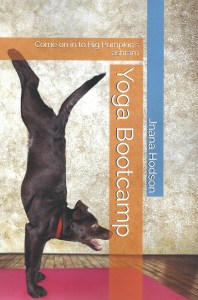
The paperback cover …

What happened for me during my residency was life-changing. I regard it as my master’s degree and my introduction to psychotherapy of an amateur sort. Among other things, it led me to the Society of Friends, or Quakers, which turned out to be the faith of my Hodgson ancestors from the 1660s down through my great-grandfather.

In the novel, I chose to confine the structure to a single day, in part because I had so many lingering questions I could not answer. Yes, within that day individuals could look back on their previous history, but the focus was on the NOW. And a lot could happen there in a 24-hour span. Besides, as I later learned through some candid discussions with a former Episcopal nun, monastic life has some commonalities of its own. As she said, some of the most intense interactions came in trying to choose the flavor of ice cream when the rare opportunity arose. I’ll argue you’re the most human under such rarified circumstances.

On top of everything, when I was drafting the book, I was out of contact with the place and its people. Critically, I had refused an order to return to the ashram after I’d married and moved to Washington state and a follow-up stipulation of heavy financial support was out of the question. A half-dozen years later, back on the East Coast, I had an opportunity to stop by but was not admitted into the house. I did learn that Swami had died and I sat by her grave. So much for making amends.

… and the back cover.

Since then, I’ve reconnected through social media with some of the key players and had a few assumptions, not in the story, deflated. In addition, Devan Malore’s “The Churning” reflects life there a few years after I’d moved on.

The story itself could have gone another way, if I hadn’t wanted to present the ideals that drew us together and kept us going. Especially the humor and playfulness.

More compelling for many readers would have been a more sordid tale of just one more “new religion” outfit run into scandal of a sexual or financial sort, preferably both. There were enough elements for that, as I’ve since learned.

The story first came out as a pioneering ebook in PDF format only and was later updated to Smashwords and its affiliated partners. A more recent, quite thorough recasting (again, blame the influence of Cassia in “What’s Left”) changed Swami from female to male and introduced Jaya as one of the eight resident yogis, thus linking her to the heftier Nearly Canaan novel. Besides, the transformation made Swami more acceptable to the expectations of many readers and allowed the Big Pumpkin and Elvis dimensions. The role was already unconventional enough, and this was more fun.

Am I still doing yoga? If you mean hatha, the physical exercises, let me say rarely and embarrassingly, at that. As exercise, I’ll substitute my daily laps in the swimming pool, and as meditation, my weekly Quaker meeting for worship. And no, I’m no longer vegetarian, other than when I voluntarily follow the Greek Orthodox “fasting” of Advent and Great Lent (again, blame Cassia), though I also eat much less flesh than most Americans. Actually, in these seasons, the Eastern Orthodox Christians are stricter than we yogis were.

I do wish there were a similar haven for youth today, one freed from the burden of student college debt. I’ll let “Yoga Bootcamp” stand where it does.


About the practice of intense meditation

Answers to some of the questions about Cassia’s father’s reasons for intensely pursuing Tibetan Buddhism, first encountered in my Freakin’ Free Spirits novels, can be found in Yoga Bootcamp, my story about eight young American yogis living on a former farm in the mountains. While each student is at a different stage of discovery, their widely divergent motivations still lead to common struggles and victories. Nothing is easy, but the lessons are priceless.

Do you practice meditation? How about yoga exercises, chanting, or Zen? Any other spiritual exercises you care to discuss?

~*~

The paperback cover …

High hippie by degrees – nobody fully fit the stereotype

By the end of ’68, the counterculture phenomenon was metastasizing from San Francisco’s Haight-Ashbury and nearby Berkeley into pockets across most of the country and even Europe. As August of ’69 proved, it was sufficiently established in the East to draw together the unanticipated throng at Woodstock.

Much of the transplanted activity existed at the fringes of college campuses, as I experienced in Bloomington, Indiana, and later Binghamton, New York. For me, growing up in Ohio, I would have rather attended hip, beat Antioch in Yellow Springs, but the finances were way out of our consideration. So a state school was my destination, and at the time, Indiana as an out-of-state student was nearly as reasonable as in-state for me in Ohio. And a bit later, to my surprise, how yesterday Antioch began to appear once I was near the East Coast.

The searing experiences shape what I describe in Daffodil Uprising and then Pit-a-Pat High Jinks. And as I continue to repeat, hippies came in all varieties – and still do. There was no standard-issue, card-carrying member, but each was one to some degree or another. Nobody completely fit the hippie image.

As someone who became addicted at the onset of adolescence to classical, opera, and folk music, I was already passionate about an alternative to commercial entertainment, which was what rock at the time really was. I was one who lamented deeply when Bob Dylan went electric. Sold out, so it seemed. I had the long hair and blue jeans and bell bottoms. I was against the war, tried a few hallucinations, loved sex when I could get it, which wasn’t often.

And then I encountered yoga, which led me to give up meat, alcohol and drugs, and sex for the life I detail in Yoga Bootcamp – and yet, curiously, this was when I felt the most hippie in all of my awareness.

Yes, variables of place

A major influence on my work has been an awareness of the variables of place. When I lived in the ashram, my yoga teacher returned from her first trip to India and described with wonder her sensation that each locale there felt different – to the extent that each village or region had its own god or gods to embody its distinct character or, as she put it, vibration.

Fifty years later, having lived and worked in eight states, I can say that’s true in America, too, even though we’ve muddied much of the indigenous awareness. I’m especially convinced that people in deeply prayerful states do somehow leave an imprint on a place.

That sensation has unexpectedly led me to Quaker meetinghouses and burial grounds or arisen in the midst of conversation in old houses of worship.

How have you felt special locales?

Maybe this is backwards, but the cover can change the story

This self-publishing field means an author is typically deeply involved in all parts of the project rather than just the writing itself.

In my Smashwords releases, I initially hired a book designer to do the covers, but my current releases have all been created by me. (Someday, I really would like to have an artist design the front, but for now, I’m sticking to photos or existing stock artwork. We’re on a strict budget.)

Still, finding an appropriate image can be a challenge.

Has anyone else had this experience? You come across a picture that clicks and select it – and then you go back into your manuscript to make the visual fit better with the text?

For me, that happened with the portrait I settled on for Promise – the model gave me a clearer vision of my character Jaya. (That novel’s now part of Nearly Canaan.)

More recently, with Yoga Bootcamp, the handstand dog reminded me to keep the story lighthearted and humorous in my final revision. Did my decision to nickname the swami Big Pumpkin and Elvis come after the pooch was on board? I don’t recall now, but it certainly wouldn’t surprise me.

Do tell me about your favorite book cover. Does it influence how you see the story? If you’re a writer, has the art on your book led to revisions?

~*~

By the way, I do hate it when the character on the cover is shown, say, as a blonde but is described in the story as a brunette. That sort of thing.

And don’t forget: You better be good to toads!

On the road to satori

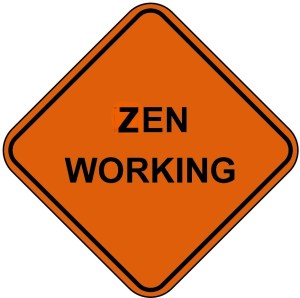
Like Zen, my mind works in strange ways, and this is how I too often see things.

How I often see or hear life around me.

I can imagine a Buddhist sutra in which two monks observe the sign. They’re walking, of course, rather than driving.

The first says something pithy asking how Zen, being nothing, can do anything, much less work.

And the second replies that work’s nothing, too. But it’s not lazy.

Better, I suppose, than “ZZZ Working,” which many assume while passing the usual sign and seeing the crew standing by idly.

If you like this, please clap with one hand.

Looking for more fiction revolving around yoga

My Yoga Bootcamp novel, and its earlier incarnation, Ashram, seem to sit in a rather slim niche on the bookshelf. There’s simply not a lot of fiction reflecting the experience. Devan Malore’s The Churning is among the exceptions.

Most of the books I’m finding are nonfiction, often dry doctrinaire texts from the perspective of a particular lineage. For that matter, relatively little is about the physical exercises, or hatha yoga.

With the fiction I have found, a handful books have yoga as central to the events, and each one is different. Not all of them head off to India, either. Some have a strong element of fantasy, while others are about living in the everyday world, often humorously. Well, and then there’s romance. I still think there’s more to be told, given the popularity of the practice.

For the particulars of what I’ve read, go to the reviews at my Jnana Hodson at Smashwords page.

Got any related books to recommend?

Finding another dimension of personal growth

In my novel What’s Left, one of Cassia’s big discoveries is how much her father had changed in the span from high school to his return to the college town a few years after his graduation.

Among the passages I cut from the final version is this:

No, I guess Baba takes it all in stride because of all the healing and growth that had happened within him since Nita introduced him to Tibetan practice.

~*~

Not everyone, of course, looks deeply into the people and the world around them. Some seem oblivious to the cosmic harmony or greater good that could be shared.

Too many, in fact, remain blatantly superficial, considering the threats now before human existence.

But I’m preaching. I’ll apologize.

There are other options, as I discovered when I took up yoga.

Who or what have you seen helping people you know change for the better? Is there any practice or teaching you’d recommend?

~*~

Cassia’s hometown may have looked something like this. Front of the store at 109-113 South College Avenue in downtown Bloomington, Indiana. Built in 1895, it is part of the Courthouse Square Historic District listed in the National Register of Historic Places. (Photo by Nyttend via Wikimedia Commons.)

~*~