THIS IS IT?

I’ve long been fond of collage as an art form. These Tendrils continue the stream.

~*~

  1. Ground Hog’s Day marks the end of solar winter, in contrast to the standard calendar’s use of the equinox on March 20. We have as much daylight now as we did around Halloween, back t the end of October. It’s another reason I view the year as eight seasons rather than four.
  2. I’ve previously posted about the ways observing Advent as the days leading up to Christmas Day – which then ushers in the Twelve Days of Christmas –greatly alters our way of experiencing the holidays. As a result, since we don’t put up our tree until Christmas Eve, we leave ours up much longer than our neighbors. Long after theirs have headed for the dump, ours is still casting magical light around our front parlor (the room we call the library) while the mass of tiny lighted bulbs outside the bay window are also still glowing. Deep winter’s much more tolerable this way.
  3. When the evergreen tree does go out of the house (meaning any day now), its place in the bay window is soon taken up by flats of seedlings we’ll transplant to the garden, likely in May. My task now is to retrieve the appropriate shelves and bars of lighting from the shed – out in the brittle cold. We always seem to be behind schedule there.
  4. How sad to see so many so-called conservatives turning barbarian, intent on destruction – pillaging civilization and culture.
  5. My last days at the office included erasing my tracks. A lot of stuffed folders went into the trash.
  6. I finally acknowledge my past lovers would have never made me a suitable spouse. How blessed I am now.
  7. Think of the books we keep returning to. Or simply journals. Which of them keep you on track?
  8. There’s a day, as the rabbi admits, for sex and delight, free from the usual intrusions. It’s called Sabbath. Seriously.
  9. Goose – all dark meat, a lot of good tasty fat – a spoonful is great for favoring other dishes while cooking.
  10. Someday has come.

~*~

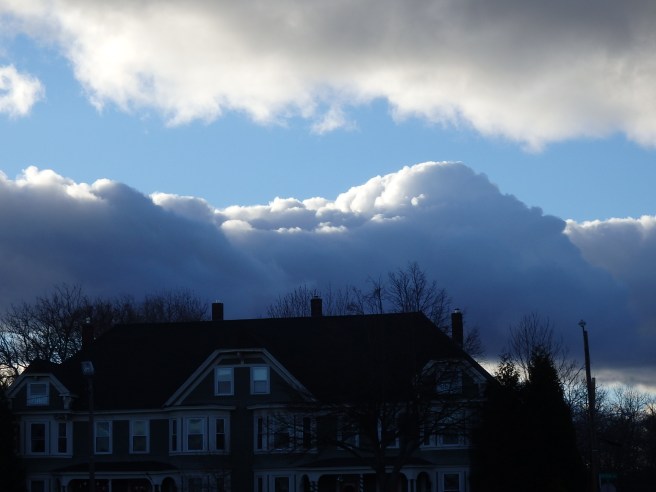
Afternoon winter sky over Dover.

YES, AQUARIUS

Why wait for the dust to settle? Here are 10 bullets from my end.

~*~

  1. Since we don’t put up a Yule tree and decorate it until Christmas Eve, ours stays on display longer than any of our neighbors’. The lights make January a less forbidding stretch. Make it more festive and relaxing. So what do you do special this otherwise cold, dark month?
  2. She’s really at home in a grocery store. Knows all the comparative prices, what’s a bargain, what’s special. Not so in other retail settings. Still, you should see our pantry. Or the two big freezers in the barn.
  3. Swami had long ago said I didn’t need a job (I’m an old soul) because that’s not the work I should be offering. That was long, long ago.
  4. How often does it seem: Fashion = Money … along with the race for something better?
  5. Would I be satisfied with a single-line poem that said everything? Stake my reputation on it?
  6. Considering all the hours I put in on my “personal writing” over the years – the poetry and fiction, especially, or genealogy and Quaker fare – it would have added up to a lot of overtime pay. Even at 10 hours a week, though I suspect with vacations and holidays thrown in, the average would have been closer to 20. I’d really have to land a bestseller to come anywhere close to recouping that investment.
  7. The frustration of my twilight years in journalism, seeing us increasingly pander to stupidity, ignorance, and hatred rather than trying to lead and enlighten.
  8. As the funeral director told me, “We hate holidays. Holidays suck.”
  9. Fortune cookie: You will make many changes before settling satisfactorily.
  10. Can this really be happening to America? Or the world?

~*~


Looks like white-painted architectural touches to me.
Still looks like white-painted architectural touches to me.


STARTING OUT BEHIND ONCE AGAIN

The mind dances here and there, rarely in a linear fashion. So what’s on my mind these days? How about counting on these fingers?

~*~

  1. This month’s annual perusal of seed catalogs leads to opening our shoeboxes of seeds themselves – counting and inspecting all the packets remaining from previous seasons. Makes for quite an impressive array, even if I’m not the principal gardener. Just listen to all that considered discussion and dreaming on the part of the actual planters, the mother and daughter and their friends.
  2. Even in retirement, I require a timetable – a to-do list – some sense of priorities and direction, in addition to routine. What does that say about me?
  3. From spam email: “Man Snake Enlargement.” Also, “Man Pole.” (Um, like a May Pole?) English terms pale by comparison.
  4. My Motets move in poetic processes that largely lack images. It’s a curious twist for me.
  5. At a holiday gathering with friends and family, one of the tots picks up my Peterson bird guide. Claudia intercepts it, opens it, and, as if it’s an illustrated children’s text, begins inventing a story. “This is Emily. And what’s this duck doing? It’s FLYING! And this one …” Anyone else think there’s another book waiting to take off there?
  6. Taking a few risks, looking at the proposal and rules. If I fail, it’s more on my own terms.
  7. Memory, as counterpoint and harmony for the present. Or maybe dissonance and discord.
  8. Still can’t take in the news.
  9. Parasite: a freeloader, usually fatal. Lives off the work of others. Seldom demonstrates gratitude or other qualities of good upbringing.
  10. What happens when we lose our sense of mission?

~*~

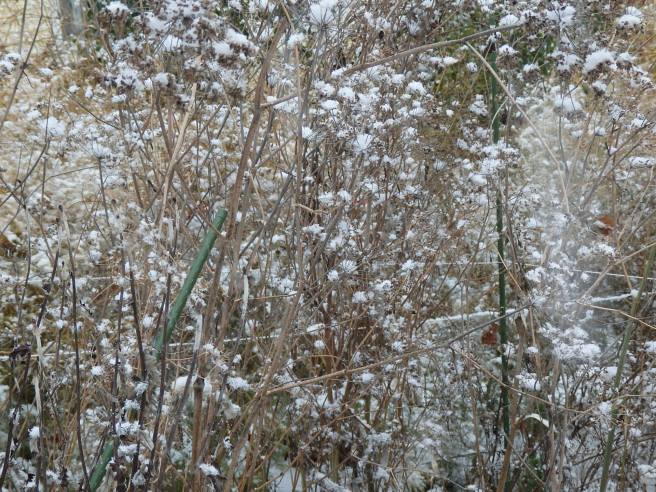
Fennel seeds dusted in snow.
Fennel seeds dusted in snow. Our herb garden at rest.


NEXT!

Caterpillar, one of the legendary periodicals in 20th century American poetry, set out with an intriguing premise – that three years was about all a literary journal could do before repeating itself or exhausting its commission. (Never mind that it went twice that.)

Somehow, Friends have found that for some offices, three-year terms work best; while they may be extended, six years becomes the upper limit. After that, the officer rotates into a new place of service.

The Red Barn’s been at it five years now – launching its four subsidiary blogs along the way. And for those of you who’ve been blogging much longer, you’ve truly earned my respect. It’s a lot of work, no doubt about it.

~*~

This past year, especially, has been intense as I’ve released some long pent-up emotions and thoughts about polity in action. (Remember, though, my degree was in political science, and I entered journalism with a sense of public service that was, in a psychically bruising degree, thwarted to the corporate profit sheet.)

So here we are, in face of the thugs who’ve been attacking our free speech and American values. However the election turned out.

And I’m still fired up, even if I’m looking at a more leisurely pace in the year ahead.

A RATHER CHECKERED CAREER

For someone who has engaged in a writing life his whole adulthood, I’ve had a rather checkered career as a reader. After a precocious outburst in the classics – Robinson Crusoe, Tom Sawyer and Huckleberry Finn in second- or third- or fourth-grade (not as class assignments, of course – who knows what we were reading there), I found myself largely oblivious to fiction. My attention turned to history and biography (the Landmark series, especially) and then science and politics. Non-fiction, with a sense of content. Fiction came later, in high school, curiously through political fiction – Brave New World, Lord of the Flies, 1984, rather than any of the traditional British canon. Throw a little Shakespeare in, and I was off – into journalism. (Let me mention that Huck Finn was much harder reading in my junior year of high school than it had been when I was younger; as a novice reader, I wasn’t tripped up by the strange spellings of dialect.)

In college, for whatever reason, I developed a passion for Samuel Johnson. Not for his moralizing as much as the sarcasm, I’d say, as well as a fascination with the baroque richness of his style. Maybe it was just the force of personality projecting from the writing. And then came Virginia Woolf, Kurt Vonnegut, Richard Brautigan, Jack Kerouac … the widening stream.

Surprisingly, a major turning point occurred in the span when I had the fewest opportunities to read – my years living in the ashram, a monastic community in the Pocono mountains of Pennsylvania. Out of the practice of meditation and reflection, however, I began to approach literature in a new way. The quietude opened poetry to me, both as a reader and a writer. The experience also introduced me to mythology, with the Hindu stories being more fantastic and meaningful than anything I had encountered in the Greek and Roman stream. Later, I was able to leap from this into the stories of the Bible as well, returning me to my previously unknown roots.

Others have written of being a promiscuous reader. I wouldn’t say I’m addicted to reading that way – at least, not any more. One of the ashram exercises, in fact, was a “reading fast,” meaning written words, rather than food. It’s all a matter of focus. That is, when I’m eating, I want to choose to concentrate on my food rather than a text. When I’m traveling, I want to see where I’m going. (Airport terminals, on the other hand, or stretches before takeoff, are another matter — they are among those place of limbo.) Later, when the newspaper first comes off the press, I found I could no longer focus on the stories – not after a shift of heavy editing. If anything, my head was so full of disjointed stimulation I needed to slow down to savor what I’d already encountered. For that matter, I prefer walking to jogging, with its restoration of a natural pace. I rush too many places and deliver on too many deadlines as it is. When I enter someone’s home for the first time, I must take care to pay attention to them more than the spines on their bookshelves. Now what were you saying?

I read, then, with greater focus these days. More selectively. I can no longer have classical music playing in the background. (It used to provide a barrier for noise from my family or neighbors.) Now, I immerse myself in what is before me. The text, then, as in scripture.

~*~

Out of all of this, my own work emerges. As a writer, I strive to create a linear progression. That is, the parts must advance is some sort of logic. Curiously, in my own work, I am often inspired by a Hegelian model – thesis, antithesis, synthesis – as drawn from cinema theory. On a wider scale, my earlier interests surface in new ways, resulting in something more akin to a matrix or spiral or collage than a straight line. I have been called a Mixmaster, with good reason. On top of it all, in my many moves about the continent, I’ve found myself exploring the soul of each place – something wine aficionados consider, in a smaller range, when they discuss terroir.
A CASE FOR NURTURING SERIOUS READERS

One of the challenges facing contemporary society is the shrinking percentage of active readers. (I say percentage, but fear what we face is more a shrinkage of actual numbers.) It’s not simply the decline in readers of fiction or the number of people who recite poetry from heart, but the lack of literary engagement of any kind. So I rat on myself early here, with my belief that the act of reading carries social value – especially when serious literature is the subject.

It is no mere coincidence that Americans’ widespread ignorance of history and our political system has accompanied the growing addiction to a sensual media orgy – large-screen television, movies, rock music – while habitual reading, including newspapers, has been declining. That is, what is superficial and easy – and ephemeral — has the upper hand. Little is demanded of the receptor, and loud excitement, rather than a deepened awareness, is the expectation; escapism, rather than engagement with life itself. Several European writers have suggested something more troubling is at work – the loss of reflective people, contemplative individuals – a theme I see developed, obliquely, in Stephen L. Carter’s Integrity and the labor of moral discernment. In other words, is the mind being enlarged or merely numbed? The fact that so many people cannot name their own senators or governors or are largely ignorant of geography, yet recognize countless actors and rockers points toward a disintegration of community and social service.

Paradoxically, the act of reading is largely a private enterprise. It’s a dialogue between a reader and a writer, sometimes separated by continents or centuries. It requires more activity from the receptor than a movie, short song, or television sit-com does – in fact, one of the concerns these days is the atrophied state of the imagination among those who have been raised on “electronic media” rather than the printed word or, for that matter, stories read aloud or in radio broadcasts. (There are, after all, degrees of imaginative challenge.) In the act of reading, there are no visible intermediaries – no actors, soundtrack, directors, sets, or costumes. The editor or printer or bookseller is of an entire order altogether. Here, the reader and the writer engage in a dance of the soul or a passionate argument. (Serious readers can be as demanding as lovers when it comes to this relationship.)

But the act of reading can also take us into the existence of another person, viewing the world from within that context. A movie, in contrast, leaves us looking at that person, hoping for a hint of emotion or profundity. The author can reflect on the situation, suggest ranges of experience, voice moral struggles in ways a movie might only touch in passing.

Here I think, too, of large-scale musical compositions – symphonies or string quartets, for instance – that demand intense listening, inducing reflection and emotional awareness. Like reading, the audience for serious music is in decline – and with it, a link to the riches of the past and its aspirations and wisdom.

WHEN OUR LIVES OVERLAP

I never intended for my blogging to take the place of personal journaling.

What I’m posting is, after all, far more public, drawing on a deep archive of writing on all fronts now augmented by current happenings in my life and the world around us. What’s emerged is a kind of collage roughly defining the boundaries of my life and thought. I was about to say “normal” life and thought, but not everyone would agree.

Over the past few years, the blog’s also evolved into a showcase for my literary writing, even during a politically overcharged year like the one we’ve just encountered. Remember, I live in the Granite State, which remains a political bellwether as well as the home for many well-known writers. After all the years of having to keep quiet about these concerns, it’s been a relief to be able to air my feelings.

That said, let me admit I’m never quite sure what will turn up here. Maybe that’s why your likes and comments, especially, are so welcome. It’s nice to know when our hopes and dreams and experiences overlap or when there are alternatives to what I’m thinking or even presuming.

Now, back to work …

FINE PRINT CRITICISM

You know that reaction after reading a page that leaves you with a sensation of missing something. A treatise about poetry or art or theology, especially?

If you’re like me and largely autodidactic, you no doubt feel yourself an outsider. So I write from the fringe, in more ways than one. Reading some reviews and critiques, I soon wonder: Am I simply inattentive? Clueless? Ignorant? Is it that such subtlety, speaking only to the highly initiated, will never accept my own efforts? Or is it that I prefer what is simple, direct, grounded in experience and place, over what is convoluted and cloaked – even in form? Without falling into cliche or triteness?

Or am I the one, despite myself, who becomes convoluted and cloaked? How do we reach higher, anyway, in this thing called art, while striving to stay true … to whatever?

How does originality run through it all? And life?

By the way, just who are the critics writing for? Even when we ourselves turn critic.

SOMETIMES I WONDER IF PANDORA WAS A NOVELIST

Maybe it was a mistake earlier this year to reopen the draft of my latest novel, which I’d put aside in July 2015 to season. But I did. (And then, once opened, something like this can become impossible to close tight again – at least until it’s done for now, whenever it decides.)

For the most part, I’m very happy with what I found – nothing embarrassed me, and some sections struck me as quite exciting, especially when I kept asking myself, “Who wrote this!”

Still, it’s been a very slow process for what was supposed to be a read-through, mostly for continuity and consistency. Admittedly, it’s a big book – about twice the length of a typical novel, or 35,000 words more than my longest one yet published. The challenge has been in finding the blocks of time to tackle each of the 16 chapters, and moving along while I have all of the characters floating around in my head. (That alone can turn an author into a rather distant person within a household, even in the middle of conversations.)

I’d made one decision to shift as many of the verb tenses as I could to more accurately reflect the way many people speak when relating events, but determining which verb to change and which one to leave alone – even in a single sentence – could be slow hoeing. (Or is that slow rowing? Another detail to check out later. Even slow going? Yipes, it gets endless.) We’ll see how successfully the verb strategy works.

And then there were the additional details to better explain the action. Instead of big cuts, which I’d anticipated as a normal part of the process at this stage, I found a need to say more. In one chapter, I found that adding no more than two pages actually makes the section move along faster and feel shorter. Anyone else have that experience?

On top of that, as I’ve found in previous manuscripts, certain words repeat through the story and no matter how crucial their underlying meaning to the emerging theme, they simply start sounding like sour notes. In this case, independent, business, gather, vague, vision, even fit topped the demand for thesaurus treatment. Each synonym then amplifies the message and infuses a wider understanding. Still, that step’s tedious.

At the moment, I’m lifted by elation and can breathe that big sigh of relief. It’s done, for now. I’ve shipped off copies to my two harshest in-house critics and can return to other projects before those two fire back with their caustic reactions, brilliant suggestions, essential additions, more essential deletions, smarty quips for my free use, or whatever.

And when that input has gone into the manuscript, I can send it off to a round of beta readers. The ones I’m hoping will be kinder.

There’s no denying my elation, even knowing how much remains to be done before going public.

AS THE WRITING ON THE WALL SAYS, LOOKING FOR FUN?

In a recent dream, a former colleague was chastising me for not having fun in my free time.

“But I write!”

“No,” he snapped, “that’s work!”

Well, I do swim laps, but I wouldn’t call that fun. It’s more of a release, I suppose, or healthy routine, back and forth, back and forth, looking at the lifeguard, other swimmers, the water, the clock.

The dream somehow overlooked choir, which is fun, no matter how demanding or even exhausting our rehearsals and performances can be. And then there’s folk dancing, especially as New England contras and Greek lines. And, yes, I do like to hike and hope to get back to camping. As for gardening? Well, my wife says I do seem to have fun with composting. Ahem. And then there are the martinis and wine. Add to the list hosting company for a party or dinner as well as visiting others. Travel with my wife or among Friends has its pleasures, too, and I somehow seem to focus on active fun rather than a passive variety like kicking back with a movie, listening intently to music, reading a book, or roaming through art galleries. Oh, yes, taking the train anywhere is fun, and the station’s only nine blocks from my house. Let’s add playing with a digital camera to the list, too. As for blogging? Curious what the dream overlooked!

Well, what I do remember is that at the end, my colleague wound up agreeing that writing could also be fun. Sometimes.