WHEN THE DAUGHTER TAKES OVER

When I wrote the four novels that formed my Hippie Trails series, Cassia was nowhere in sight.

But now that she’s taken center stage in What’s Left, she’s changed my perspective on those earlier novels. Quite simply, I’ve revised them to bring them more into line with her story. Drastically revised them, in fact – deep cuts, offset by new material.

Quite simply, they’re now her discovery of her father and his era rather than mine. Having a character take over a book is rather eerie, actually, especially when she’s livelier and more interesting and more critical than I’d be. Moreover, she wasn’t even present in those earlier works – they’re all before her birth. Before she was even conceived, as it were.

That hasn’t stopped her from pushing for more extensive revisions than I had anticipated. Not only are the novels all retitled – and two are even compressed into one – but many of the characters are renamed, a few new figures are introduced, and hefty cuts are offset by rich new detail and restructured storylines.

So what we have now is Daffodil Uprising, Pit-a-Pat High Jinks, and Subway Visions. And the series they form with What’s Left is no longer Hippie Trails but Freakin’ Free Spirits.

Well, quite simply, my wife hates the word “hippie,” says too often these days it translates as “loser” or “lame,” and I wanted something that might fit bohemians over time … in this case from Cassia’s Greek great-grandparents right down to today.

By the way, I’m still blaming Cassia for my putting so much else aside in the past five months. She just wouldn’t shut up, and she can be quite bossy. Admittedly, though, I’m much happier with the novels as they’ve evolved and finally emerged. Let’s hope she is, too.

As for you and other readers? That’s the real question.


TWO TWEAKS IN THE DESIGN

As I moved from the Advance Reading Copy to the First Edition of my new novel, I decided to make two tweaks in the cover design.

The photo itself remains unchanged. It’s the typeface that altered.

When I lined the original cover up beside the covers for the related books in the cycle of Cassia’s discoveries, I realized it’s serif typeface was out of step with the sans serif on the other three volumes. As much as I love serifs (they have more character, for one thing), I also saw that a sans would have more punch on the thumbnail size used to display most ebooks. OK, so that changed.

Again, as I considered the four books together, I saw something else happening. The next book in line, Daffodil Uprising, features a prominent daffodil bloom in a bright yellow antique-style drawing. The contrast between its artwork and the photo on What’s Left works, I think, but the white title somehow felt out of step.

That’s when the thought flashed, “You idiot! It has to be yellow! Like the yolk! Like the daffodil, too!”

Here’s the progression. First, the ARC:

What’s Left

Then the sans serif:

And finally color:

What’s Left

So here you have it. Any reactions?


AND NOW FOR THE FIRST EDITION

The cardio incident in January threw off my planned marketing campaign to support the Advanced Reading Copy availability of my new novel, What’s Left, but maybe that’s a good thing.

Instead, “laying low” meant I had time to read all of the frothy Richard Avedon bio I’d been given at Christmas, and that had me rethinking the particulars of the life of a photographer. Remember, in the novel, Cassia’s father is a famed photographer, though nothing like Dick. The negatives and glossy prints her Baba leaves behind establish the foundation for much of her own recovery and growth.

At the time, I was already planning to revise the four novels that form the backstory to What’s Left – my Hippie Trails series – but had no intention of becoming as immersed in that project as I did. Well, it’s one of the big reasons I’ve been AWOL or missing in action the past five months. I’ll leave that for an upcoming post.

One critical reaction to the new novel, however, sent me back through the story to make some crucial changes.

The Advance Reading Copy used no quotation marks. Not one. Since the story is being told by Cassia, who’s to say she’s quoting others exactly or is instead paraphrasing what she remembers hearing them say? That is, filtering them into her own voice? The quotation-mark-free approach, I hoped, would present the tale as her own rich interior experience, but it was unconventional and apparently a challenge for some readers to follow. Since engaging everyone in this story is far more important to me than my personal pursuit of a literary technique, I yielded in preparing the first edition. Yes, I have to admit, judiciously adding quotation marks here and there does clarify the flow.

The revision also had me simplifying much of the grammar and syntax. As much as I love long, complex sentences, not everyone is comfortable reading, say 17th century literature. Besides, this novel is being told by Cassia, not me.

Well, this official version, the first edition, is now available. I think the tweaks make a huge difference, and I’m grateful for those who’ve given me feedback.

Hope you enjoy it.

COUSINS WHO COUNT

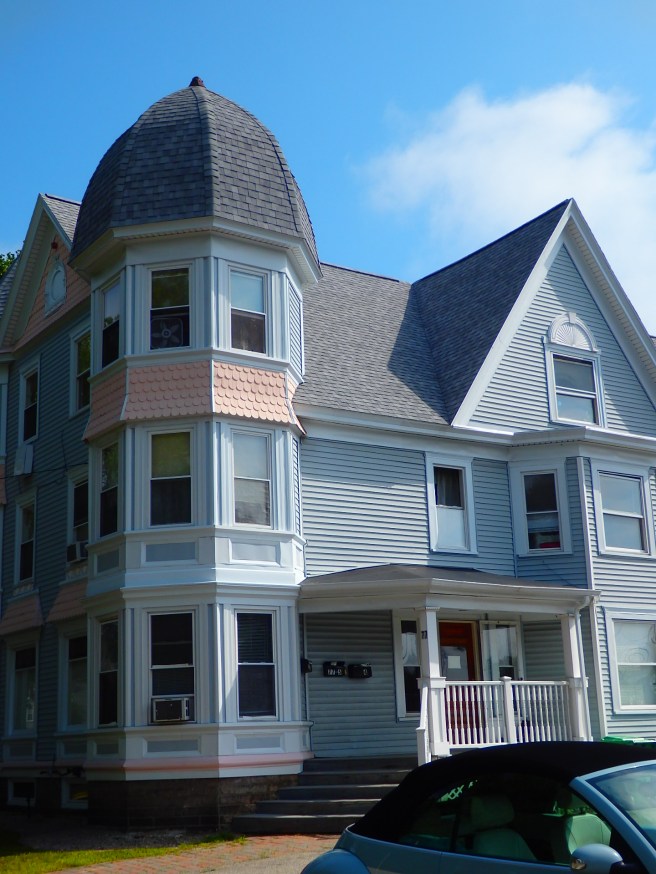
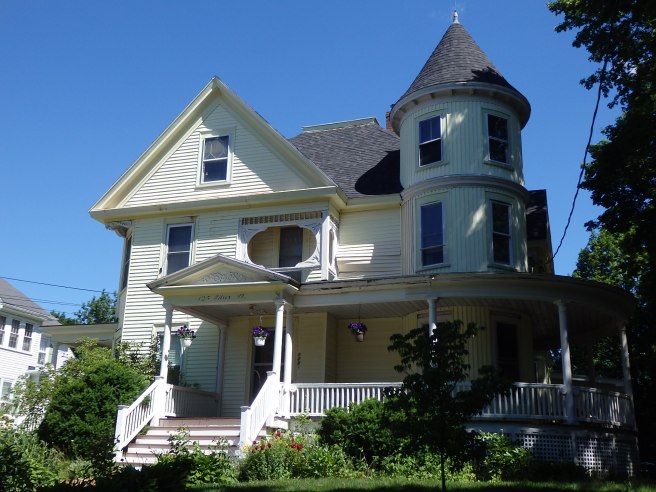
A large Queen Anne-style house with a distinctive witch’s hat tower something like this is the headquarters for Cassia’s extended family in my new novel, What’s Left. If only this one were pink, like hers.

Could I have directed my new novel, What’s Left, to move straight from her loss at age 11 into her subsequent growth within her close-knit circle of cousins?

Since so much of their group identity depends on the family restaurant where they all work at some point in their youth and the big Victorian house where they gather and many of them still live, this would nevertheless require some hints of the history of their being where they are – and who they are – pretty close to the top of the story anyway, plus far more detail about the cousins and their parents than I now need to engage in the opening chapters.

As a writer, I’m left wondering how I’d ever introduce all of this at once and still have you readers following the narrative. A related challenge would be any attempt to work our way back through the family history, like an archaeologist, layer by layer, rather than jumping down to the trunk of her family in the New World and moving upward from there. There are many sound reasons for presenting a history chronologically, after all. Especially when past events help us more clearly understand where we are and who we are now.

~*~

Well, you can check out the book as it stands.

The story, of course, turns toward the crucial decisions they’ll face. Will Cassia and her cousins ever live up to their family’s resourceful and romantic roots? Will they be able to take their legacy to greater heights?

What would you do in their place, given their resources? Stay and work in the restaurant and real estate? Start something of your own while living close at hand? Or head off for careers and family elsewhere?

CHARACTER OR ACTION DRIVEN?

A large Queen Anne-style house with a distinctive witch’s hat tower something like this is the headquarters for Cassia’s extended family in my new novel, What’s Left. If only this one were pink, like hers.

A common question for novelists asks whether their book is driven primarily by the development of its characters or by the actions of its plot. It’s not one that had been front-and-center for me until my newest work began taking shape. For one thing, my previous fiction all falls under the category of Experimental, and, for another, I’ve usually been of a contrarian nature. Maybe the earlier stories were more event or episode driven than action propelled, and characters added whatever they had. As I’ll say, up till now. Or, as I might add, a journalist is more concerned about what’s happened than the motivations of the individuals involved.

My new novel, What’s Left, was initially envisioned as a kind of post-hippie history – an update flowing from the ending of my first published novel, in fact. But then it began turning into a different kind of history, going back further to her immigrant great-grandparents. Well, at that point the story could develop either way, based on the characters or their encounters. What clarified the direction for me was my decision to have her father vanish in an avalanche halfway around the globe, which precipitates her obsession to know just who he really was. And that made it character-driven.

As she discovered more about her father – and her colorful, extended family – I realized I wanted to know more about Cassia herself, starting with her reactions to the clues she was uncovering.  In the end, What’s Left is about her, told in her voice from age 11 into her early 30s. As for the history? It’s bound to be in her blood.

Continue reading “CHARACTER OR ACTION DRIVEN?”

WHEN THE STORY GOES WHERE IT WANTS

Carmichael’s, the restaurant her family owns in my new novel, has me looking more closely at others.

Over recent years, I’ve been especially fascinated by the hippie outbreak and its legacy. We had a taste of what society could be and let it slip away, or so the story goes. In reality, nobody ever fit the hippie stereotype, and while the impression is that the movement died out, so many of its concerns continue – from environmental awareness and sustainable economics to racial and sexual equality to social justice activism to Asian and Native spiritual traditions to back-to-the-earth and natural living and so on. It’s a long list, actually.

Continue reading “WHEN THE STORY GOES WHERE IT WANTS”

PLAYING WITH FIRST NAMES

Carmichael’s, the restaurant her family owns in my new novel, has me looking more closely at others.

Long before I ever anticipated what’s evolved into my newest novel, What’s Left, I ended my first published novel with a young woman named Diana, in part because I liked the two puns it allowed. Her husband-to-be, a student of Tibetan Buddhism, had returned to Indiana – and now he could boast of a love that allowed him to be in Diana as well as in Dhyana, or deep meditation.

Not that you have to understand Sanskrit to read it. Shouldn’t the mere hint of something exotic should suffice?

Continue reading “PLAYING WITH FIRST NAMES”

MY LIFE AS A ROGUE, AS IT WERE

Being born in Aquarius, maybe it’s all too natural:

  1. Rogue scout troop (with all of our hiking, backpacking, and primitive camping – plus all the scoutmaster’s strictness).
  2. Rogue education, a patchwork of political science, literature, economics, sides of philosophy while aiming for the field of daily journalism.
  3. Rogue hippie.
  4. Rogue lover.
  5. Rogue ashram, with its decision to quit the world I’d known up till then.
  6. Rogue worship (this alternative Christianity).
  7. Rogue Quaker, too?
  8. Rogue career, mostly in out-of-the-way settings before abandoning the executive ladder to return to the ranks and a real life.
  9. Rogue poet, rogue novelist.
  10. Rogue blogger.

Maybe it makes sense.

~*~

Just how don’t you fit into expectations?

In open water on the Piscataqua River, Newington, New Hampshire.

Not that this fits into the theme, it’s just one more thing on my mind.

DO THEY HAVE TO BE SYMPATHETIC CHARACTERS?

Carmichael’s, the restaurant her family owns in my new novel, has me looking more closely at others.

One of the conundrums I’m left with in my new novel, What’s Left: What if you don’t like her father, her deceased Baba, as she recovers him? (Or recovers from him.) Is it essential to your enjoyment of the story?

Or worse yet, what if you don’t like her?

Continue reading “DO THEY HAVE TO BE SYMPATHETIC CHARACTERS?”

SHIFTING GEARS ON HIGHWAY ‘18

You no doubt noticed a new look at my suite of blogs here at WordPress during the past year. In midsummer I converted to four quite different templates – or what WordPress calls themes – each one a sharp new presentation for the unique material of the blogs. The process also prompted a redefinition of their separate identities.

Much of my literary attention last year focused on my newest novel, which underwent two major revisions and a cleanup reading – along with a new title. You’ll hear a lot more about it through the coming year. In fact, the Red Barn will be engaged in conversations about the many themes running through the big book. Look for the new Cassia’s World category.

Doing that has me anticipating fewer postings here – typically three a week, rather than seven to 10. To be frank, there were weeks when I felt things were getting way too hectic. Sometimes less really is more.

One other refinement: My Tendrils category will be getting more playful. I hope you like it – more way than one.

On the other sites, Chicken Farmer, I Still Love You is settling more fully into its inland New England character. More photos, mostly of historic brick mills, will accompany the serialization of my Big Inca novel, before giving way later in the year to poetry that fits the region.

As Light Is Sown steps up its pace to two postings a week, mostly short entries drawn from my books Religion Turned Upside Down and Stillwater. Consider it provocative inspiration. I hope.

While I’m not anticipating any further big genealogical reports at Orphan George, I am looking forward to excerpting from helpful correspondents over the years as one way of acknowledging their generous assistance. Maybe I’ll throw in some more family photos, too. We’ll see.

Finally, my Thistle/Flinch imprint will explore fresh typographical concepts in six of the new releases – venturing somewhere between broadsides and chapbooks, I expect. This new lineup of free offerings is all poetry.

~*~

What are you looking forward to in the new year?


Here’s the latest at THISTLE/FLINCH.