I had already made this point elsewhere in my novel What’s Left, so this sentence was trimmed out of the final version:
Theos Graham joins Theos Barney and Thea Pia in feeding the homeless at Carmichael’s back door or the soup kitchen at the Lutheran church or even letting them sleep in our bus, once we have one.
I do miss the mention of the Lutheran church or the bus, by the way, but they just didn’t fit what was left.
~*~
Yes, we all have found ourselves proclaiming, “I’m starving!” Not that many of us have suffered so much as starvation itself.
Have you ever gone truly hungry? Have you ever wound up accepting handouts from strangers? Have you ever fasted? What’s the longest you’ve gone without food?
~*~
In the family, Cassia would have had food like this.
In early drafts of my novel What’s Left, I considered going into detail on her uncle Dimitri’s practice of micro-lending and startup investing. Here at home we discussed including a whole list of failures and successes — or reasons applications were approved or rejected. Just think of all the once bright options that soon failed, as well as the ones that have since gone mainstream.
One proposal that didn’t survive my second-thoughts was this:
Thus, when friends decide to launch a local winery, we support them.
At the time I first noted this, 45 or so years ago, a local winery would have been cutting edge. Now there seem to be wineries everywhere, and their output can be widely uneven and often overpriced.
~*~
My experience as a home brewer, making more than 2,500 bottles of beer, was fascinating. We relied on kits from a local aficionado and never had a bum batch. But we still haven’t tried making our own wine.
Gardening, of course, is another matter. As is composting.
Do you raise any of your own food? Make your own bread or yogurt? How about jams or jellies or artisanal vinegars? Any other hands-on touches?
~*~
Cassia’s family transforms an off-campus neighborhood into something like this, one they call Mount Olympus.
Let me express my own everlasting gratitude for Glenn Thompson and his eye for talent, in my case after my letter to the editor and then his offer of an internship, later followed by a full summer. In a seemingly casual interview, he urged me to keep a personal journal, which I actually have. And then came the job offer. Without him (and so many others), my life would have taken a different direction. Gee, indirectly he even led to my first lover. (Look for Mitch in Daffodil Uprising, who’d been a copy boy I met thanks to Glenn’s support. Mitch was the catalyst to the crucial introduction. That dimension, in itself, could be a novel.)
Glenn was the editor-in-chief of the morning newspaper in Dayton, Ohio, and in his own way, a visionary. Behind the scenes, he even brought together the first university I attended, Wright State. And also, through him, I became a professional journalist, even while still in college. Another long story.
The paperback cover …
And he asked questions no one had prodded me with before. How would I change the world? What issues could I raise and address? At first, I was speechless. We were so green, and within a year, everything would look different. The biggest item on the agenda was the Establishment, not even its war in ‘Nam. Civil rights issues were a distant second.
The next summer I was a hundred miles up the road from Woodstock, working for a publisher who totally ignored me and editors who kept their heads down. But a new direction was taking shape for me.
Alas, as I’m also seeing, mine are steps youth today cannot follow. The pathways simply no longer exist, to the larger society’s impoverishment.
As I describe in my novel Hometown News, American journalism has long been based on a precarious business model. News itself is a byproduct of trying to attract customers for advertisers, and many publishers considered news gathering mostly as a costly nuisance. Successful newspapers were defined mostly by their obscene profits, and the pay levels for reporters and editors were often at the bottom of pay scales for professionals. As a priest reminded me before my first marriage, we might as well have been bound by vows of poverty. Oh, yes, and some of the highest quality papers – the kind I aspired to – were fighting for their very survival. We can now add to the toll of the role of the Internet.
So it’s all in flux now.
… and the back cover.
Still, newspapers show up in the majority of my novels, though in Nearly Canaan the field turned from journalism into non-profit organizations where the long, odd hours, public service, and stress nevertheless remained.
As I look back on my own years of being on the management track in a shrinking business, I see how I started out a hot-shot who thought the New York Herald Tribune in its last years was the best newspaper ever – led by an editor who later admitted in a letter to me he seemed to have become a specialist in trying to recover dying papers. Even then, I would have loved to have worked for him.
Despite my own honors, I had some crucial near misses. For one, I wound up in the final 24 for a dozen summer internships at the Washington Post but failed to make the final cut. The next summer, the Wall Street Journal was laying off staff rather than hiring, so their interest evaporated. Ten years later, something similar happened with timing for a high-level spot at the Detroit Free Press. And so my career veered away from the big cities where I had dreamed of living and from the big time, maybe for the best for me personally and ultimately professionally.
Somehow, this also has me thinking back to the lost hippie wannabes at the corner of Third and Main in Dayton during the summer of ’68. Theirs was a story I had hoped to write, but I couldn’t ask the right questions, I was too green myself. But, more honestly, maybe I just wasn’t cold-hearted enough to cut through to the real hurt and relate it without concern for the consequences.
While walking down the street after finishing a revision of my novel What’s Left, I noticed a vanity license plate with five letters, PAPOU. I smiled, recognizing the Greek for “grandpa.” The car was parked in front of the Orthodox church. Wonder if I know him.
Do you have a similar affectionate term for your grandparents?
Think of the names of bands and singers having a food tag. (Will Red Hot Chili Peppers or Smashing Pumpkins get your thoughts bubbling?)
Throughout my novel What’s Left, her uncle Barney has rock playing prominently in the restaurant kitchen. Does this provide a good counterpoint to his thoughts and actions? Do you find it amusing? Annoying? Confusing?
Who would you like to add to the food-themed playlist?
~*~
The old church Cassia’s family buys in my novel might have looked like this … before the wild rock concerts begin.
While my novel What’s Left picks up a generation after the final events in my Subway Visions tale, I found myself needing a better understanding of the five siblings’ roots. That meant going back not just one generation but two in this case.
Have you ever done genealogy or looked into your family’s history? Are there stories you feel would make for good fiction? How about the characters, too?
~*~
Here’s how her ancestry might have looked back in the Old World.
Growing up in a financially secure family like the one in my novel What’s Left could open your educational and career options, I suppose. For Cassia’s mother, I saw events unfolding along these lines — which I then cut from later revisions of the story:
Manoula, on the other hand, possessed some of her sister’s ability to ask those questions, however gently. And she had some of her brother Dimitri’s practical streak. But she also had an underlying spiritual awareness and a sharp intelligence to match. It’s a potent combination — even intimidating to many potential suitors.
Crucially, both Manoula and Baba knew the vitality of artistic practice and expression. Remember, he was more than a photographer — he may have worked on a daily newspaper, but he profoundly appreciated all the fine arts. On top of that, he had a natural ability in writing that had yet to be encouraged and released.
On her part, Manoula loved literature, in particular, and practiced hours a day on her violin. Realizing early on how difficult it is to earn a living in either endeavor, she followed Dimitri’s advice to pursue a double major — English and music — with a minor in business to fall back on. As she told people, she was open to a career in arts management, and in a way, with the publishing, she’s held to it. She spent five years on her bachelor’s degree — including summer courses — but she was in no race to get out into the world, not once my Baba crossed her path. They were both taking a long-range view ahead.
In a way, you could say she was a Yiayia Dida while Nita was a Yiayia Athina in new guise. Oh, I don’t know — maybe it was the other way around. They were all strong, emancipated women with a bohemian streak. Not all bohemians, I should add, are strong — not by a long shot.
~*~
In early versions of the novel, when Cassia was piecing together her family history from the perch of a teen or 20-something, she might have seen events something along these lines. But in the later revisions, told as she’s seeing them as a teen, this passage was just too much. Way too much. Besides, through much of high school time, she was a lackadaisical student more interested in managing a live music scene.
Looking at her ancestors, though, I doubt that her great-grandmothers had more than a rudimentary education. Her grandmother, Bella, came to town for a college degree but was thwarted in her plans. Cassia’s mother, her Manoula, raised the educational bar.
Fortunately, Cassia’s aunt Nita provides crucial encouragement that leads to college in time.
So what is essential in releasing talent or dreams you have? What kind of advice have you received regarding continuing education and career? How have your plans taken shape? What’s been especially helpful?
~*~
They know how to work together. In my novel, a family like this takes their skills far beyond the kitchen. The most important thing that’s happening has nothing to do with the dishes.
I wish there were a better label than “hippie” to apply to the counterculture explosion that swept the world in the late ’60s and early ’70s. Contrary to popular assumptions, there was no standard-issue hippie, male or female. Not everyone did pot or ventured into acid and beyond, nor did everyone participate in a protest march or have long hair or have sex every night or at least on the weekend. We all came in various degrees of separation from general society yet, somehow, we also recognized a kinship with each other.
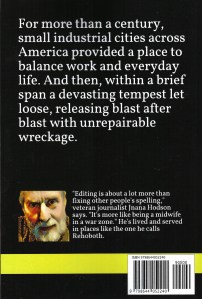
The paperback cover …
“Are you sure you were a hippie,” my wife sometimes asks. So what if I didn’t like rock? Many of my friends had been at Woodstock just down the highway from the milieu I describe in Pit-a-Pat High Jinks. No, we didn’t recite a credo, you dig what I mean?
The only other flash in history I can see similar to this was the mid-1600s in England, with its World Turned Upside Down before the restoration of the monarchy – stresses that would fester until the American Revolution a century later. What we shared was a vision of a more just, equal, and caring society. We didn’t have standard-issue, card-carrying members. Alas, we didn’t have elders or cohesive discipline, either. And the breakdown that followed can’t be blamed entirely on a youth movement crossing over into the dreaded age 30. (Oh, how I’d love to be back there, if only I wouldn’t have to figure out how to survive in the current economy.)
Tom Wolfe, author of “The Electric Kool-Aid Acid Test,” pointedly asked why there wasn’t the big hippie novel, overlooking a few notable entries like Gurney Norman’s “Divine Right’s Trip.” The problem, as I see it, is that the scope of the events was too big and too fuzzy to be encapsulated in a single volume. You had the activist side, from civil rights and draft resistance to pacifism, feminism, and the environment, for starters. Add to that sexual revolution. And then drug use, abuse, and visions, as well as new spiritual teachings and practices. All before we even get to the music and its scene. How could you possibly wrap all of that, plus more, into a single volume?
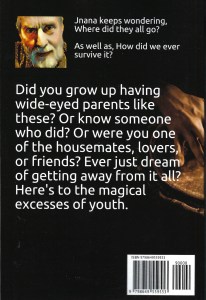
… and the back cover.
Believe me, I’ve tried with my own Daffodil Uprising and its companion “Pit-a-Pat High Jinks.” Hate to admit there’s so much more that could be added to the, uh, pot. Make that “pan.”
By the way, I think there are worthy nominations in each of the subcategories I’ve just mentioned. I’d love to hear more.
Frankly, I think we, as a nation, have been in a state of denial about the era, with its tension between the war in ‘Nam and the Establishment supporting it, on one side, and the opposition on multiple grounds, on the other. Those rifts in the soul of the nation have never been adequately examined and addressed from either side, much less healed. We could start with the MIA-POW myth, for one, or the ways we might have failed to answer our kids’ questions about pot use, for another. They are definitely exploding in our face now.
Meanwhile, Cassia, in What’s Left, has come along to try to make her own way out of the debris.
And so I humbly or brashly offer my own novels for discussion.




 Jnana's Red Barn