A thought while assembling Tendrils

Once upon a time, meaning not all that long ago, trying to track down ten more or less related facts impinging upon a particular topic would have required a very tedious amount of time in a library. Or may some more remote back office or agency, wherever.

Instead, thanks to the Internet, the list can be cobbled together within a few hours on a laptop.

It can seem like cheating or at least borderline plagiarism.

No guaranties on accuracy, either.

Look for the witness in the work, too

Cinema critic Roger Ebert was talking of the importance of the witness in every movie and pointing to the places where the character appeared in the film under discussion, mostly in a lower corner. The comment flashed me to the reality of how often the hardest thing to see is what should be the most obvious. It’s not just the elephant in the room, but also smaller things we take for granted.

One way or another, all fiction is built on the observer, who is also to some degree an outsider or misfit, too. (If there are any exceptions, I’d love to hear them.) Four of my novels, for instance, were intuitively built around a photographer, a profession that makes Cassia’s father a well-trained witness. In turn, as she investigates his archives, she, too, becomes a witness, even before she starts commenting on his earlier life.

Of course, as a reader, you also become a witness. Or even a voyeur, as Camille Paglia has contended. It’s almost like every page is a microscope slide to be interpreted.

Curiously, I now see this also at play in a long-term non-fiction project in my life. Forty 40 years ago, seemingly by accident, I became involved in trying to uncover my father’s ancestry. I thought we were simply homogenous Midwesterners who had always been in Ohio from its beginning. What I discovered, though, was that one branch was – but German-speaking and largely akin to Amish. My name-line, however, was Quaker by way of North Carolina and its slaveholding culture. Both strands were outsiders to the larger society and also pacifist. It opened my eyes to alternative histories and to a recognition that stories don’t always have to resolve nicely – three people may record their memories quite differently, and maybe all three are true, if not factually accurate.

Oh yes, the research was often collaborative, with correspondence going and coming from others working on parts of the puzzle. It wasn’t always quite as lonely as drafting fiction or poetry.

To my surprise, as my novel What’s Left was taking shape, Cassia started assembling bits about her Greek-American grandparents, who had died before her birth, and then beyond to her great-grandparents, who brought the family to the New World. Like me, she found valuable clues in the surviving snapshots and formal portraits regarding their personalities, as she also did in the letters and other documents.

None of my ancestors came by way of Ellis Island, and on Dad’s side they were all in this country by the time of the Revolutionary War. I once pondered doing a series of novels on them, but I’m still intimidated by the technical challenges – a realistic language they can speak and we can understand being high among them.

Witness, I might add, has an extra dimension in Quaker thinking. It’s not just what one sees or hears but how one lives. The goal is integrity, as in wholeness or consistency. Is that what others see in us or our lives and work? Or even as our goal and ideal, even when we fall short reaching for it?

And, as a final twist, I’m realizing that the Indigenous perspective of looking back seven generations when making decisions for the future would take me back to the birth of Orphan George in 1701.

I do find that mindboggling.

~*~

You can find my genealogical gleanings on my Orphan George blog.

The novels, meanwhile, are available in the digital platform of your choice at Smashwords, the Apple Store, Barnes & Noble’s Nook, Scribd, Sony’s Kobo, and other fine ebook retailers. They’re also available in paper and Kindle at Amazon, or you can ask your local library to obtain them.

The role rides on conflicted feelings

As I continue to reflect on the writing life as I’ve known it, I’ve been collecting loose ends and wrapping them up. As I writer, I feel I’ve gained much with age, countered by so much that’s been lost.

I do wonder about how the parallel works for people whose best moments have been in their youth – professional athletes or dancers, for instance – but most novels do seem to be rooted by events and experiences of people under 30 or so. We can argue the same for movies, and then salute the efforts to look beyond that.

Sitting down to compose a novel requires some bravado, an assumption or presumption, even outright arrogance, that you have something important to say and an ability to do it in an interesting way.

You know, balls, swagger, mojo. Go to a writers’ group and just listen. But it’s not all sheer ego-driven. For many, at least, there’s an ongoing tension between believing in our own talents and shielding ourselves from the nagging self-doubts. Even Stephen King has them. Remember, the practice of the craft is a solitary act, not a team sport. It gets lonely, especially in the absence of feedback or fans in the stands, whether they’re cheering or jeering. Sometimes, to your surprise, harsh criticism is easier to handle than any praise.

Unless you’ve been there, you have no idea how important a voiced reaction can be in nurturing you. Those brief reviews and star ratings are important, not just for guiding others to certain books but for guiding you as an author in your practice. An astute reader picks up important elements that have slipped right over their creator’s consciousness. Please, please, please take a few moments to weigh in when you finish a volume. We all need confirmation that we’re not wasting our time – or yours. Best of all is the epiphany when we’re left feeling that someone finally “gets it,” actually understands what we’re about. Don’t be shy.

I recall giving a friend a booklet I’d written about the Quaker metaphor of Light. (By the way, in the first two centuries of the Society of Friends, the term was always Inward Light or some variant, never the Inner Light expressed today. It’s a crucial distinction.) When he finished, he thanked me, said the text had cleared up his understanding, and then added, “You write very well.” Even after four decades in the words-on-paper business, I was taken aback, considering that he is, by any measure, an important American literary figure and a master of the language. It was like “welcome to the club,” the exclusive one with the dark paneling and Manhattan address. It was like a cup of fresh water in a desert. Within myself, I felt freed from the “hack writer” label so often applied to journalists from Dr. Samuel Johnson on.

Later, in an aside, he told me I was more of a poet than a novelist. Knowing his fondness for poetry, I took some comfort in the perspective, as well as some umbrage about the fiction part. On reflection, I now have to agree on his assessment, at least as my novels stood then. He certainly helped my character Cassia press her case for the reworking of all my existing novels, as I did in the aftermath of What’s Left, where she’s the star. The revisions in that book really took off once she started dictating to me.

There’s also that frightening moment in the gap between when a book’s been accepted for publication and when it actually comes out. We’re afraid someone’s going to somehow uncover our darkest secrets or that we’ll be shamed by some indiscretion or that we’re about to make an unforgiveable transgression or that we’ll be sued for everything we have and more. Again, go to a writers’ group and listen or even ask. If you’re an author, you think you’re somehow bonkers when you feel this, not knowing how much company you actually have.

As I’ve previously confessed, I’m of the camp that hews to Bukowski’s regime of daily “butt time” at the keyboard, day in and day out, regardless of how inspired you might be feeling. Many days it’s a dry struggle, but on others something different and amazing blossoms. From my perspective, it’s when writing becomes a kind of prayer and you find yourself in a “zone” where things come together as if by magic and characters start dictating to you, if only your fingers can keep up with what your soul is hearing. It’s a dialogue with the Other, as in Muse, and you’re the mere scribe at her service.

It’s not always at the keyboard, either. Sometimes it happens while you’re in the shower or on the throne next to it or swimming laps in the pool or commuting on the highway to work.

You can’t control this. Realistically, it happens when you’re not in control.

It happened to me at the finale of Subway Hitchhikers, which years later became the launch pad for What’s Left, where I had to make sense of what I’d been given, however intuitively.

Perhaps the best, well, I just had a phone call and lost the thread of thought. Maybe it wasn’t that important.

~*~

To back up, then. I hope you’re among my small but loyal following.

Not just here at the Barn but in the novels and poetry, too.

I would like to think all this work has not been in vain.

How’s that for raw and candid?

Not that I would know how to cope with fame or fortune.

Still, every writer and other kind of artist yearns for the support of fans and a loyal following.

If you like a work, tell everyone you know.

Otherwise, tell the source. In this case, me.

You have no idea of how important even a brief review, too, can be.

I experienced that with my book Quaking Dover, especially when readers delighted in the quirkiness that led one publisher to reject it.

Let me emphasize my deep desire as an independent writer for recognition (affirmation!) – after years of largely reclusive labor. But I’m also asking which circle did I most want to recognize me – Quaker, international literary, Seacoast New Hampshire? At some level, perhaps, it was also wanting to visit Dayton and be known even there – or to hear again from many people I’ve known and lost contact with in my relocations. The Quaker world seems awfully small and restrained, especially with its three sharp divisions. The literary world, meanwhile, has so many high priests and exclusive emphases – could I move among them? Yet, if the Society of Friends is to survive and grow, I sense I must have somehow moved beyond its confines and reached out to a wider audience. In a larger sense, then, my recognition would have been as one who brilliantly bridged those disparate worlds.

Labor on, then. Or simply quit and do something more sustaining.

Still, let me fall back on this: “Jnana, I’m really amazed. I didn’t think thee had it in thee to write a novel, at least from what I had seen in thy letters and Tract Association writings. But this is amazing, I couldn’t put it down. I read the first seventy pages last night after work, and if the rest of it’s just as good … why, it reminds me of Vonnegut. Thee writes in swatches, just like him. Jnana, we’re quite different in so many ways, but thee knows what? I’ve just realized from reading this that thee looks at women the same way I do. I had the feeling that thee was speaking what I had felt.”

Well, perhaps I’m still trying to find the RIGHT people.

And I’m wondering if I’ve been too kind to the true villains along the way. Maybe their “truth” still needs to be exposed as Satan’s?

Oh, will this ever let up?
Some discoveries along the way

Some writers manage to follow a detailed outline, but that’s never worked for me. Sometimes I’ve had a vague timeline or trajectory or anticipated structure, but then the piece started going its own way.

Technically, that makes me a “pantser” – someone writing by the seat of his or her pants.

I do write to discover as well as remember, or as another artist once said, “What’s the use of sticking to an outline if you already know how it will end?”

Point taken.

An artwork in progress can become a living organism. It will be seen differently by readers and editors differently than from you do. What you would cut, they might love. What you love, they see as sore thumb.

I’d love to hear from songwriters and filmmakers and playwrights and painters along those lines.

There’s also the potential of becoming so rarified we lose all connection to others.

~*~

I suppose that rigidity can extend to the way we work. Do we keep a tight schedule – so many hours a day, putting in what Bukowski called “butt time,” or do we slack off and then explode in a two-week frenzy the way Kerouac would?

Again, we all differ.

Me? I used to prefer the wee hours around midnight. And then somewhere it switched over to early morning.

I had imagined having three books published each year – one of poetry, one of Quaker practice, and one of fiction or memoir/genealogy. (They were already written.)

The rest of the time would be correspondence and basic living, including a social life, with concerts/plays/etc. filling the evenings.

My wife rather scoffed at that, seeing so much I was overlooking. Alas.

As I once noted: Trying to catch up but constantly behind – the modern mind. The motor mind. As for your visions in the night?

~*~

Another shift has come in my appreciation of slang. It can truly enliven a passage.

The words don’t always continue with the same meaning, either, which is an additional live wire.

But listening to kids today or even athletes and pop musicians I’m finding I have no idea what they’re saying, not even the sentence construction.

~*~

When I first began reading contemporary poetry (for pleasure, independent of classroom assignment), I sensed that often the poem existed as a single line or two, with the rest of the work as window dressing. Now I read the Psalms much the same way, for the poem within the poem, or at least the nugget I’m to wrestle with on this occasion. Psalm 81, for instance, has both “voice in thunder” and “honey from rock.” How wondrous!

Also: Revise, revise, revise, and be alert for the flash out of nowhere.

I translated the motto inside a friend’s harpsichord as “Who sings once, speaks twice.” The original quotation, from Augustine, was “He who sings prays twice.” Maybe out of need?

Good poetry, I’ll insist, also sings. Or perhaps drums, I’ll take either. Even when it doesn’t fit traditional scanning.

Let me repeat the challenge that bad religion can be overcome only by good religion. Ignoring that only allows it to fester.

For me, the act of writing – especially poetry – becomes a form of prayer. Not that you will necessarily see that.

Does that work for any other writer? I’m all ears.

~*~

Remember, you can find my novels in the digital platform of your choice at Smashwords, the Apple Store, Barnes & Noble’s Nook, Scribd, Sony’s Kobo, and other fine ebook retailers. They’re also available in paper and Kindle at Amazon, or you can ask your local library to obtain them.

Gleanings from the pressroom

After four decades as a daily newspaper editor, I was recognizing I was among the last in a long tradition. I do worry about the future of community and democracy in the aftermath.

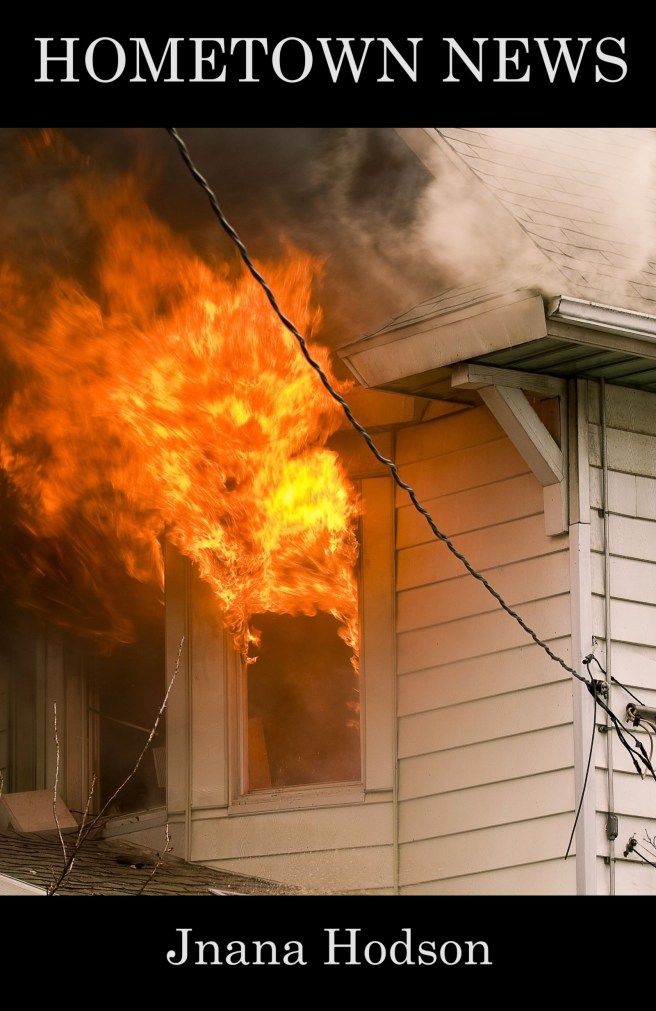
As I pitched my novel at the time, “Hi, my name is Jnana Hodson and I’m not surprised American newspapers are in crisis. In my four decades as a professional journalist, I’ve seen news coverage under attack – not just from the outside, but more crucially from owners who first bled billions from its renewed growth and vitality and now give the product away without a viable business model in sight. My novel, Hometown News, pays homage to the battle and what could have been, along with journalists’ role in the survival of communities across the continent and democracy itself. Along the way, Brautigan and Molly Ivins meet Dilbert and Kafka on the prairie, even when their names, sex, and races are changed. May I introduce you to the full story?”

An alternative version went, “Hi, my name is Jnana Hodson and my career as a journalist has placed me in enough decaying industrial cities to shape my novel of high-level global investor intrigue. If you think Dilbert tells of modern business operations, think again. May I show you my take?”

A bigger question was why anyone would be interested in this or see themselves impacted by these corporate machinations.

At their best, daily newspapers have shaped both a central identity for localities across America, and their conscience.

For many years, despite the arcane business structure in which advertising rather than sales of copies provided the bulk of the income, hometown newspapers were cash cows for their owners – who, in turn, paid their reporters and editors minimal wages.

The resulting management practices – reflecting those of surrounding corporate retailers and manufacturers – have put news coverage at risk, endangering both the communities and democracy itself. How will they, like the reporters and editors, survive?

As a journalist, my touchstones have been Accurate, Informative, Useful, and Entertaining. I wonder how those apply to poetry, as well.

The novel is cast on an experimental frame, one that anticipated AI and then backed away from it. The daily events, however, get weirder and weirder as the demands and tensions ratch up. You might even think of it a dystopian.

That said, you can find Hometown News in the digital platform of your choice at Smashwords, the Apple Store, Barnes & Noble’s Nook, Scribd, Sony’s Kobo, and other fine ebook retailers. It’s also available in paper and Kindle at Amazon, or you can ask your local library to obtain it.

With an eye and ear of personal detachment

One of the luxuries of not writing under deadline is that you can put a work aside for a while to let it season. Pick it up again a few months or even years later, and you may see so much that needs reworking or the trash can, but at other times the page can astonish you.

I’ve had that experience lately at the monthly open mic nights at the arts center, where I’ve been reading snippets from my published The Secret Side of Jaya as well as selected poems. As I was halfway through my time on the stage one night, I was struck by the thought, “Who wrote that!” It was a daring approach to fiction, completely contrary to what would emerge from the Iowa Writers Workshop, but it was mesmerizing my audience. I certainly wouldn’t write that way again, either. Still, I feel pride.

Sometimes, of course, that sense of “Who wrote that, it is so incredibly fine,” is countered by “Who wrote that piece of tripe? I’m glad it never saw publication.” Sometimes only pages apart.

Reading at an open mic or as a featured reader is a valuable test for how a page works, as you can feel from the energy in the room. Lately, I’ve been taking pages from the middle of a novel and reading them without an explanation of the previous action. Think of them as a trailer for a movie.

~*~

Well, mine is a contrast to the kids who get up on the stage and apologize for reading an old work, meaning something they wrote three weeks ago or even three months. Little do they know!

Parts of The Secret Side of Jaya go back 50 years.

~*~

At the moment, that has me wondering how non-writers revisit earlier times in their lives. Photos, old letters, trophies, musical albums?

The Argentine writer Borges took the concept so far as to ask himself about Borges and the other Borges – the one on paper and the other in the flesh – which one was which, at any given time? He no longer knew.

Or the Japanese composer who insisted he wasn’t the same person today he was yesterday, much less 30 years earlier.

Another consideration in revisiting earlier writing, especially as drafts, is that what we’re most fond of is likely to be what bothers others the most; what we’re about to toss out in the next revision may be what is most effective with our readers. The point was raised, I believe, by Joyce Carol Oates, but it’s true to my experience.

As critics of others’ work, by the way, we’re likely to be harshest on those whose work is most like our own! Too much mirror?

~*~

You can find my novels in the digital platform of your choice at Smashwords, the Apple Store, Barnes & Noble’s Nook, Scribd, Sony’s Kobo, and other fine ebook retailers. They’re also available in paper and Kindle at Amazon, or you can ask your local library to obtain them.

A baroque twist runs through my distilled expression

Samuel Johnson and his baroque literary constructions gave a big push to my writing ambitions after high school. Let me just say I’ve loved the clarity of Mozart from my adolescence on, and Bach and Handel have risen in my estimation in the years since. The brash English master fell right into that, though I now see again just how irreverent he was, despite all of his professed orthodoxy.

What it means it that I’m comfortable reading and writing certain kinds of complex sentences that are foreign to modern readers. Perhaps I should apologize? At least it’s not the only way I put sentences in line. Still, there’s a richness that’s missing in Hemingway and his progeny.

And here I am, drilled in the newspaper journalism Papa Ernie claimed was his inspiration. Think again. (Ernie? Makes me think of Pyle, and his big desk at the Indiana Daily Student, where I once collaborated.)

But then there’s Nicholson Baker’s effortless spinning of sentences of 250 to 300 words spanning a full book page. What wonder!

My wife has noted the dichotomy between my fondness for many Old Ways and the rule-breaking, experimental edge of so much of my writing and thinking. She can point, for instance, to my fascination with the fiery writings of early Quakers in the mid-1660s placed in contrast to wild hippie extremes.

Are they really that different, though? I feel they enrich and deepen each other.

Well, to go back to the late ‘60s, let me share a personals ad I placed in the Purdue Exponent, which charged by the word.

~*~

ANNOUNCING

Dr. Samuel Johnson’s first eventful super cosmic transcendental celestial love in, incorporating the essence of mystical human enigmatic & existential psychic understanding & zodialogical causes of karmic experiences in the metaphysical process.

Syllogistic examination of cerebral chemo electrical phenomena are hitherto banished to the outermost polarities of unconscious stimulation for the duration of the aforesaid soiree.

All persons, souls, and spirits seeking admittance to the heurese beuverie must present evidence of psychological and physical preparedness & predispositions for the event. Mind blowing, seclusivenessly introverted behavior, and abstinence from mind-liberating drugs, drink, or sex, will be considered detrimental to the well-being of the sociological matrix selected for hedonistic propensities &, to avoid contamination & empoisonment of the purity of the greater society therein gathered, will be cause for expulsion.

Adoption & encasement in persona & masquerade are desired for the happening; the playwright hereby assumes no further responsibility for the roles assumed by the characters. Coming soon at your local neighborhood hanging, where all else be suspended for the duration.

RSVP

~*~

In case you’re wondering, she wasn’t impressed.

I have come a long way since then, in more ways than one.

My, that is embarrassing.

That said, you can find my novels in the digital platform of your choice at Smashwords, the Apple Store, Barnes & Noble’s Nook, Scribd, Sony’s Kobo, and other fine ebook retailers. They’re also available in paper and Kindle at Amazon, or you can ask your local library to obtain them.

Brace for the intensity of submitting your writing

If you’re not a booklover but still think your story would interest tons of readers, let me tell you, Forget it.

An editor can tell immediately when somebody’s manuscript is from a non-reader.

~*~

For other wannabes, the big test comes in submission of a manuscript. Typically, the first step is in approaching small literary journals, but be warned the rejection rate is steep. When I began, it ran to about 20 rejections for each piece accepted. And that went for just one of the three to five poems that went out in each submission. And that was for established, recognized poets.

Another place to start is as a contributor to a local newspaper, covering local public meetings and the like. At least your work will appear in print or the equivalent.

Still, when I was submitting poetry this way, I managed to get more than a thousand acceptances. I have deep gratitude for the devoted editors and publishers who encouraged me, back when. We need more, should you want to step up.

I think, too, of all of the envelopes, clean photocopies (once that was acceptable), postage stamps, time involved researching addresses. It got pricy.

When I was actively submitting to the journals, I could never predict who would accept what, no matter how long I’d known a publisher or how carefully I had examined the publication.

It was a quirky process, this exercise of seeking homes for personal work. The reactions of editors and readers is so idiosyncratic and varied that the same poem could be considered too intense, by one, and not raw and bloody enough, by another.

~*~

The bigger step came in trying to land full-book publication. More was at stake, considering the costs, especially in a marginal niche like poetry.

As for fiction?

Approaching literary agents was generally a black hole. Few even bothered to return the self-addressed stamped envelopes. Book publishers, ditto.

I had some nibbles, even so.

Even with a few non-literary manuscripts, I was repeatedly running full force into brick walls.

And then ebook opportunities came along. It still requires self-promotion in search of a readership. So here we are.

~*~

At this point in my life, I’m backing off from the cutting edge, wherever that is. Hate to admit I’m also out of the loop and haven’t kept up with literary journals. As for the hot celebrated novelists? I don’t recognize their names. Of course, they don’t recognize mine, either.

The real challenge for both of us is encouraging others to read as an essential part of human understanding. Since you’re reading this already, I’m assuming you’re already active in that commonwealth.

Stay the course, please!

Where are they now?

In the hippie circles where I lived immediately after graduating from college, I remember visiting one couple’s apartment on the second floor of a former Victorian carriage house, not that it was in any way chic. They had one room that had benches or modest pews around the four walls, something I now see as resembling a Quaker meetinghouse interior.

Their reason was the small group they welcomed to study the works of Armenian mystic George Gurdjeff (c 1867-1949). He’s best known for his book, Meetings with Remarkable Men, published in 1963, describing his visits in remote mountains and deserts mostly, places he paid homage to eccentric and often aged holy men of varied stipes.

Looking back at my own life and people I’ve met, though, I’m not sure his were any more exceptional than many I’ve known. Maybe they were just a bit more eccentric.

It’s a thread running through most of my work, actually.

In my relocations around the country, I’ve lost touch with 99 percent of them, but do wonder how the rest of their lives unfolded.

Here’s a sampling.

  • High school classmates and other youths from our church.
  • Fellow commuters and faculty from the new Wright State University.
  • The other residents in my two dorms in Indiana, especially the ones who show up in Daffodil Uprising.
  • The other residents of the hippie farm in New York’s Southern Tier or my Hawley Street digs in town. See Pit-a-Pat High Jinks.
  • The yogis of the ashram and those who came as guests. (Yoga Bootcamp.)
  • Ex-lovers over the years. (Blue Rock, Braided Double-Cross, Long-Stem Roses in a Shattered Mirror.)
  • Colleagues from the public policy research institute at Indiana University. One of the leaders did go on to win the Nobel Prize in economics. As for the others?
  • Fellow poets and writers along my way.
  • Fellow journalists and other newspaper workers. I’ve come across a few and read of others, but mostly they, too, have faded from sight. Eight papers in all. (Hometown News.)
  • Quakers I’ve experienced in nine yearly meetings.
  • The staff as the media syndicate where I worked, plus newspaper editors in 14 states, back when I lived in Baltimore.
  • Mennonites and Brethren in Maryland.
  • Neighbors around the Jacuzzi at Yuppieville on the Hill, Granite State.
  • New England Contradancers in Greater Boston and across New Hampshire and southern Maine.
  • Greek Orthodox in Dover. (What’s Left.)
  • Voices in Revels Singers in Watertown outside Boston.

Trying to trace down even a few of them has been frustrating. Some have shown up in news reports that led me to them, fleetingly. Many of the women have taken their husband’s surname, which becomes a barrier. Facebook has led to some from my high school years, but beyond that I am surprised by the number of “friends” who are inactive at their profiles or other folks who have no online presence at all. And then there are ones I’ve come across at Find-a-Grave.

It’s been quite a cast in my zig-zag journey to here.

By and large, though, I’m seeing how short we’ve come in regard to the lofty goals we once professed. My heroes, especially.

~*~

That said, you can find the novels they inspired in the digital platform of your choice at Smashwords, the Apple Store, Barnes & Noble’s Nook, Scribd, Sony’s Kobo, and other fine ebook retailers. They’re also available in paper and Kindle at Amazon, or you can ask your local library to obtain them.