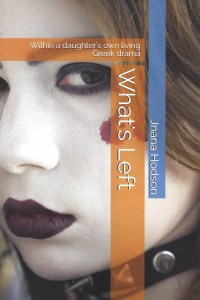
Let me repeat, What’s Left is my final novel, even though it’s appeared before several earlier ones — or their later revisions. That doesn’t mean I might not rework some more of my earlier books, but I have no intention (at this point, ahem) of undertaking such an ambitious project.
Still, if it’s ever successful, there can be a demand for a sequel. There are many possibilities that point to further development.
One plot twist I considered was this:
A handful of the Erinyes’ grandchildren rebel by returning to attend college across the street from Carmichael’s. Perhaps it’s inevitable that they apply for jobs in the restaurant.
Can they work? We’ll let them decide about becoming cousins.
This could have opened considerations about rebalancing the ownership, for one thing. Or more dimensions to our understanding of what it means to be a family. Or even their own reasons that parallel those of Cassia’s father in moving way back in the early ’70s.
~*~
It’s a big book, admittedly. But it could be a lot bigger.
Where would you take the story of What’s Left from what’s already there? What would you like to have answered?
~*~
I wonder where Cassia’s generation of her extended family or even their children go from here as they face today’s big challenges.
It’s is not my debut novel. Rather, I have the feeling it’s the opposite — the final one. I could never do this again. What’s Left is a big novel chock full of surprising turns, deep thoughts, and lively details. Unless Cassia starts speaking to me again, there will be no sequels. For me, at least, the story condenses so much into its pages I’m feeling completed.
Unlike my earlier novels, this one was not written on the fly while working full-time as a journalist. Like them, though, it’s undergone extensive revision.
Woven through the book are themes I’d explored in my earlier stories, now seen in a new light, while investigating others I’m tackling for the first time. Family and family enterprise, adolescence and childhood, death and divorce, and Greek-American culture, especially, are new while counterculture, romance, spirituality, community, nature and specific place, livelihood, journalism itself all run through my previous work.
~*~
Think of this bit as going into the compost rather than being served on the plate:
All I’m doing is asking you to apply your new comprehension to the rest of your life.
~*~
Of course, you’ve heard somebody blurt out, “I’m never going to forget this as long as I live!” Or some such. And sometimes it’s true.
Me? I have trouble remembering nearly everything. Could it be one reason I read so widely is to help me remember? Of course, writing gets it down on paper, once again so I don’t forget.
So while I read to help me remember and to gain insight on the world around me, it’s not the only reason by any stretch.
What do you look for most in a novel or poem?
~*~
A large Queen Anne-style house with a distinctive witch’s hat tower something like this is the headquarters for Cassia’s extended family in my novel. If only this one were pink, like hers.
Sitting down to compose a novel requires some bravado, an assumption or presumption, even outright arrogance, that you have something important to say and an ability to do it in an interesting way.
You know, balls, swagger, mojo. Go to a writers’ group and just listen. But it’s not all sheer ego-driven. For many, at least, there’s an ongoing tension between believing in our own talents and shielding ourselves from the nagging self-doubts. Even Stephen King has them. Remember, the practice of the craft is a solitary act, not a team sport. It gets lonely, especially in the absence of feedback or fans in the stands, whether they’re cheering or jeering. Sometimes, to your surprise, harsh criticism is easier to handle than any praise.
Unless you’ve been there, you have no idea how precious a voiced reaction can be in nurturing you. Those brief reviews and star ratings are important, not just for guiding others to certain books but for guiding you as an author in your practice. An astute reader picks up important elements that have slipped right over their creator’s consciousness. Please, please, please take a few moments to weigh in when you finish a volume. We all need confirmation that we’re not wasting our time – or yours. Best of all is the epiphany when we’re left feeling that someone finally “gets it,” actually understands what we’re about. Don’t be shy.
The paperback cover …
I recall giving a friend a booklet I’d written about the Quaker metaphor of Light. (By the way, in the first two centuries of the Society of Friends, the term was always Inward Light or some variant, never the Inner Light expressed today. It’s a crucial distinction.) When he finished, he thanked me, said the text had cleared up his understanding, and then added, “You write very well.”
Even after four decades in the words-on-paper business, I was taken aback, considering that he is, by any measure, an important American literary figure and a master of the language. It was like “welcome to the club,” the exclusive one with the dark paneling and Manhattan address. It was like a cup of fresh water in a desert. Within myself, I felt freed from the “hack writer” label so often applied to journalists from Dr. Samuel Johnson on.
Later, in an aside, he told me I was more of a poet than a novelist. Knowing his fondness for poetry, I took some comfort in the perspective, as well as some umbrage about the fiction part.
On reflection, I now have to agree on his assessment, at least as my novels stood then. He certainly helped my character Cassia press her case for the reworking of all my existing novels, as I did in the aftermath of What’s Left, where she’s the star.
There’s also that frightening moment in the gap between when a book’s been accepted for publication and when it actually comes out. We’re afraid someone’s going to somehow uncover our darkest secrets or that we’ll be shamed by some indiscretion or that we’re about to make an unforgivable transgression. Again, go to a writers’ group and listen … or even ask. If you’re an author, you think you’re somehow bonkers when you feel this, not knowing how much company you actually have.
… and the back cover.
I’m of the camp that hews to Bukowski’s regime of daily “butt time” at the keyboard, day in and day out, regardless of how inspired you might be feeling. Many days it’s a dry struggle, but on others something different and amazing blossoms. From my perspective, it’s when writing becomes a kind of prayer and you find yourself in a “zone” where things come together as if by magic and characters start dictating to you, if only your fingers can keep up with what your soul is hearing. It’s a dialogue with the Other, as in Muse, and you’re the mere scribe at her service.
It’s what happened when Cassia started dictating to me.
It’s not always at the keyboard, either. Sometimes it happens while you’re in the shower or on the throne next to it or swimming laps in the pool or commuting to work.
You can’t control this. Realistically, it happens when you’re not in control.
It happened to me at the finale of “Subway Hitchhikers,” which years later became the launch pad for “What’s Left,” where I had to make sense of what I’d been given, however intuitively.
Perhaps the best, well, I just had a phone call and lost the thread of thought. Maybe it wasn’t that important.
Like most of us, Cassia finds herself carrying a host of identities. She’s Greek-American, on one side, and Midwestern WASP, on the other. She’s been raised with both Tibetan Buddhist and Greek Orthodox religious influences. She’s a female, of course, and an entrepreneur. She’s part of a large extended family, a Hoosier, a bohemian, a college graduate, a devoted sister, a daughter. And that’s just for starters.
What are your most prominent identities? How do they shape your life?
In creating What’s Left, I’ve been on fragile ground with both Greek-American life and the behind-the-scenes realities of the family restaurant business.
Those are both places your insights would be gratefully received, especially when I hit a wrong note.
Well, we can extend that to the entire work as it treks across a lot of unfamiliar ground.
What have I caught right? And where I’m I off-track?
~*~
Horiatiki. I’ll probably leave some ingredient out when I make it. Or add something I shouldn’t.
These days some of my favorite daily encounters come at our city’s indoor pool, where I swim laps. In addition to the familiar faces of fellow swimmers, there are the interactions with the lifeguards, many of them still in high school. When they’re not actively watching us in the water, they have rounds manning the front desk, where they might also be doing their physics homework or working on a paper. In other words, they were the right age to help me with my novel What’s Left, not that I’m ever that direct. No, just a wild question or subtle ear’s enough to keep me grounded in their direction.
In revising a manuscript, I sometimes chance upon a “zipper” that seems to run along the entire piece and releases something trapped within it. Tugging along page after page is an amazing experience, when it happens, which is not nearly as often as I’d hope. Mercifully, that’s what’s happened in the ninth revision of What’s Left, my novel thanks to comments from some of the early readers. The key this round came in having her talking to her father throughout, at least in her head and often in the midst of other people, rather than simply about him. It gives the work a whole new dimension and makes the story far more intimate, especially when she makes irrational leaps that match her emotions.
This, in turn, allowed her to relate much of her investigation as it happened as a young teen, rather than looking back on it from her early twenties, and had her aunt Nita and her best friend, cousin Sandra, present as co-conspirators.
Note that none of these revisions changed the way I saw the novel as an author — I knew how it begins, develops, and ends — but they change it entirely for the reader.
Yes, the changes were extensive. When one of the lifeguards remarked, “What? You’re not done yet?” I came back the next week with two pages from the hardcopy I was working from — half of the sentences containing crossed-out words and phrases, several moved to new locations, and a taped-on flap of new notes to add in, all needing to be keyboarded. It’s typical professional work, as you’ll discover reading the Paris Review or any number of writer-oriented magazines.
Still, they were astonished. I doubt they’ll look at a 500-word assignment quite the same again.
The point is that all of these changes are for the reader. Curiously, the very shift of having Cassia speak directly to her father throughout soon has the reader stepping into his shoes, hearing through his ears in a new intimacy.
And now I trust the story’s ready for you, as its reader.
~*~
It’s not always simply a coincidence, is it?
Have you ever started out on your way to one place and wound up somewhere quite different? Somewhere that turned out to be right? Tell us about what happened.
~*~
Working with photographic film, as Cassia learns to do with her father’s archives, means learning to “read” negatives like this one by Yuukikatrarra. She’s good.
Samuel Johnson and his baroque constructions gave a big push to my literary ambitions after high school. Let me just say I’ve loved the clarity of Mozart from my adolescence on, and Bach and Handel have risen in my estimation in the years since. The brash English master fell right into that, though I now see again just how irreverent he was, despite all of his professed orthodoxy.
What it means it that I’m comfortable reading and writing certain kinds of complex sentences that are foreign to modern readers. Perhaps I should apologize? At least it’s not the only way I put sentences in line. Still, there’s a richness that’s missing in Hemingway and his progeny.
And here I am, drilled in the newspaper journalism Papa Ernie claimed was his inspiration. Think again. (Ernie? Makes me think of Pyle, and his big desk at the Indiana Daily Student, where I once worked.)
My wife has noted the dichotomy between my fondness for many Old Ways and the rule-breaking, experimental edge of my writing and thinking. She can point, for instance, to my fascination with the fiery writings of early Quakers in the mid-1660s placed in contrast to wild hippie extremes.
Are they really that different, though? I feel they enrich and deepen each other.
Cassia and her brothers and cousins face a crucial decision. Do they continue to jointly hold the family business as a resource for future generations, requiring them to keep working for a living, or do they divvy up their shares and then live independently wherever and however they desire?
Put yourself in Cassia’s shoes.
How would your life be different if you didn’t have to worry about how you’d make ends meet? What would you dream of doing?
~*~
The family enterprise extends beyond the restaurant itself, as they demonstrate when they buy an old church something like this and convert it into a late-night hotspot.