A HUNDRED STEPS TO THE SEA

1

along the shoreline, the heads of two gray seals
bob and glisten

later, three seals together, lazy

and then, a dozen seals basking and lolling ensemble
twenty feet out
“you never see that”

while strolling a ribbon
between sand cliff and ocean

I try estimating one ladder or stairway
from the cottage above

later, two young wives
from Atlanta and Nashville
cute as can be
in their annual escape from their husbands

tell me they rent a place
just over the crest

109 steps        “Every year we count ’em
and they’re never the same”

against shoreline hammered every fifteen seconds
by a three-foot curler or six-foot breakers

judging by surf fishermen
at fifty- to a hundred-foot intervals

still, where the high apron of beach has been cut away
at high tide, I’m forced to remove shoes
roll up my pants and allow the surge to swell around me

it’s warmer than Maine
now after Labor Day

“Had I known, I would have brought my swim trunks”
“but it’s pretty rough, too”

hard to believe I’m walking on oysters or clams
the receding wave sighs
when I glance back at bubbling sand

another seal patrols the shore

when I see more of them in one day
than in all the rest of my life

2

comb jellies – white melting ice cakes
gelatinous to the touch
slightly resilient, like grapes
all over the place, where the water’s just been

scallops, they call ’em – open up in the water
like jellyfish (their relations
but these don’t sting

crab shells, a few mussels:
somebody’s eating well:
a decaying small shark

3

just three boats visible white specks
plus the freighter over the horizon

yes, 3 vessels
where yesterday
we saw none

wide open ocean

at my feet

would I rather be
kelp
or the indestructible
green rope
tossed from the sea?

sea spinach

4

just north of Marconi Station
keep thinking I hear jets
under the relentlessly crashing surf

many crab shells at the waters edge

some decaying fish up to two-feet long {cod
strands of spine
a gull leg and webbed foot

all to myself, step out and pee

a pair of footsteps
one going my direction
the other, approaching

above, beach plum like large blueberries

Marconi Station “you’ll know by the bricks”
knocked down to the Atlantic

but I see just one red cube and
way down the shoreline
what I think old pier pilings
begin moving as I approach
schoolchildren, field trips

the real debris appears as milk jugs
clear plastic bottles and cups, foam plastic coffee cups
and insulation, yellow nylon netting, multicolor nylon rope
a battered lobster pot, a child’s toy outboard motorboat
a cooler melted in one corner, stray firewood neatly cut
bottle caps, a large oil filter like a radar cover canister
(haven’t seen a condom yet), a black inner sole to a size
eight or nine shoe, pressure-treated lumber, nothing
too revealing so far, Glad bags, drinking straws
an aluminum shard barnacle embossed, a rusted horseshoe

4

as for cottage colors
on the bluff

gray shingles
blue trim

each one with a brick chimney
and fireplace romance

my wife contends a seaside cottage
should be plain, simple
something that can be blown away in a storm
without horrific loss

Poem copyright 2016 by Jnana Hodson
To see the full set of seacoast poems,
click here.
HARVARD’S GREAT THEATER

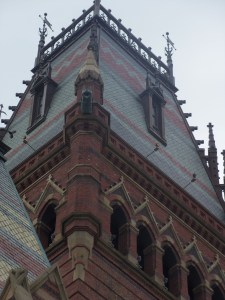
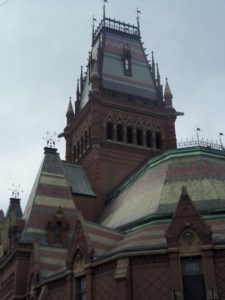
The aspirations are obvious.


Instead of gargoyles, just look ...
Instead of gargoyles, just look …


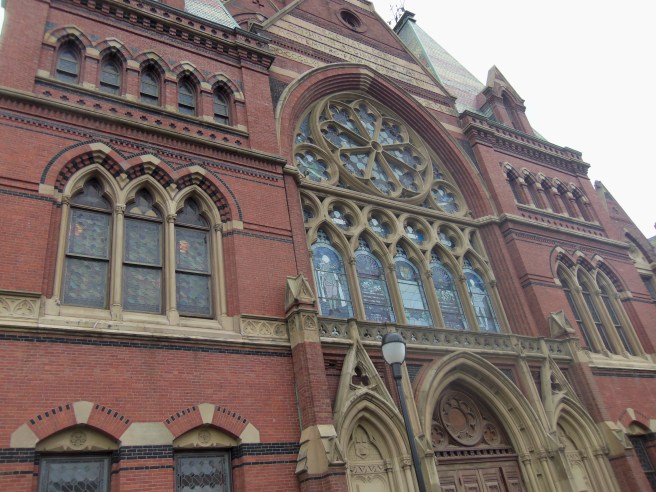
Memorial Hall in Cambridge is a high Victorian Gothic building erected in honor to the Harvard University men who died defending the Union in the American Civil War. One end of the structure holds Sanders Theatre, an intimate, wood-toned Globe-style auditorium – one we treasure for its Christmas Revels productions each year. The other half of the building embraces the Harry Potter-like Annenberg dining hall. The two parts connect at a marble-lined hallway engraved with the names of the fallen Harvard students.


Even on a cold, blustery day, it's hard not to be impressed when approaching its entrance.
Even on a cold, blustery day, it’s hard not to be impressed when approaching its entrance.


Imagine trumpets from every portal. Not that the Revels do it ... yet.
Imagine trumpets from every portal. Not that the Revels do it … yet.


Greater Boston is a rich and varied destination – the Hub of New England, or the Universe, as they used to say. Living a little more than an hour to the north, we’re well within its orb.

JUST WHAT, THEN?

In town, the side of one building has a ghostly paint on black brick. With difficulty I decipher

COMMERCIAL SALOON
T. MALLET PROP.
CIGARS NOW 5 c

across from the train depot and next to the OPERA HOUSE. Railroads, cigars, saloon, and opera all fit together in a remarkable calculation. Just where were women, besides up on stage?

What, precisely, mad the Far West so different? No family roots? It was all male: cowboys, loggers, miners, fishermen, soldiers, trappers. Even an orchard’s considered a ranch. You need only a few acres, Buckaroo. Where is my wife at this moment? Like Maya of Sanskrit lore, she’s a weaver. Like Maya, she had spun a web of entrapment. Maybe these open spaces aren’t really so open.

For more insights from the American Far West and Kokopelli, click here.

SEPTEMBER, THE CAPE

Wellfleet, at their grandfather’s

two perfect horseshoe crabs
adorn the table
of the uninhabited house
while he’s in Florida

in the fridge, Heineken dark
“your surprise” – available across the highway

Wellfleet and just think
oysters or the saltmarsh

sunlight breaks through
my desire to travel lighter than this
unlike the children

an array of silver cups, a blinding turn
the chameleon hiding nowhere
but itself or the air, last week:
“You don’t look happy these days”
also: “What do you want from me?”
how I wish I could answer the latter

pine / oak / locust scrub
“tick country”                        even the lawn

tiny green acorns
dry cranberry bushes, as part of the groundcover

in his yard                              }           in the house
sand everywhere                               the arranged ginger jars
the grass brown                                his collection
with pine needles                             Rookwood Pottery, at least
the book

patch of mussels, each one the size of a pea

round brick
worn by the ocean

of course if we lean back, even nearly at shoreline
the water’s over our heads

water taller than I am
is the problem

or water that sweeps you
off your feet in this ocean so clear
we see fish swimming past us – one
a striper two feet long, the other a cod,
halibut, mackerel – I don’t know fish, really
bigger than my daughter beside me
just days past twelve

what kind of life has this been?
with flashes of brilliance, just enough
remaining for harvest

her knife, sharp and long

sailing into the wind
repeatedly, returning and now
through the years

windowpanes
two over two
traditionally
live our lives

one, in a denim jacket
while the other, in a blue swimsuit
nap in clear breeze

I wonder how people fall asleep in the sun
in chairs, at that

Rachel, my wife, informs me of changes
how so much has overgrown now
she no longer sees the saltmarsh or cove
from the dining room, even traces
of Reenie’s garden have vanished

ever dutiful, busily Rachel thins hostas and day lilies
where Grandpa has taken an ax to their roots
“and I came to the Cape for this?” but the motion
grounds her in a way the surf grounds me

blue sky, blue ocean
warm water compared to Maine
choppy surf “knocks a child over”
happened once and now Rachel won’t
bring them back here but prefers
bayside, where the water’s warmer

I believe her, yet

when we walk the road to the Atlantic full on
she observes
overgrowth around cottages and houses
is often quite pronounced
to go with the windswept, cracked gray of dunes cabins
and the ever present shake siding

all night, all day
the highway mocks
the surf’s rhythm

in the swells with Megan, she snarls
“I thought you said it was warm”
“warmer than Maine!”
and laments the waves aren’t bigger
though they knock us off our feet and
fill our suits with small gravel
(viz Grandpa’s bathroom floor after her shower)

turning overcast, trying to spit rain
cool, too
no swimmers but three dozen surfers in one stretch
kids sledding on the dune cliffs
30 feet, maybe, the low spots
100 in others

a seal, faroff, away from the surfboarders
feel the sun now, too much on my face

wind and wind gong
fiddler crab and mussels
the saltmarsh tide turning
chalk and slate outside the general store

oak, pine, and locust trees
a mole scurrying along the foundation

all these beachcombers
tomorrow expect no one
after the weekend

“we’ll take you back”
the waves cackle and rage

will the kid ever learn, packing a whole suitcase for herself
(too much and still no swimsuit)
for a short trip?


morning water cold but great breakers,
a great workout, knocked over, body slams –
lose my trunks once, saved at the ankles
fortunately, out of season

surf calms but still choppy, very windy
a seal head appears, just briefly

Sunday morning, clearly the last swim of the season
a record amount of rain for the month
Hurricane Wilma decaying offshore
kicked up quite a show here

twenty-foot swells crashing on the rocks

Poem copyright 2016 by Jnana Hodson
To see the full set of seacoast poems,
click here.
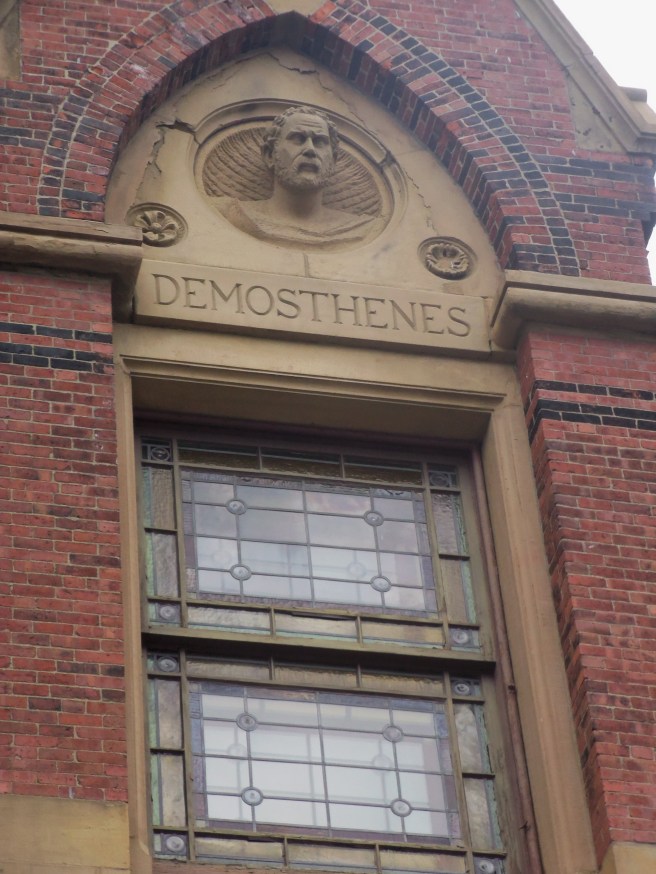
OF SOJOURNING AND EXILE

Kokopelli is not quite of this place, but he will stand in for the local hunchbacked flute players. As will Krishna, in tunes that begin slowly and build to ecstatic climax. Maybe they will be joined by a wandering sailor, looking for water. Maybe by fiddlers like me. Our melodies haunt and echo. This music demands dancing. The drummers appear.

You might ask what the Native American flute is made of. As well as Krishna’s pipe. What kind of bone or horn the sailor has carved. What opens as a simple, plaintive cry gains complexity and liveliness. Spider, in fact, weaves their intricate counterpoint.

The sailor knows sees their progression running from reel to jig to, ultimately, hornpipe. Who knows what the Hopi or Hindu call it — the effect is the same. Just look at a cow skulls and see where the horns were. Look at elk antlers. Look in his Bible, where horns are an image of power. Some who venture out into solitude return with their own power song. Begin wailing. Begin reeling.

I reflect. Suppose my children are born here? Is this really an arrival or a failed promise? What about the long exile ahead? The decades of trying to understand precisely what I’ve encountered in this desert and at its rim. Perhaps I will face a desert in my profession, as well. Perhaps I’ll find the sea is another kind of desert — one giving rise to the fishermen who were Christ’s first apostles. I already know of salmon returning to the desert.

I had believed this would be his Canaan — my place of milk and honey. I could spend the rest of this life pondering exactly what I experienced. Attempting, as well, to recover something of the encounter. The tune ends, but I remember its sound and its place on my maps. No matter that I might have even found this Canaan in a large city of orchestras and quartets, stages and screens, galleries and architecture, lectures and bookstores.

Maybe I’m merely sojourning here all along. In exile here as much as anywhere. And maybe it wasn’t the desert as much as the promise itself I explore.

At the end, a door closes. Maybe a gate. Like Eden, with its reality that I’ll never return. This desert is not a land that many visit. It reveals its true nature slowly, if you’re patient. If you’re reverent.

Actually, this might be just one more gate locked behind me. Even if I could return, I’d find everyone scattered. Or at least older. Here I haven’t even collected an antique basket or beaded moccasins or a piece of turquoise and silver jewelry to carry with me. Wherever I’m going.

Those were the days when I could read a totem pole and anticipate the stories. Maybe even name the children and their grandparents.

I should have known traveling with Kokopelli comes with risk. There’d be a price, eventually. Maybe it was while I was at the office or those other times when I turned, and he wasn’t there with me.

Now I come home and both Kokopelli and my wife are missing. I should have been suspicious all along.

It’s time for me to leave, then. I’m free.

For more insights from the American Far West and Kokopelli, click here.

IN THE RHYTHM OF THE BOUNCY WALK

where dirty children
eluding prayers blasted from loudspeakers
everywhere
sell plastic necklaces

we all smelled like camels

leathery men resembling the caravan
each one swaying from a high perch
in a ship of the desert
will gallop
pulling between nostrils with a sharp yank

trusting the three eyelids of their beasts
with their very blood

humps of fat rather than water
devouring nothing for months

thorn-eaters
with efficient respiration
cud and three-section stomach

how many days, how many weeks
camel milk, as a staple

a winged, rank-odor harrowing pariah

~*~

            “don’t worry, we use many animals
and give them rest:
they’re all well fed, believe me”

to pull a plow, to turn an irrigation wheel, to draw water

to comb the wool
serve the meat

when you’re finished

Poem copyright 2017 by Jnana Hodson
For more, click here.

ROUND AND ROUND ANEW

I awaken with indigo skin. Sparrows hop about on my mattress. I vaguely recall a plunging star followed by blindness. In that sleep, a voice spoke in primary colors and related a saga oozing blood between brown feathers. I followed her in a procession toward the origin. She pointed out a killer whale, a shaman’s folded robes, a raven’s halo, a falcon spitting fog, a cluster of warthogs, a gathering of peacocks and white llamas, the roots of a great-grandfather’s moustache. As we ascended from a swampy trail of frogs, birds, cobwebs, sunning turtles, and lizards, we skirted the foot of a smoldering volcano. Off in the other direction in emerald water, an island burned. She, however, had other plans. Wild goats ran from our approach. Soon we braved auto glare, road owls, iron bridges. Spinning me back to my Midwestern sources, she demonstrated how thin the thread of perception remains. Spider-thin, in fact. She showed me I’m one animal at one time and in one location, but when those factors change, I become another. Only the soul is constant. When she held a mirror before me, there was no reflection. When I asked her name, she smiled coyly. “You’ll find it written in the desert.”

Each time you acknowledge the distractions that keep you from dancing freely, turn back toward the melody and the rhythm. Turning, I knew, was repenting. Turning and returning, in the music I danced and played. My partner there has always been faithful.

For more insights from the American Far West and Kokopelli, click here.

LATE MORNING TRAFFIC

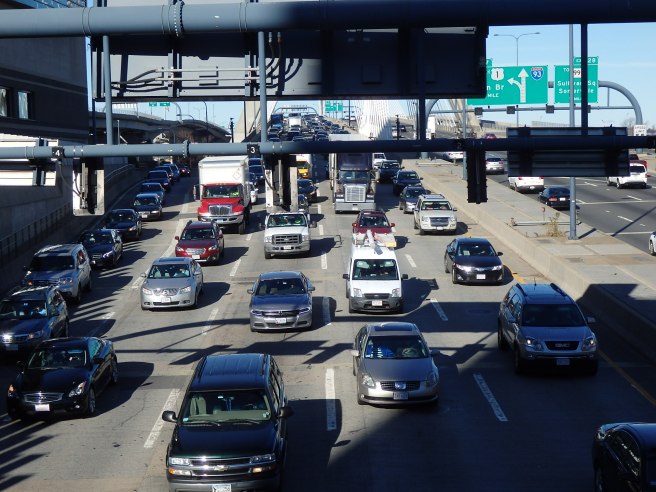
Medium traffic.
Medium traffic.

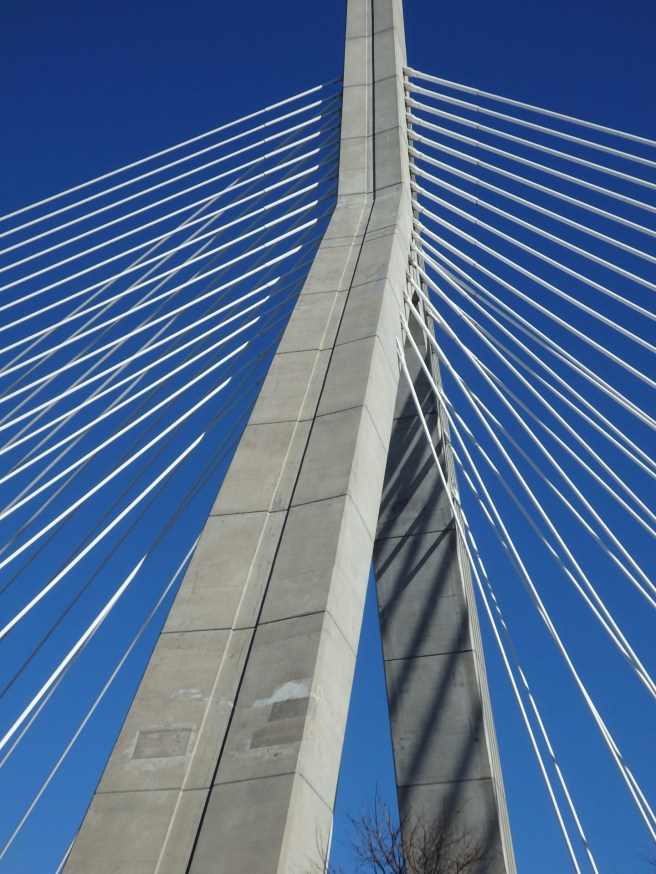
Vehicles on Interstate 93 stream from the Leonard P. Zakim Bunker Hill Bridge into the depths of the Big Dig tunnels. The graceful wishbone design of its two supports gives no hint of the engineering challenge of crossing a navigable waterway before plunging a highway deep under the heart of a major metropolis.

Boston is a rich and varied destination – the Hub of New England, or the Universe, as they used to say. Living a little more than an hour to the north, we’re well within its orb.

The bridge itself is gorgeously breathtaking.

LEAVING THE POINTS OF REFERENCE

To step into desert far enough you no longer see cars or houses brings a break with convention. Returning from one exploration with Kokopelli, I view the town as a mound of pea pods. Next, it becomes peanuts (which aren’t raised in these parts). Eventually, as packages of Grape-Nut Flakes — each building containing bodies, nothing more. Entire cities appear as collections of books identical to a room of cardboard boxes. Every abode duplicates a television set. I know this isn’t how people should be living. This isn’t freedom. This isn’t personality. We have our work cut out, don’t we? If Kokopelli hadn’t come this way earlier, I might have feared for my sanity. Instead, I know the brain’s a weird instrument and let it go at that.

Imagine undertaking a trip where there are no road signs, no maps, no pages of text. You have no way of knowing how far to the next town, gas station, restaurant, motel, or campground. Ask people and hope they know. With utter sincerity, half of them give bogus information. The other half lie. Without a guide, all the books you’ve read can’t possibly help find the marker, YOU ARE HERE. Your teacher embodies map, compass, path, and highway. If you have the genuine article, it’s better than an Interstate speedway. If it’s false, watch out. I wished my own were closer. I was running on memories. As my Teacher said, “When you think I-I-I, you’re a smoky fire blowing every which way. No I, no me, no my attachment means there’s no smoke, just a good hot flame burning clearly.” For me, this meant breaking out of my own shell. Would I have wings or claws? I hadn’t considered the spider.

At least I have Kokopelli, on occasion. Most of the time.

In this desert, I seek to unearth the hidden meanings of place. I return to a chart of Aboriginal names and translations, and substituted these for the Geological Survey’s designations. The mountain once known as Komo Kulshan is STEEP. That’s how it is when GOING FOR CLIMAX in the spiritual quest. You must keep asking, “What can I do WHERE I AM?” The answer? “Take another step dancing with your beloved.”

For more insights from the American Far West and Kokopelli, click here.