My initial explorations in the Cascades

The primary attraction had been the mountains. We were in the foothills on the eastern flank of the Cascade Range. I was getting out into the wild probably every week from summer to the start of winter. Here are a few excerpts.

Darling Mountain

One of my first exploration, maybe the first, was on a Tuesday I had off work, when I drove up the Middle Fork from Tampico and then logging roads to Darling Mountain crest. Sheep scats and tracks around the snow and awesome meadows. Old site of forest fire lookout, since torn down. Climbed a dead tree to enhance the view. Mount Hood, above clouds. Adams, thrusting into them, closer. Goat Rocks across the way, and St. Helens’ perfect cone beyond. Straight ahead, following the road, Rainier thicker into the clouds somehow superior to the others. Then, a golden eagle sailing straight toward me, turning off perhaps 30 yards away, soaring off, circling briefly, and disappearing. With my guest status, I gave gratitude.

Deep forests were extraordinary.

I had no idea that this was on the second-highest logging road in the state.
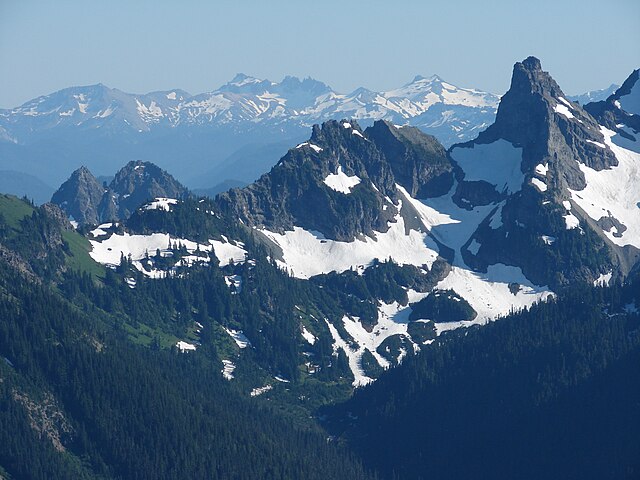
Cowlitz Chimneys (center) with the Goat Rocks (background) from Sunrise point on Mount Rainer, photo by Steve Redman at Wikimedia Commons. 

Rainier route

On another trip, on my way to Mount Rainier, saw my first petroglyphs (rock inscriptions) and petrographs (rock paintings) outside of Naches. The paintings looked a little faked — red and white, perhaps with a little blue or red.
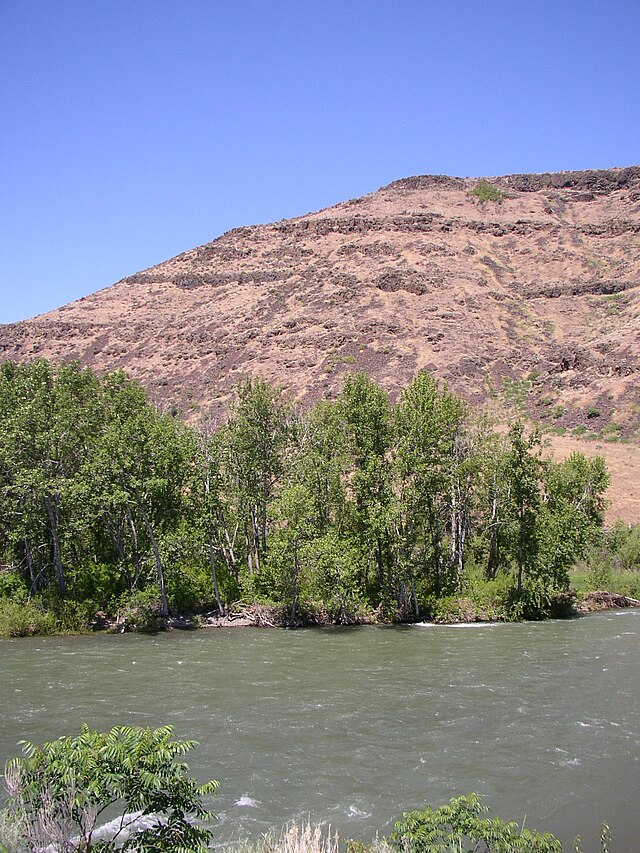
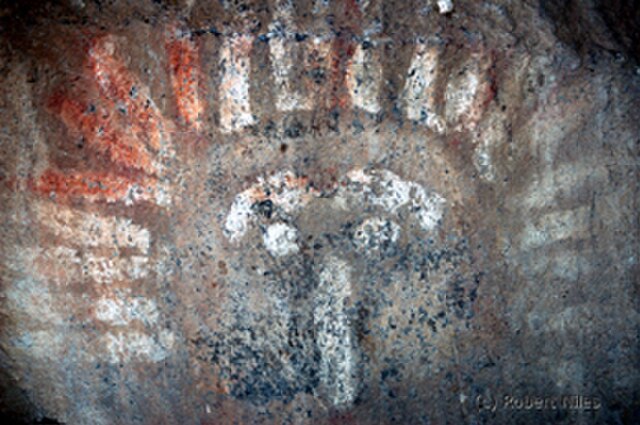
They were found near where the Naches and Tieton rivers veered off westward toward the Cascade Range. Photo by William Borg.


Photographs by Robert Niles via Wikimedia Commons.

Our routes to Rainier were progressions through ecosystems that became familiar over repeated exposure as we drove from sagebrush desert into ponderosa pines and reservoirs of future irrigation waters on our way to the high country of the Cascade Crest and the rainforests beyond.

Rainier hikes inspired many poems as well as scenes in my novel Nearly Canaan.

Each day trip was intoxicating.

To the south

John Day Dam in Columbia River: fish ladder and 80-foot drop of locks: air in stomach, at man’s mass of cement: aluminum company by the RR tracks.

Steam locomotive at Maryhill State Park, reflecting Sam Hill’s source of wealth: Maryhill Museum of Fine Arts, his castle above the palisades, green lawn dropping off into clouds. The sculpture studies by Rodin the claim to fame. During the trip, pondering Mount Adams vs Rainier …
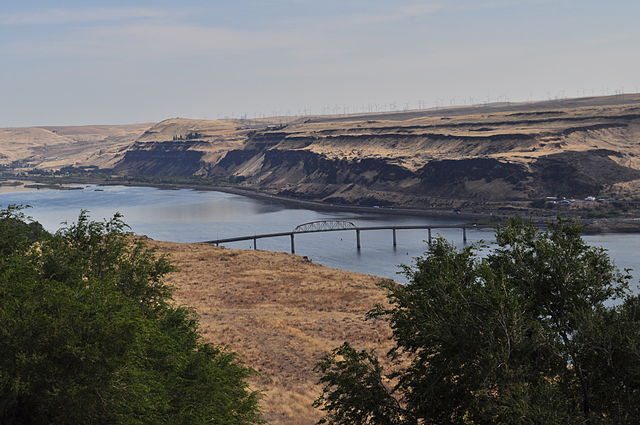
Sam Hill Memorial Bridge and Columbia River, seen from Maryhill Museum of Art, Maryhill, Washington. Oregon at top/right. Photo by Joe Mabel at Wikimedia Commons.

~*~

Along the way

Sweet vinegar smell of hay [up to 5 mowings a year in the interior Far West; the hay was grown in the sunny lands east of the Cascades, and much of it was trucked to dairy farms and other livestock operations on the rainy western side of the mountains].

~*~

From Spiralbound Cascadia with commentary.
 

Newfoundland is really out there

It’s a remote land of icebergs, northern lights, puffins, and moose, the easternmost part of Canada. Now, for a few details.

  1. Although the province also includes Labrador, making it larger than California, the usual focus is on the island itself, the world’s 16th largest, ahead of Cuba, Iceland, or Ireland. The island aka “The Rock” sits at the mouth of the St. Lawrence River, creating the world’s largest estuary.
  2. It has the only verified Viking settlement in North America, around the year 1001, possibly with Leif Erikson. The UNESCO World Heritage Site is on the northern tip of the island and includes restored sod buildings; for a sense of the size of the island, it’s an 11-hour, 20-minute drive from St. John’s. Legend has Irish Monk St. Brendan arriving in the 6th century, and Englishman John Cabot may have landed in 1497. Portuguese fishermen were also prominent explorers.
  3. Newfoundland was an independent country before joining the Canadian confederation in 1949. It’s one reason it’s not considered a Maritime Province like Nova Scotia, New Brunswick, and Prince Edward Island.
  4. It has its own time zone, a half-hour ahead of Atlantic, although, strangely, it appears a half-hour later, as in “9 a.m. Atlantic, 9:30 Newfoundland.”
  5. Getting there can be convoluted. Flying from the U.S., for instance, generally takes nine hours; driving, 36. There are two ferry routes from Nova Scotia – the shorter one runs six- to seven-hours; the longer one, 16 hours.
  6. Just 12 miles away, off the southwestern coast of Newfoundland, are the islands of St. Pierre and Miquelon, technically part of France and a vestige of what was once New France.
  7. The Newfoundland dog and Newfoundland pony are symbols of the province.
  8. As for those striking North American puffins, 95 percent of them live in Newfoundland and Labrador, a good reason it’s the official bird of the province.
  9. Between 400 and 800 icebergs a year typically get as far south as St. John’s. Hamlets further north, such as Twilingate, get even more.
  10. It’s pronounced NEW-fundlund. Its people, informally, are Newfies – and Canadians second.

While we’re at it, do note that the Rock has some eye-raising town names. Here’s a sampling, without explanation or commentary:

  1. Dildo.
  2. Goobies.
  3. Tickle Cove.
  4. Blow Me Down.
  5. Come by Chance.
  6. Witless Bay.
  7. Cow Head.
  8. Gander.
  9. Placentia.
  10. Botwood.

St. John’s, the provincial capital and largest city, is not to be confused with St. John, New Brunswick. Both are significant seaports.


How many of the busiest airports have you flown into or from?

They’re not always ones you might expect. On the top ten list you won’t find Boston’s Logan, New York’s Newark, San Francisco’s SFO, or Seattle-Tacoma, for instance. Globally, Paris, Amsterdam, Seoul, and Beijing miss the list.

For this Tendrils, we’ll look closest at the USA. I started out basing the measure by what the industry calls scheduled seats but have switched to passenger volume, not that I know the difference other than it alters the ranking slightly, notably with Chicago dropping from No. 2 to No. 8. Do note these rankings can be confusing, and may shift around a bit if we look closer.

Should you be curious, English is the international language of aviation when it comes to pilots’ and air traffic controllers’ communicating. In contrast, French takes too long to convey essential information.

That says, here goes, however tentatively.

  1. Hartsfield–Jackson Atlanta: ATL is king of the skies, both as the busiest airport in the U.S. — and the world. Its dominance arises in being Delta Air Lines’ largest hub, making it the primary gateway to nearly every U.S. city, but especially Florida and the South. Despite having relatively limited international traffic, its massive domestic network keeps it soaring.
  2. Dallas/Fort Worth: DFW’s sheer size – at 26,8 square miles, larger than Manhattan, and set midway between the two cities – allows its domestic connectivity, a result of being home to American Airlines, to support the cliché claim that everything’s bigger in Texas, boosted in part by the state’s population boom and heavy air freight action. DFW winds up as the eighth busiest airport internationally, too. Measured by aircraft movements, DFW ranks as the third-busiest airport in the world; by passenger traffic, it’s the world’s second-busiest. As I was saying about those definitions?
  3. Denver International: DEN is built on a 53-square-mile campus, giving it more room to grow than any other airport in the U.S. It does have a 16,000-foot runway, the longest public use one in America, is the biggest hub for Frontier and Southwest airlines, and has 27 airlines providing nonstop service to 230 destinations throughout the Americas, Europe, and Asia, making it the sixth busiest internationally. Ride ‘em, cowboy?
  4. Chicago O’Hare: Traditionally the nation’s second-busiest airport, ORD has been eclipsed by Dallas and Denver. Located 17 miles from the Windy City’s downtown, ORD’s strategic location in the Midwest still makes it one of the busiest transit points in North America, driven by United Airlines and American Airlines hubs. Last July 20, it set an all-time record for daily Transportation Security Administration screenings, 115,962 passengers. That was part of the busiest month ever for U.S. air travel, when TSA agents screened 85 million passengers. Globally, ORD ranks eighth
  5. Los Angeles: LAX remains the top West Coast gateway, especially with heavy traffic from Asia. Internationally, it’s 11th. The airport is getting a massive facelift in preparation for the city’s upcoming 2028 Olympics.
  6. John F. Kennedy: With its international long-haul flights, especially across the Atlantic, driving growth, New York’s JFK also ranks 19th The crown jewel of a historic massive redevelopment is a public-private partnership is the new Terminal 6 with JetBlue and Vantage, with the first gates expected this year and full completion in 2028.
  7. Charlotte Douglas: Bet this one flew under your radar, but CLT is a crucial hub for American Airlines. Major expansion includes a $1 billion Fourth Parallel Runway scheduled to open in 2027. Repeated, this North Carolina operation has earned recognition as North America’s most financially efficient airport.
  8. Harry Reid: Las Vegas continues to shine as a leisure travel powerhouse, but there’s more to the metropolis than gambling and conventions. The fact that LAS is a central airline connection to much of the Southwest was the reason I placed Cassia in my novel What’s Left there during her years as a financial field representative. Globally, the airport ranks 24th.
  9. Orlando: Taking over from McCoy Air Force Base after its closure in 1975, MCO does much more than welcoming tourists to Walt Disney World. Its location between sunny coasts has made it a hub for a cluster of flights serving Florida. MCO ranks 25th Welcome to the sunshine, you snowbirds.
  10. Miami-Dade: As the busiest gateway to Central and South America and the Caribbean, MIA conveys major cargo traffic in addition to international travelers. For American Airlines, it’s the third-busiest hub. Globally, MIA comes in 27th.

As for those world rankings, Dubai International comes in third. Not surprising, since the modern city was premised on the international airport’s luxury terminals, duty-free shopping, and emerging strategic global connector. Tokyo Haneda ranks fourth. London’s Heathrow, fifth. Istanbul comes in seventh. Indira Gandhi, ninth. And China’s Shanghai Pudong International Airport, tenth.


Typical comments from our cruise ship visitors

In season, we like interacting with the passengers from visiting cruise ships. Eastport does limit the ships to no more than one a day, and most of the ships come after the summer season and many of our retailers had traditionally closed up. For the restaurants and stores, the ships more than doubled the retail season and often provide the best days of the year. What a relief!

So here’s a sampling.

  1. There are no yachts! This is a real working harbor!
  2. Where can I find a lobster dinner? Or a fresh lobster roll.
  3. It’s so lovely. (Or, quaint. Or, charming.)
  4. Is this typical weather? (Think of June with temps in the lower 50s.)
  5. What are the winters like? Is snow a problem? How much snow do you get?
  6. Your garden looks great.
  7. This is an island?
  8. Do you have schools?
  9. That’s Canada?
  10. It’s not like other ports, we feel welcome.

 Some inquire about lighthouses or the Bay of Fundy.

The crew members, meanwhile, want to know how to get to the IGA and Family Dollar, where they stock up on snacks and junk food. They quickly establish a kind of ant trail moving in both directions.

Gilkey Harbor memory

The member ships of the Maine Windjammer Association are independently owned and operated, and apart from setting firm departure and return dates, each of them ventures at the will of its skipper and the elements each day.

Watching the others in the course of a cruise is almost a game, and sometimes two or three wind up spending the night in the same cove, as happened here on Islesboro. We had the Heritage, above on one side, and the Angelique on the other, and the atmosphere was festive.

For more schooner sailing experiences, take a look at my Under Sail photo album at Thistle Finch editions.