A few more things to put Maine in perspective for you

Geographically, Maine is the biggest state in New England – almost as large as the other five combined. That still ranks it 39th in size in the USA.

We’re also famed for some very dry humorists and fresh-from-the-sea lobsters the way Vermont’s stuck with maple syrup and a red leaves identity.

Beyond that, here are some other things that are unique to the place.

  1. It’s the only state that borders just one other state. But it’s also the only one that borders three Canadian provinces.
  2. Half of the state is essentially unpopulated – mostly forests, wetlands, black flies, and mosquitoes.
  3. Its craggy coastline is longer than California’s, but shorter than Florida’s and Louisiana’s and, of course, Alaska. While the state and its tidal waters are famed for lighthouses, Michigan – with four of the freshwater Great Lakes ringing its shores – has the most.
  4. The bulk of the population lives within twenty miles of the Atlantic and its tides. Less well known are the interior towns between the ocean and the mountains. Much of that belt’s suffering, economically.
  5. Some of the state’s biggest urban centers are divided into two cities by rivers: Portland/South Portland, Lewiston/Auburn, Bangor/Brewer, Biddeford/Saco, Brunswick/Topsham. Calias/Saint Stephen is complicated by the U.S.-Canada border. Augusta and Waterville are the prime exceptions.
  6. Demographically, Mainers are the oldest folks in the country. The median age is 45.1 years. About 21.2 percent of the residents are 65 and above while only 18.5 percent is under 18.
  7. Despite all the white steeples you see in the photos, Maine is among the four least churched states. Typically, it’s hovering at the bottom, with New Hampshire, Massachusetts, and Vermont as rivals. Some of the variation occurs when looking at religious affiliation versus measures of religiosity.
  8. Famed outdoor outfitter L.L. Bean in Freeport can be seen as the epitome of the Pine Tree State. But quirky discount chains Mardens and Remy have their own loyal following, as adventurous visitors discover.
  9. Maine is the leading lobster-producing state in the nation, employing more than 5,600 hundred lobstermen (male and female). The tightly regulated catch contributes more than a billion dollars to the state’s economy.
  10. The state is also famed for its wild, lowbush blueberries. More than 70 percent of them are harvested in Washington County, where I live. Ranked by dollar value in the state’s agricultural output, the berries traditionally come in second, a bit above $100 million a year, but way below the $247 billion potato crop, mostly in Aroostook County to our north or the $137 million milk output statewide. But medical cannabis sales, at $266 million in 2020, surpassed them, and that’s without recreational marijuana figures, $72 million in 2021. They’re expected to go even higher this year.
My first nights out on the water

sleeping with the ocean
a mere foot from my head

the ship at port / anchored creaks, lines grinding / groaning
I hear the neighbors either side
Intimately

have you read
a common topic so uncommon
elsewhere

“I’m dying to be a better reader”

like digging a hole
I like going to bed
or lying on a beach

back below, in my berth
I hear steady breathing a few feet away
only a thin wall separating our heads

her boyfriend’s in crab school

yep, they giggle
unlike the couple with Southern accents
from Florida

the knitting picked up again

I’m going to sleep
[I’m falling asleep]
and so is most of the rest

finally

how many times will I be up
in the middle of the night
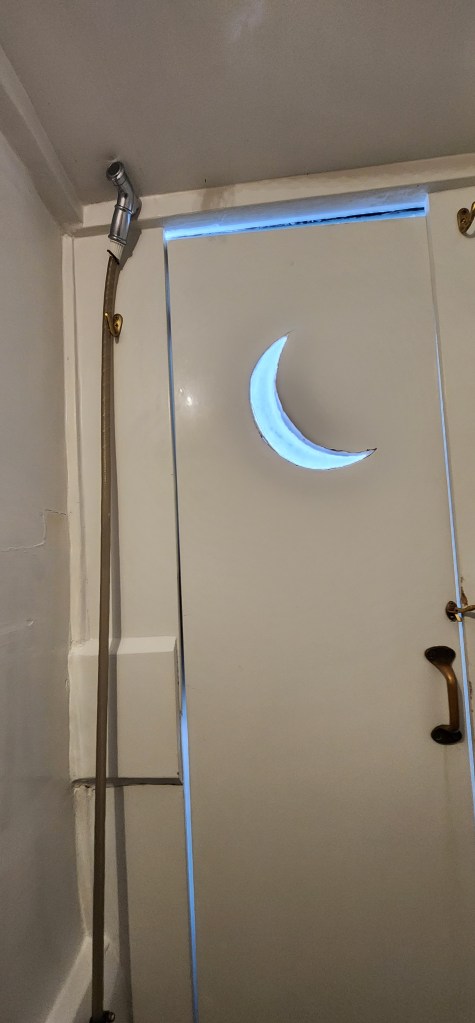
the head’s up on deck

I’m glad it’s not raining
or heavily foggy

though we’re sleeping at sea
it’s calmer than a water bed

creaking and thumps
more likely my neighbors
than the interplay of planks and sea

yes, somebody’s bones

now, for that damned mosquito
or some scratching overhead

who just dropped what
on the deck above me?

a shutting door
with a latch
and shuffling

who’s securing the gear
in the dusk?

what a still, calm spot she’s chosen
for the night

3:30 am, a nearly full moon
scattering sound of steady traffic
the other side of Isle au Haut
(the south)
may simply be the water motion

there’s definitely surf other side,
slight breeze, 1 mph?
to the west

can barely see Polaris
light cloud cover

only one plane overhead
on the European flight way

and the flash of a fishing boat
light array
in the gap of Deer Isle

what’s all the noise around me tonight
besides a stray cough
or zipper

are we really that restless

I have no idea what the Patriots
or Sox
did over the weekend
though they’ve been spiraling downward

light snoring in my ear last night

I had the most erotic dream
of someone who in reality was almost well

This could become obsessive.

Full sail!

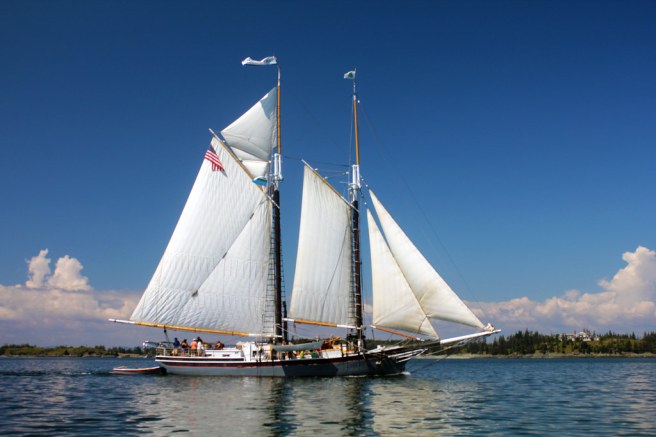
The evolution of the surviving coasting schooners from freight to a summer vacation platform where people could get a taste of what had previously been available only aboard the yachts of the rich is largely credited to Captain Frank Swift and his efforts from 1936 to create what he saw as a kind of dude ranch escape on the waters of Penobscot Bay.

In time, other owners joined in.

Notably, in 1973 Captain John Foss purchased the Louis R. French and removed her from the freight trade. He spent three years restoring the vessel to her original sailing condition and outfitting her hold for passengers. Oh, my, did he!

In 1986, he sold the schooner to his brother-in-law, who sailed and captained the French out of Rockland and then Camden until she was purchased from by Captain Garth Wells in 2003, who in turn sold to Captain Becky Wright and Nathan Sigouin. Maybe “passed her on” would be a more apt description.

Meanwhile, the already legendary Foss turned his attention to renovating the American Eagle, which he purchased in 1984. It’s now one of the few schooners that undertake longer voyages to places like Grand Manan Island near me or down to Gloucester on Cape Ann, Massachusetts, in addition to venturing offshore looking for whales.

At first, those names meant little to me. Now, however, I understand why they’re often uttered in reverential tones.

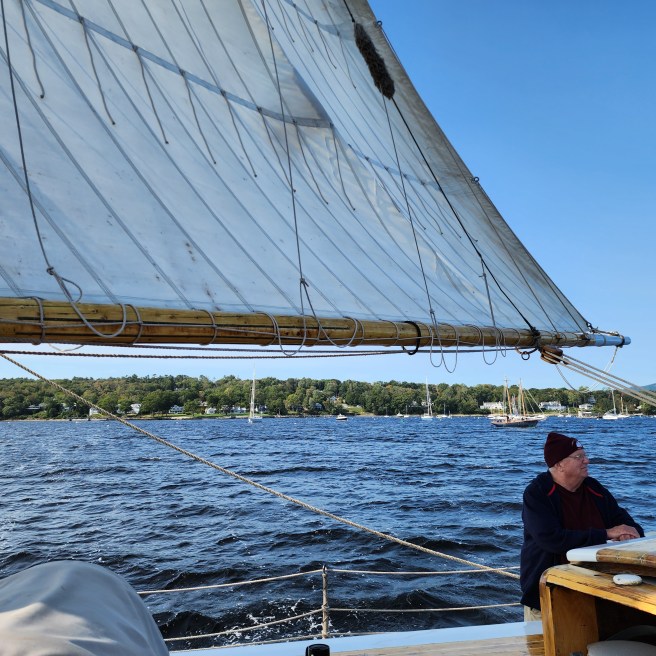
first, flapping fabric as wind kicks in
then a surge at my seat and flooring
like riding a stallion
muscular under the saddle

They weren’t always considered romantic

The 1990 application to include the restored and repurposed Louis R. French in the National Register of Historic Places includes much more than a detailed physical description of the schooner and her history.

The National Park Service document, Louis R. French (Schooner), available online  portrays the two-masted coasting schooner as the most common American vessel type, with tens of thousands of them functioning as the “freight trucks” of their time, carrying coal, bricks, iron ore, grain, oysters, lumber, and even ice between ports.

Yet, at the time of the application, only five of them were surviving in the United States.

In addition, the French was the oldest surviving sailing vessel built in Maine, the center for wooden shipbuilding in the United States after the Civil War.

As the application noted, until the outbreak of World War II, the coasting schooners were so common that nobody paid much attention to them. Designed to run fairly close to shore, the coaster lacked the fishing schooner’s ability to ride out a gale offshore on the fishing grounds. Nor did the coaster approach the scale of the great four-, five-, or six-masted coal schooners that transported coal from southern to northern ports.

Deepwater sailors, who occasionally took a large schooner across the Atlantic, scorned the useful and ubiquitous little coasters, sometimes accusing their skippers of “setting their course by the bark of a dog.”

The application quoted maritime historian Howard I. Chapelle, who observed “the straight fore-and-aft-rigged schooner is decidedly a coastwise vessel, and attempts to use such craft for long voyages have invariably been disappointing and disillusioning, if not disastrous to the adventurers.”

The schooner supplanted the square-riggers in the coasting trade for practical reasons:

Fewer sailors were required to handle the vessel, and a schooner could be worked into and out of harbors and rivers more easily than any square-rigged craft. Her trips could also, as a rule, be made in quicker time, as she could sail closer into the wind, and it was hardly necessary for her to sail from Maine to New York by way of the Bermudas, as some square-rigged vessels have done during baffling winds.

Put another way, they were the errand boys, the short-haul freight droghers, and the passenger buses for many a year, and their contribution to coastal community life, especially in New England, was substantial.

“Without them, the country could hardly have been settled,” as the report quotes one source.

These days, there’s nothing Plain Jane about them, though. Not in my boat – err, book.

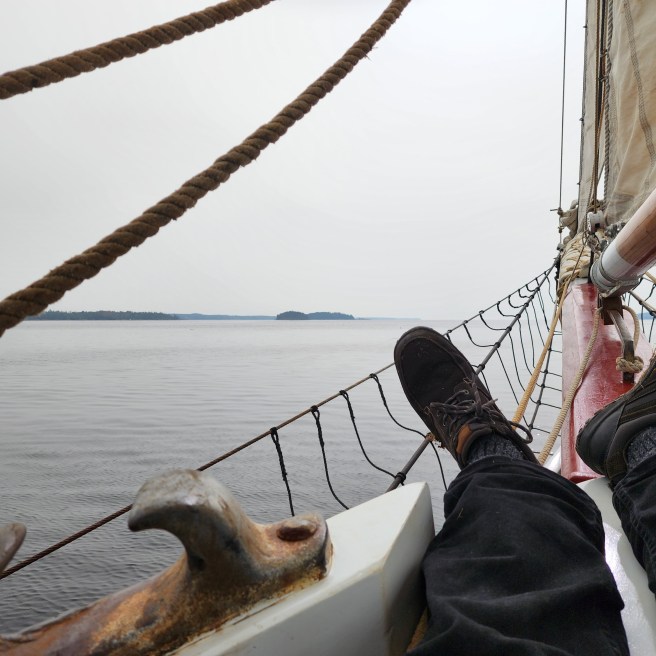
From the bow seat

Finally warm enough to take my cap off
and we’re getting some wind

yes, it’s all atmosphere

haze-infused grays with tinges of green forests
and bluish mountains

pulley block rasping behind me

the advantages of a cloudy day
without sunscreen
for a bald guy

sitting motionless
apart from a slight roll
in a nearly dead wind

how calming

am still surprised the tiny yawl can push this big boat

a porpoise here, a porpoise there
a bald eagle flies past

the chains to even the tension
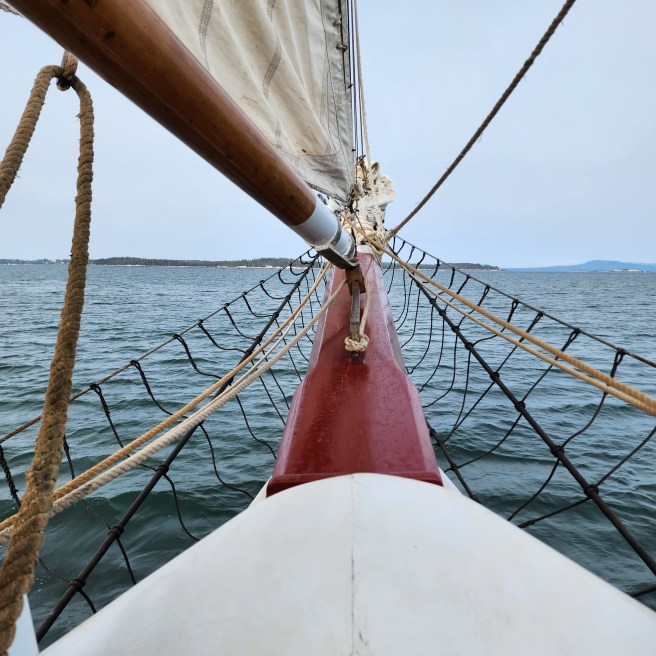
on the bowsprit with jibs

A few things to do in Dayton

The Gem City of Ohio has taken some hard hits since I left for other points as an adult. Even then, many folks said there was nothing to do or see, but that’s not what I find in return visits. Here are some things I’ll recommend.

  1. Carillon Park: This charming 65-acre historical park, originating with support from the National Cash Register company and designed by the famed Olmstead brothers, is somewhat like Henry Ford’s Dearborn Village but much smaller and less crowded. Settled in the shadow of a limestone carillon tower donated by engineer and industrialist Edward Deeds and his wife, the campus of small, often historic buildings at the foot of a wooded hillside showcases the region’s industrial innovations and contributions to world progress. One pavilion displays an early Wright Brothers’ airplane, while other buildings feature the automotive self-starter (launching the Delco division of General Motors) and indoor refrigeration (leading to Frigidaire), among the many contributions inventor Charles F. Kettering that advanced the lives of Americans and the rest of the world. John Henry Patterson’s development of the cash register changed retailing from cigar-box accounting while pioneering modern marketing and creating demand where none had existed. The displays have grown and become more diverse, and there’s even brewpub and festivals now. Still, it used to be free admission.
  2. Air Force Museum: My, this trove at the edge of Wright-Patterson Air Force Base has come a long way from the old hangars it occupied inside the base when I was a teen. You can get lost in what’s billed as the world’s oldest and largest military aviation museum. Some of the Wright Brothers’ earliest work in human flight took place in this locale. Free admission.
  3. Cox Arboretum: New to me is this botanical delight on the former estate of newspaper publisher, governor, and U.S. Democratic presidential nominee James M. Cox. The floral displays and gardens at this 174-acre park can be stunning, the trails are gentle, and there’s even a butterfly house. Thank goodness it was spared from development.
  4. Dayton Art Institute: Some astute collecting over the years has resulted in a wide-ranging collection of masterpieces from both the Old World and the Americas. While others were bidding up prices on third-rate pieces by famed signatures, Dayton was acquiring first-rate works by lesser-known hands or rare pieces from Inca and Aztec traditions, among others. Now it even has extensive Asian galleries.    
  5. Paul Lawrence Dunbar home: The Black American poet is finally getting due attention. His neighborhood on the West Side, which he roamed with friends Orville and Wilbur Wright, is now restored and open to the public.
  6. America’s Packard Museum: New to me is the world’s largest public collection of Packard automobiles and memorabilia – more than 50 classic cars, thousands of parts, and a research library in a 60,000 square-foot facility that was built in 1917 as an art deco Packard dealership, the Citizens Motorcar Company.
  7. Miamisburg Mound and Fort Ancient: Many of my favorite memories involved hiking in the neighboring landscape. These two sites – one in neighboring Miamisburg, the other further south along the Little Miami River, give a clue to the wonders of the ancient peoples who constructed intricate earthworks we’re only beginning to comprehend – think Stonehenge, for an English parallel, only vaster. Miamisburg’s, for instance, rises 65 feet, has a circumference of 800 feet, and contains 54,000 cubic yards of earth, all built by hand.
  8. Clifton Gorge, John Bryan State Park, and Glen Helen: Upstream on the scenic Little Miami River, these three sites connect into one for the ambitious stroller. The gorge, or limestone canyon, was largely unknown when I explored it but is now more available to the public. The river then meanders through the state park and its trails. Glen Helen, in Yellow Springs, was part of Antioch College.
  9. Englewood dam: The largest of the five passive flood-control dams erected in the Great Miami River watershed after floodwaters in 1913 devasted the valley, Englewood’s is 4,716 feet long and 110.5 feet high, part of an innovative civic district and remarkable engineering feat that became a model for the federal Tennessee Valley Authority during the Great Depression. Here, as well as at the Taylorsville, Huffman, Germantown, and Lockington dams, the retarding basins on the upstream side and the wooded hillsides now form the Five Rivers Metroparks system. And downstream has never been inundated since.     
  10. Aullwood Audubon Center and Farm: Adjacent to Englewood dam is one more relief from the suburban sprawl that has overtaken much of Greater Dayton. This 200-acre sanctuary includes a nature center and educational farm, along with eight miles of walking trails.

Fine carpentry, too

Jesus was a carpenter, after all, surrounded by fishermen and their boats. Maybe he built a few to float, too.

the curve of the deck – sheer
ours noticeably higher at the bow
than even the stern

while the crown with its sides
for water runoff

a dutchman
a piece of wood
cut in
to replace a rotten section

ditto in our home